zenpundit.com » biography

Archive for the ‘biography’ Category

More Books!

Friday, November 26th, 2010

Just picked up a few new reads…..


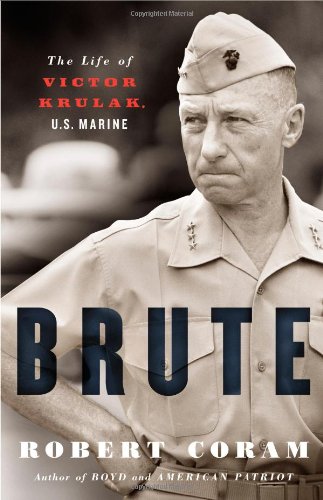
Brute: The Life of Victor Krulak, U.S. Marine by Robert Coram

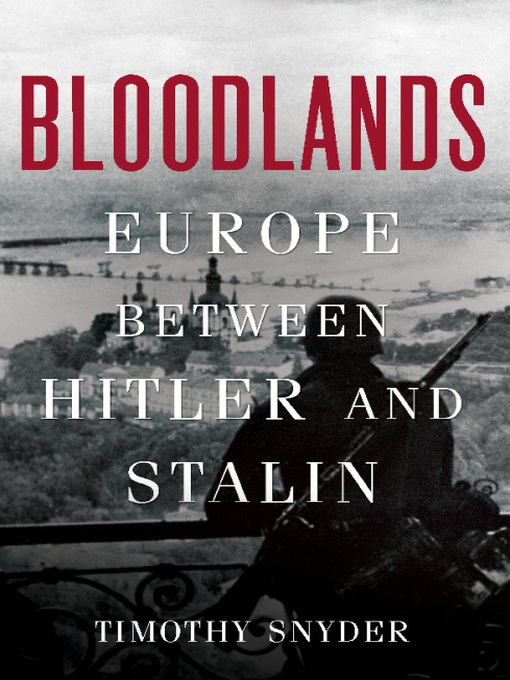
Bloodlands: Europe Between Hitler and Stalin by Timothy Snyder

Robert Coram, whom I had the pleasure of meeting at Boyd ’07, has a new biography of the legendary military visionary and Marine Lt. General Victor “Brute” Krulak, reviewed here by Max Boot and here by Tony Perry (Hat tip to Dr. Chet Richards). Having thumbed a few pages, Krulak appears a complicated man – gifted, dauntless and extremely driven but also possessed of a mean streak, edging at times toward petty cruelty.

Bloodlands I intend to read in a “Hitler-Stalin/Nazi-Soviet Comparison” series along with Richard Overy’s The Dictators: Hitler’s Germany, Stalin’s Russia, Robert Gellately’s Lenin, Stalin, and Hitler: The Age of Social Catastrophe , Richard J. Evans’ The Third Reich at War and Alan Bullock’s classic dual biography Hitler and Stalin: Parallel Lives.  I’d also recommend, for those with the stomach for historiographic commentary, Robert Conquest’s Reflections on a Ravaged Century and John Lukac’s The Hitler of History

CURRENTLY READING:

Human Face of War by Jim Storr

After reading approxmately a third of The Human Face of War by  Dr. Jim Storr, a retired Lt. Colonel, King’s Regiment and an instructor at the UK Defence Academy, I will say that if you are going to read only one book on modern military thought this year, it should be The Human Face of War. It’s that good.

Aside from a reflexive hostility toward John Boyd’s OODA Loop ( though not, strangely enough, toward the substantive epistemology advocated by Boyd that the diagram represented), Storr’s tome is an epistle of intellectual clarity on military theory that deserves to be widely read.

ADDENDUM:

NDU Press recommends, and I concur, this review of The Human Face of War by Col. Colonel Clinton J. Ancker III. Ancker, like Storr, is an expert on military doctrine, so it is a well-informed review by a professional peer.

Summer Series 2010: The Autobiography of Theodore Roosevelt

Tuesday, September 21st, 2010

Summer Series 2010: Reviewing the Books! continues……

The Autobiography of Theodore Roosevelt

This summer I read the autobiography of America’s greatest near-great president. It was partly a memoir but mostly idiosyncratic, stream of consciousness commentary by TR, who seemingly grew bored with attempting a dry recounting of his life within the first few dozen pages and launched into a series of never-ending and generally entertaining digressions. Teddy regales the reader with honest beat cops in New York slums, crooked saloonkeeping politicians, rugged cowboys in the twilight of the Old West, ramrod straight Army officers, genteel Harvard men, desperados, captive madmen, wild animals in locales from the silence of nature to the sound of battle with orders barked over the cries of wounded men. Every story involves a fistfight, a gun, a test of integrity and manly honor where respectable men who are “right square” do their duty without complaint and few concessions, except perhaps to a glass of whiskey “taken for medicinal purposes”.

My God, to have a president like that again!

Theodore Roosevelt was an accomplished historian and polished writer and was capable of scholarly work, such as his first book on The Naval War of 1812, or of focused popular history as in his books on the West or his account of his fabled volunteers in the Spanish-American War, The Rough Riders ( I have a 1920 edition); his autobiography is not that kind of book. While historians regard Ulysses S. Grant’s memoir as the greatest written by an American president, Roosevelt’s has a different quality. His voice comes through on the pages; it is more like he is sitting in a chair in his study at Sagamore Hill, talking to you directly, gesticulating, shouting, laughing, leaping up like a jack-in-the-box, leaning forward, face fierce with emphasis and good humor.

Roosevelt would have been a natural blogger.

The autobiography has it’s weaknesses. Despite his ability to cunningly turn a phrase, TR could have used the services of a stern editor. There are parts of this book, particularly in his recounting of minor legislative battles with creatures of the New York political machines that wander at times into redundancy and tediousness. Roosevelt’s periodic expositions into public morality and social problems of his day have a weird conflation of victorian prudishness and liberal noblesse oblige that can run so contradictory that the modern reader wonders which sentiment represents Roosevelt’s real views and which have been judiciously added for public consumption. Outspoken and impetuous in person, TR’s autobiography bears the imprint of an author who has repeatedly gone back and toned down or qualified original judgments or recollections and excised names to spare others embarrassment. Roosevelt was in many ways, a product of his era and his class.

The Autobiography of Theodore Roosevelt is not a great book but is still a good read after over a hundred years since Teddy Roosevelt last sat in the Oval Office. That’s praise enough.

Still too Busy to Blog Properly….But Hey, Look What I’m Reading!

Tuesday, November 24th, 2009

Were it not for guest posts, November would have seemed like I went on hiatus 🙂  Normal blogging will resume in a few weeks.

I did find time to pick up a few new books to read in the late hours of the night, one of which will be the subject of a book review by a new guest poster.


The Genius of the Beast: A Radical Re-Vision of Capitalism by Howard Bloom

The Shia Revival: How Conflicts within Islam Will Shape the Future by Vali Nasr

Nixonland: The Rise of a President and the Fracturing of America  by Rick Perlstein

The only thing these three tomes have in common is that the authors have a penchant for contradicting conventional wisdom, at least to a degree. 

Howard Bloom is an offbeat, pop science to pop culture master of horizontal thinking whose earlier work, Global Brain, I very much enjoyed and highly recommend. Bloom’s intellectual reach is first rate and he is one of the few writers who can take very difficult concepts from wildly disparate fields and tie them together for a lay audience with comprehensible analogies and anecdotes .

I put Vali Nasr’s The Shia Revival on my list back after the high praise Thomas P.M. Barnett gave Nasr in his book, Great Powers – in my experience, Tom does not hand out comments of “brilliant” all that often ( Great Powers, BTW, is also a “must read” book for those interested in strategy and geoeconomics). I am approximately 80 pages in to The Shia Revival and I will say that as a writer, Nasr does not waste time getting to key points in explaining his subject – concise but not simplified.

Rick Perlstein, while far to the Left, has the uncommon quality among leftwingers of working very, very hard at the scholarship of attempting to understand conservatism and leading conservatives ( must be a legacy of attending the University of Chicago). Much like Orangemen in Ulster, eavesdropping on a Catholic mass, I suspect the essence of conservatism eludes Perlstein, but at least he takes the ideas seriously.  That Richard Nixon is Perlstein’s subject is an added draw, since Nixon’s foreign policy was an area of historical research for me. Very interested to see how Perlstein’s take on Richard Nixon compares to that of Robert Dallek and Richard Reeves.

“Let me make one thing perfectly clear….”

The Father of Sovietology

Sunday, September 13th, 2009

Great piece of intellectual history here by Dr. David Engerman, writing in Humanities on Philip Mosley, who was to Cold War Sovietology what Vannevar Bush was to the Manhattan Project:

The Cold War’s Organization Man How Philip Mosely helped Soviet Studies moderate American policy

When Winston Churchill ominously announced in March 1946 that an “Iron Curtain had descended over Europe,” the United States government employed around two dozen experts on the Soviet Union and even fewer on Central and Eastern Europe. Two years later, after a steady drumbeat of Cold War crises, the young Central Intelligence Agency employed thirty-eight Soviet analysts, only twelve of whom spoke any Russian. The few university-based Russia specialists varied tremendously in intellect and energy; only a handful were willing and able to contribute to shaping policy. How could American officials chart a foreign policy without knowing what was going on inside the Soviet Union, let alone inside the Kremlin? As Geroid Tanquary Robinson, head of the USSR analysis for wartime intelligence and the founding director of Columbia’s Russian Institute, put it, “Never did so many know so little about so much.”

Into this breach stepped a handful of scholars, including Philip Edward Mosely, the man who would become the most influential Sovietologist of the Cold War. He lacked the name recognition and elegant writing style of the diplomat George Kennan, whose 1947 “X” article introduced the concept of containment to the world. Nor could he rival the publication record and scholarly reputation of Harvard professor Merle Fainsod, whose 1953 book How Russia Is Ruled introduced generations of readers to Soviet politics. And Mosely was nowhere near as colorful a character as the economic historian Alexander Gerschenkron, whose 1952 essay on “economic backwardness” remains a subject of debate into the twenty-first century. Mosely’s contributions to the development of Soviet Studies have received little attention. But in a field of study that emphasized its practical application to policymaking, no one else was so adept at working the lines of influence and power that connected America’s campuses and its capital.

Read the rest here.

Hat tip to Meredith Hindley.

Book Review: The Bloody White Baron

Wednesday, July 29th, 2009

The Bloody White Baron: The Extraordinary Story of the Russian Nobleman Who Became the Last Khan of Mongolia by James Palmer

The 20th Century was remarkable for its voluminous bloodshed and civilizational upheaval yet for inhuman cruelty and sheer weirdness, Baron Roman Nikolai Maximilian Ungern von Sternberg manages to stand out in a historical field crowded with dictators, terrorists, guerillas, revolutionaries, fascists and warlords of the worst description. Biographer James Palmer has brought to life in The Bloody White Baron an enigmatic, elusive, monster of the Russian Civil War who is more easily compared to great villains of fiction than real life war criminals. Palmer’s bloodthirsty Mad Baron comes across like a militaristic version of Judge Holden from Cormac McCarthy’s Blood Meridian or perhaps more like Hannibal Lecter with a Mongol Horde.

Ill-tempered, impulsively violent, insubordinate and socially isolated even among fellow aristocratic officers, Baron Ungern was, as Palmer admits, without much wit or charm, a complete failure in Tsarist society and the Imperial Army until the coming of the Great War. As with many “warlord personalities“, the chaos and ruin of the battlefield was the Baron’s natural element and for the first time in his life, he experienced great success, his maniacal bravery under fire winning Ungern promotions and the highly coveted St. George’s Cross. This is an eerie parallel with the life of Adolf Hitler, and numerous times in the text, Palmer alludes to similarities between the Baron’s apocalyptic views on Communists and Jews, and that of Baltic-German refugees like Alfred Rosenberg and Max Scheubner-Richter who contributed eliminationist anti-semitism and theories about “Jewish- Bolshevism” to Nazi ideology.

A fanatical monarchist and philo-Buddhist fascinated with far-off Mongolia and Tibet, the Baron regarded the Russian Revolution as the greatest of calamities and joined the Whites under the leadership of the gangster-like Ataman Semenov to rape, loot, torture and murder with a hodgepodge Cossack horde across the Transbaikal region of Siberia. The Baron’s fiefdom under Semenov was a macabre, bone-littered, execution ground ruled by reactionary mysticism and ghoulish exercises in medieval torture visited upon the Baron’s own soldiers scarcely less often than on hapless peasants or captive Reds.

Dismayed by Semenov’s corruption and dependence on the Japanese and the collapsing fortunes of Russia’s White armies, Palmer recounts how the Baron fled with a ragtag band of followers to Chinese occupied Mongolia, where, in a series of bizarre circumstances, the Baron managed to destroy a sizable Chinese army (charging on horseback straight into enemy machine gun fire and emerging unscathed), seized the fortified capital, restored the “living Buddha” the Bogd Khan to the throne and become celebrated the eyes of the Mongolians, variously as the reincarnation of Ghengis Khan and/or the prophesied coming of the “God of War”. Naturally, to further his dream of building a pan-Asian Buddhist Empire, Baron Ungern unleashed a nightmarish reign of terror in Mongolia, taking especial and personal delight in the executions of Jews and captured commissars.

Ungern’s final foray in battle, before his capture, trial and execution at the hands of the Bolsheviks, is like something out of the Dark Ages:

With this final defeat, Ungern shed any trace of civilization. He rode silently with bowed head in front of the column. he had lost his hat and most of his clothes. On his naked chest numerous Mongolian talismans and charms hung on a bright yellow cord. He looked like a prehistoric ape-man. People were afraid to look at him.

Despite the best efforts of the Bolshevik prosecutor to focus upon political motives, even the Soviet revolutionary tribunal that condemned him to death on Lenin’s orders, considered the Baron to be a dangerous madman.

James Palmer has shed a great deal of light on one of the darkest corners of the Russian Civil War, Baron Ungern von Sternberg, a subject that largely eluded prominent historians like W. Bruce Lincoln, Orlando Figes and Richard Pipes. The Bloody White Baron is a fascinating read and a window into the life of the 20th century’s strangest warlord.

Switch to our mobile site