zenpundit.com » 20th century

Archive for the ‘20th century’ Category

For the Fourth of July: The Once and Future Republic?

Thursday, July 4th, 2013

Ahem….”I told you so“.

“Congress intended to allow the intelligence communities to access targeted information for specific investigations. How can every call that every American makes or receives be relevant to a specific investigation?”

                                                             – Representative James Sensenbrenner (R-Wisconsin)
                                                                 A primary author of The Patriot Act 

“We have not yet seen any evidence showing that the NSA’s dragnet collection of Americans’ phone records has produced any uniquely valuable intelligence. Gen. Alexander’s testimony yesterday suggested that the NSA’s bulk phone records collection program helped thwart ‘dozens’ of terrorist attacks, but all of the plots that he mentioned appear to have been identified using other collection methods. The public deserves a clear explanation”

                                                                 – Senators Ron Wyden (D- Oregon) and Mark Udall (D- Colorado)

“What I learned from our journalists should alarm everyone in this room and should alarm everyone in this country….The actions of the DoJ against AP are already having an impact beyond the specifics of this particular case. Some of our longtime trusted sources have become nervous and anxious about talking to us, even on stories that aren’t about national security. And in some cases, government employees that we once checked in with regularly will no longer speak to us by phone, and some are reluctant to meet in person. This chilling effect is not just at AP, it’s happening at other news organizations as well”

                                                               – Gary Pruitt, President of the Associated Press 

“The people who are worried about privacy have a legitimate worry….But we live in a complex world where you’re going to have to have a level of security greater than you did back in the olden days, if you will. And our laws and our interpretation of the Constitution, I think, have to change.”

                                                              – Michael Bloomberg, Mayor of New York City 

“One-party autocracy certainly has its drawbacks. But when it is led by a reasonably enlightened group of people, as China is today, it can also have great advantages.”

                                                                -Thomas Friedman, NYT Columnist 

“Toll records, phone records like this, that don’t include any content, are not covered by the fourth amendment because people don’t have a reasonable expectation of privacy in who they called and when they called, that’s something you show to the phone company. That’s something you show to many, many people within the phone company on a regular basis.”

                                                                 – James Cole, Deputy Attorney-General 

“In the abstract you can complain about Big Brother and how this is a program run amok, but when you actually look at the details, I think we’ve struck the right balance.”

                                                                 -Barack Obama, President of the United States 

While we need intelligence services, including the formidable collection capacity of the NSA, we don’t need a mammoth repository of information being continually compiled on every American, held in perpetuity by the US government.

First, the mere existence of so massive a database on the data of all Americans is itself a critical strategic vulnerability and a potential risk to the national security of the United States because it centralizes for any would be spy or hacker not just anything, but virtually *everything* they would want to know about *everyone*. The greatest testament against the strategic wisdom of this scheme from a counterintelligence perspective is the erstwhile Mr. Edward Snowden – breach just one security regime and you walk away with the whole store or as much of the store as you have time and brains to snatch.

How many Snowdens have we *not* heard about because they were quietly fired by a contractor? How many other Snowdens working for foreign intelligence services eluded government detection and got away with who knows what?  Or are still doing it now?

Not exactly a resilient system from a cybersecurity perspective, is it?

What the USG has done here is not dumb. It is fucking dumb with a capital F. Sometimes we get so caught up from a technical viewpoint in what we might be able to do that no one stops and seriously considers if we should do it. From such unasked questions come the unwanted second and third order effects we live to rue.

Unless, of course,  building a draconian comprehensive digital dragnet for a  “leaky system” is what was desired in the first place. If so, bravo gentlemen.

Which brings us to the second point: the surveillance state as currently configured in law with the legal equivalent of string and chewing gum is inimical to the long term survival of the United States as a constitutional Republic. This is not an attack on any particular person or politician or three letter agency. It’s a hard world filled with extremely bad men who would do us lasting harm, so we need our spooks, but the spooks need proper constitutional boundaries set by our elected representatives in which to operate and somewhere in the past decade we have crossed that Rubicon.

The United States of America has had a historically remarkable run of 237 years of good government and in all that time the system failed us only once. That one time cost the lives of approximately 630,000 Americans.

On a level of moral and political legitimacy, we have created a bureaucratic-technological machine, a sleepless cyber  J. Edgar Hoover on steroids that contradicts our deeply held political values that define what America is and aspires to be. There is no way to reconcile cradle-to-grave digital dossiers on the 24/7 life of every American with the provisions of the US. Constitution. Really, an ever-watching state was not in the cards at our Constitutional Convention, even with the delegates like Alexander Hamilton who privately thought George Washington might make a fine King.

On a more pragmatic level, in creating the SIGINT-cyber surveillance state we have made not an idiot-proof system, but an idiot-enabling one that represents an enormous potential reserve of power that will be an unbearable temptation for misuse and abuse. The long, bloody and sordid record of human nature indicates that someone, eventually, will not be able to resist that temptation but will be smart enough to get away with it. If we are greatly fortunate, it will be a lazy person of limited vision looking merely to enrich themselves and their friends. Or a malevolent minor bureaucrat like Lois Lerner looking to punish “the little people” who raised her ire.  If we are unlucky, it will be a gifted figure of ill intent and outsized ambitions, an American Caesar.

Or an American Stalin.

In the long term, our Democracy will not be healthy when the government – that is, the Executive – monitors everyone and stores everything  we do forever. While most of us are not that interesting, reporters, public figures, newspaper publishers, members of Congress, aspiring politicians, their campaign donors,  judges, dissenters, writers and so on are very interesting to people in power. The Congress, for example, cannot do it’s job properly when it’s cloakroom is bugged and their email is read anymore than can the editorial office of the Associated Press. What we have built, if it existed in a foreign country, would be frankly described as a “Deep State.  Nations with deep states are not pleasant places to live and they usually do not work well. At best, they look like Russia and Turkey, at worst they look like Pakistan and Iran.

Rolling the surveillance state back to targeting foreign enemies, it’s proper and constitutional role, instead of every American citizen – yes, we are all, every man, woman and child of every race, creed, color and political persuasion being treated as potential enemies by the Federal government – is up to us and only us.  Tell your Congressman, your Senator and the President what you think in a respectful and thoughtful way – and then make this an issue that decides your vote.

If we do nothing, we have no one to blame but ourselves for what comes next. We can at least console ourselves with pride in the fact that the US had a good go at making freedom work unequaled in world history, but that democracy may had had it’s time.  Others in the distant future, may profit from our example the way we learned from Athens, Rome and Britain. Or we can leave while the door still remains open.

Enjoy your Fourth.

                                                “Well, Doctor, what have we got, a republic or a monarchy?”

                                                                      – Mrs. Powell

                                             ” A Republic, if you can keep it”

                                                                      – Benjamin Franklin
                                                                         Signer of the Declaration of Independence
                                                                         Delegate, Constitutional Convention

Yet More Biographies…..

Monday, June 17th, 2013


Alexander The Great by Robin Lane Fox  

Colonel Roosevelt by Edmund Morris 

Shadow Warrior: William Egan Colby and the CIA  by Randall Woods 

The first, was one of the works cited by Paul Cartledge in his own biography of Alexander the Great. Fox is an eminent historian at Oxford, now emeritus and his biography was a an important work in the field.

The next two were gifts from my own students. Now that I have Colonel Roosevelt, I will have to read the prize-winning trilogy as I have copies of the first two volumes (somewhere). The impression Morris made with his Reagan biography, Dutch, was very strange, but this will probably redeem him.

Not very familiar with Woods, but William Colby was a fascinating, controversial and contradictory DCI whose intelligence career spanned the OSS and much of the Cold War, dying in retirement under mysterious circumstances.

Added to the pile…..

Moral Degeneration in the Crucible of War

Wednesday, June 12th, 2013


The recent post on Is 4GW Dead? stirred a great deal of interest, so I would like to extend the discussion on a point that that is critical not only for those who have responsibility for conducting military campaigns, but for statecraft and policy as well.

One of more important tenets of 4GW was the importance of “the moral level of war”, drawn from Colonel John Boyd’s thinking on the strategic impact of a combatant’s behavior, immoral  or exemplary, on all observers – belligerents, civilian noncombatants, neutral third parties, the media, the combatant’s own soldiers and citizens back home. Here is Boyd:

Morally our adversaries isolate themselves when they visibly improve their well being to the detriment of others (allies, the uncommitted), by violating codes of conduct or behavior patterns that they profess to uphold or others expect them to uphold.

· Morally we interact with others by avoiding mismatches between what we say we are what we are and the world we have to deal with, as well as by abiding by those other cultural codes or standards we are expected to uphold.

In a Reader’s Digest version of Boyd,  heroic, noble and magnanimous  behavior is admirable and attractive while hypocrisy, cruelty and cowardice are repulsive and antagonizing characteristics. While the former won’t guarantee your victory and the latter, unfortunately, won’t ensure your defeat, they will be a significant factor in ameliorating or generating friction.  The impression given by an army impacts the will of the enemy to fight, the morale and discipline of the soldiers, the restiveness of the civilians, the loyalty of allies and the goodwill of neighbors.

Boyd developed his thinking about the moral level of war in Patterns of Conflict  all the way up to grand strategy and above. The rub about the moral level  is that war is a crucible that puts every “cultural code” or “standard” to the test, as well as the character of the men fighting it and their leaders upon whom great responsibility rests.  Even with the best of intentions in policy and careful generalship in the field, the horrors of war can erode moral fiber and military discipline in an army, in a company or in the heart of one man. Nor does every army begin with good intentions and effective discipline – some fighting forces are scarcely to be regarded as “armies” at all while others embrace the darkness as a matter of policy.

In terms of warfare, let us define “moral degeneration” as a degraded state of moral decline where a belligerent has effectively abandoned the operational and tactical restraints on conduct mandated by the Laws of War (i.e. war crimes are SOP) and in some instances, the vestiges of civilization.

A textbook example of this kind of moral degeneration came to light a few weeks ago when a jihadi lunatic in Syria, a rebel commander Khalid al-Hamad, who goes by the name of “Abu Sakkar”, cut out the heart of a (presumably) dead government soldier and ate it on video. Charles Cameron expounded at length upon this minor atrocity here. I am not, to say the least, a fan of radical, revolutionary, transnational Sunni Islamism but I cannot honestly say that its proponents like Abul Mawdudi , Sayid Qutb, Abdullah Azzam, Osama bin Laden and their ilk ever openly advocated cannibalism. It is much more likely that Mr. al-Hamad’s behavior is explained by the ferocity of the civil war in Syria eroding customary norms of the combatants than  it is by Islamist ideology.

Moral degeneration in war seems to spring from two directions:

a) As a calculated act of Policy, from the top down, enforced by the leadership by military discipline and bureaucratic control.

b) As a spontaneous reaction by soldiers or fighters, appearing from the bottom up, without orders and frequently, in spite of them, possibly due to a breakdown in the chain of command, an erosion of discipline or sheer mutiny for the age-old purpose of reprisal, pillage and rapine.

The first category often occur with war as a convenient cover rather than a cause of grave crimes against humanity that leaders and  ideologues had long wished to carry out. The Armenian Genocide, as John Keegan wrote, belongs properly to the history of Ottoman imperial policy than it did WWI; in truth, the Genocide was the greatest and worst in a long succession of vicious pogroms that the Ottomans had launched against their Armenian Christian subjects during the reign of Abdul Hamid and the Young Turks. The Holocaust (which had some inspiration in Hitler’s mind, from the fate of the Armenians) was more closely tied to the evolution of  Nazi war policy but once Operation Barbarossa opened up the vast spaces of Soviet Eurasia, “the East” in Nazi parlance, the war itself increasingly took a backseat to expediting Hitler and Himmler’s ghastly and murderous racial priorities. This is a pattern of a priori planning, an escalating ideological radicalization of society that tends to be present with most of the large scale democides and genocides. It is the organizational powers of  coercion utilized by the state, or a mobilized faction of , it that makes the enormous scale of death possible, not the war.

What is different and also dangerous about moral degeneration from the bottom-up, is that it is cultural evolution driven by the psychological effects of extreme violence at work and, unlike an act of policy, more likely to be diffused widely across society as a permanent change for the worse. Too many German soldiers in WWI, former peasants and artisans and boys from middle-class families, returned from the Western Front morally coarsened and addicted to the adrenalin rush of combat and became in succession Freikorps paramilitaries, Communist streetfighters, Nazi Stormtroopers and SS men. The World War also gave Russia the men of the Cheka, the Red terror and the first Gulags on the Bolshevik Left and brutal and mad warlords on the White Right.

In more recent two decades, the break-up of Yugoslavia unleashed atavistic passions of ethnic hatred and atrocity, while organized society in Western African states and central Africa broke down entirely in transnational regional civil wars with unrestrained massacres and mass rape. As a result, there is little that is political but much that is primeval, at this juncture, to explain Joseph Kony’s motivations; he resembles nothing so much as a 21st century Kurtz. Mexico too is degenerating from the escalating violence of cartel insurgency and narco-cultas – there is not much tactical or strategic value in pagan death cults or human sacrifice but it is spreading:

…Our impression is that what is now taking place in Mexico has for some time gone way beyond secular and criminal (economic) activities as defined by traditional organized crime studies.3 In fact, the intensity of change may indeed be increasing. Not only have de facto politicalelements come to the fore-i.e., when a cartel takes over an entire city or town, they have no choice but to take over political functions formerly administered by the local government- but social (narcocultura) and religious/spiritual (narcocultos) characteristics are now making themselves more pronounced. What we are likely witnessing is Mexican society starting to not only unravel but to go to war with itself. The bonds and relationships that hold that society together are fraying, unraveling, and, in some instances, the polarity is reversing itself with trust being replaced by mistrust and suspicion. Traditional Mexican values and competing criminal value systems are engaged in a brutal contest over the ?hearts, minds, and souls‘ of its citizens in a street-by-street, block-by-block, and city-by-city war over the future social and political organization of Mexico. Environmental modification is taking place in some urban centers and rural outposts as deviant norms replace traditional ones and the younger generation fully accepts a criminal value system as their baseline of behavior because they have known no other. The continuing incidents of ever increasing barbarism-some would call this a manifestation of evil even if secularly motivated-and the growing popularity of a death cult are but two examples of this clash of values. Additionally, the early rise of what appears to be cartel holy warriors may now also be taking place. While extreme barbarism, death cults, and possibly now holy warriors found in the Mexican cartel wars are still somewhat the exception rather than the rule, each of these trends is extremely alarming, and will be touched upon in turn.

The crucible of war either tempers a people or it breaks them.

The easy way or the hard way?

Saturday, June 1st, 2013

[ by Charles Cameron — thinking more in terms of challenge than of threat, and skipping via Chicago Law, Everest, and Handel’s Messiah to a Venn diagram of the workings of conscience ]
.

Well, I don’t always read the Chicago Law Review cover to cover, or even at all to be honest — but I confess I did like this opening paragraph from George Loewenstein† & Ted O’Donoghue†† (love those daggers after your names, guys):

If you ever have the misfortune to be interrogated, and the experience resembles its depiction in movies, it is likely that your interrogator will inform you that “we can do this the easy way or the hard way.” The interrogator is telling you, with an economy of words, that you are going to spill the beans; the only question is whether you will also get tortured — which is the hard way. In this Essay, we argue that much consumption follows a similar pattern, except that the torturer is oneself.

**

Here’s the easy vs hard contrast I was thinking about as I googled my way to the Law Review — as you’ll see, it has nothing to do with interrogation:

**

So, a little background. Jason Burke has been covering Everest for The Guardian lately, since it has been almost exactly sixty years since Hillary and Tenzing were the first to “conquer” the highest peak on earth — and one of his reports caught my eye — Everest may have ladder installed to ease congestion on Hillary Step:

It was the final obstacle, the 40 feet of technical climbing up a near vertical rock face that pushed Sir Edmund Hillary to the limit. Once climbed, the way to the summit of Mount Everest lay open.

Now, almost exactly 60 years after the New Zealander and his rope-mate, Sherpa Tenzing Norgay, stood on the highest point in the planet, a new plan has been mooted to install a ladder on the famous Hillary Step, as the crucial pitch at nearly 29,000ft has been known since it was first ascended. The aim is to ease congestion.

That’s what the upper panel, above, is all about — and I think it contrasts nicely with the bottom panel, which shows a rurp. Should you need one, you can obtain your own Black Diamond rurp here.

**

Rurps are awesome. Here are two descriptions of them, both taken from the mountaineering literature, and neither one of them focusing in too closely on the poetry of the name…

Steve Rope, Camp 4: Recollections of a Yosemite Rockclimber, p. 107:

Chouinard’s “rurp” was obviously something special. An acronym for “realized ultimate reality piton,” this ludicrously small fragment of heat-treated steel opened our eyes to untold possibilities.

and Chris Jones, Climbing in North America, p. 273:

It was about the size of a postage stamp. The business end was the thickness of a knife blade and penetrated only a quarter-inch into the rock. With several of these Realized Ultimate Reality Pitons, or rurps, Chouinard and Frost made the crux pitch on Kat Pinnacle (A4). It was the most difficult aid climb in North America.

Chouinard named this postage-stamp-sized thing the realized ultimate reality piton (RURP) because if you willingly and literally hang your life on that quarter-inch of steel, you’re liable to realize, well, ultimate reality.

Zen — yours for $15 and exemplary courage.

**

Here’s my question: should we make the hard way easier?

When is that a kindness, and when is it foolish?

**

In its own way, of course, a rurp is an assist — it makes the hard way a tad easier for the serious climber.

As indeed would the proposed “ladder” on Everest: here’s why it might be not-such-a-bad idea:

This year, 520 climbers have reached the summit of Everest. On 19 May, around 150 climbed the last 3,000ft of the peak from Camp IV within hours of each other, causing lengthy delays as mountaineers queued to descend or ascend harder sections.

“Most of the traffic jams are at the Hillary Step because only one person can go up or down. If you have people waiting two, three or even four hours that means lots of exposure [to risk]. To make the climbing easier, that would be wrong. But this is a safety feature,” said Sherpa…

Besides, the idea is to set it up as a one-way street…

Frits Vrijlandt, the president of the International Mountaineering and Climbing Federation (UIAA), said the ladder could be a solution to the increasing numbers of climbers on the mountain.

“It’s for the way down, so it won’t change the climb,” Vrijlandt told the Guardian.

Ah, but then there’s human nature to consider:

It is unlikely, however, that tired ascending climbers close to their ultimate goal will spurn such an obvious aid at such an altitude.

Bah!

**

Shouldn’t we just level the top off, as Handel and Isaiah 4.4 suggest, and as we’re doing in the Appalachians?

A little mountaintop removal mining, a helipad, and voilà — even I could make it to the summit!

**

But to return to Loewenstein† & O’Donoghue†† — their paper’s full title was “We Can Do This the Easy Way or the Hard Way”: Negative Emotions, Self-Regulation, and the Law — how can a theologian such as myself resist a diagram such as this?

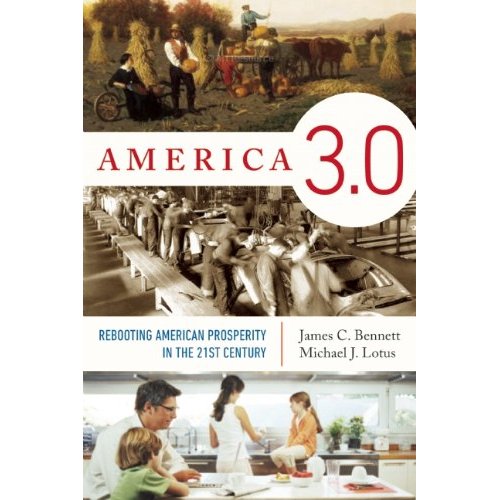
Update on America 3.0 Book Events – Bennett and Lotus

Friday, May 31st, 2013

America 3.0 

From Chicago Boyz:

America 3.0: Mike Lotus on The Bob Dutko Show

Mike Lotus will be on the Bob Dutko radio show tomorrow, May 31, 2013 at 12:40 p.m. EST. Bob hosts Detroit’s #1 Christian Talk Radio Show on WMUZS 103.5 FM.

Please listen in if you can!

Many thanks to the Bob Dutko Show for having me on.

This weekend we will post an updated list of upcoming appearances by Jim Bennett, Mike Lotus, and occasionally both of us together, talking about America 3.0.

Thanks to The Takeaway, the The Armstrong & Getty Show, and The Janet Mefferd show for interviewing Jim Bennett — all yesterday. It was a Bennett Threefer! 

And Author Appearances:

Upcoming appearances for Jim Bennett and Mike Lotus discussing America 3.0

Tuesday, May 28, 2013
Lou Dobbs Tonight (James and Michael)
We will be on about 7:45 p.m. EST.

Wednesday, May 29, 2013
Armstrong & Getty (James)
11:15 am EST

Wednesday, May 29, 2013 
Janet Mefferd Show (James)
3:30 pm EST

Friday, May 31, 2013 
Bob Dutko Show (Michael)
1:40 pm EST

Tuesday, June 4, 2013
Talk to Adam Smith Society, Booth School of Business (Michael)
Noon

Thursday, June 6, 2013
Mornings with Nick Reed (Michael)

Saturday, June 7, 2013
Marc Bernier Show (James & Michael)
4:25 pm EST

Monday, June 17, 2013
Western Conservative Summit, “Envisioning America 3.0” (James)

And their maiden TV appearance with Lou Dobbs:


Switch to our mobile site