zenpundit.com » horizontal thinking

Archive for the ‘horizontal thinking’ Category

“No one is really listening, they are just pretending.” – Madhu

Wednesday, May 2nd, 2012

[by J. Scott Shipman]

As mentioned recently, I’m reading Inventing Grand Strategy and Teaching Command, by Jon Tetsuro Sumida. Chapter 2 is complete, however Sumida included one sentence at the end of the Introduction that has been nagging me. Professor Sumida said, speaking of Alfred Thayer Mahan:

“It remains to be seen whether readers exist with the mind and will to accept his guidance on what necessarily is an arduous intellectual and moral voyage into the realm of war and politics.” (emphasis added)

The phrase “whether readers exist with the mind and will” jumped off the page. Over the last few days I’ve seen several articles of warning of the West’s decline, and while many shed light on symptoms that would indicate decline, most are tired old bromides masquerading as “new thought.” For instance, a few days ago, a friend on Twitter (an Army officer) shared a Tweet from The New Atlanticist of an article called, “Why We Need a Smart NATO.” He tweeted, “Call me a cynic, but haven’t we ALWAYS needed a smart NATO?” Good question. In my estimation, “smart NATO” is yet another venture into sloganeering. While it may call into question my judgement, my first thought on reading “smart NATO,” was a line from the cult movie Idiocracy (if you haven’t seen it, get it) and one scene where the time traveling protagonist is attempting to explain the importance of water to plants to people of the future who use a sports drink instead. Here is the clip:

but it’s got electrolytes…

We’re living in a world of unprecedented availability of information, yet our meta-culture seems indifferent to anything that takes more than a few minutes to consume. Among too many military colleagues I know, it is not uncommon to hear the phrase, “I’ve not read Clausewitz through….nobody does…” And I respond, “But if not you, then who will?” If the practitioners of a profession as serious as the profession of arms don’t read and think deeply, who will? And what will become of the timeless principles learned and recorded at the cost of blood and treasure and how those principles translate into how we fight? I have an abiding fear our military, not out of malice but neglect, is cutting the intellectual cord with the past by making it culturally acceptable to be intellectually indifferent and incurious, to sloganeer instead of think, allowing slogans and PowerPoint as woefully inadequate substitutes. There is no app for intellectual development.

We can’t afford to allow the profession of arms to be anything but intellectually robust and challenging. Zen wrote an excellent summation of the recent posts on disruptive thinkers (which may for some have the ring of sloganeering). However these posts are evidence a lot of the young guys “get it” and want more. Good news, but recognition of the problem is not enough; action is required. Action that may damage a career.

I’m a member of the US Naval Institute, and an on-going concern of the Institute is relevance to the young folks. Yep, relevance. Relevance with a mission statement like this:

“To provide an independent forum for those who dare to read, think, speak, and write in order to advance the professional, literary, and scientific understanding of sea power and other issues critical to national defense.”

Reading, thinking, speaking, and writing requires what Sumida referred to as “mind and will.” Leaders create this condition and desire by example, unambiguous expectations, and by listening, adapting, and sharing their knowledge with subordinates and encouraging them to push their intellect. Good leaders will create a space where deep thinking is expected, where curiosity isn’t the exception, but the rule. Many of our folks in uniform compete in the physical fitness arena and do the hard work necessary to be the best physically, but we need more intellectually rigorous competition in both formal schools and at the unit level. Leaders create this environment, for the best leaders want their people to think. Robert Leonhard in his excellent book, The Principles of War for the Information Age said it best:

“The greatest legacy that a leader can leave behind is a subordinate who is not afraid to think for himself.”

While we can’t pretend to be in good condition or physically fit, some may be tempted to pretend on the intellectual front. Which brings me back to Madhu’s quote: “No one is really listening, they are just pretending.” Doc Madhu, a blog friend and frequent commenter at zenpundit, was commenting on an excellent essay by Mike Few at Carl Prine’s Line of Departure. The essay was titled Finding Niebuhr, and Mike reminds us of Niebuhr’s famous Serenity Prayer:

“Lord, grant me the serenity to accept the things that I cannot change, the courage to change the things that I can, and the wisdom to know the difference.”

Courage and wisdom are virtues enabled by a well-developed, well-rounded, curious intellect. “Pretending” in the profession of arms can have deadly consequences, and more often than not, the pretenders are trying to “be someone” instead of “doing something.” More often than not, this is a group effort, enabled by a crippled culture dominated by groupthink.

Boyd’s challenge continues to ring true:

“To be somebody or to do something. In life there is often a roll call. That’s when you will have to make a decision. To be or to do. Which way will you go?”

This is cross-posted at To Be or To Do.

Before Disruption….Thinking

Monday, April 23rd, 2012

“What you think, you become”

    – Buddha

“We are what we frequently do”

    – Aristotle

There has been a lively and still evolving debate in the milblogosphere regarding “disruptive thinkers”, starting with Benjamin Kohlman’s post at SWJ whose editor Peter J. Munson has done a fine job steering, collecting and commenting upon. A selection:

The Military Needs More Disruptive Thinkers by Benjamin Kohlman

Disruptive Thinking, Innovation, Whatever You Want to Call It is Needed for a Military in Crisis by Peter J. Munson 

The focus on disruptive thinkers coincided with a different but relevant debate over professional military education (PME) when a scathing blast was recently  leveled at the US Army War College by Major General Robert Scales (ret.) , himself the former commandant and a strong advocate of rigorous PME.  A few of the criticisms made by General Scales at a gathering at FPRI were mentioned in a post by Thomas Ricks who believes in shutting down the service academies and war colleges and maybe just sending everyone to Yale, Princeton and Harvard for MBAs. Or something.
.
What was interesting to me is that many authors and their points had less to do with a close examination of cultivating cognitive skills than related topics of changing organizational culture, the perils of groupthink, rehashing ideas from Frans Johanssen’s The Medici Effect and John Kao’s Innovation Nation, the superiority of entrepreneurshiphidebound military bureaucracy and other tangents to indirectly create an environment in which insightful or innovative behavior might happen.  Only Mike Mazarr zeroed in to the heart of the matter, writing:
….We need to improve, for example, in the detail and specificity of critical and creative thinking methodologies that we integrate into the curriculum.
Bingo!
.
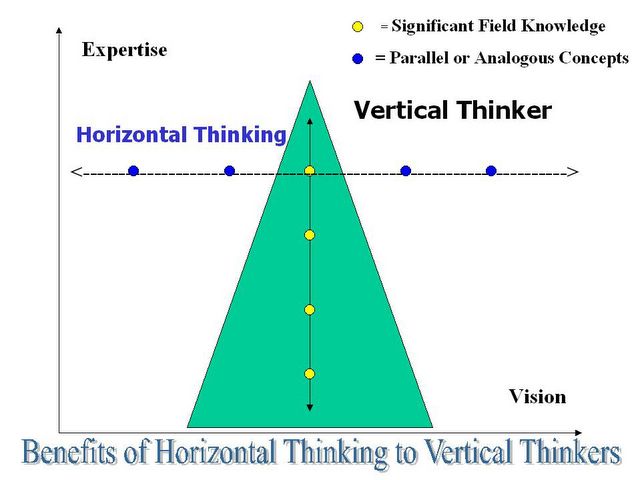
There’s nothing wrong -in fact, much to the good – with the call of Kohlman and others like Joan Johnson-Freese to deliberately combine students and faculty of radically different professional backgrounds. Such a personnel mix is a good base for horizontal thinking to take place, where discussions can range across fields generating insights and analogies and accelerating learning.
However, just assembling a broad mix of talent and putting them together in a building is not enough because it is not any more goal oriented than a MENSA social. Good things might happen, sure, but just as easily not. This is why DARPA is a lot more productive of an organization on an annual basis than the Institute for Advanced Study. There needs to be a mixture of problem-solving and play, free inquiry or experimentation and unifying goals. Communities of interest have to first have a sense of community for the vibrantly sharing and inspiring “minds on fire” effect to take place.
.
If the military or more broadly, American society, wants a larger number of creative, innovative, “disruptive”, strategic or whatever kind of thinker, then the answer is to actively and purposefully teach students creative, critical, insight-generating and strategic thinking skills and to value intellectual curiosity, skepticism, imagination and empiricism over ideology and conformity. The other indirect, “better environment”, stuff certainly improves your chance of success, but systemic improvement will only come about by making such objectives the focus of instruction and learning rather than a haphazard byproduct.
UPDATE:
At Best Defense, Ricks has provided a copy of his prepared remarks on PME as well as a link to the audiofile that I could not pull up the other day. Check out what he has to say.

Nancy Fouts and the heart of the matter

Thursday, March 22nd, 2012

[ by Charles Cameron — Nancy Fouts, sculpture, juxtaposition, essence of creativity, pocket universes, Arthur Koestler, Mark Turner ]
.

Nancy Fouts is an American artist based in London. I ran across her work a while ago thanks to Michael Weaver on Google+, and was immediately struck by the intensity of her images, each one of which seemed like a landmark from a larger geography, more precisely focused and dense with meaning than our own world usually appears to be.

First impression:

.
The first image I saw was of a snail on the straight edge of a razor blade (above, left) — an image out of the script of Apocalypse Now to be sure, but presented by Fouts in sharp detail and unadorned by any other context, visually, direct from eye to mind and heart.

This may be the image many people first see of her work — very, very striking, exquisite, terrifying if you allow it to be so, and yet as clear and simple, almost, as a single drop of water on a leaf.

Singer and song:

.
But it was this next image that conquered me:

The juxtaposition is impeccable: sewing machine, record on turntable – and the overlap between the two, the link, the vesica piscis between them, is the needle.

The music of Bach, Handel, and Vivaldi — particularly on harpsichord — has been disparagingly called “sewing-machine music”. If that phrase gave rise to this marvelous image, perhaps the slight can be forgiven.

The sewing-machine? It’s a Singer. And in what must surely be an ironic, gender-influenced choice coming to us from an artist so assured and exacting — the music that the needle draws from the groove of the record is, as you can tell from the record label, the music of His Master’s Voice.

Philosophical aside:

.
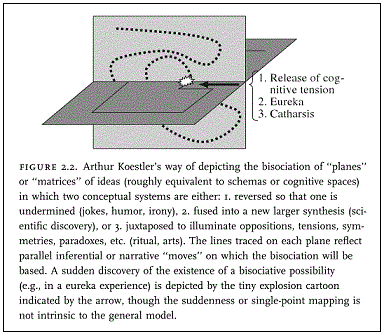
I have pointed before to this diagram from Mark Turner‘s The artful mind: cognitive science and the riddle of human creativity, based on those in Arthur Koestler‘s The Act of Creation (eg those on pp 35 and 37):

koestler-model.gif

It shows the essence of the creative act — the “release of cognitive tension” that occurs when some form of analogy, similitude, overlap allows the mind to join conceptual clusters from two fields in a “creative leap”.

Nancy Fouts’ work doesn’t merely make use of such twinned field overlaps, it makes twinned fields with overlap the defining quality of her works.

She is aiming right at the heart of the creative process. And it shows.

Moving further afield:

.
In that earlier post of mine, I talked about Ada, Countess of Lovelace, and noted that her analogy between Charles Babbage‘s Analytical Engine and Jacquard‘s mechanical loom, famously expressed by her thus:

The Analytical Engine … weaves algebraic patterns, just as the Jacquard-loom weaves flowers and leaves.

was precisely the creative leap that led to the us of punched card systems in computation from Babbage to Watson…

I could give other examples. The Taniyama-Shimura conjecture which formed the basis of Andrew Wiles‘ proof of Fermat‘s Last Theorem, bridges two previously distinct branches of mathematics precisely by showing that for every elliptic curve, there is a related modular form

And no, I don’t understand the mathematics. But I understand the concept of twinned fields, and the power of their overlap.

Some favorite tropes:

.
Back, then, to Nancy Fouts:

One thing that interests me about her work is that she has a few simple “essences” that she returns to time and again: in this case, bees, forms that resemble honeycombs, and by implication, honey.

In my own work, making similar connections between what we might paradoxically call “kindred ideas in unrelated fields” — I might set Nancy’s honeybees across from the verse from the Upanishads [Brihadaranyaka, fifth Brahmana, 14] which says:

This Self is the honey of all beings, and all beings are the honey of this Self.

Another of Nancy’s tropes connects nature and music…

The piercing:

.
And thimbles, those miniature emblems of armor and protection, are another recurring theme:

Let’s take a look at that last image, of the thimble transpierced by a needle.

I believe it has a history — again, accessible via an associative leap. Here are three images of the “wounded healer” motif, two of them specifically images of the Inuit shaman who has harpooned himself — a motif which the anthropologist and zen roshi Joan Halifax writes “captures the essence of the shaman’s submission to a higher order of knowing”:

Armor, the defenses we have in place to protect our selves, and vulnerability, the ability to to allow our selves to be wounded, so that the “self” which is “the honey of all beings” may shine through us. The paradox of Selflessness and Self.

Koan and sacrament:

.
Among wounded healers, we might count the crucified Christ, his side pierced by the spear of a Roman soldier — and here I might suggest that Fouts contrasts (image below, left) the self-sacrifice at the heart of Christianity with the pugilistic approaches of some proponents of his message:

And the image of Christ (right) balancing on a high wire?

Again I’m reminded of the language of shamanism. The anthropologist Barbara Myerhoff studied the religious beliefs and practices of the Huichol or Wixaritari of the Mexican Sierra Madre Occidental, with Ramon Medina Silva, a mara’akame or shaman of the tribe.

In her book, Peyote Hunt: The Sacred Journey of the Huichol Indians, she describes a feat of balance that Ramon performed, which appeared to serve a “sacramental” function for his people – providing them with what Cranmer‘s Book of Common Prayer calls “an outward and visible sign of an inward and spiritual grace”:

One afternoon Ramon led us to a steep barranca, cut by a rapid waterfall cascading perhaps a thousand feet over jagged, slippery rocks. At the edge of the fall Ramon removed his sandals and told us that this was a special place for shamans. We watched in astonishment as he proceeded to leap across the waterfall, from rock to rock, pausing frequently, his body bent forward, his arms spread out, his head thrown back, entirely birdlike, poised motionlessly on one foot. He disappeared, reemerged, leaped about, and finally achieved the other side. We outsiders were terrified and puzzled but none of the Huichols seemed at all worried. The wife of one of the older Huichol men indicated that her husband had started to become a mara’akame but had failed because he lacked balance.

It’s easy to read the description — but by no means as easy to keep one’s balance — something that Fouts’ image perhaps suggests more vividly than words easily can.

Richard de Mille describes the mara’akame‘s function in Huichol society as to “cross the great chasm separating the ordinary world from the otherworld beyond,” and suggests that Medina Silva’s feat of acrobatics on the barranca that day is to be understood as offering “a concrete demonstration in this world standing for spiritual balance in that world.”

Myerhoff herself was never entirely sure whether Medina Silva was “rehearsing his equilibrium,” or giving it “public ceremonial expression” that afternoon: it is clear, however, that for the Huichols, such feats of balance possess a resonance and meaning that extends beyond the “merely” physical.

Bringing the viewer into the picture

.
I may of course be projecting some of my own ideas onto Nancy Fouts’ work — and indeed, perhaps that’s the point.

She has some pretty fierce observations to make concerning matters religious — Christian, Buddhist and other — and I’ll leave those who are interested to make their own discoveries on her website. I don’t doubt there are places where her sympathies and my own overlap, and others where we differ.

Fouts speaks a direct and visceral language of images — and her juxtapositions, carefully chosen and choreographed as they are, provoke us to feel and think.

Thank you, Nancy.

No need to reach for the gun, fellas — but that’s art.

_________________________________________________________________________________________

credits for images of Harpooned Shaman: Charlie Ugyuk (left); David Ruben (right).

Ruminating on Strategic Thinking

Wednesday, December 21st, 2011

“Let the Wookiee win….”

Warning! Thinking out loud in progress…..

Strategy is often described as the alignment of “Ends-Ways-Means” and “planning” to achieve important goals and several other useful definitions related to matters of war, statecraft and business.  That great strategists have come in many forms, not just between fields but demonstrating tremendous variance within them – ex.  George  Marshall vs. Alexander the Great vs. Carl von Clausewitz – indicates that strategic thinking is a complex activity in terms of cognition.

What are some of the mental actions that compose “strategic thinking” or “making strategy”? A few ideas:

  • Recognition of important variables
  • Assessment of the nature of each variable
  • Assessment of the relative importance of each variable
  • Assessment of the relationships among the variables
  • Assessment of the relationship between the variables and their strategic environment
  • Assessment of current “trajectory” or trend lines of variables
  • Assessment of costs to effect a change in the position or nature of each variable
  • Assessment of the strengths and weaknesses of the variables as a functioning system
  • Recognition of systemic “choke points”, “tipping points” and feedback loops.

  • Probabilistic estimation
  • Logical reasoning
  • Introspection 
  • Extrapolation
  • Simplification
  • Metacognition
  • Horizontal Thinking
  • Insight
  • Imagination (esp. at “grand strategic” level)

  • Logistical estimation of costs
  • Normative evaluation of potential benefits
  • Understanding of temporal constraints
  • Recognition of opportunity costs
  • Recognition of boundary conditions
  • Recognition of physical constraints of strategic environment (terrain, weather, distance etc.)
  • Recognition of patterns in the history of the strategic environment

  • Net assessment of the maximum capabilities of a political community (first ours, then theirs)
  • Understanding of organizational structure of a political community
  • Recognition of stakeholders in the political community 
  • Understanding of decision making process of the political community
  • Understanding the power relationships of the decision making process of the political community
  • Understanding the distribution of resources within the political community
  • Recognition of the touchstone points of the cultural identity of the political community (positive and negative) and worldview
  • Assessment of morale of the political community and the community’s moral code
  • Assessment of psychology of individual adversary decision makers
  • Identification of points of comparative advantage
  • Recognition of how different bilateral outcomes/shifts will affect third parties
  • Assessment of relationship between the adversaries and between them and third parties

This list is not comprehensive. In fact, I have a question for the readership, particularly those with military service and/or a good grasp of military history:

Where do the interpersonal skills or “emotional intelligence” abilities that comprise the activity we term “leadership” fit into strategic thinking? Or is it a separate but complementary suite of talents? We often assume that great strategists are the great leaders, but we tend to forget all of the generals who were popular yet mediocre in the field and gloss over the human faults of those who won great glory.

I have some ideas but I would like to hear yours. Or any additional suggestions or comments you would care to make.

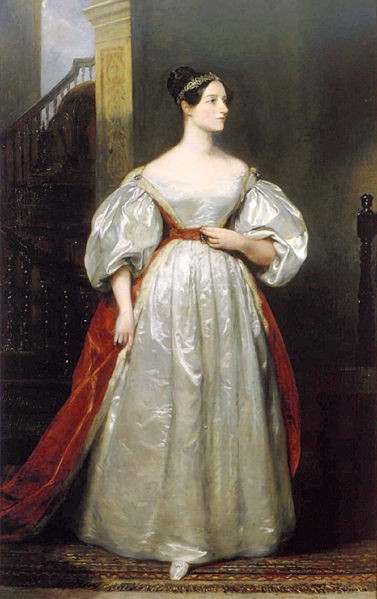
In honor of Ada, Countess of Lovelace

Friday, October 7th, 2011

[ by Charles Cameron — childhood memories, computer history, creative thinking, analogy, bead game ]

.

hors508.jpg

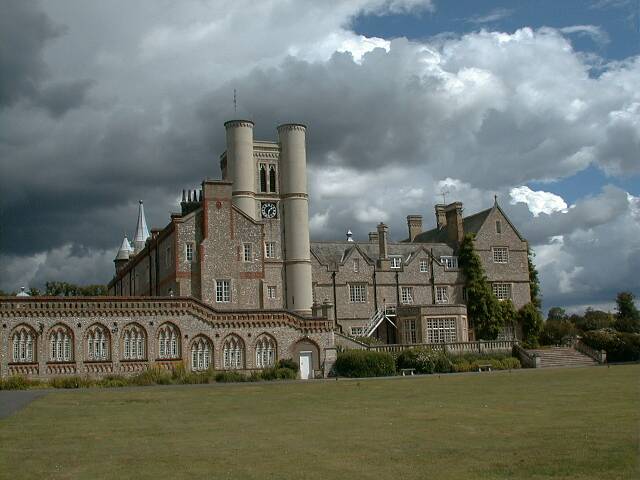
This menacing old pile, Horsley Towers — John Julius Norwich said of it in his Architecture of southern England, “The over-riding idiom seems to be vaguely Italianate Gothic, but in reality East Horsley is like nothing but itself, a grotesque Victorian Disneyland which has to be seen to be believed – and may not be even then” — was home to Ada, Countess of Lovelace, daughter of the poet Lord Byron.

Today is Ada Lovelace Day, and I have special reasons to honor her.

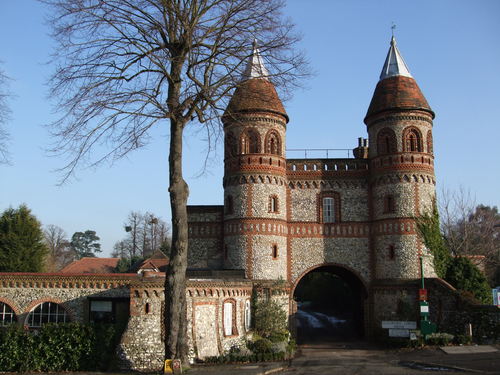
horsley-gateway.jpg

For one thing, I grew up inside these gate-towers, in the last little house before the Lovelace estate proper began, and certain features of the first fields on the way to the big pile were my childhood haunts, the old oak with its dark and mysterious hollow wound, the clovered grass and cow pats, the small mound for boyish climbing, the bramble bushes with their delicious blackberries…

*

But it is as a devotee of Hermann Hesse‘s great Bead Game that I want to celebrate Ada Lovelace today —

ada3.jpg

for she illustrates to perfection the importance of cross-disciplinary analogies in creativity.

*

Consider this diagram from Mark Turner‘s The artful mind: cognitive science and the riddle of human creativity, based on those in Arthur Koestler‘s The Act of Creation (eg those on pp 35 and 37):

koestler-model.gif

Hesse proposes — in his Nobel-winning novel, the Glass Bead Game (aka Magister Ludi) the building of an architecture of ideas in which the great works of human culture are linked — bound together — by analogies between them.

Beginning players of his Game,  he writes, learn “how to establish parallels, by means of the Game’s symbols, between a piece of classical music and the formula for some law of nature.” As I wrote elsewhere, on a more complex level, Hesse speaks of scholars proposing materials for inclusion in the Game Archives, and specifically mentions someone who had been studying “the rhythmic structure of Julius Caesar’s Latin and discovered the most striking congruences with the results of well-known studies of the intervals in Byzantine hymns”…  Hesse couldn’t possibly have known about it when writing that particular sentence, of course, but there is actually a book by Jane-Marie Luecke, OSB, entitled Measuring Old English Rhythm: an Application of the Principles of Gregorian Chant Rhythm to the Meter of Beowulf, (Literary Monographs, vol 9, U. Wisconsin Press, 1978).

Hunh?  So?

*

Consider what Ada, Countess of Lovelace hath wrought.

She perceived just such an analogy — comparing Charles Babbage‘s Analytical Engine with Jacquard‘s mechanical loom, and writing:

The Analytical Engine … weaves algebraic patterns, just as the Jacquard-loom weaves flowers and leaves.

That analogy between weaving and algebra was the great creative leap: from there to the adoption and adaptation of Jacquard’s punched card system in computation was the lesser step from insight to application.

And think about it: her mind moved unerringly between “art” and “science” — or more exactly, craft and mathematics — in 1843, to deliver a technological insight on which the mainframes of the 1970s still relied…

That, my friends, was a superb move in the spirit of the Glass Bead Game — and impossible without a well-furnished and agile mind.


Switch to our mobile site