zenpundit.com » social networks

Archive for the ‘social networks’ Category

Descent into Barbarism

Wednesday, August 10th, 2011
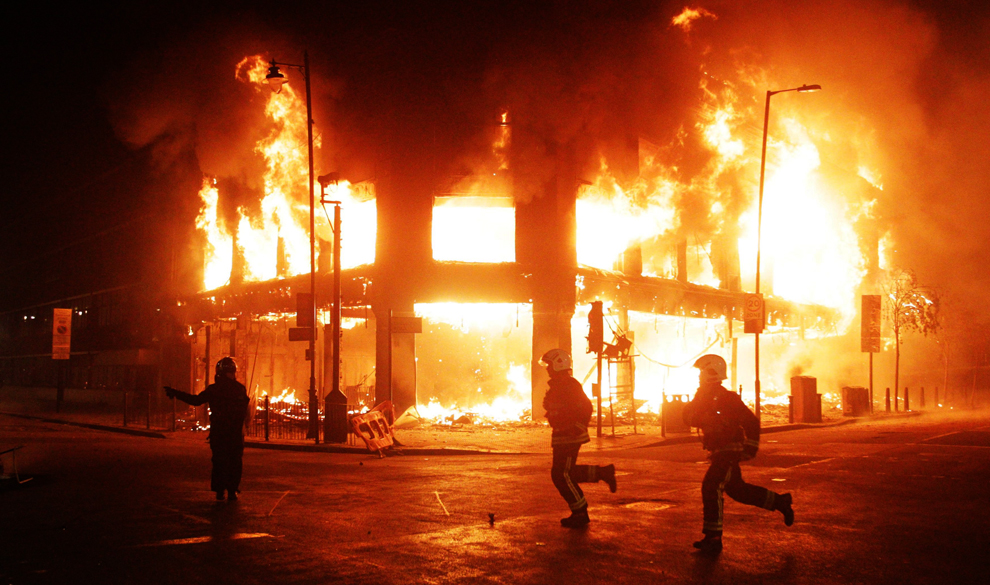
London burns for four days as UK authorities dealt timidly and uncertainly with semi-organized swarms of brazen thugs, causing rioting to spread to other cities. What have we seen so far?

* The British government and police acted with moral uncertainty in the face of violent challenge from swarming tactics by “underclass youth” rioters.  The BBC was filled with interviews of victimized citizens complaining about how police were unwilling to intervene to stop acts of looting, assault and arson. Police behavior fed the cycle of rioting and encouraged fence-sitters to join in and swell the ranks of the mob, as did early talking head comments in the British media that argued that the rioters were “justified”

* The British government was politically paralyzed by the crisis and needed three days and a Cabinet meeting to begin to organize an effective anti-riot strategy, distribute proper equipment, summon additional manpower, change police ROE and marshal a rhetorical narrative against the rioters.  All the halmarks of excessive top-down control by out of touch technocrats and politicians.

 John Robb summed up this kind of anti-leadership beautifully in his review of Rebecca Solnit’s A Paradise Built in Hell  :

…In contrast to the people on the ground, she shows that the only people that actually do panic during disasters are the elites — from those with wealth to those running the government’s response (I’m not talking about the first responders actually on the ground doing good work).  They panic over the loss of control a disaster brings.  This often results in extreme actions that only serve to make things worse: from martial law authorized to use deadly force against looters (often just people trying to survive the situation) to arbitrarily hearding people into locations that aren’t able to support large groups of people.  

What This Means

The lesson here is that during an extreme disaster, the people you may most need to fear are those in charge, particularly if their motives are focused on protecting elite interests put at risk by the disaster

* The Cameron government’s legitimacy is at risk, being currently blamed for everything connected to the riot from the underlying “root causes”, to their initial total lack of interest in defending ordinary Britons to the bad impression made of having senior ministers being on vacation while the capitol of the UK was ablaze. Earnest and repeated assertions by government officials that no political or racial motives were behind the rioting conflicted with the reality being broadcast live by the government’s own news service in the first hours and days of the riot.

Handling a riot properly is state power 101. The Prime Minister has about two days to turn this situation and the political perceptions created around or he will begin an irreversible downward spiral to an early retirement.

The East Rising

Sunday, July 3rd, 2011

Gifts from a generous Meatball:


Hardcovers too. Nice.

The Party: The Secret World of China’s Communist Rulers by Richard McGregor

Monsoon: The Indian Ocean and the Future of American Power by Robert D. Kaplan

I have already dived a few chapters into the McGregor book and it is very good. What makes it good is that is running counter to the message of the herd in terms of popular Sinology, which is to emphasize that China is a) uniquely Chinese with deeply introspective Confucian civilizational traditions (that’s modern PC-speak for “inscrutable”) and b) the brave new world of liberal, globalized, capitalism with a benign technocratic face.

Now there’s important truths in both of the popular mass messages on China, incompatible as they can be with one another. The economic rise of China in a globalized economy is the most important story of the last quarter of the 20th century and the first quarter of the 21st ( collapse of the USSR is second; the Soviets were beaten before they imploded and imploded largely because they knew they were beaten). China is also not like America, not even when they imported stock options, blue jeans, McDonald’s and the American jobs that used to create all those things. China’s civilization is truly of a dizzying depth, complexity and scale that is best compared to Europe rather than a specific country. That in itself, is important because it points to how ignorant the average American policy maker is, never mind the average American, about what makes their Chinese counterpart tick.

[ Sidebar: Perhaps the Obama administration assembling a new senior “China/East Asia” diplomatic and national security team that does not include a single official with any professional knowledge of China was unwise? How is that better than the Bush II administration shunning Arabists during the run up to and occupation of Iraq? It is not that these diplomats and officers are poor, they are smart and experienced, but none of them are China specialists. Or Japan specialists, for that matter and only one has expertise in Korean affairs. These are the region’s great powers! This is like turning EU/NATO policy over to diplomats who speak Hindi and Swahili ]

What McGregor is doing in The Party that is important is reminding Westerners that the Soviet experience, particularly the Leninist Party model, is still deeply embedded in China’s political DNA. Not in an ideologically Marxist, Khrushchevian, shoe-pounding sense but in a functional sense. In a structural sense. In an instrumental governance sense. In a networking theory sense. And all these characteristics, which are largely innately hostile or indifferent to the values of liberal democracy, continue to shape Chinese policy, leadership succession, national security, defense strategy and geopolitical outlook to this day.

That doesn’t mean China is itching for a war with the United States, but it means they are playing a longitudinal strategic game where the first goal is to stay in power forever and the next is to advance one’s position relative to others.

We are the other.

China is not an enemy but she is no friend or ally of the United States either, yet it is the most important relationship the US has to manage for the next thirty years – and that relationship in a strategic context with rising India, Japan, South Korea and Australia.

It might help if America brought a team to the table that included people who could tell Han Fei Tzu from Mencius or spoke Chinese.

PRISM: Col. Bob Killebrew on Criminal Insurgency

Tuesday, June 14th, 2011

Criminal Insurgency” is becoming a preferred term of art to describe entities like the Narco-cartels of Mexico that have evolved from transnational criminal organizations into groups with paramilitary and intelligence capabilities or Colombia’s FARC which formerly was a model Marxist insurgency but devolved downward into a drug trafficking army. The term is used partly to placate doctrinaire purists among defense intellectuals who see insurgency definitively as armed political movements following Mao’s three stages or bust. After all, they have only had since the late 80’s and early 90’s, when Bill Lind and Martin van Creveld warned them this was coming, to get used to the idea.

Colonel Robert Killebrew, a smart fellow at CNAS, has an article in NDU‘s PRISM that puts the problem of criminal insurgency into a hemispheric context:

Criminal Insurgency in the Americas and Beyond

….Essentially, the United States faces external and internal challenges in reorienting to more effectively fight the cartels and their allies. Refocusing U.S. policy from a “war on drugs” to a more comprehensive fight against the cartels and gangs is essential if the United States and its allies are to prevail. Since the basis of the cartels’ survival lies in the control of regions where governmental control is nonexistent and populations may be impoverished and alienated, successful counter-cartel strategies are fundamentally counterinsurgency strategies developed by the concerned states themselves and supported by the United States. Counter-cartel strategies must first be political strategies, integrating military and police activity into a broader political approach that emphasizes the rule of law as an alternative to the rule of force. Four aspects of a Western Hemisphere counter-cartel strategy follow.

First, step up the direct attacks on the cartels. Over the past decades, U.S. law enforcement professionals have developed successful operational techniques that cartel leaders fear: partnerships with effective local police (often with U.S. training), expertise with judicially approved wiretaps and electronic surveillance, rewards programs that make criminal bosses vulnerable to betrayal, and, above all, when local laws permit, extradition to U.S. courts and prisons. The United States and its allies should increase the capability for multiagency field operations in all these dimensions, as well as the professionalization of host country military forces for operations requiring holding ground while the rule of law is reinstituted by other national agencies. DEA already operates throughout the region and has solid relationships with counterpart agencies; additionally, the agency has worked closely with U.S. combatant commands, notably U.S. Southern Command, where its powerful extraterritorial jurisdiction authority supplemented the military’s own programs to help U.S. allies in the region. DEA should continue to advise and assist host country police and counternarcotics forces, but the size of the agency must be greatly increased. With 5,500 agents spread over the hemisphere-including the United States-the agency that plays such a key role in the ongoing war with the cartels is spread too thin.

Second, the U.S. and its allies must continue to attack the cartels’ financial networks and money-laundering capabilities-a key strategy that requires more resourcing at Treasury. Cartel leaders fear U.S. indictments and extradition to American courts; extradition, exposure, and seizure of “dirty” money from criminal operations are all effective strategies that identify kingpins and threaten them with trials in U.S. courts and long terms in U.S. prisons. The United States has learned to use financial analysis and indictments as weapons against the cartels, even when they are beyond the immediate reach of U.S. law. Their use should be expanded.

Third, help our neighbors build more functional state institutions, particularly courts, and stimulate economic growth. In terms of the U.S. role and our assistance to allies, our understanding of security assistance must be broadened to include effective assistance to police and courts. For example, as part of Plan Colombia-a Colombian-developed counter-cartel strategy-the United States provided the Colombian National Police (CNP) with telecommunications-intercept equipment and, working through the Department of Justice, helped the CNP build a judicial process to support wiretap investigations. The result was a powerful tool that assisted indictments against cartel leadership and extraditions to the United States for prosecution. Likewise, assisting host nations to build strong, noncorrupt judicial systems is critical to assisting or restoring stable governments in areas threatened by cartel or other insurgent violence; courts, appellate courts, and efficient prisons are key pieces. Other U.S. agencies and contractors can provide other materiel assistance, training, partnership, and, when authorized, direct help in specified areas such as the collection of certain kinds of strategic intelligence. The U.S. Department of Defense can provide advisors and trainers on the Colombia model to supplement local military and law enforcement efforts, and occasionally direct aid in the form of helicopter transportation and naval support.61

Reputation in the dark

Tuesday, May 17th, 2011

[ by Charles Cameron — Towards a Pattern Language for CT II ]

.

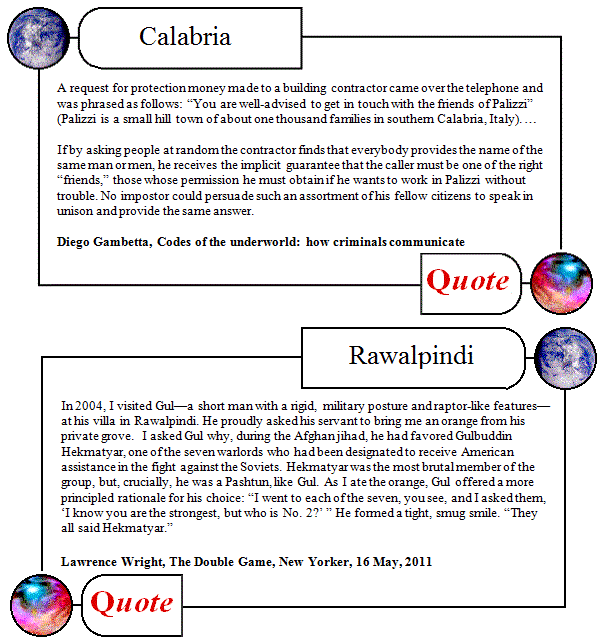
A tip-of-the-hat to Mercutio for pointing me towards Diego Gambetta‘s Codes of the underworld: how criminals communicate in a comment here on ZP today. I went off to see what snippets of Gambetta I might find — and ran across a paragraph which sent me in search of another that I’d read earlier this week, and which I finally located (after devious detective work) in Lawrence Wright‘s summation of the situation with regard to Pakistan.

quo-reputation.gif

There’s a pattern here, and it has to do with the assaying of reputation under, shall we say, precarious circumstances?

You may recall my post of two weeks ago, Towards a Pattern Language for CT? — well, this can be the second in the series.

The tightly woven web of Jarret Brachman

Wednesday, May 4th, 2011

[ by Charles Cameron — cross-posted with minor alteration from SmartMobs ]
*

Jarret Brachman is one of our brightest analysts of jihadist behavior on the internet. He was the first Director of Research with the Combating Terrorism Center at West Point, and is the author of Global Jihadism: Theory and Practice.

His blog today featured an extraordinary post titled My One Fan in Abottabad.

First he writes:

Out of sheer curiosity, I ran a google analytics search to see if I’ve ever had any hits from Abbottabad, Pakistan to the blog.

Then he shows us the map his research produced :

abbot

and then he comments:

Sure enough, I’ve got one fan there who has been checking the blog randomly over the past couple years.

*

As my Watchmen-hip son might say, … Quis custodiet ipsos custodes?


Switch to our mobile site