zenpundit.com » national security

Archive for the ‘national security’ Category

Iranian Assassination – Narco-Cartel Plot Charged

Wednesday, October 12th, 2011

The US Attorney General Eric Holder, supported diplomatically by the Kingdom of Saudi Arabia, charged the Iranian government earlier today with a plot to enlist a Mexican narco-cartel to assassinate the Saudi Ambassador to the United States. SECSTATE Hillary Clinton, the FBI Director and President Barack Obama have all weighed in on this issue with strong public statements:

U.S. authorities said they had broken up a plot by two men linked to Iran’s security agencies to assassinate Saudi Ambassador Adel al-Jubeir. One was arrested last month while the other was believed to be in Iran.

Iran denied the charges. But President Barack Obama called the plot a “flagrant violation of U.S. and international law” and Saudi Arabia said it was “despicable.” Revelation of the alleged plot, and the apparent direct ties to the Tehran government, had the potential to further inflame tensions in the Middle East, and the United States said Tehran must be held top account.

Secretary of State Hillary Clinton, in a Reuters interview, expressed hope that countries that have hesitated to enforce existing sanctions on Iran would now “go the extra mile.” At a news conference, FBI Director Robert Mueller said the convoluted plot, involving monitored international calls, Mexican drug money and an attempt to blow up the ambassador in a Washington restaurant, could have been straight from a Hollywood movie.

U.S. Attorney General Eric Holder alleged that the plot was the work of the Islamic Revolutionary Guard Corps, which is the guardian of Iran’s 32-year-old revolution, and the Quds force, its covert, operational arm. “High-up officials in those (Iranian) agencies, which is an integral part of the Iranian government, were responsible for this plot,” Holder told the news conference.

“I think one has to be concerned about the chilling nature of what the Iranian government attempted to do here,” he said….

I confess that I am not quite sure what to make of this story. 

If accurate – the case originated with a DEA confidential informant in Mexico – it would amount to a new stage of reckless boldness by Iran’s hardline Pasdaran clique of security and intelligence agencies run by the Iranian Revolutionary Guards and their retired leadership that have a semi-hegemony over the Iranian regime. It also points to the danger to American national security of a long, basically open, border with a failing state Mexico that is deeply embattled in a polycentric counterinsurgency war with the rapidly morphing narco-cartels (that said, I do not expect the administration to move a policy inch to repair the latter). Why would Iran do this – and in such a harebrained manner?

Some possible motives:

* Internal factionalism – Iran recently released imprisoned American hikers, albeit after a substantial ransom payment. Potentially, this could be viewed in the topsy-turvy world of Iranian Islamist politics as a “goodwill gesture” toward the United States. Historically, such gestures provoke rival factions in Iran to initiate anti-American actions, including acts of terrorism, usually via proxies. If an intel operation was “factional” rather than blessed by a wide elite consensus, it might very well be a marginal idea carried out on a shoe-string.

* Counterpressue – Indirect Iranian skirmishing against the US which is drawing down in Iraq and is pressuring Iran’s ally Syria. Also against the Saudis who brutally suppressed a predominantly Shia “Arab Spring” rising in Bahrain which, if it had succeeded in toppling the regime, would have added Bahrain to the regional “Shia Revival”.

* Opportunism – The Pasdaran leadership may have  believed the stories of American decline, assessed our extensive military commitments and budgetary problems and taken the Obama administration’s temperature and concluded that the benefits of carrying out the assassination outweighed the remote risk direct  of US military retaliation.

Some points to consider:

* Proximity – Iran could more easily, with less risk and with far greater likelihood of success, carry out acts of anti-American terrorism closer to home in Iraq, Lebanon, Afghanistan the Gulf States, even in Saudi Arabia or Egypt.  Acts of terrorism in the American homeland risk a massive overreaction by Washington ( the US only needs the Navy to deal out severe consequences to Iran) which might welcome a legitimate pretext to bomb all of Iran’s suspected nuclear facilities and national security sites.

* Self-Preservation by the Mexican narco-cartels make such cooperation with Iran less likely, having the example of their Colombian predecessors in the 1980’s before them when they raised the ire of the USG sufficiently. The narcos have their hands full fighting the Mexican Army and one another without adding the CIA, Global Predator drones or the SEALs to their plate.

* Friends of MeK – By some miraculous deus ex machina, the cultish, 1970’s era Iranian Marxoid terrorist group, the People’s Mujahedin of Iran (MeK) have spent a wealth of funds to buy the lobbying services of a glittering array of former top US national security officials and general officers – despite being on the State Department’s official terrorist list.

….Among the new faces: former Indiana Congressman Lee Hamilton (D), who once chaired the House Foreign Affairs Committee, and who served as vice chairman of the 9/11 Commission; Ambassador Dell Dailey, who was the State Department’s Coordinator for Counterterrorism from July 2007 to April 2009; General Michael Hayden, director of the CIA from 2006 to 2009; and not one, but two former chairmen of the Joint Chiefs of Staff. Former Attorney General Michael Mukasey, former New Mexico Gov. Bill Richardson, former Under Secretary of Defense for Policy Walter Slocombe and ex-Sen. Robert Torricelli (D-NJ) also spoke.

In what should be a national scandal, those names are not even a comprehensive list of the very influential former politicians, K Street lobbyists and Beltway law firms accepting payments to whisper in the ears of current officials in the national security community, regarding Iran, on behalf of the MeK. Not sure how it is legal to do so either, since aiding a group on the State Department’s list by providing services normally can get you hauled into Federal  court pronto, if you are an ordinary American citizen. A most curious situation….

I have no brief for Iran, the regime is a dedicated enemy of the United States, but a group of exiled Iranian Marxist-terrorists who used to work for Saddam Hussein hardly have our best interests at heart.

It will be interesting to watch this case unfold, but in the meantime, opinions are welcome in the comments, particularly on the Mexican narco-cartel angle.

Hat tip to James Bennett.

A Strategy for the Pacific – Will the US have the $$$ and the courage for a credible and survivable one?

Tuesday, October 4th, 2011

[by J. Scott Shipman]

To have an executable strategy, a nation needs the wherewithal to pay for it. This applies the United States, too. 

As the United States heads into an election year with rising unemployment, a double-dip recession threatening, and deep cuts to defense on the horizon (even as we continue to prosecute the war on terror) a controversy continues to brew in the South China Sea. China has increasingly heated up the rhetoric. On 30 September the Taipei Times reported on an opinion article in the Chinese Communist Party-run Global Times (the original article is here), calling on the Chinese to declare war on Vietnam and the Philippines over their intransigence with respect to China’s claim of the South China Sea as being part of China proper. While this tantrum might be a saber-rattling “fire for effect” exercise aimed at intimidation, the writer surmised the position of the United States:

“The US has not withdrawn from the war on terrorism and the Middle East … so it cannot afford to open a second front in the South China Sea,” he wrote…“[Military] action by a big country in the international arena may result in initial shock, but in the long run, regional stability can be achieved through great power strategic reconciliation.”

“It cannot afford” is writ large. What, indeed, would the US do if China followed the advice of this hot-headed pundit? The US Navy is operating at about 283 ships, and the op-tempo is wearing out both ships and crews—fast. A recent article in the Atlanta Constitution reported the USN is investigating extending the typical six month deployment for fast-attack submarines. As I wrote earlier, we are retiring our submarines faster than we’re replacing them. With the US defense budget under the axe for even further cuts, what is the proper course of action? And do we have a strategy supported by an adequate budget? Are we strengthening our relationships among allies, or are we neglecting relationships that will be vital if hostilities break out? I would submit the US refusal to Taiwan’s request to purchase modern F-16 C/D variants, offering instead upgrades for A/B sends a message of waning US resolve to honor the Taiwan Relations Act (TRA). (A rumor within the Beltway is the upgrades were a first step, with what the administration hopes will be a request by Taiwan for the troubled and increasingly costly F-35.) The TRA requires the United States “to provide Taiwan with arms of a defensive character”, and “to maintain the capacity of the United States to resist any resort to force or other forms of coercion that would jeopardize the security, or the social or economic system, of the people on Taiwan.” We may have that “capacity” today, but what are we doing to insure we sustain the capacity to maintain open sea lines of communications? Can we afford it?

Our friends in the South China Sea environs aren’t feeling the love. India, Indonesia, Japan, Malaysia, the Philippines, Singapore, South Korea, Taiwan, and Vietnam have all expressed concern about China’s increasingly belligerent actions with respect to the South China Sea areas. All of these nations rely ultimately on the USN to keep the sea lanes of communication open. Most have modest defense budgets, but they’re beginning to realize the new reality and are acting and good for them—we could learn something in the reality department. Vietnam has ordered six Russian Kilo Class diesel boats (very good subs, btw), and the Philippines are shopping. Singapore has a pretty impressive sub fleet (six reasonably modern hulls) and national defense given her size. Taiwan has two 20-plus year old subs and two WWII era US boats that are 60 years old!

If we look at numbers, our strategy seems pretty puny. As our fleet continues to atrophy in numbers, the Chinese continue to build. An inventory of submarines in the area shows that between China and North Korea there are about 128 hulls compared to a total of 42 among the aforementioned nations. Our friends in the area will continue to need US submarine support in the area for the foreseeable future as subs are long lead time platforms.

In this theater alone, cutting our defenses seems nuts. Rather than cut line units, perhaps DoD should begin to improve/streamline our antiquated procurement and acquisition processes. Our acquisition process is so complicated we have a Defense Acquisition University (DAU)! At an estimated $124M for FY012, perhaps we should cut DAU first. Last year at Boyd & Beyond 2010, Dr. Ray Leopold shared the contrasts in commercial contracting versus government contracting. Commercial contracts are built on the presumption of trust, government contracts are written on the presumption of distrust. Rather than use normal legal remedies to hold mischievous and unscrupulous contractors to account, DoD has erected mind-numbing processes that attempt to eliminate any risk a contractor could successfully rip-off the government. And when a contractor does rip-off the government, the contractor pays a fine and continues to do business with the Pentagon. If someone steals from you, do you continue to do business with them? Not me. This would be a good place for DoD to begin true accountability—you can bet one defense company out of the market would send a message to the others. The sad truth is the revolving door between the military and the contractor community has created a incestuous and inbred swamp of rules and processes only the participants understand that are so impenetrable DoD has no idea how much money it is spending (never mind tracking waste)—so fiscal irresponsibility continues in an increasingly dangerous world with budget cuts guaranteed. What’s the strategy again? This madness is fast becoming an issue of national security. On our current track we could well be incapable of defending ourselves, much less our allies.

Here are few other ideas for consideration before touching a single line unit:

  • DoD should lay-off every nonessential employee. Whenever there is a snowstorm in the DC area, nonessential personell are instructed to stay home or “liberal leave” is in effect. We need to disabuse ourselves of the luxury of the nonessential employee. Regular businesses don’t operate like this, neither should DoD. Every employee should be integral, essential, and necessary; if they’re not essential, we can’t afford them—not while we have troops in harm’s way.
  • Stop double-dipping on 1 January. If a member retires from the military, they shouldn’t be able work for the government (often in the same office where they separated from service) and draw two salaries. If the member wants to work for the government,  pick one, but not both. We can’t afford it and this contributes to the ongoing inbreeding in defense. And here’s a cruel truth: why should we pay a member who could not continue advancing in the military a military pension and a government civil service salary?
  • Flag officers and members of the Senior Executive Service should have a minimum five year ban on working in the defense or defense lobbying industry. Stop the revolving door. Our current mess was created by many of these folks (even if well-intentioned), they should take a five-year time out and give others a chance to fix the mess they’ve helped create.
  • Abandon the current acquisition process and close DAU. Hire commercial attorneys at a commercial rate to write contracts based on trust, but contracts with teeth. This would be cheaper than the bloated and incestuous bureaucracy we now carry.  If a contractor defrauds the government, ban that company for 10 years from doing business with the government, and put the offending members in jail. Word will get around, and folks will behave.
  • Allow contractors to earn 8-10% on their work and stop nickel-diming them on fee. Businesses are in business to make money.
  • The government should assume more technical oversight/intimacy in procurement programs. We have too many generalist contracting officers who can be misled by an unscrupulous contractor, or perhaps worse, have no idea “what” they’re buying. The government needs to get engaged and informed and know “what” they are buying and know real costs.
  • Develop a promotion system based on merit, not time in grade. Our promotion system breeds risk averse officers who focus on punching career tickets instead of doing. Following John Boyd’s “to be or to do” maxim, the promotion system should reward officers who think and take risks, not poster-boy/cookie cutter conformists. “We’re warriors, dammit!” was a phrase my old CO used—let warriors be warriors! Scrap time in grade and promote based on performance, and if folks don’t perform well enough to be promoted, separate them from service.

Robert Frost said good fences make good neighbors; well a good deterrent makes good neighbors, too—but fences and deterrence costs money. DoD can and must do better; business as usual is becoming a death of a thousand paper cuts for us, and our allies. We need a real strategy and the budget to make it happen—that won’t happen with our current acquisition rules. The axe should fall on the Pentagon procurement bureaucracy before it touches a single line unit.

America is better than this, we must raise the standard by bringing DoD into the real world of fiscal responsibility and contract law, so whatever our strategy it can have a sound fiscal and legal foundation.

Open-Source Counterinsurgency in Mexico?

Thursday, September 29th, 2011

Are the Mata Zetas an open source counterinsurgency of loyalist paramilitaries, a “black hand” of frustrated state security personnel or an embryonic cartel?

Mexico Fears Rise of Vigilante Justice

MEXICO CITY-A self-styled drug-trafficking group calling itself the “Zeta Killers” claimed responsibility this week for the recent murders of at least 35 people believed to belong to the Zetas, Mexico’s most violent criminal organization.

The claim by the “Mata Zetas” has stoked fears that Mexico, like Colombia a generation before, may be witnessing the rise of paramilitary drug gangs that seek society’s approval and tacit consent from the government to help society confront its ills, in this case, the Zetas.

On Wednesday, Mexico’s national security spokeswoman Alejandra Sota vowed in a statement that the government would “hunt down” and bring to justice any criminal group that takes justice into its own hands.

….”Our only objective is the Zetas cartel,” said a burly, hooded man who said he was a Mata Zetas spokesman, in the video. The man said that unlike the Zetas, his group didn’t “extort or kidnap” citizens and were “anonymous warriors, without faces, but proudly Mexican” who would work “clandestinely” but “always to benefit Mexico’s people.”

The mysterious group appears to be part of the New Generation drug cartel, which operates in the northwestern state of Jalisco, according to an earlier video that showed some three dozen hooded men brandishing automatic rifles as a spokesman vowed to wipe out the Zetas in Veracruz. In that video, the spokesman lauded the work of the Mexican armed forces against the Zetas, and urged citizens to give information on their location to the military.

Given the small size and relatively meager investment in Mexico’s military, compared to it’s GDP, the endemic corruption of the Mexican police and judiciary, the scale and firepower of the cartels and the degree of violence unleashed, the real surprise is that paramilitary activity has not arisen sooner. Assuming that the Mata Zetas are a genuine, emergent, grassroots paramilitary group ( something that Mexico’s corrupt political elite would find more threatening than the narcos). Too soon to tell.

It is difficult to see how the Mexican state, left to it’s own resources, can regain the initiative in Mexico against the cartels without either adopting tactics similar to those employed by Colombia to beat back FARC and ELN or engaging in a military mobilization sufficient to create a crushing advantage in manpower.

ADDENDUM:

SWJ Blog – Mexican Cartel Strategic Note

Mapping our interdependencies and vulnerabilities [with a glance at Y2K]

Wednesday, September 28th, 2011

[ by Charles Cameron — mapping, silos, Y2K, 9/11, rumors, wars, Boeing 747s, Diebold voting machines, vulnerabilities, dependencies ]


www.fun1001.com | Send this image to your friend

The “bug” of Y2K never quite measured up to the 1919 influenza bug in terms of devastating effect — but as TPM Barnett wrote in The Pentagon’s New Map:

Whether Y2K turned out to be nothing or a complete disaster was less important, research-wise, than the thinking we pursued as we tried to imagine – in advance – what a terrible shock to the system would do to the United States and the world in this day and age.

1.

My own personal preoccupations during the run-up to Y2K had to do with cults, militias and terrorists — any one of which might have tried for a spectacle.

As it turned out, though, Al Qaida’s plan to set off a bomb at Los Angeles International Airport on New Year’s Eve, 1999 was foiled when Albert Ressam was arrested attempting to enter the US from Canada — so that aspect of what might have happened during the roll-over was essentially postponed until September 11, 2001. And the leaders of the Ugandan Movement for the Restoration of the Ten Commandments of God, acting on visionary instructions (allegedly) from the Virgin Mary, announced that the end of the world had been postponed from Dec 31 / Jan 1 till March 17 — at which point they burned 500 of their members to death in their locked church. So that apocalyptic possibility, too, was temporarily averted.

2.

Don Beck of the National Values Center / The Spiral Dynamics Group, commented to me at one point in the run-up:

Y2K is like a lightening bolt: when it strikes and lights up the sky, we will see the contours of our social systems.

— and that quote from Beck, along with Barnett’s observation, pointed strongly to the fact that we don’t have anything remotely resembling a decent global map of interdependencies and vulnerabilities.

What we have instead is a PERT chart for this or that, Markov diagrams, social network maps, railroad maps and timetables… oodles and oodles of smaller pieces of the puzzle of past, present and future… each with its own symbol system and limited scope. Our mapping, in other words, is territorialized, siloed, and disconnected, while the world system which is integral to our being and survival is connected, indeed, seamlessly interwoven.

I’ve suggested before now that our mapping needs to pass across the Cartesian divide from the objective to the subjective, from materiel to morale, from the quantitative to the qualitative, and from rumors to wars. It also needs a uniform language or translation service, so that Jay Forrester system dynamic models can “talk” with PERT and Markov and the rest, Bucky Fuller‘s World Game included.

I suppose some of all this is ongoing, somewhere behind impenetrable curtains, but I wonder how much.

3.

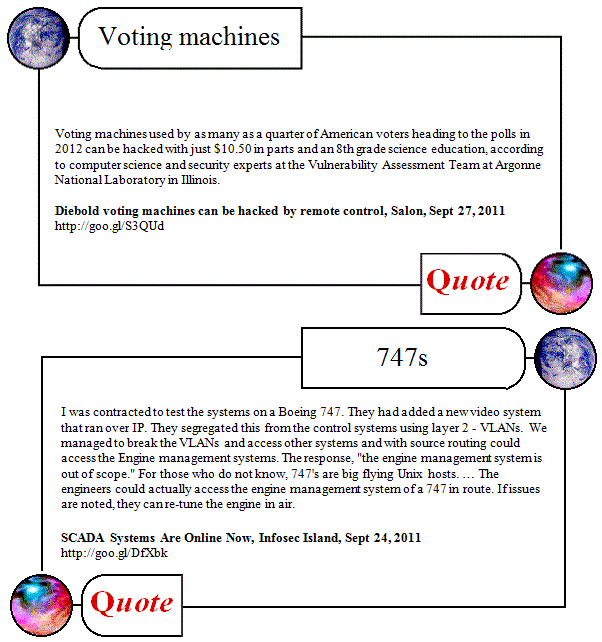
In the meantime, and working from open source materials, the only kind to which I have access – here are two data points we might have noted a litle earlier, if we had decent interdependency and vulnerability mapping:

quo-vulnerabilities.gif

Fear-mongering — or significant alerts?  I’m not tech savvy enough to know.

4.

Tom Barnett’s point about “the thinking we pursued as we tried to imagine – in advance – what a terrible shock to the system would do to the United States and the world in this day and age” still stands.

Y2K was what first alerted me to the significance of SCADAs.

Something very like what Y2K might have been seems to be unfolding — but slowly, slowly.

Are we thinking yet?

R2P is the New COIN: Slaughter on Authority and International Law

Monday, September 26th, 2011

Part II.

This is the second part of  a series analyzing Anne-Marie Slaughter’s ideas about “Responsibility to Protect” doctrine, based on her Stanford Journal of International Law article, “Sovereignty and Power in a Networked World Order“, to better understand and critique the assumptions on which R2P rests. The topic will be Dr. Slaughter’s uses and conceptualization of “Authority” as it relates to international law and state sovereignty.

Slaughter is particularly concerned with sovereignty and redefining it in international law so that national sovereignty is in harmony with R2P and other au courant academic concepts of “global governance” that are outside the scope of this post. While much of Slaughter’s paper relates to description of empirical trends in the behavior of regulatory bodies in transnational and IGO networks or works of theory, for R2P or “new sovereignty” to be meaningful, it has to be expressed as a legal argument. Furthermore, that legal argument for R2P/new sovereignty must gain acceptance by being expressed by source(s) or forms that a majority of the international community regards as authoritative and binding.

To the unininitiated, international law as a field is something of an intellectual wonderland that bears little resemblance to how positive law functions judicially inside of a sovereign state. First, there is no Hobbesian global leviathan that can enforce international law. The UN is not the “parliament of man” and neither the World Court nor the International Criminal Court can directly compel sovereign states to do anything, and sovereigns retain considerable discretion of interpreting for themselves what international law means and requires them to do or not do. International law theory therefore bears greater resemblance, at times, to mediating theological disputes than it does to the kind of law cases people ordinarily encounter.

International law is most accurately described as a body of competing centers of legal authority that possess varying degrees of legitimacy and that attract voluntary compliance ftom state actors, including: binding international covenants, customary international law, precedent, rulings from internationally sanctioned institutions like the UNSC, the World Court, the WTO or the Red Cross and the consensus of government officials and experts in in international law. These do not all have equal authority or legitimacy – a clause in the Geneva Convention, a UNSC resolution or a concept like “diplomatic immunity” carries more legal weight in international law than an informal but common diplomatic practice or the opinion of a faction of law professors. The ambiguity and heterogeneous nature of international law leaves a lot of room for scholarly debate, litigation, for officials to “shop for opinions” and for ambitious ideologues to push novel theories as allegedly natural extensions of existing jurisprudence.

Slaughter’s legal justification for R2P and redefined sovereignty are in section II. where she leans primarily upon the authority of the ICISS ( International Commission on Intervention and State Sovereignty). As I am examining the ICISS section, I will break up the quoted text with comments:

….On the humanitarian side, Kofi Anana issued a challenge to all UN members at the opening of the General Assembly to “reach consensus – not only on the principle that massive and systematic violations of human rights must be checked, wherever they take place, but also on the ways of deciding what action is necessary, and when, and by whom.” In response to this challenge, the Canadian government, together with a group of major foundations, established the International Commission on Intervention and State Sovereignty (ICISS), headed by former Australian Foreign Minister Gareth Evans and Special Adviser to the UN Secretary General Mohamed Sahoun, and composed of a distinguished group of global diplomats, politicians, scholars and nongovernmental activists….

The ICISS has genuine, but very trivial, legal stature, having been brought into being by a single (!) member state of the UN and some very powerful and wealthy left-liberal American philanthropic foundations including the  Carnegie Corporation of New York, the William and Flora Hewlett Foundation, the John D. and Catherine T. MacArthur Foundation, the Rockefeller Foundation, and the Simons Foundation. The governments of the UK and Switzerland also gave financial support to the ICISS.  Politically, while the commissioners were prominent center-left statesmen, the ICISS advisory board tilted further to the international Left and toward elite “neoliberal” politicians. The ICISS was approximately as politically and philosophically balanced as would be an international small arms control commission composed entirely of members of the NRA.

The ICISS by itself is thin gruel in terms of legal authority, but has just enough substance to be legitimately served up on the table.  Once the foot was in the door, advocates for R2P were, over time, able to get it into the 2005 World Summit Outcome Document (again, relatively minor in itself, but an additional precedent) and, more substantially, into UNSC Resolution 1674. Much like sediment, a new theoretical concept has to lay down legal particulates in order to become a durable and freely recognized part of international law by sovereigns. That kind of autonomous judgment by sovereigns is something R2P advocates would like to sharply curtail.

….In December 2001 the ICISS issued an important and influential report, “The Responsibility to Protect“, which essentially called for updating the UN Charter to incorporate a new understanding of sovereignty.

Dr. Slaughter has a gift for understatement. “Incorporating a new understanding of sovereignty” means irrevocably changing national sovereignty as the term has been traditionally defined and understood. This is not exactly a minor ambition in international relations, which is one reason why I tend to regard Anne-Marie Slaughter as a revolutionary or radical IR theorist and not as a “neoconservative”, as she is sometimes accused of being by left-wing ideologues. Slaughter expounds further:

….The ICISS seeks to change the core meaning of UN membership from “the final symbol of independent sivereign statehood and thus the seal of acceptance into the community of nations” to recognition of a state as a responsible member of the community of nations.” Nations are free to choose or not not to sign the Charter: if they do, however, they must accept “the responsibilities of membership” flowing from their signature. According to the ICISS, “There is no transfer or dilution of state sovereignty. But there is a re-characterization involved: from sovereignty as control to sovereignty as responsibility in both internal functions and external duties.

[emphasis in original] 

That’s the kind of “re-characterization” that George Orwell’s Winston Smith regularly undertook in his job at the Ministry of Truth. To where or to whom does the political locus of control then move? Cui bono?( Hint: read Slaughter’s fifth section).

“Sovereignty as responsibility” implies duties or obligations rather than decision making power and, indeed, earlier in section II, Slaughter uses the phrase “conditional social contract” in the introductory paragraph. Slaughter’s ICISS derived social contract however is not Lockean in nature, formed by and with the consent of the governed, but is instead drawn by the state from the collective authority of the community of nations and sovereignty is manifested to the degree with which the state is interactive and interdependent and has “the capacity to participate in international institutions of all types”. A community not just of nations, but one that is extended and buttressed by being interwoven by transnational, quasi-independent, “governmental networks” of former and current politicians and bureaucrats

If you are thinking that this formula shifts political authority and power away from a state and the popular sovereignty of it’s citizens and toward a vaguely defined, supranational community, you would be absolutely correct. Drawing on the theories of Abram and Antonia Chayes, Slaughter, argues that the connectivity and interaction of the modern international system is such that “sovereignty as autonomy makes no sense”.

Such a position requires a healthy contempt for the consent of the governed as well as a childlike faith in the wisdom, integrity and basic competence of a superempowered technocratic elite.

To continue:

….Internally, a government has the responsibility to respect the dignity and basic rights of it’s citizens; externally, it has a responsibility to respect the sovereignty of other states.

Further, the ICISS places the responsibility to protect on both the state and on the international community as a whole. The ICISS insists that an individual state has the primary responsibility to protect individuals within it. However, where the state fails in that responsibility, a secondary responsibility falls on the international community acting through the United Nations. Thus, where a population is suffering serious harm, as a result of internal war, insurgency, repression or state failure, and the state in question is unwilling or unable to halt or avert it, the principle of non-intervention yields to the international responsibility to protect.

As Slaughter is redefining sovereignty as the “new sovereignty” of interactive capacity championed by Chayes and Chayes, “respecting the sovereignty of other states” probably does not mean “non-interference in the internal affairs of other states”. Interference (albeit not necessarily military intervention) might be the natural default position from using the premise of “sovereignty as responsibility” or as a “capacity to participate”. Hey, we aren’t intefering in your elections, your economy or your social system – we’re just “harmonizing” (Slaughter’s term) your laws and regulations and increasing your capacity to participate!

One wonders what aspects of American life that R2P advocates see as being most in need of international harmonization?  That’s a subject we can take up in future posts, but in terms of military intervention and R2P, a few comments in regard to international law as well as “capacity to participate”:

First, under current international law, the legitimate pretexts for military intervention largely revolve around the right of self-defense or disturbance of international peace, as recognized by the UNSC.  While this is a fairly narrow set of pretexts, in practice they are sufficiently flexible to address most scenarios of violent conflict without also justifying military aggression bent on conquest. What was lacking in Rwanda and the Balkans during the 1990’s were not legal rationales for military intervention but political will among the great powers to do so.  I see little evidence that R2P would carry greater moral or legal weight with state decision makers to compel them to undertake major military interventions out of altruism than does the Genocide Convention (which unlike R2P, as an international covenant, is an inarguably solid part of international law). Or, for that matter, the emotional pull of horrifying media imagery of dying children.

Secondly, by greatly broadening the scenarios under which military intervention is allowed under international law, R2P incentivizes such conduct primarily where doing so is inexpensive and will further national interests rather than in the worst cases, like Rwanda, where they are expensive and risky while yielding no tangible benefits. The global military capacity to intervene is finite and instead of doing triage, statesmen will go for the low-hanging fruit in a now much larger set of cases for potential intervention. If R2P were taken seriously, North Korea, Burma, Congo, Somalia, Syria and perhaps Yemen would be ahead in line for intervention before Libya. 

Thirdly, in terms of “capacity to participate”, the net global capacity for military intervention is overwhelmingly American and the logistical ability to sustain a major military intervention for more than a few weeks is a complete American monopoly. On pragmatic grounds, R2P will never work orchestrated in so lopsided a fashion of “America and some of the West vs. the Rest”. Nor will not be politically tolerated by either the American public or most of the world’s population. Or by Beijing’s steely-eyed rulers, who would have to bankroll this catalogue of expeditions because America no longer can afford to do so. Perhaps we can put “R2P” on our tin cup and get a better interest rate.

Even acting as benignly-intended peacekeepers, the potential scale of R2P vastly exceeds our will, our wallet and our welcome.


Switch to our mobile site