zenpundit.com » legal

Archive for the ‘legal’ Category

R2P is the New COIN: Slaughter’s Premises

Wednesday, September 21st, 2011

Part I. 

As I mentioned in my last post, I will be analyzing Anne-Marie Slaughter’s ideas about “Responsibility to Protect“doctrine, based on her Stanford Journal of International Law article, “Sovereignty and Power in a Networked World Order” in a series of posts order to better understand and critique the assumptions on which R2P rests. Before I begin, some caveats:

Reading these posts is no substitute for reading the article yourself and drawing your own conclusions. A truly remarkable paper of some 44 pages of academic prose, a blog review of Dr. Slaughter’s thesis, even in a series, will only be able to focus on her operative premises and not delve into every shade or nuance. Limitation of the medium, but readers are free to disagree or agree in the comments.

Dr. Slaughter is an IR theorist and international lawyer of eminent stature and her style of argumentation reflects both the strengths and the weaknesses of those fields.

On the empirical issue of general, trends in international affairs and conflict, I do not take issue with Dr. Slaughter’s assumptions about the rise of networked non-state actors, greater degrees of uncertainty, complexity and multipolarity among and within states and the systemic erosion of state legitimacy. Indeed, in a broad and fundamental sense, I share them as I think do most people studying irregular conflict, counterinsurgency, 4GW and hybrid wars. I take exception though to the truly radical legal and policy conclusions Slaughter draws from these trends, as well as her normative delight in their trajectory. It as if we both agree that the Westphalian house is on fire, but she is reaching for a jerrycan of gasoline in order to speed the process along.

Finally, in this series I intend to tackle her argument from a thematic perspective, addressing how Slaughter views core philosophical questions of authority, international law, sovereignty, legitimacy and power in inventing a “responsibility to protect” doctrine and what the logical extrapolation of her ideas entails. Slaughter structured her article differently, with these concepts interwoven as she made her case in five sections, with sovereignty being a dominant concept.

The first post will concentrate on Slaughter’s premises regarding the problem facing the international community and her proposed solution:

An excerpt from Dr. Slaughter summarizing her thesis in her introduction:

….Westphalian sovereignty faces two fundamental challenges in contemporary international relations….First, the ineffectiveness challenge….A State’s ability to control its own territory without external interference is no longer sufficient to allow it to govern its people effectively – to provide security, economic stability and a measure of prosperity, clean air and water, and even minimum health standards.

Second, is the interference challenge. The letter of Article 2(7) remain; the spirit is violated repeatedly and increasingly routinely. All of human rights law deliberately infringes on the domestic jurisdiction of every state, denying governments the freedom to torture, murder, “disappear”, or systematically discriminate against their own citizens. Moreover, throughout the the 1990’s the Security Council repeatedly found that the conditions prevailing within a state, from starvation in Somalia to political intimidation and massacre in East Timor, constituted a threat to international peace and security sufficient to require collective armed intervention, and should have made such a determination regarding the genocide in Rwanda. States can no longer assume that if they refrain from interfering in the affairs of other states they will remain free from interference themselves.

….In short, states can no longer govern effectively by being left alone. The converse proposition is equally true, although perhaps more startling: States can only govern effectively by actively cooperating with other states and by collectively reserving their power to intervene in other states’ affairs. The world has indeed turned upside down: small wonder that the concept of sovereignty needs to be redefined!

Startling, is a good description.

Slaughter’s first “fundamental challenge” pivots on an odd usage of the word “effective”. “Effective governance” here is defined by Slaughter as something other than a state’s actual physical control over the territory and population over which it asserts sovereignty. Explicitly, “effective governance” is then defined as the provision of modern public goods, presumably without resort to autarkic policies, as interdependence is one of her themes. 

To be fair to , there’s some merit to Slaughter’s consideration of the provision of public goods. States that face non-state actor challengers like Hezbollah who do fill social needs are thwarting their state opponents at the moral as well as the material level of conflict, winning over their loyalty and eroding the legitimacy of the state. So, if Dr. Slaughter was writing a manual on, say, psychological warfare or insurgency, she would have me on board here.

But, unfortunately, she isn’t. Slaughter is writing an article, ostensibly on international law, and a vague laundry list of economic items, a transient de facto state of public policy, strikes me as a poor foundation for a universal principle of law. By Slaughter’s standard, Mexico which provides public services, is democratically governed and economically  interdependent despite being strangled by a narco-insurgency of atavistic brutality, is “effectively governed”. Lebanon, whose government in is under the hegemony of Hezbollah is “effectively governed”. There’s a subsumed “correct” political economy embedded in the argument here by Slaughter; if a first world state decides to reject carbon footprint taxes, nationalized health care or privatizes it’s mail delivery, is it “ineffectively governed”?

At least the first challenge is relatively straightforward. Slaughter’s second “fundamental challenge” is an exercise in logical acrobatics.

Slaughter is correct that the spirit and at times the letter of international law (actual, real world, international law that has a chance of being followed, not R2P theory) is stretched to justify military intervention. She is also right that Rwanda’s genocide by the then radical Hutu regime constituted a threat to international peace and cried out for intervention, and the failure to do so resulted in not just genocide of the Tutsi people but ultimately an African WWI in the Congo basin. These two factually accurate examples are diametrically opposed to one another, yet somehow, they combine to arrive at the solution of institutionalizing military intervention in international law as a rule and not an exception. They are juxtaposed with the cases of Somalia, where no state, legitimate or otherwise, existed and East Timor, which was a case of de jure military aggression and annexation by Indonesia. The only thread tying all of these disparate examples together is a large pile of dead bodies.

Charnel house examples make for bad law, unless you have to govern a society of cannibals.

Finally, while boldly rejecting international law’s long established definition of sovereignty, Slaughter offers two easily falsifiable assertions, that states can no longer govern effectively by governing alone and that the ever present danger of arbitrary meddling by foreigners is a prerequisite for good governance. If so, Switzerland would be a Hobbesian hellhole today and Central America and the Caribbean islands would resemble tropical Singapores . The omnipresent threat of foreign meddling on religious grounds is what states ran away from screaming after the Thirty Year’s War, which may have killed up to a third of all the people in the Germanies.

Anne-Marie Slaughter proposes to restore that state of affairs on more secular grounds.

Next post – Slaughter on Authority and International Law.

ADDENDUM – Related posts:

Inkspots –R2P is NOT the new COIN, but Ulfelder is just as wrong as Safranski about why*

Fear, Honor and Interest –Geopolitics, Networks, and Complex Friction

R2P is the New COIN

Monday, September 19th, 2011

Introduction: 

The weirdly astrategic NATO campaign in Libya intervening on the side of ill-defined rebels against the tyrannical rule of Libyan strongman Colonel Moammar Gaddafi brought to general public attention the idea of “Responsibility to Protect” as a putative doctrine for US foreign policy and an alleged aspect of international law. The most vocal public face of R2P, an idea that has floated among liberal internationalist IL academics and NGO activists since the 90’s, was Anne-Marie Slaughter, former Policy Planning Director of the US State Department and an advisor to the Obama administration. Slaughter, writing in The Atlantic, was a passionate advocate of R2P as a “redefinition of sovereignty” and debated her position and underlying IR theory assumptions with critics such as Dan Drezner, Joshua Foust, and Dan Trombly.

In all candor, I found Dr. Slaughter’s thesis to be deeply troubling but the debate itself was insightful and stimulating and Slaughter is to be commended for responding at length to the arguments of her critics. Hopefully, there will be greater and wider debate in the future because, in it’s current policy trajectory, R2P is going to become “the new COIN”.

This is not to say that R2P is a military doctrine, but like the rise of pop-centric COIN, it will be an electrifying idea that has the potential fire the imagination of foreign policy intellectuals, make careers for it’s bureaucratic enthusiasts and act as a substitute for the absence of a coherent American grand strategy. The proponents of R2P (R2Peons?) appear to be in the early stages of following a policy advocacy template set down by the COINdinistas, but their ambitions appear to be far, far greater in scope.

It must be said, that unlike R2P, an abstract theory literally going abroad in search of monsters to destroy, COIN was an adaptive operational and policy response to a very real geopolitical debacle in Iraq, in which the United States was already deeply entrenched. A bevy of military officers, academics, think tank intellectuals, journalists and bloggers – some of them genuinely brilliant – including John Nagl, Kalev Sepp, Con Crane, Jack Keane, David Petraeus, Michèle Flournoy, David Kilcullen, Fred and Kim Kagan, James Mattis, Montgomery McFate, Thomas Ricks, Andrew Exum,  the Small Wars Journal and others articulated, proselytized, reported, blogged and institutionalized a version of counterinsurgency warfare now known as “Pop-centric COIN“, selling it to a very reluctant Bush administration, the US Army and USMC, moderate Congressional Democrats and ultimately to President Barack Obama.

The COIN revival and veneration of counterinsurgent icons like Templer and Galula did not really amount a “strategy”; it was an operational methodology that would reduce friction with Iraqis by co-opting local leaders and, for the Bush administration, provide an absolutely critical political “breathing space” with the American public to reinvent an occupation of Iraq that had descended into Hell. For US commanders in Iraq, adopting COIN doctrine provided “the cover” to ally with the conservative and nationalistic Sunni tribes of the “Anbar Awakening” who had turned violently against al Qaida and foreign Salafist extremists. COIN was not even a good theoretical  model for insurgency in the 21st century, never mind a strategy, but adoption of COIN doctrine as an American political process helped, along with the operational benefits, to avert an outright defeat in Iraq. COIN salvaged the American political will to prosecute the war in Iraq to a tolerable conclusion; meaning that COIN, while imperfect, was “good enough”, which in matters of warfare, suffices.

During this period of time and afterward, a fierce COINdinista vs. COINtra debate unfolded, which I will not summarize here, except to mention that one COINtra point was that COINdinistas, especially those in uniform, were engaged in making, or at least advocating policy. For the military officers among the COINdinistas, this was a charge that stung, largely because it was true. Hurt feelings or no, key COINdinistas dispersed from Leavenworth, CENTCOM and military service to occupy important posts in Washington, to write influential books, op-eds and blogs and establish a think tank “home base” in CNAS. Incidentally, I mean this descriptively and not perjoratively; it is simply what happened in the past five years. The COINDinistas are no longer “insurgents” but are the “establishment”.

R2P is following the same COIN pattern of bureaucratic-political proselytization with the accomplished academic theorist Anne-Marie Slaughter as the “Kilcullen of R2P”. As with David Kilcullen’s theory of insurgency, Slaughter’s ideas about sovereignty and R2P, which have gained traction with the Obama administration and in Europe as premises for policy, need to be taken seriously and examined in depth lest we wake up a decade hence with buyer’s remorse. R2P is not simply a cynical fig leaf for great power intervention in the affairs of failed states and mad dictatorships like Gaddafi’s Libya, R2P is also meant to transform the internal character of great powers that invoke it into something else. That may be the most important aspect and primary purpose of the doctrine and the implications are absolutely profound.

Therefore, I am going to devote a series of posts to analyzing the journal article recommended by Dr. Slaughter, “Sovereignty and Power in a Networked World Order“,  which gives a more robust and precise explanation of her ideas regarding international relations, sovereignty, legitimacy, authority and power at greater length than is possible in her op-eds or Atlantic blog. I strongly recommend that you read it and draw your own conclusions, Slaughter’s argument is, after all, about your future.

ADDENDUM – Related Posts:

Slouching Toward Columbia – Guest post: Civilian Protection Policy, R2P, and the Way Forward

Phronesisaical –Dragging History into R2P

Dart-Throwing Chimp – R2P Is Not the New COIN

Committee of Public Safety –With Outstretched Arm | The Committee of Public Safety

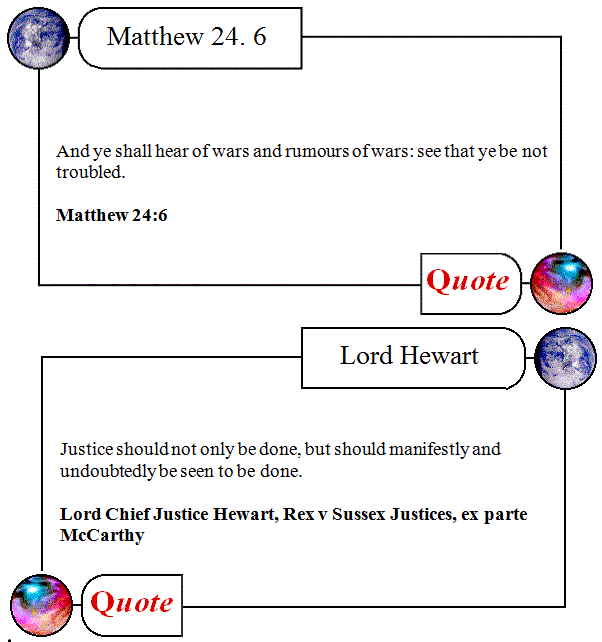
Idle thoughts: on wars, justice and banking

Sunday, September 18th, 2011

[ by Charles Cameron — reality, appearance and virtuality ]

.

quo-functions.gif

These two phrases, wars and rumors of wars and done and seen to be done have apparently been rattling around in my head for long enough that they finally dodged all the other stuff about Mahdis and Glass Bead Games and met.

Okay, I’d already thought of the first one in terms of “Cameron’s Function”:

f(x) = x + rumors of x           (i)

because it seemed to “apply” to other things than war — the instance that gave me that insight was the run-up to the Year 2000, during which it became abundantly clear that rumors of bank runs were precisely what bank runs themselves were about — which in turn became my classic instance of the need for mapping that “crossed over” between the subjective and objective realms — or morale and materiel, as I called them in a recent post.

And so here comes “Cameron’s Function #2”:

f(x) = x + seen to be x         (ii)

What I’m wondering now is whether the two of them are essentially the same “function” — any thoughts? They’re twins — but are they identical?

R2P is a Doctrine Designed to Strike Down the Hand that Wields It

Saturday, September 3rd, 2011

There has been much ado about Dr. Anne-Marie Slaughter’s ennunciation of “Responsibility to Protect” as a justification for the Obama administration’s unusually executed intervention (or assistance to primarily British and French intervention) in Libya in support of rebels seeking to oust their lunatic dictator, Colonel Moammar Gaddafi. In “R2P” the Obama administration, intentionally or not, has found it’s own Bush Doctrine, and unsurprisingly, the magnitude of such claims – essentially a declaration of jihad against what is left of the Westphalian state system by progressive elite intellectuals – are beginning to draw fire for implications that stretch far beyond Libya.


People in the strategic studies, IR and national security communities have a parlor game of wistfully reminiscing about the moral clarity of Containment and the wisdom of George Kennan. They have been issuing tendentiously self-important “Mr. Z” papers for so long that they failed to notice that if anyone has really written the 21st Century’s answer to Kennan’s X article, it was Anne-Marie Slaughter’s battle cry in the pages of The Atlantic.

George Kennan did not become the “Father of Containment” because he thought strategically about foreign policy in terms of brutal realism. Nor because he was a stern anti-Communist. Or because he had a deep and reflective understanding of Russian history and Leninism, whose nuances were the sources of Soviet conduct. No, Kennan became the Father of Containment because he encapsulated all of those things precisely at the moment when America’s key decision makers, facing the Soviet threat, were willing to embrace a persuasive explanatory narrative, a grand strategy that could harmonize policy with domestic politics.

Slaughter’s idea is not powerful because it is philosophically or legally airtight – it isn’t – but because R2P resonates deeply both with immediate state interests and emotionally with the generational worldview of what Milovan Djilas might have termed a Western “New Class”.

While it is easy to read R2P simply as a useful political cover for Obama administration policy in Libya, as it functioned as such in the short term, that is a mistaken view, and one that I think badly underestimates Anne-Marie Slaughter. Here is Slaughter’s core assertion, where she turns most of modern diplomatic history and international law as it is understood and practiced bilaterally and multilaterally by sovereign states in the real world (vice academics and IGO/NGO bureaucrats) on it’s head:

If we really do look at the world in terms of governments and societies and the relationship between them, and do recognize that both governments and their citizens have rights as subjects of international law and have agency as actors in international politics, then what exactly is the international community “intervening” in?

…For the first time, international law and the great powers of international politics have recognized both the rights of citizens and a specific relationship between the government and its citizens: a relationship of protection. The nature of sovereignty itself is thus changed: legitimate governments are defined not only by their control of a territory and a population but also by how they exercise that control. If they fail in that obligation, the international community has the responsibility to protect those citizens.

Slaughter is a revolutionary who aspires to a world that would functionally resemble the Holy Roman Empire, writ large, with a diffusion of power away from legal process of  state institutions to the networking informalities of the larger social class from whom a majority of state and IGO officials are drawn, as a global community. In terms of policy advocacy, this is a brilliantly adept move to marry state and class interests with stark moral justifications, regardless of how the argument might be nibbled to death in an arcane academic debate.

As with Kennan’s X Article, which faced a sustained critique from Walter Lippmann who realized that Containment implied irrevocable changes in the American system, R2P has attracted criticism. Some examples:

Joshua Foust –Why sovereignty matters

Much as advocates of the “Responsibility to Protect,” or R2P, like to say that sovereignty is irrelevant to the relationship of a society to its government (which Slaughter explicitly argues), it is that very sovereignty which also creates the moral and legal justification to intervene. For example, the societies of the United States and NATO did not vote to intervene in Libya – their governments did.

Foreign Affairs – The Folly of Protection

….RtoP, responding to the sense that these domestic harms warranted international response, solidified the Security Council’s claims to wider discretion. Yet it also restricted its ability to sanction intervention to the four situations listed in the RtoP document — genocide, war crimes, ethnic cleansing, and crimes against humanity — and thus precluded, for example, intervention in cases of civil disorder and coups. Although the resolution authorizing force against Libya will certainly further entrench the principle of RtoP, it will not completely resolve the tension between RtoP — in itself only a General Assembly recommendation — and the UN Charter itself, which, according to the letter of the law, limits action to “international” threats.

Dan Trombly –The upending of sovereignty and Responsibility to Protect Ya Neck

Beauchamp, along with Slaughter, have revealed R2P for what it actually is: a doctrine based on regime change and the destruction of the foundations of international order wherever practically possible. After all, are intervening powers really fulfilling their responsibility if they fail to effect regime change after intervening? This is exactly why I believe R2P is far more insidious than many of its advocates would have us believe or intend in practice. It is essentially mandating a responsibility, wherever possible, to seek the sanction, coercion, or overthrow of regimes which fail to meet a liberal conception of acceptable state behavior. Even if R2P is never applied against a major power, it is hard to see why such behavior would not be met with just as much suspicion as humanitarian intervention and previous Western regime change operations were. Indeed, a full treatment will reveal there is immense pressure for R2P to initiate the more fundamental, and more universal, impulse to revert to the potential ruthlessness inherent in international anarchy.

Understandably, such critiques of R2P are primarily concerned with sovereignty as it relates to interstate relations and the historical predisposition for great powers to meddle in the affairs of weaker countries, usually with far less forthrightness than the Athenians displayed at Melos. It must be said, that small countries often  are their own worst enemies in terms of frequently providing pretexts for foreign intervention due to epic incompetence in self-governance and a maniacal delight in atavistic bloodshed. Slaughter is not offering up a staw man in relation to democide and genocide being critical problems with which the international community is poorly equipped and politically unwilling to counter.

But R2P is a two edged sword – the sovereignty of all states diminished universally, in legal principle, to the authority of international rule-making about the domestic use of force is likewise diminished in it’s ability to legislate it’s own internal affairs, laws being  nothing but sovereign  promises of state enforcement. Once the camel’s nose is legitimated by being formally accepted as having a place in the tent, the rest of the camel is merely a question of degree.

And time.

As Containment required an NSC-68 to put policy flesh on the bones of doctrine, R2P will require the imposition of policy mechanisms that will change the political community of the United States, moving it away from democratic accountability to the electorate toward “legal”, administrative, accountability under international law; a process of harmonizing US policies to an amorphous, transnational, elite consensus, manifested in supranational and international bodies. Or decided privately and quietly, ratifying decisions later as a mere formality in a rubber-stamping process that is opaque to everyone outside of the ruling group.

Who is to say that there is not, somewhere in the intellectual ether, an R2P for the the environment, to protect the life of the unborn, to mandate strict control of small arms, or safeguard the political rights of minorities by strictly regulating speech? Or whatever might be invented to suit the needs of the moment?

When we arrest a bank robber, we do not feel a need to put law enforcement and the judiciary on a different systemic basis in order to try them. Finding legal pretexts for intervention to stop genocide does not require a substantial revision of international law, merely political will. R2P could become an excellent tool for elites to institute their policy preferences without securing democratic consent and that aspect, to oligarchical elites is a feature, not a bug.

R2P will come back to haunt us sooner than we think.

ADDENDUM:

Doug Mataconis at Outside the Beltway links here in a round-up and commentary about R2P posts popping up in the wake of the Slaughter piece:

The “Responsibility To Protect” Doctrine After Libya

….It’s understandable that the advocates of R2P don’t necessarily want to have Libya held up as an example of their doctrine in action. Leaving aside the obvious contrasts with the situation in Syria and other places in the world, it is by no means clear that post-Gaddafi Libya will be that much better than what preceded it. The rebels themselves are hardly united around anything other than wanting to get rid of Gaddafi and, now that they’ve done that, the possibility of the nation sliding into civil and tribal warfare is readily apparent. Moreover, the links between the rebels and elements of al Qaeda that originated in both Afghanistan and post-Saddam Iraq are well-known. If bringing down Gaddafi means the creation of a safe haven for al Qaeda inspired terrorism on the doorstep of Europe, then we will all surely come to regret the events of the past five months. Finally, with the rebels themselves now engaging in atrocities, one wonders what has happened to the United Nations mission to protect civilians, which didn’t distinguish between attacks by Gaddafi forces or attacks by rebels.

….Finally, there’s the danger that the doctrine poses to American domestic institutions. If Libya is any guide, then R2P interventions, of whatever kind, would likely be decided by international bodies of “experts” rather than the democratically elected representatives of the American people. American sailors and soldiers will be sent off into danger without the American people being consulted. That’s not what the Constitution contemplates, and if we allow it to happen it will be yet another nail in the coffin of liberty.

Read the rest here.

Trial of a Thousand Years, by Charles Hill—a review

Thursday, August 11th, 2011

 trial of thousand years

by J. Scott Shipman 

Trial of a Thousand Years, World Order and Islamism, by Charles Hill

Ambassador Charles Hill’s Grand Strategies, Literature, Statecraft, and World Order was the best book I read in 2010, so I had high expectations for this volume and was not disappointed. Ambassador Hill provides a 35,000-foot view of the relationships between the West and Islam in history focusing on the subtitle of his earlier work in the form of “world order.”

Unsurprisingly, as in Grand Strategies Hill goes back to the roots of modern order in the Treaty of Westphalia (1648). He provides a brief review of the world ushered in by the men who negotiated, and quotes another historian who said, “men who were laboring, each in his own way, for the termination of a terrible war. They had no idea of progress. The word “innovation” was anathema to them. The last thing on their minds was the creation of a new system of sovereign states…” Here we are 363 years later and “from the seeds sown at Westphalia” the system they set in place is has grown, but has been under siege many times from many fronts.

Westphalia was distinctive because it was “procedural, not substantive” and required a minimum number of procedures/practices to which to adhere and allowed disparate parties with different, “even mutually antagonistic, substantive doctrines and objectives” to work together. Hill points out four distinctions:

  • Religious arguments were not allowed in diplomacy.
  • The State was the fundamental entity.
  • Interstate/international norms and laws were encouraged, absent “divine sources” but based on mutually beneficial/positive agreements.
  • Use of professional military and diplomats with “its own set of protcols.” [Personal note: In another life, I was an arms control inspector enforcing the START I and INF Treaties—protocol was very serious and the true measure of the actual treaty language. There was also a strong and consistent application of reciprocity that made each party think before stretching protocol—this happened to my teams more than once.]

For Hill a central mission of the United States is the defense of the Westphalian world order. In less than 165 pages and six chapters, he outlines the origins of modern Western order and correspondingly covers Islamic order. From the beginning to the end Hill provides ample evidence of challenges to Westphalia, often from indigenous Western sources, but focusing mostly on our trials with Islam.

Hill sets the sources from whence the Western and Islamic world orders arose, where the West was grounded in Christianity, and the Islamic in the Caliphate. For two religions claiming Abrahamic roots, their worldviews were, and in many instances remain diametrically opposed. Central was the question of duality or unity. For the West, the State and religion were two complementary systems/powers—following the teaching of Christ ““Render unto Caesar the things which are Caesar’s, and unto God the things that are God’s” (St Matthew’s Gospel 22:21) For Islam there was no distinction, and the very thought was hateful to Islamists. Islam’s “unswerving devotion to monotheism” continues to this day among those groups and states using terror to upend existing world order.

I am sympathetic to Hill’s ideas; however recognize with globalization and the internet tweaks may be required. And I’ll take this segue to introduce an idea for consideration.

Westphalia’s removal of religion made trade possible among former religious enemies. Unambiguous rules for contracts and dispute resolution evolved. What if we could bridge the gap between Western jurisprudence and tribal, or non-Western legal systems? What if, instead of insisting our way or the highway we design a solution that would allow both sides to keep their respective legal processes and procedures, thereby opening untapped markets?

At least one person has already considered these alternatives. Michael Van Notten (1933-2002) was a practicing lawyer in the Netherlands and married into a Somali tribe. Van Notten used his legal training and insights gained as a member of his new family to design a method of contracting where tribal law and Western jurisprudence could peacefully and prosperously coexist. Van Notten recorded his ideas in a book called The Law of Somalis, A Stable Foundation for Economic Development in the Horn of Africa. I’ll not review this book, but wanted offer this as a teaser alternative.

After reviewing the history of the West and Islam, Hill identifies seven Clausewitzian centers of gravity for both: legal, military, the State, women, democracy, nuclear weapons, and values. Hill makes the distinction between the use of diplomacy by Islam and the Islamist (the fundamental variety). No surprises, to the Islamist a secular State is an “apostasy,” as is international law (Sharia being the single source), democracy and the rights of women.

Hill concludes, “Islamic civilization entered the international system under duress,” which he believes has contributed to the current situation of failing states and lagging economies that establish conditions where radicalized Islam can flourish. The radicalized elements reject the secular Westphalian world order, however Hill points out that some in Islam insist that sharia imposed by the state “cannot be the true law of Islam. It is not possible to apply sharia through the state; it can only be applied through acceptance by human beings (An-Na’im).” Another alternative is the Medina polity established by the Prophet (“later called the Pact—kitab—of Medina) “guaranteeing each tribe the right to follow its own religion and customs, imposing on all citizens rules designed to keep the overall peace, establishing a legal process by which the tribes settled purely internal matters themselves and ceded to Muhammad the authority to settle intertribal disputes…Although this document has been called the first written constitution, it was really more of a multiparty treaty” (Ansary).

Hill convincingly demonstrates that more often than not, rulers have co-opted Islam as a way to dominate the people (Iran comes to mind.). He quotes Professor L. Carl Brown of Princeton, “nothing exclusively “Islamic” about this Muslim attitude towards politics, any more than the politics of feudalism or of imperial Russia was distinctly “Christian.” It is the political legacy of Muslims, not the theology of Islam…”

For the Islamist, secularism is the booger man, but secularism in the Westphalian order has its own set of problems. Hill writes, “A new phenomena arose: wars motivated by religious convictions were replaced by wars driven by ideologies—surrogates for religion—each aimed to oppose, undermine, destroy and replace the Westphalian system. The greatest of these was international communism, the latest is international Islamism.”

In many respects, Trials is as good as Grand Strategies. Ambassador Hill is to be commended for his insight, courage, and conviction—this little book packs a big, enlightening punch. Strongest recommendation.

References you may find of interest (links to quoted authors above are links to the respective reference):

The Incoherence of the Philosophers, Abu Hamid Muhammed Al-Ghazali

The Crisis of Islamic Civilization, Ali A. Allawi

The Caliphate, Thomas W. Arnold

Sayyid Qutb and the Origins of Radical Islamism, John Calvert

Crimea: The Last Crusade, Orlando Figes —Figes’ The Whisperers was very good.

The Morality of Law, Lon L. Fuller

The Muqaddimah, Ibn Khaldun (Translated Franz Rosenthal)

The Clash of Empires: The Invention of China in Modern World Making, Lydia H. Liu

The Government of the Ottoman Empire in the time of Suleiman the Magnificent, Albert Lyber

Byzantine Civilization and The Fall of Constantinople, both by Steven Runciman

The First World War, Hew Strachan

Mozart and the Enlightenment; Truth, Virtue and Beauty in Mozart’s Operas Nicholas Till

Muslim Intellectual: A Study of Al-Ghazadi, W. Montgomery Watt

Dialectic of Enlightenment, Max Horkheimer and Theodor W. Adorno 


Switch to our mobile site