zenpundit.com » john robb

Archive for the ‘john robb’ Category

COIN may be Dead but 4GW has a New Lease on Life

Monday, December 12th, 2011
As I had predicted, a global recession, budgetary chicken in Congress and national weariness after a decade of war in Afghanistan and Iraq have forced a public rethink of the prominence of counterinsurgency doctrine in America’s military kit.  Colonel Gian Gentile, long the intellectual archenemy of FM 3-24 and the “Surge narrative” has pronounced COIN “dead” and even CNAS, spiritual home of COIN theory inside the Beltway, is now advocating COIN-lite FID (Foreign Internal Defense). As this entire process is being driven by a global economic crisis, there is another aspect to this American inside-baseball policy story.

While COIN as the hyperexpensive, nation-building, FM 3-24 pop-centric version of counterinsurgency is fading away, irregular warfare and terrorism are  here to stay as long as there is human conflict. Moreover, as economic systems are to nation-states as vascular systems are to living beings, we can expect an acceleration of state failure as weak but functional states are forced by decreased revenues to reduce services and diminish their ability to provide security or enforce their laws. The global “habitat” for non-state, transanational and corporate actors is going to grow larger and the zones of civilized order will shrink and come under internal stress in the medium term even in the region that Thomas P.M. Barnett defined as the “Core” of globalization.

The theory of Fourth Generation Warfare is helpful here. Many people in the defense community object to 4GW thinking, arguing that it is a poor historical model because it is overly simplified, the strategic ideas typified by each generation are cherrypicked and are usually present in many historical eras (albeit with much different technology). For example, eminent Clausewitzian strategist Colin Gray writes of 4GW in Another Bloody Century:

….The theory of Fourth Generation Warfare or 4GW merits extended critical attention here for several reasons. It appears to be a very big idea indeed. It’s author [ William S. Lind] and his followers profess to be able to explain how and why warfare has evolved over the past 350 years and onto the future….

….Talented and intellectually brave strategic theorists are in such short supply that I hesitate before drawing a bead on Lind and his grand narrative of succeeding generations of warfare. Nonetheless, there is no avoiding the judgment that 4GW is the rediscovery of the obvious and the familiar. 

4GW theory is not something that can be defended as having sound historical methodology. However, it works well enough as a strategic taxonomy of mindsets and political environments in which war is waged; particularly with the inclusion of the van Creveldian assumptions of state decline, it is a useful tool for looking at warfare in regions of weak, failing and failed states. The same global region Dr. Barnett has termed “the Gap” in his first book, The Pentagon’s New Map.

Tom predicated his geostrategy on the power of globalization being harnessed with judicious use of Core military power to “shrink the Gap” and provide connectivity as an extremely powerful lever to raise up billions of the world’s poor into a more stable, freer and middle-class existence. While that still holds, the flipside is that times of  sharp economic contraction limit the ability of the Core, led by the United States, to intervene robustly, permitting the “bad guys” to make use of connectivity and black globalization for their own purposes. Where the great powers are disunited, disinterested or increasingly in the case of European power projection, disarmed, the Gap could potentially grow.

A new Iraq or Afghanistan sized campaign is not in the American defense budget for at least a decade. Or NATO’s. Hence the newfound interest in cheaper alternatives to massive intervention on the ground, for which the Libyan campaign might charitably be classed as an “experiment” ( where it was not simply bad strategy and negotiated operations) or as a multilateral reprise of Rumsfeldian ideas of transformative, light and fast military force mashed up with Reagan Doctrine proxy warfare, justified under a new ideological theory of R2P.

These are rational policy responses to conditions of parsimony, but it also indicates a coming era of strategic triage rather than grand crusades in using military force to stabilize parts of the global system.  The US and other great power  are going to be more likely to follow Teddy Roosevelt’s advice to “Do what you can, where you are, with what you have” than they are to heed JFK’s call “to pay any price, bear any burden”. The politics of hard times means that we will be minimizing our burdens by replacing, where we can, boots with bots, bullets with bytes and Marines with mercs. Not everywhere, but certainly on the margins of American interests.

Beyond those margins? We will aid and trade with whatever clients can maintain a vestige of civilized order without too much regard to the niceties of  formal state legitimacy. Too many states will be ceding autonomy to subnational and transnational entities on their territory in the next few decades and we will have to abide by that reality if regions of the world become Somalia writ large. What to do? A number of recommendations come to mind:

  • Get our own economic house in order with greater degrees of transparency and adherence to rule of law in our financial sector. Legitimacy and stability, like charity, begins at home.
  • Adopt policies that strengthen the principle of national sovereignty and enhance legitimacy rather than weaken or erode it. This does not mean respecting hollow shells of fake states that are centers of disorder, but respecting legitimate ones that effectively govern their territory
  • Foreign policies that reject oligarchical economic arrangements in favor of encouraging liberalization of authoritarian-autarkic state economies prior to enacting political reforms ( democracy works better the first time on a full stomach).
  • Create a grand strategy board to advise senior policy makers and improve the currently abysmal level of strategic calculation and assessment prior to the US assuming open-ended commitments to intervention
  • Accept that the Laws of War require a realistic updating to deal with the international equivalent of outlaws, an updating that contradicts and rejects the 1970’s era diplomatic effort to privilege irregular combatants over conventional forces.
  • Fighting foreign insurgencies is something best done by primarily by locals, if willing, with our aid and advice. If those with the most to lose are not willing to stand, fight and die then they deserve to lose and the US should either eschew getting involved at all or resolve to secure whatever vital interest that exists there by brute force and make certain that reality is clearly communicated to the world (i.e. Carter Doctrine).  Truly vital interests are rare.

John Robb on the OODA Loop

Thursday, December 1st, 2011

John Robb at Global Guerrillas had a nice primer on John Boyd’s OODA Loop recently and he put on a twist that I thought was very useful:

HOW TO WIN ANY CONFLICT

….I’m Inside Your OODA Loop

How does all of this apply to conflict?  The simple answer is that conflict, in its most basic form, is a contest between decision making loops.  The side with the FASTER and BETTER decision making loop wins any conflict.  Why?  They adapt quicker.   Here’s some more detail:

A FASTER decision making loop means that you accomplish a successful OODA loop quicker than an opponent.  If you can do this, you are inside your opponent’s OODA loop.  This means that by the time your opponent responds to your last actions, you are already onto your next ones.  Get far enough ahead and the opponent’s decision making process will collapse and victory is assured.
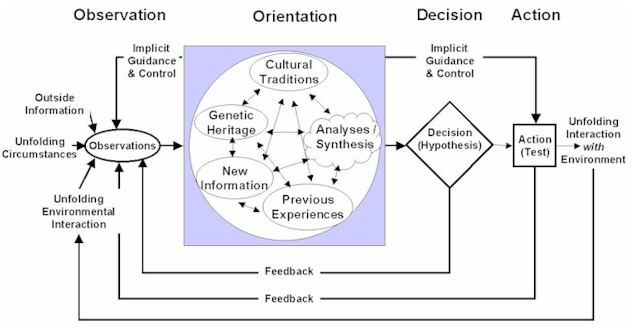
A BETTER decision making loop?  That’s question that can lead to endless debates and theory crafting.  My approach to improving a decision making loop?  Connectivity.  The more connected a loop is, the better the decision loop is.  Connectivity falls into three categories:

  1. Mental — improves decisions by connections to a superior mental model of the current situation.  A superior model/strategy is predictive of events. It can tell you what data is important and what isn’t.  Weak strategies/tactics fall apart upon first contact w/enemy.
  2. Physical   — improves observation through connections to better sources of data, cleaner w/less distortion  — improves action by making it possible to actually accomplish the desired decision in the real world
  3. Moral — better orientation due to connections to strong traditions, extensive experience, and collected wisdom.  Training can help here.

The opposite is true also.  Damage an opponents connectivity, and their decision making loops are less effective.

One of the difficulties with discussing OODA is that many people who either oppose the concept or do not know much about it, will explain the OODA Loop only as “getting inside your opponents OODA Loop” in terms of the capacity to “go faster” -i.e cycle through your own OODA Loop faster than your opponent, making more decisions, taking more actions, leaving them in the dust, disoreinted and going into a downward spiral to defeat. Usually, misrepresented like this:

Ok, well going “faster” is a small part of it, but not sequentially and there’s neurological limits on this that arrive pretty quickly in terms of thinking speed in any case. Robb’s use of “BETTER” helps capture more of the critical and subtle qualitative nature of the “Orientation” box:

What are some of the possible effects of a “virtuous cycle” of better decisions?

Position yourself with more options
Gain new perspectives (“Observation”, “Orientation”)
Position yourself with the greatest comparative advantage (best option)
Lock in a comparative advantage
Position yourself with the longest potential decision tree (no quick “dead ends” or “cul de sacs”)
Change the tempo of interaction in your favor
Change the rules of interaction in your favor
Prevent a conflict with additional potential oponents
Lower your costs or increase theirs
Assure minimum gains
Arrive first
Increase or decrease the distance between yourself and your opponent
Broaden or narrow the field of conflict
Gain time
Seize or maintain the initiative
Define or redefine “victory”
Foreclose a critical option or set of options to your opponent
Force your opponent to act on your terms (“Check”)
Lower the morale of your opponent

Confuse, mystify or mislead your opponent
Attract allies or supporters
Increase your resources or potential maximum gains
Repair, remediate or replace previous losses

John is correct that “connectivity” helps you gain many of these benefits. 

Remember:

 “Being on the winning side is a lot more fun!”

ADDENDUM (Some interesting commentary on OODA):

Adam Elkus

I’ve Got the OODA Blues

Joseph Fouche:

Libeling Boyd

How Not to be Like Boyd

Who’s Afraid of Genghis John?

TDAXP, PhD

Variations of the OODA Loop 1: Introduction
Variations of the OODA Loop 2: The Naive Boydian Loop
Variations of the OODA Loop 3: The Sophisticated Boydian Loop
Variations of the OODA Loop 4: Pseudo-Boydian Loops
Variations of the OODA Loop 5: Post-Boydian Loops
Variations of the OODA Loop 6: Bibliography

Tea Party and / or Occupy?

Sunday, October 9th, 2011

[ by Charles Cameron — parallels, opppositions, analysis, games, coincidentia oppositorum ]

.

labelling-bodies1.jpg

My friend Cath Styles, who has been developing an iPad playable version of my HipBone Games under the name Sembl for the National Museum of Australia, made a point I’ve been trying to make for a while now, with sweet lucidity, in a recent blog post:

A general principle can be distilled from this. Perhaps: In the very moment we identify a similarity between two objects, we recognise their difference. In other words, the process of drawing two things together creates an equal opposite force that draws attention to their natural distance. So the act of seeking resemblance – consistency, or patterns – simultaneously renders visible the inconsistencies, the structures and textures of our social world. And the greater the conceptual distance between the two likened objects, the more interesting the likening – and the greater the understanding to be found.

That’s absolutely right, and it gets to the heart of my games and analytic practice — to see and acknowledge both parallelisms and differences, oppositions…

Oxford is the polar opposite of Cambridge as anyone at the annual boat race between them will tell you — yet they’re so similar that the term Oxbridge exists to distinguish them as a dyad from all else the wide world round…

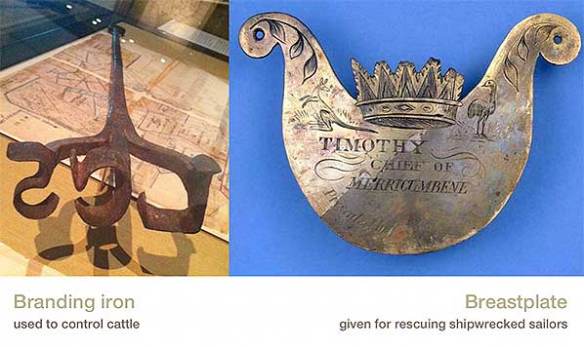
Similarly, in the example illustrated above, Cath shows two items from the Museum collection that were juxtaposed by players of an early version of her game, and writes:

the Sembl players who linked the above branding iron to the breastplate – because both are tools for labeling bodies – cast new light on the colonial practice of giving metal breastplates to Aboriginal people.

* *

Since the essence of my own analytic style (and that of HipBone and Sembl games) is the recognition of parallelisms and oppositions, I was particularly interested to see one group of early Tea Party folk reaching out to the emerging Occupy movement. Here, then, are two posts in which we can see the beginnings of recognition that there may be a kinship between the two…

Occupy Wall Street: Another View:

You know what the “Occupy Wall Street” movement is?
.
It is all the things that were in the original Tea Party, but were steadily ignored as the TP became a Republican booster club.

That comes from a post on FedUpUSA, a site with the Gadsden flag as its web-logo that was [as “Market
Ticker”], one of the founding orgs behind the TP. It’s from someone who identified as a Libertarian Party activist.

Here’s another post from FedUpUSA, not so identified:

An Open Letter From FedUpUSA To Occupy Wall Street Protestors All Over The Country:

This is a letter to OWS from FedUpUSA, one of the original Tea Parties:
.
We support you in exercising your First Amendment Right. We are outraged that any peaceful demonstrator would be assaulted or abused by any authorities.
.
If you are protesting because there are no jobs— We stand with you.
.
We are for a free economy and recognize that what we have now is NOT a free economy; it is not capitalism what we have is a fascist state or crony-capitalism. There is nothing free about doing business with Countries that manipulate their currencies to attract cheap labor. We agree that these jobs need to come back to America.
.
If you are protesting because no one has gone to jail— We stand with you.
.
Regardless of what is being said from the white house and media, we know that there are many in the financial district and the banks that have committed fraud and outright theft and we too want to see them prosecuted. We support the stop looting and start prosecuting.
.
If you are protesting because everything costs more— We stand with you.
.
We see prices rise in our food, gas, clothes yet our wages have stayed the same or have decreased. The Federal Reserve has bailed everyone out but us and not only are we going to have to pay for that, those bailouts make the price of everything else go up because it devalues our currency. We support monetary reform.
.
If you are protesting because you are tired of our bought and paid for government on both sides— We stand with you.
.
We are also against the banks and big corporations buying our politicians and writing laws that favor their special interests. We understand that our economy is broken BECAUSE of this and that all of our other issues will never be addressed as long as the financial elite control OUR government.
.
We understand that these issues cross party lines and ideologies and effect each and every one of us. We also understand that these issues will never get fixed as long as we continue to let the media, the elite, and members of the government separate us by our differing ideologies.
.
Only Together, can we Implement Change
.
It is time, We Americans, put our ideologies in our back pocket and not let them separate us so that we can work together for this ONE COMMON GOAL: to get the special interest money and elite out of OUR Government and return it to US — the people.
.
As long as the banks, largest corporations, and wealthy elite control our government, we will never have a representative republic and laws will continue to be passed that only benefit the few 1% at the expense of us 99
.
Demand that NOT ONE MORE LAW gets passed until they pass:
.
Lobby reform:
.
It is a Federal Offense punishable by a minimum 5 years in prison to:

.
Lobby any member of the US Congress outside of the district you live, work, or own a business.
Lobby a member of congress while they are physically outside the district they represent.
.
Campaign Reform:
.
It is a Federal Offense punishable by a minimum 5 years in prison to:
.
For any one person, corporation, enterprise, group, union or the like, to donate more than $2,000 to any one candidate during one campaign period.
For any member of the media to deny equal access to competing candidates.
.
These two laws will cut the control the Financial elite have on our government by leveling the playing field. You will have just as big as a voice with your representative as the big box retailer that resides in your town. Simply, it will end the Crony-Capitalism that is strangling our economy.
.
I encourage all my fellow Tea Partiers to join Occupy Wall Street protesters in their non-violent, peaceful protests and together demand that the Government be returned to the people. After all, this is precisely what the Tea Party was intended to be before it was taken over and marginalized by the establishment politicians.

.
FedUpUSA.org

* *

And we’re deep into John Robb territory…

What do you think? Do the parallelisms strike you, or the oppositions — or, perhaps, both?

FWIW, Cath’s Sembl version of my game looks like it is going to be a beautiful steampunk affair…

Two Links on Political Economy

Friday, August 19th, 2011

That are complementary:

Fabius MaximusOur fears are unwarranted. America is in fact well-governed.

….America is in better shape than Europe and Japan.  We have good demographics, sound fundamentals, relatively easily solved problems, and no powerful enemies.  Why the constant sense of crisis?  QE2, hyperinflation, climate armageddon, Obama the socialist, AIDS, alar on apples, jihadists, debt, swine flu – a constant drumroll of doom, explained by Peter Moore in “The Crisis Crisis” (Playboy, March 1987).   Answer:  elites govern a weak people by exploiting their fears.  For example, look at the “government is broke” panic.

  • The Federal government’s net debt is only 2/3 of GDP, well below the 100% of GDP “red line” (that Italy reached many years ago).
  • The short-term deficit is mostly the result of the recession.  The medium-term deficit results from the Bush tax cuts.
  • Social security’s funding gap is small vs. GDP and easily fixed.
  • The massive funding gap is mostly Medicare, easily fixed by adopting features from the mixed public-private systems in Europe.

Panic pushes Americans to allow cuts to popular social services plus increased and highly regressive taxes.  No matter who wins, after the 2012 election our representatives will implement the necessary policy changes:  raising taxes, cutting expenditures, rebuilding our infrastructure, and beginning the long process of reforming health care.  It will be another morning in America.  There is no crippling polarization, just distracting noise masking a consensus between both parties about the key points of economic and foreign policy.

We do not see this long-standing pattern (see the previous post for details) because our collective OODA loop is broken (see section 6 here).  That makes us easier to lead.  Relying on wealth-based elites to run the country has a cost.  They take a large share of the pie; we take a small slice….

Global Guerrillas –JOURNAL: Global Financial Cancer

….A couple of years ago, I wrote that the underlying structure of the global financial system was a “bow-tie.”  Here’s what I said (it’s worth going back and reading the entire article and this paper on bow-ties from John Doyle at Caltech):

If we look at this new global system from a distance, its architecture is something called a bow-tie. This is a universal control system architecture that underlies complex systems from the Internet to cell metabolism.

Bowtie

What is a Bow Tie?

The bow-tie is a very powerful approach to organizing a complex system (it’s a system design that is used by controls engineers.)  Visually, it starts with complex inputs (the left side of the bow-tie), boils them down into simple build blocks (the knot), which then allows the construction of complex outputs (the right side of the bow-tie….

….Unfortunately, as I mentioned in the earlier article, bow-ties are vulnerable to organisms that attach themselves to the knot at their center (like the way cancer uses the body’s metabolism system).  These organisms relentlessly use the bow-tie’s knot to for selfish ends (rapid growth).  The end result is typically death for the system.  My suggestion was that the instability we were seeing in the financial system was an indication that it had been co-opted by a malicious, self-serving organism.

Of course, at the time there wasn’t much data to support this systemic analysis.  That has been rectified with a new paper, The Network of Global Corporate Control by Vitali et. al. from ETH in Zurich.  This paper finds, through extensive network analysis, that a small group of tightly intertwined financial institutions control the bow of the global financial system.  It is in effect, the world’s first super-organism….

They are both right. Probably not perfectly, the American economy, even more the world’s, is too complex a subject, but right enough.

FM is right that the emerging class of people I have been calling “the Oligarchy” the past couple of years do not intend to deliberately implode the system that is working outrageously to their benefit. They are currently in the stage of trying to come up with an arsenal of tax-farming schemes that will pass political muster (i.e. – not provoke uncontrollable, “Arab Spring” street demonstrations or a successful populist electoral revolt  that would eject their sycophants from government en masse in a single election) and are quietly, methodically and strategically neutering the capacity of the populace to resist their rule over the long term. It is there that we see seemingly unrelated measures as the coordinated political attack on public education and university education, restrictions on the ability of citizens to get courts to review arbitrary actions of Federal agencies, imposition of laws to permit total surveillance of US citizens and acquisition of their personal information and so on.

The elite, who are not completely cohesive or formally organized, are supremely confident in their ability to manage the technocratic economy they are putting into place, or if bumps in the road appear, to squeeze sufficient new leverage from the populace through inflation, devaluation and other forms of expropriation. Unfortunately, I am not confident that these folks are nearly as competent as they imagine themselves to be. Nor am I sure that the global system that they have built, a high-performance, deeply complex, ultra-leveraged, financial sector dominant political economy isn’t as fragile and dangerously unstable as people like John Robb and Nassim Nicholas Taleb have maintained it is. The system might not just crash, it could crash to extreme depths with unprecedented speed with unforseen consequences (financial systems also ensure the reliable and continuous logistical flow of *food* and *power* to population centers).

Why [still] bother with Breivik?

Friday, August 5th, 2011

[ by Charles Cameron — popular opinion, informed decision-making, journalism and analysis in reference to Oslo / Utoya ]

.

At least two regulars here on ZP, Cheryl Rofer and Joey, have wondered whether it’s even worth bothering to track Anders Breivik’s thought — fifteen hundred pages of cut and paste from all across the web, interspersed with page after page of his own musings.

Joey wrote, “I’m not sure this guy deserves the kind of close analysis he is getting” — and Cheryl:

I’m not at all sure that examining his “writings” tells us much beyond that these themes have been pulled into a particular orbit of hating. What might be interesting is why those themes have been found so suitable for that purpose.

I believe that tracking Breivik’s thought processes are important for two main reasons, and for two main audiences: the general public (and by extension the journalists who inform them), and policy makers, military and civilian (and thus also the intel analysts who brief them).

1: media and public

It’s important for the general public not to be left with the wrong impression, specifically as regards who or what is to blame — so that the events in Oslo do not contribute to a further deterioration in public debate.

There are a number of ongoing public conversations around Islam, Islamophobia, Christianity, the clash of cultures, the “socialist” left or “fascist” right, the media, the internet, the pernicious effect of gaming, etc., where it’s not just useful but necessary to establish some clarity on what can and cannot fairly be said about Brevik — who he was, who influenced him, who ignored him, who publicized him, who he really hated, whether he was simply mad, and above all, whose fault “it” was.

And as always the truth is more nuanced than black and white – so that in all this morass of claims and counterclaims, there are slippery slopes to be avoided, and significant distinctions to be drawn..

2: analysts and policy makers

There are also a number of areas of intel analysis where his writings may provide significant leads, and where intelligent intelligence (forgive the play on worlds) is at a premium.

As an example, I have suggested that just as it’s important to know the history of the far enemy and global jihad concepts in studying contemporary jihadism, it would be helpful to know if Breivik’s manifesto is the first place where Hindutva and Odinist and militant Christian and Masonic strands have been brought together in what I can only call an “ecumenical” manner.

I’ve no doubt some of this is of importance to those whose job it is to prosecute or defend Breivik himself: but it’s the significance Breivik has as a marker of otherwise barely detected currents of thought — “undertows” in my personal shorthand — and of the fact that such currents can now easily connect across the net to create an increased complexity of the unexpected, that most concerns me.

*

By now, most of the specific groups and individuals mentioned by Breivik have been identified, and those with specific interest in them have taken note: thus the Indian press has reported on his interest in Hindutva and quotations from Sita Ram Goel, both the UN-recognized “International Templar Order” and his own Masonic order have disowned him, and so on – so there’s no point in my posting separate comments on the role of the Hindutva movement in his thinking, nor of his fascination with the Templars and their symbolic presence in other places of interest such as Joseph Di Mambro and Luc Jouret‘s Order of the Solar Temple (locus of mass suicides/murders in France, Switzlerland and Quebec, 1994), or more recently the Michoacan La Familia cartel offshoot Los Templarios – a link which John Robb was one of the first to make…

ap-templar-09-small.jpg

Mexico, not Norway…

I will, however, post two more roundups of articles: one of pieces that strike me as outliers from the usual media coverage, touching on some of these specifics, the other noting the most thoughtful and informed coverage I have seen from scholars of religion.

I offer these as resources for those who have good reason for continuing interest in Breivik, in the hope that they may turn up some data points that are illuminating when connected — but also to help correct some of the erroneous linkages that have already been made.

*

I am also hoping to make a post here shortly on Romanticism and the significance of myths, rituals and dreams — focusing mainly on the recent Requiem and obsequies for Otto von Habsburg, but with, I suspect, relevance to a strong romantic streak in Breivik, too…


Switch to our mobile site

