zenpundit.com » tribes

Archive for the ‘tribes’ Category

Trial of a Thousand Years, by Charles Hill—a review

Thursday, August 11th, 2011
 trial of thousand years

by J. Scott Shipman 

Trial of a Thousand Years, World Order and Islamism, by Charles Hill

Ambassador Charles Hill’s Grand Strategies, Literature, Statecraft, and World Order was the best book I read in 2010, so I had high expectations for this volume and was not disappointed. Ambassador Hill provides a 35,000-foot view of the relationships between the West and Islam in history focusing on the subtitle of his earlier work in the form of “world order.”

Unsurprisingly, as in Grand Strategies Hill goes back to the roots of modern order in the Treaty of Westphalia (1648). He provides a brief review of the world ushered in by the men who negotiated, and quotes another historian who said, “men who were laboring, each in his own way, for the termination of a terrible war. They had no idea of progress. The word “innovation” was anathema to them. The last thing on their minds was the creation of a new system of sovereign states…” Here we are 363 years later and “from the seeds sown at Westphalia” the system they set in place is has grown, but has been under siege many times from many fronts.

Westphalia was distinctive because it was “procedural, not substantive” and required a minimum number of procedures/practices to which to adhere and allowed disparate parties with different, “even mutually antagonistic, substantive doctrines and objectives” to work together. Hill points out four distinctions:

  • Religious arguments were not allowed in diplomacy.
  • The State was the fundamental entity.
  • Interstate/international norms and laws were encouraged, absent “divine sources” but based on mutually beneficial/positive agreements.
  • Use of professional military and diplomats with “its own set of protcols.” [Personal note: In another life, I was an arms control inspector enforcing the START I and INF Treaties—protocol was very serious and the true measure of the actual treaty language. There was also a strong and consistent application of reciprocity that made each party think before stretching protocol—this happened to my teams more than once.]

For Hill a central mission of the United States is the defense of the Westphalian world order. In less than 165 pages and six chapters, he outlines the origins of modern Western order and correspondingly covers Islamic order. From the beginning to the end Hill provides ample evidence of challenges to Westphalia, often from indigenous Western sources, but focusing mostly on our trials with Islam.

Hill sets the sources from whence the Western and Islamic world orders arose, where the West was grounded in Christianity, and the Islamic in the Caliphate. For two religions claiming Abrahamic roots, their worldviews were, and in many instances remain diametrically opposed. Central was the question of duality or unity. For the West, the State and religion were two complementary systems/powers—following the teaching of Christ ““Render unto Caesar the things which are Caesar’s, and unto God the things that are God’s” (St Matthew’s Gospel 22:21) For Islam there was no distinction, and the very thought was hateful to Islamists. Islam’s “unswerving devotion to monotheism” continues to this day among those groups and states using terror to upend existing world order.

I am sympathetic to Hill’s ideas; however recognize with globalization and the internet tweaks may be required. And I’ll take this segue to introduce an idea for consideration.

Westphalia’s removal of religion made trade possible among former religious enemies. Unambiguous rules for contracts and dispute resolution evolved. What if we could bridge the gap between Western jurisprudence and tribal, or non-Western legal systems? What if, instead of insisting our way or the highway we design a solution that would allow both sides to keep their respective legal processes and procedures, thereby opening untapped markets?

At least one person has already considered these alternatives. Michael Van Notten (1933-2002) was a practicing lawyer in the Netherlands and married into a Somali tribe. Van Notten used his legal training and insights gained as a member of his new family to design a method of contracting where tribal law and Western jurisprudence could peacefully and prosperously coexist. Van Notten recorded his ideas in a book called The Law of Somalis, A Stable Foundation for Economic Development in the Horn of Africa. I’ll not review this book, but wanted offer this as a teaser alternative.

After reviewing the history of the West and Islam, Hill identifies seven Clausewitzian centers of gravity for both: legal, military, the State, women, democracy, nuclear weapons, and values. Hill makes the distinction between the use of diplomacy by Islam and the Islamist (the fundamental variety). No surprises, to the Islamist a secular State is an “apostasy,” as is international law (Sharia being the single source), democracy and the rights of women.

Hill concludes, “Islamic civilization entered the international system under duress,” which he believes has contributed to the current situation of failing states and lagging economies that establish conditions where radicalized Islam can flourish. The radicalized elements reject the secular Westphalian world order, however Hill points out that some in Islam insist that sharia imposed by the state “cannot be the true law of Islam. It is not possible to apply sharia through the state; it can only be applied through acceptance by human beings (An-Na’im).” Another alternative is the Medina polity established by the Prophet (“later called the Pact—kitab—of Medina) “guaranteeing each tribe the right to follow its own religion and customs, imposing on all citizens rules designed to keep the overall peace, establishing a legal process by which the tribes settled purely internal matters themselves and ceded to Muhammad the authority to settle intertribal disputes…Although this document has been called the first written constitution, it was really more of a multiparty treaty” (Ansary).

Hill convincingly demonstrates that more often than not, rulers have co-opted Islam as a way to dominate the people (Iran comes to mind.). He quotes Professor L. Carl Brown of Princeton, “nothing exclusively “Islamic” about this Muslim attitude towards politics, any more than the politics of feudalism or of imperial Russia was distinctly “Christian.” It is the political legacy of Muslims, not the theology of Islam…”

For the Islamist, secularism is the booger man, but secularism in the Westphalian order has its own set of problems. Hill writes, “A new phenomena arose: wars motivated by religious convictions were replaced by wars driven by ideologies—surrogates for religion—each aimed to oppose, undermine, destroy and replace the Westphalian system. The greatest of these was international communism, the latest is international Islamism.”

In many respects, Trials is as good as Grand Strategies. Ambassador Hill is to be commended for his insight, courage, and conviction—this little book packs a big, enlightening punch. Strongest recommendation.

References you may find of interest (links to quoted authors above are links to the respective reference):

The Incoherence of the Philosophers, Abu Hamid Muhammed Al-Ghazali

The Crisis of Islamic Civilization, Ali A. Allawi

The Caliphate, Thomas W. Arnold

Sayyid Qutb and the Origins of Radical Islamism, John Calvert

Crimea: The Last Crusade, Orlando Figes —Figes’ The Whisperers was very good.

The Morality of Law, Lon L. Fuller

The Muqaddimah, Ibn Khaldun (Translated Franz Rosenthal)

The Clash of Empires: The Invention of China in Modern World Making, Lydia H. Liu

The Government of the Ottoman Empire in the time of Suleiman the Magnificent, Albert Lyber

Byzantine Civilization and The Fall of Constantinople, both by Steven Runciman

The First World War, Hew Strachan

Mozart and the Enlightenment; Truth, Virtue and Beauty in Mozart’s Operas Nicholas Till

Muslim Intellectual: A Study of Al-Ghazadi, W. Montgomery Watt

Dialectic of Enlightenment, Max Horkheimer and Theodor W. Adorno 


Killebrew on The End of War

Thursday, August 11th, 2011

Colonel Robert Killebrew comes to a conclusion I would endorse as both empirical and probable for reasons of economics – interstate warfare and military establishments are very expensive, while irregular conflict is both cheap and accessible to many hands of various motives. Great power wars can still happen, but as ventures of existential risk.

The End of War: Nonstate violence is the new norm

In “The Invention of Peace,” British historian Michael Howard notes that it was the rise of the modern state, with powerful kings, that first brought the idea of “peace” to the Western world. So long as the king or government retained sufficient power, determining “peace” and “war” remained the prerogative of the state, to be managed as required. Hence, the marching armies of August 1914. In the beginning years of the 21st century, though, we are entering into a new historical period. The state no longer has a monopoly on violence, and national borders are not as inviolate as they were in the long-ago 20th century. No other concept for managing fractious relations between states has yet emerged. (Except, perhaps, the concept of “bigness,” as in, “I’m big enough to do this and get away with it.”)

Since the attacks of Sept. 11, 2001, constant conflict has been the norm not only for the U.S. but also for much of the world, whether because of ideological struggle (the Balkans and Southwest Asia), political conflict (the Middle East and Eurasia), tribal wars (the Balkans and Africa), criminal insurgencies (Mexico, Central and South America) or terrorism (global). The pat-down at your local airport is a sign that the world has changed. Looking back, it’s hard to believe that Americans and Europeans used to vacation in spots where they would be beheaded today. In Central America – now the most violent region in the world – citizens report the social fabric that held their civic life together is disintegrating in the face of gang violence and government impotence.

Five global conditions that have grown exponentially since the end of the Cold War are challenging governments everywhere: first, the enormous growth in criminal wealth over the past two decades, fueled by drug money, human trafficking, illegal arms sales and other crimes; second, mass migrations of peoples from south to north, pressing in on developed countries; third, the Internet and other technology that has brought violent organizations into the same technical sphere as governments; fourth, the free flow of arms that supplies firepower equal (or superior) to government security forces; and, finally, the empowerment of violent extremists who use the first four conditions to attack states and their legal institutions, whether to overthrow them, neutralize them for criminal or other purposes, or out of simple nihilism.

….It is increasingly clear that the greatest armed threat the U.S. faces is the attack on international civil order that violent extremists represent. The most likely use for U.S. armed forces in the coming century will be to help extend the rule of law to states struggling against extremists that also threaten the U.S. This does not mean the end of armored warfare, for example; future battlefields are impossible to predict. But the Afghan and Iraqi conflicts have already begun to align U.S. military thought toward the more complex world of the 21st century. Conflict changes both winners and losers, and the armed services’ world after Iraq and Afghanistan will not be a return to the good old days of predictable deployments and annual training cycles, any more than the Army in 1946 was able to go back to the garrisons of 1935. While the development of aggressive, highly skilled units and combined-arms capabilities is still very necessary, the uses to which they are put will change….

ADDENDUM:

Posting from me will be light until next Monday.

Booksbooksbooksbooks….

Monday, August 1st, 2011

Two more for the pile….


Another Bloody Century by Colin Gray

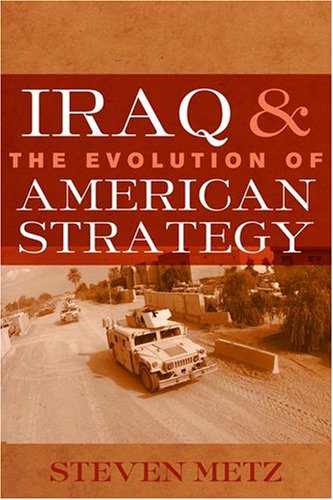
Iraq & the Evolution of American Strategy by Steven Metz

Comments or opinions?

War, the Individual, Strategy and the State

Sunday, July 31st, 2011


One of the nicest things about ZP is the quality of the commenters. In a post by Charles Cameron, 2083 – Breivik and the Qur’an, deception and warfare, there was this exchange between Joseph Fouche and Seydlitz89 after the latter disputed the utility of looking at the Norwegian mass-murderer Anders Breivik through the lens of strategy:

Joseph Fouche:

From Clausewitzian perspective, Breivik’s actions are the conjunction of the three poles of the Trinity, two of which have nothing to with Breivik’s rationality. If CvC can’t be applied to madmen, criminals, mass murderers of children, or men trapped in their own little world, then Van Creveld’s contention that the actions of madmen can’t be considered political (in noted Clausewitzian Christopher Bassford’suse of the word) is correct. War would be “nontrinitarian“.

The words and ideas of murderous stooges have consequences as well as their actions. CvC can shine as much light on them as he can on any other field of human conflict.

Can Breivik’s actions can be considered war? Can an individual wage war? By his own sinister lights, Breivik considered himself at war, the Pied Piper of a host of other Breiviks born and unborn, even if that host only existed in his fevered imagination.

Can an individual have a strategy? Or can an individual only have a strategem? Breivik had a plan that had a tactical expression and apolitical effect (as here we comment on the doings of an otherwise obscure Norwegian). Does the jumbled mass of tissues that connect his evil ends with his evil means rise to the level of strategy?

In her recent book The Evolution of Strategy, noted CvC scholarBeatrice Heuser examines the modern history of the word strategy since Guibert revived it in the mid-eighteenth century. Even the core understanding of the word, the art of connecting political ends with (operational or tactical) military means, has shifted since CvC as the scale and ambitions of campaigns increased. Heuser herself chooses to refer to strategy as understood by Clausewitzians (connecting political ends with military means) with a capital S to differentiate [it] from other current uses.

In that light, was Breivik a Strategist or a strategist? Where do we put the raid on Harpers Ferry or the Beer Hall Putsch, two events that were equally ridiculous and equally consequential? What’s the cutoff point between crime and war? What’s the cutoff point between Strategy and strategy? John Brown’s 21? Herr Hitler’s 100? Or Breivik’s one?

Fouche, who it must be said, is no fan of eminent Dutch-Israeli military historian Martin van Creveld, is referering to MvC’s theory of the decline of the state and “non-trinitarian” warfare of non-state or non-Westphalian entities that van Creveld articulated in The Transformation of War, The Rise and Decline of the State and other books and articles since the 1990’s.  The 4GW school adopted van Creveld’s ideas of state decline and to significantly varying degrees, his critical attitude toward Clausewitzian theory (van Creveld’s own assessment of Clausewitz also seems to vary in his works).

Seydlitz89, himself a noted Clausewitzian, responded:

You’re mixing apples and oranges.  Clausewitzian strategic theory pertains to collectives, all concepts pertain to collectives – victory, defeat, strategy, tactics . . . and a very particular collective at that – political communities.  “War” does not consist of one individual fighting against a political community, that is criminality, and always has been.  This is the very definition of what being a criminal, an outcast, or a traitor is all about .  .  . “War” on the other hand is organized violence within or between political communities which involves once again collectives.  These collectives would have to enjoy both moral and material cohesion within them which in turn allows them to use violence as an instrument in their political actions.  The Nazis, as repugnant as they were, did gain “legitimacy” (yet another collective concept) over time and formed a political community around them of Germans dissatisfied with the “system” of their time, and their political takeover did constitute a revolution. 

ABB is all about ABB and nothing more.  Assuming that his “message” or rather mad rant is going to draw an audience and a following is an assumption, based on what exactly?  Great knowledge of how “Europeans” feel about immigration?  Define “Europeans” and how this act is going to mobilize concerted action against immigrants, draw a political community around it?

Even if he did appeal to a selection of alienated loners who bought his sorry soap, that would not constitute them as a political community nor make their struggle war.

If ABB is a “warrior” fighting a “war”, than so was Charles Manson.     

[ Sidebar: Seydlitz has, BTW, previously undertook a formal two-part paper at the old DNI site on this subject, one very much worth reading, that serves as a Clausewitzian rebuttal to van Creveld :The Decline of Strategic Theory – the Influence of The Transformation of War  and part II. The Continued Existence of the State: The Clausewitzian Concept of Cohesion ]

The discussion of whether or not an individual can wage “war” is interesting because it takes place largely at the level of fundamentals. Politics, polities, policy, the State, war. All terms with somewhat different meanings depending on the philosophical tradition brought to the table. Or lack thereof. Strategic discussions are frequently impoverished because of the extinction of systematic education in the Western canon in this country, it is almost dead, even at the university level, which means that those interested in matters of strategy and diplomacy need to dedicate themselves to personal programs of professional reading and reflection.  Some things need to be read firsthand and more than once to be understood.

Can an individual “wage war”? Can they have ” a strategy”? Some very meandering thoughts from me on the subject [Joseph Fouche and Seydlitz are cordially invited to guest-post here in response, if they so desire]:

Historically, this was usually a moot point. The ability of private individuals to use violence that could have a strategic effect on a whole political community was virtually nil – with one exception – assassination. While seldom fully successful, tyrannicide or regicide was celebrated and feared in the ancient world because in highly personalized polities with absolute rulers, such a decapitation attack could paralyze a society as heirs of the ruler struggled for succession or plunge it into anarchy and civil war. Walter LaQueur devotes the first part of his Voices of Terror to examples of ancient assassination for this reason.

Assassination, it should be said, is still more likely to be associated with personal grievance, mental illness or political protest than strategic intent. Brutus and Cassius and their fellow conspirators had a strategic intent in assassinating Julius Caesar, namely reversing the fortunes of civil war as well as the political intent of ending Caesar’s Dictatorship as a regime and restoring the Republic under the dominance of patrician Optimates. By contrast, Charles Guiteau who assassinated President Garfield was merely insane, while Soghomon Tehlirian’s motive for killing Talaat Pasha was vengeance for the Armenian Genocide.

However, as the potential for using assassination at a strategic level exists, then the possibility that an individual may do so of their own accord, instead of as an agent of a state or out of personal grievance, also exists. It’s just quite rare once a society ascends from the Hobbesian hunter-gatherer stage of development to true chiefdoms or kingdoms because two things change: first, a chiefdom or kingdom is a political community that creates and enforces all kinds of constraints, incentives, rules and specialization of tasks related to warfare on individuals in the tribe. Secondly, the scale of society in a chiefdom or kingdom or state vs. a hunter-gatherer band makes an individual’s one-man war impractical. Society has grown far too large. Even if the head is willing, the reach exceeds the grasp.

Now, this truism of war being a collective endeavor, which Seydlitz rightly identifies as being the case and has been so for thousands of years, is now in jeopardy with the acceleration of technological capabilities and ever cheaper productions costs disseminating them into many hands. This is the theory of  the “superempowered individual“, that technology that can permit one person to inflict damage on an enormous scale was becoming too common, as is information about where such technology could be leveraged to best effect. We are not quite there yet, but we have had some serious foreshadowing of SEIs with Ted Kaczynski, the unknown Anthrax mail terrorist and the partially successful WMD terrorist efforts of the Aum Shinrikyo cult. Right now, it is still collectives that are the likeliest culprits for waging a mass casualty attack but those collectives have gotten uncomfortably small in size. Nation-states are far more dangerous and versatile entities, if slow moving and obvious, but they are no longer required if your intent is to inflict strategic damage and eventually, all you will need is one unusually resourceful and intelligent individual.

With individuals and, more commonly, very small substate groups waging war, the nature of warfare will change from the culture of warfare that typified the era of Westphalian nation-states with their centralizing hierarchical bureaucracies, mobilized industrial economies, conventional armed forces and populations bristling with nationalism. Smaller entities that lack the vast resources of states are going to be idiosyncratic in their approach to warfare because their capacity to sustain conflict, what motivates them to stand, fight and die, how they conceive their “Ends” differs from that of states.

Can you use Clausewitz’s general theory to  analyze them? Sure, Clausewitz proposed, after all, a general theory of war, but if you operate with the implicit assumption that the non-state adversary will “do strategy”just  like a state your analysis is likely to be off. The utility of van Creveld’s theory is his emphasis on their non-Westphalian characteristics of these combatants and their blurring of war with crime, religion, culture and politics which goes to the heart of what might be the nature of warfare in this epoch; where the irregulars are no longer marginal players but represent the new normal and interstate conventional war among great powers is the outlier.

Book Review: The Profession by Steven Pressfield

Monday, July 25th, 2011

The Profession by Steven Pressfield

We should begin this review with “Full Disclosure“:

I just finished reading The Profession by Steven Pressfield, which I enjoyed a great deal. Steve sent me an earlier draft doc of the book and I consider Steve a friend. Furthermore, in an extremely gracious gesture, Steve granted me (or at least zenpundit.com) the novelist’s equivalent to a walk-on cameo appearance in his book. Therefore, if you the reader believe that I cannot review this book objectively…well….you are right. It’s not possible 🙂 . Here are some other reviews by Shlok Vaidya, Greyhawk of Mudville Gazette and Kirkus if you want greater impartiality.

Nor am I going to delve into the mechanics of the plot structure and action sequence in The Profession. For one, I think too much of the story in a review of a work of fiction spoils the enjoyment for the group of readers who would be most interested. And you can get the blow by blow elsewhere.

Instead, I would like to draw your attention to how Pressfield has written this novel differently. And why that matters.

There is plenty of action in The Profession and the book really moves. It is violent, but not at a Blood Meridian level of cruelty and the murky political intrigue that surrounds the hero, the mercenary’s mercenary and “pure warrior” Gilbert “Gent” Gentilhomme, is a nice counterpoint to physical combat and technical military details. Many people will enjoy the novel on this level and The Profession would make for an exciting action film. Or perhaps a series of films along the lines of The Bourne Identity or those Tom Clancy movies with Harrison Ford. All well and good. But that is not why The Profession is worth reading – that’s merely why it is fun to read.


What surprised me initially about The Profession was how unlike Killing Rommel it was. Killing Rommel also had war and adventure, but it was a deep study in the character development of Chap, the protagonist, who had enough of a textural, cultural, authenticity as a young gentry class British officer of the WWII period as to make Killing Rommel seem semi-biographical. As a reader, I didn’t much care if Chap and his men succeeded in killing Rommel, only that I would be able to continue to see the story unfold from Chap’s perspective. Many artists believe characters and character interaction are the most important element in a story, from Saul Bellow to Quentin Tarantino. Their stories are captivating even though their narratives are not always particularly logical or centered on a grand conflict.

The Profession is not like that at all. In my view, Pressfield turned his creative energies, his knowledge for military affairs and his formidible ear for history away from character development and toward theme. This difference may or may not explain his own reports of difficulty in wrestling with this novel.

Reaching back to the lessons learned from late Republican Rome, Thucydides, Xenophon and seasoning it liberally with Machiavelli, Pressfield’s 2032 near-future is also jarringly allegorical with America of 2012. Like Rome of the 1st century BC or Athens after it’s defeat in the Peloponnesian War, America in The Profession is strategically paralyzed, politically polarized and teetering on the precipice of decay and decline. These historical inspirations have been mashed up with a dystopian 4GW world, filled with mercenary PMCs like Force Insertion and The Legion, terrorists, drones, tribes, criminal corporations and and a devious and cowardly global financial elite. A future more evenly distributed from the present.

The antagonist against whom the plot is structured is not the story’s nominal villain terrorist, but Gent’s Homeric father-figure, former Lieutenant General James Salter, USMC,  “the crawling man” who was martyred, disgraced, exiled and redeemed as the new master of Force Insertion’s Mideast deployed “armatures” (combined arms divisions) and the book’s geopolitical apex predator, who boasted:

” I was obeying a more ancient law” 

This marks a drastic shift in Pressfield’s use of characters from people existing in themselves with humanistic nuances to their use as philosophical archetypes to better express the theme, more like the technique of Fyodor Dostoyevskii, Victor Hugo or Ayn Rand.

The interplay between the kinetic Gent and the increasingly totemic Salter elucidates a theme that is creating tectonic political shifts in America and the world; a theme which is expressed explicitly to Gent at one point by the ex-Secretary of State, Juan-Estebaun Echevarria. The ex-Secretary plays Cicero to Salter’s Caesar, but Gent is ultimately cast in the role of a very different Roman by the manipulative Salter. Pressfield, in honing the various characters, including AD, Maggie Cole, El-Masri and others, is also drawing on Alcibiades, Critias, Livy, Homer, Robert Graves, Joseph Conrad and the pattern of mythic epics. Salter is at once a pagan chieftain and a philosopher-king, a civilized Kurtz or a barbaric John Galt, who after continuous dissembling, in a brutally honest speech, gives his followers, his enemies, Gent and even himself, no opportunity to morally evade what he has become or his reasons for what he proposes to do. A speech that resonates with the negative trends we see today.

The Profession is a cautionary tale outfitted in kevlar.


Switch to our mobile site