zenpundit.com » blogosphere

Archive for the ‘blogosphere’ Category

Before Disruption….Thinking

Monday, April 23rd, 2012

“What you think, you become”

    – Buddha

“We are what we frequently do”

    – Aristotle

There has been a lively and still evolving debate in the milblogosphere regarding “disruptive thinkers”, starting with Benjamin Kohlman’s post at SWJ whose editor Peter J. Munson has done a fine job steering, collecting and commenting upon. A selection:

The Military Needs More Disruptive Thinkers by Benjamin Kohlman

Disruptive Thinking, Innovation, Whatever You Want to Call It is Needed for a Military in Crisis by Peter J. Munson 

The focus on disruptive thinkers coincided with a different but relevant debate over professional military education (PME) when a scathing blast was recently  leveled at the US Army War College by Major General Robert Scales (ret.) , himself the former commandant and a strong advocate of rigorous PME.  A few of the criticisms made by General Scales at a gathering at FPRI were mentioned in a post by Thomas Ricks who believes in shutting down the service academies and war colleges and maybe just sending everyone to Yale, Princeton and Harvard for MBAs. Or something.
.
What was interesting to me is that many authors and their points had less to do with a close examination of cultivating cognitive skills than related topics of changing organizational culture, the perils of groupthink, rehashing ideas from Frans Johanssen’s The Medici Effect and John Kao’s Innovation Nation, the superiority of entrepreneurshiphidebound military bureaucracy and other tangents to indirectly create an environment in which insightful or innovative behavior might happen.  Only Mike Mazarr zeroed in to the heart of the matter, writing:
….We need to improve, for example, in the detail and specificity of critical and creative thinking methodologies that we integrate into the curriculum.
Bingo!
.
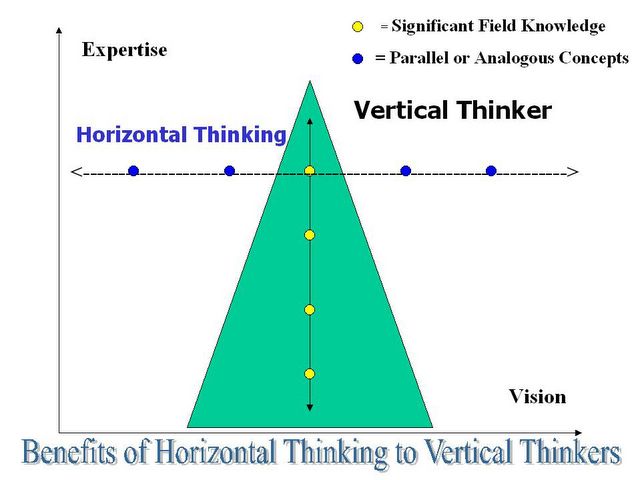
There’s nothing wrong -in fact, much to the good – with the call of Kohlman and others like Joan Johnson-Freese to deliberately combine students and faculty of radically different professional backgrounds. Such a personnel mix is a good base for horizontal thinking to take place, where discussions can range across fields generating insights and analogies and accelerating learning.
However, just assembling a broad mix of talent and putting them together in a building is not enough because it is not any more goal oriented than a MENSA social. Good things might happen, sure, but just as easily not. This is why DARPA is a lot more productive of an organization on an annual basis than the Institute for Advanced Study. There needs to be a mixture of problem-solving and play, free inquiry or experimentation and unifying goals. Communities of interest have to first have a sense of community for the vibrantly sharing and inspiring “minds on fire” effect to take place.
.
If the military or more broadly, American society, wants a larger number of creative, innovative, “disruptive”, strategic or whatever kind of thinker, then the answer is to actively and purposefully teach students creative, critical, insight-generating and strategic thinking skills and to value intellectual curiosity, skepticism, imagination and empiricism over ideology and conformity. The other indirect, “better environment”, stuff certainly improves your chance of success, but systemic improvement will only come about by making such objectives the focus of instruction and learning rather than a haphazard byproduct.
UPDATE:
At Best Defense, Ricks has provided a copy of his prepared remarks on PME as well as a link to the audiofile that I could not pull up the other day. Check out what he has to say.

If You Can’t Go to the Mountain, Have the MountainRunner Go to You

Saturday, March 31st, 2012

After many years of  interaction in the blogosphere, I had the pleasure of finally meeting Matt Armstrong of the noted public diplomacy and information influence blog MountainRunner, at a suburban Chicago watering hole.  A lively discussion ensued in which Smith-Mundt legislation only made the briefest appearance. 🙂

More on Strategy

Friday, March 30th, 2012

Two posts worth your attention:

Gulliver at Inkspots continues the strategy convo between myself and Jason Fritz with a major post of extended commentary:

Let’s just be up front with each other: this is a really long rant about strategy 

….I’m willing to concede that the line between civilian and military reponsibilities in strategy formation and the associated operational planning is a blurry and unstable one, and that what I’ve laid out as the normative standard isn’t always the way things play out in reality. You certainly shouldn’t take anything I’ve written above as an exculpatory argument for our elected officials. But more on this a bit later.

As for our man Carl: Jason’s choice of Clausewitz quote is simultaneously interesting and surprising to me. Committed students of the sage will recognize it from perhaps the most remarked-upon pages of On War: Book Eight, Chapter 6B. (If it were an episode of “Friends,” they’d call it The One With the Politics By Other Means.) The language Jason excerpted is from the 19th-century Graham translation; just for the purpose of clarity, let’s look at the somewhat more fluent Paret/Howard version:

In making use of war, policy evades all rigorous conclusions proceeding from the nature of war, bothers little about ultimate possibilities, and concerns itself only with immediate probabilities. Although this introduces a high degree of uncertainty into the whole business, turning it into a kind of game, each government is confident that it can outdo its opponent in skill and acumen. (606)This is a pretty difficult passage (especially as I present it here, mostly out of context) but I take it to mean that governments are little interested in ruminations on war’s escalatory momentum in the direction of its absolute form, but rather in how violence may be used to achieve concrete political goals. But the paradoxical reality is that addition of violence to politics – violence that is fueled in part by hatred and enmity, violence that is fundamental to war’s nature and sets it off as distinct from all other human activity – actually re-shapes the character of the political contest. War’s essential violence pressures the political contest to take on the character of a duel or a sporting event; without the harness of policy, war risks becoming a self-contained competition conducted according to its own rules, one where victory is not the mere accomplishment of political objectives but rather a revision of the relationship between the two competitors such that the victor is free to enact his preferences. 

The “high degree of uncertainty” that Clausewitz concedes is introduced “into the whole business” is produced by divergence between the things we do in war and the things they are meant to achieve. In limited war, our actions are conceived as violent but discrete and purposive acts of policy, while as war moves toward its absolute form our actions are increasingly divorced from discrete political objectives short of the destruction of our enemy. To put it simply, shit gets crazy in war. [….] 

In a different strategic venue, Matt Armstrong at MountainRunner analyzes  The President’s National Framework for Strategic Communication (and Public Diplomacy) for 2012 :

It should be common knowledge that the “information consequences of policy ought always be taken into account, and the information man ought always to be consulted. This statement, from 1951, is reflected in Eisenhower’s dictum of the next year that “everything we say, everything we do, and everything we fail to say or do will have its impact in other lands.” It was understood then that words and deeds needed more than just synchronization: public opinion could be leveraged to support and further the execution of foreign policy.

What was true then is more so in a modern communication environment of empowerment. The interconnected systems of Now Media, spanning offline and online mediums, democratizes influence, and undermines traditional models of identity and allegiance as demands on assimilation fade as “hyphens” become commas. What emerges is a new marketplace for loyalty that bypasses traditional barriers of time, geography, authority, hierarchy, culture, and language. Information flows much faster; at times it is instantaneous, decreasing the time allowed to digest and comprehend the information, let alone respond to it. Further, information is now persistent, allowing for time-shifted consumption and reuse, for ill or for good. People too can travel the globe with greater ease and increased speed.

It is in this evolving environment that the President issued an updated “National Framework for Strategic Communication” for 2012 (3.8mb PDF, note: the PDF has been fixed and should be once again visible to all). This report updates the 2010 report issued last March that was little more than a narrative on how the Government was organized for strategic communication. The report is required under the National Defense Authorization Act of 2009.

Some highlights from the 2012 Framework: [….]

Strategy and Perception, Part II.

Monday, March 26th, 2012

To continue, my last post was inspired by analysis by Jason Fritz at Inskspots and I would like to continue to use excerpts from his post as a foil to ruminate about strategy:

Delicate strategic balancing: perception’s role in formulating strategy

….We have a whole suite of problems with our strategy in Afghanistan, foremost of which are a failure to state specific and achievable ends as well as a misalignment of ways and means to achieve the pitifully-described desired ends we have written down. But if our strategic success now depends upon selling to the Afghans that we mean well and that they are now more skeptical than not of us, well we have a very, very serious problem. Balancing the Say-Do equation is an imperative. However, if public perception is that mistakes and crimes committed by individual U.S. service members is indicative of U.S. policy or strategy, then public communications begins to drive strategy instead of the other way around.

Incidentally, I agree completely with Jason’s emphasis that we do not have the fundamentals right on strategy and Afghanistan. To an extent, worrying about “Perception” when you do not have Ends, Ways and Means in sync is akin to fretting about the paint job and waxing of your automobile while the battery is dead, the engine is shot and your car is up on blocks with the tires stolen. Nevertheless, perception will always be at least a contingent factor in strategy, affecting the friction of your diplomatic and theater environment, the attitude of the home front and the political will of elite decision makers.

The classic example of perception having a strategic impact is the Tet Offensive and the effect it had on America’s Eastern Establishment political elite and the Johnson administration directing the war in Vietnam. While Tet was a debacle militarily for the southern Communist cadres that composed the Viet Cong, the offensive struck the American political center of gravity hard. SECDEF McNamara resigned, the antiwar movement was energized and Tet indirectly contributed to the primary results in New Hampshire that caused President Lyndon Johnson to withdraw from the race for president in 1968 and subsequently order a halt to bombing North Vietnam. The mighty Democratic Party, which had dominated American politics since 1933, was riven by an ideological civil war that played out in the streets of Chicago.  Had Hanoi been prepared to seek a negotiated settlement, Johnson likely would have given away the store (a TVA on the Mekong!) to secure peace.

….Public communications and information operations to influence perceptions are ways, but the U.S. keeps falling into the trap of making perceptions ends in themselves. If our ends, ways, and means were better formed and aligned, I suspect that the “Do” side of the equation would be solid enough to negate the affects of mistakes. But this is not the situation in Afghanistan where continued programs of questionable efficacy, strategic drift with regard to ends (compare this and this for instance), andcontinued support for an illegitimate and ineffectual government abound. If ways and means are not succeeding (to what ends?!?) or are the wrong ways and means entirely then your strategy rests in total upon Afghan perception that you’re making a difference instead of in part, which amplifies individual disasters such as we’ve seen of late. While it is unlikely that the United States will change course at this juncture, we need to start paying attention to this phenomenon now and avoid it in the future so we can avoid codifying perceptions as ends and put influencing them back where they belong: as ways. A successful strategy would go a long way to restoring this balance. Once again, maybe in the next war.

I think Jason has put his finger on another problem altogether here. His description of “perception” in that paragraph is one of political perception of a foreign audience of our actions as they constitute an ongoing, apparently unending process to which there is no conclusion in the sense of a defined End, just an arbitrary time limit (to which we are only kinda, sorta, maybe sticking to).  Actually “audience” is not even the right word, as the Afghans are interested participants and actors as well as onlookers who happen to be on the weaker side of an asymmetric dynamic. Weak does not equate to “powerless”, and as we have stupidly set very high strategic goals that require the voluntary consent, adoption and cooperation of the Afghan people to reach, withholding of consent, passive or active resistance or armed insurgency are Afghan bargaining alternatives to abject submission to our wishes. As occupation in the form of unending process looks a lot like foreign domination of Afghanistan by infidels and their corrupt and predatory collaborators, it is not surprising that the Afghans of all stripes are bargaining hard after ten long years.

American civilian leaders running the Afghan war are politicians and lawyers, for whom unending process (like for example, the Federal budget) rather than results is familiar and comfortable and for whom irrevocable choice making is anathema. Crafting a usefully effective military strategy is difficult if one of the unspoken, sub rosa, goals is to “keep all options open as long as possible” which precludes commitment to and vigorous pursuit of a prioritized, specific End to the exclusion of others in as short a time as possible.

This perspective, while perhaps a career advantage for a politician, is over the long haul ruinous for a country in a statesman, as the net result becomes burning money and soldier’s lives to garner nothing but more time in which to avoid making a final decision, hoping to be rescued by chance (Once in a blue moon in warfare, a Tsarina dies or an Armada sinks and changes fortunes, but most nations losing a war ultimately go down to defeat).

A defined and concrete End, by contrast, yields a different perceptual effect because uncertainty for soldiers and onlookers alike is reduced. Foreigners can calculate their own interests and costs with accuracy and decide if opposition, neutrality or alliance will be to their advantage. Now it may be that a desired strategic End is so provocative that it is best kept secret until a sudden victory can be presented to the world as fait accompli, but that is still a very different thing from elevating process of Ways and Means over distant, ambiguously unrealistic and vaguely defined Ends. Loving policy process and tactical excellence above strategic results when employing military force gets you a very long and likely unsuccessful war.

However, somebody else said it much better than I can  2500 years ago….

….When you engage in actual fighting, if victory is long in coming, then men’s weapons will grow dull and their ardor will be damped. If you lay siege to a town, you will exhaust your strength
Again, if the campaign is protracted, the resources of the State will not be equal to the strain
Now, when your weapons are dulled, your ardor damped, your strength exhausted and your treasure spent, other chieftains will spring up to take advantage of your extremity. Then no man, however wise, will be able to avert the consequences that must ensue.
Sun Tzu

Of Kony and Constellation

Friday, March 23rd, 2012

[ by Charles Cameron — non-linearity, complexity, “constellational thinking”, a quick spin around the blogosphere, history, Walter Benjamin — following on from Nancy Fouts ]
.
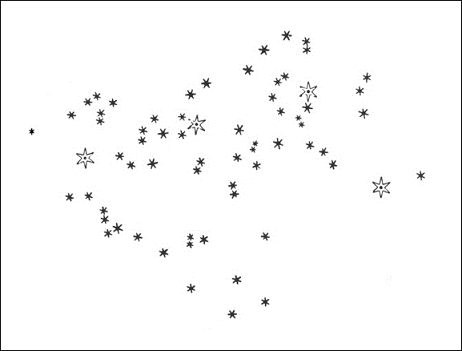

image: Galileo Galilei, Siderius Nuncius (i.e. The Starry Messenger), 1610

.
The novelist Teju Cole has a piece in the Atlantic that’s triggered by the Kony2012 business, and zooms out to touch on much else besides. His piece is titled The White Savior Industrial Complex, and as I was reading it, I came across a phrase that tweaked my keen interest. Cole is talking about Nicholas Kristof, and writes:

His good heart does not always allow him to think constellationally. He does not connect the dots or see the patterns of power behind the isolated “disasters.” All he sees are hungry mouths, and he, in his own advocacy-by-journalism way, is putting food in those mouths as fast as he can. All he sees is need, and he sees no need to reason out the need for the need.

By my lights, “he sees no need to reason out the need for the need” is a powerful tongue-twister, but it’s the phrase “to think constellationally” that interests me here.

Cole returns to a slight variant on the phrase later, this time saying:

Success for Kony 2012 would mean increased militarization of the anti-democratic Yoweri Museveni government, which has been in power in Uganda since 1986 and has played a major role in the world’s deadliest ongoing conflict, the war in the Congo. But those whom privilege allows to deny constellational thinking would enjoy ignoring this fact.

Constellational thinking, then, connects the dots, sees the patterns behind isolated events, sees not just the events themselves but also the circumstances that caused them – and its absence allows us to reduce complexly-interwoven reality to one or more simplistic polarities — better suited to sound bites than to analysis.

*

Cole also points us to Rosebell Kagumire‘s video response to the Kony affair, and she in turn has her own way of addressing the same kind of reduction of complexity to simplicity. She wrote, back on March 8th:

For the last many hours i have followed a campaign by Invisible Children NGO called KONY2012 that has gone viral getting more than 20 million hits on Youtube. I am a story teller and i know the danger of a single story.

So simple, that: I know the danger of a single story.

Remember the Ocean of the Streams of Story diagram in my post almost a week ago, Countering Violent Extremism: variants on a theme? Edward Tufte designed it, to illustrate a paragraph by Salman Rushdie

The truth of a complex situation lives in the interweaving of many stories, not in a single strand, a single view.

*

Constellations — of thoughts, of ideas.


image: Eugen Gomringer, Constellation, ca 1960

I did some digging – I’m not the Oxford English Dictionary, and I can’t say for sure that any particular use of “constellation” marks its first appearance in the sense that interests me here – Eugen Gomringer‘s Constellations (from 1954 onwards, example above) may be relevant in an avant-garde way– but my search brought me to a post by Liz Danzico at Bobulate titled Celestial History, in which Liz wrote:

Teaching constellations is an exercise in storytelling. You see, dots, these anonymous light encrusted patterns, must be memorized and categorized, and it’s only through stories that one can make sense of them. Starting with the north star, and systematically creating relationships in the winter sky among Hercules and Sagittarius, Libra and Polaris, we told tales. We’d trade stories on top of the old stone building in the middle of dark campus until late into the night. Creating these stories, giving Hercules a relationship to Cassiopeia — true or not, good or not, believable or not, it didn’t matter — what mattered were that patterns were found and marked.

Marking patterns and making content accessible through stories is what we do. And often, still, when we begin, we’re in the dark.

*

This post in turn lead Robin Sloan at Snarkmarket to write a quick note of praise, Explosions in the sky, which drew a comment from Tim of Short Schrift that said:

After the Copernican revolution, a constellation isn’t even a constellation. Instead, it’s a two-dimensional flattening of a three-dimensional reality. Actually, we should probably say a FOUR-dimensional reality. The light from stars at varying distances, leaving their sources at various times in the distant past, gets mistaken, from our earthbound point-of-view, as a simultaneous two-dimensional pattern.

BUT! That distortion, that accident, produces something extremely powerful — both imaginatively and practically.

Take “constellational thinking” and apply it to something besides stars in space. Let’s say — history.

Over here, you’ve got the Roman Republic, over there, the French Revolution. Distant in time, distant in geography, no kind of causal proximity let alone a relationship between them.

But bam! Slap them together. View them as a single event, a collapse of time.

Now you begin to see the French Revolution the way part of the Revolution saw itself, as an explosion of the continuum of history.

Now — and sorry if I slow-played this — you’re in Walter Benjamin’s “On the Concept of History.” Now you’re performing a genuinely three-dimensional nonlinear reading of historical time.

Consider that process, spelled out in the phrases “Distant in time, distant in geography, no kind of causal proximity let alone a relationship between them. But bam! Slap them together. View them as a single event, a collapse of time.”

Consider how that “fits” the same Arthur Koestler model of thinking I was on about yesterday in my post Nancy Fouts and the heart of the matter, in which I described:

the “release of cognitive tension” that occurs when some form of analogy, similitude, overlap allows the mind to join conceptual clusters from two fields in a “creative leap”

*

Well, I’m not along in finding this sort of thing useful. Here’s bethr from Mixed Bits writing on tumblr:

Constellational thinking

Omigosh… I’ve been using this phrase in numerous conversations for at least 4 years, usually when attempting to describe how I seem to process information and think, in contrast to the linear thinking which is more prevalent and encouraged in my profession. I’ve never heard anyone else use this phrase…it excites me that others have applied the same phrase and metaphor to the same idea and have articulated it much better than I ever have.

*

And Walter Benjamin:


image: Paul Klee, Angelus Novus, 1920

Turning to Walter Benjamin’s On the Concept of History for a moment, we find a remarkable and justly celebrated paragraph about the angel depicted above, a 1920 Paul Klee painted etching which Benjamin himself once owned, now housed in the Israel Museum, Jerusalem:

There is a painting by Klee called Angelus Novus. An angel is depicted there who looks as though he were about to distance himself from something which he is staring at. His eyes are opened wide, his mouth stands open and his wings are outstretched. The Angel of History must look just so. His face is turned towards the past. Where we see the appearance of a chain of events, he sees one single catastrophe, which unceasingly piles rubble on top of rubble and hurls it before his feet. He would like to pause for a moment so fair, to awaken the dead and to piece together what has been smashed. But a storm is blowing from Paradise, it has caught itself up in his wings and is so strong that the Angel can no longer close them. The storm drives him irresistibly into the future, to which his back is turned, while the rubble-heap before him grows sky-high. That which we call progress, is this storm.

*

More prosaically, Benjamin then gives us the twinned realities to which Tim had pointed in his comment at Snarkmarket:

For Robespierre, Roman antiquity was a past charged with the here-and-now, which he exploded out of the continuum of history. The French revolution thought of itself as a latter day Rome. It cited ancient Rome exactly the way fashion cites a past costume. Fashion has an eye for what is up-to-date, wherever it moves in the jungle of what was.

*

Benjamin’s “moment” — his here-and-now — has passed, perhaps. The nuances discoverable through juxtaposition, counterpoint, overlay, constellational thinking, remain.

Switch to our mobile site

