zenpundit.com » blogosphere

Archive for the ‘blogosphere’ Category

Dateline, June 5th 2012

Monday, June 10th, 2013

[ by Charles Cameron — screengrabs from a very recently posted video, mostly Taliban with just a smidgeon of NSA ]

[edited to add: please see warning in comment below]
.

Scary, hunh? Yeah?

**

No, this is not from a NSA / Prism video — I’ll have just a little more on that topic later.

Nor is it from your local mafiosi

In fact, it’s from the Islamic Emirate of Afghanistan

i.e the Afghan Taliban.

And it’s addressed to Saakashvili and the people of Georgia (FSU), telling them:

and:

**

What interests me here is this: I tend to think of the Islamic Emirate as mainly Afghanistan-centric, so viewing this video I wondered whether they’ve announced similar intent to raid or attack other nations. Alex Strick van Linschoten responded to my query as to whether he’d seen this sort of message before:

He also pointed me to his book, An Enemy We Created: The Myth of the Taliban-Al Qaeda Merger in Afghanistan, where (p. 277 in my uncorrected proof) we read:

It was around this time that Dadullah started to make increasingly strident statements of support for a global jihad, one in which attacks in Europe and the United States were not to be ruled out.101 Dadullah was, in contrast to most other Talibs of his generation, a ‘true believer’ in this rhetoric. Some commentators have suggested this is pathological, but a possible explanation can be found in the time he spent with foreign jihadis both on the northern fronts during the 1990s as well as post-2001, when he was in South Waziristan. He was frequently used as a go-between for the Taliban in Pakistan and retained ties to the foreign al-Qaeda affiliates as well.

So this kind of thing is not entirely unknown, and indeed “revenge” strikes outside Afghan territory would fit the model Dadullah himself proposed for strikes within Afghanistan (pp. 273-73):

Our tactics now are hit and run; we attack certain locations, kill the enemies of Allah there, and retreat to safe bases in the mountains to preserve our mujahidin. This tactic disrupts and weakens the enemies of Allah and in the same time allows us to be on the offensive. We decide the time and place of our attacks; in this way the enemy is always guessing.

Mullah Dadullah died in 2007, but it seems his thinking still exerts some influence…

** ** **

And NSA — or Nonesuch as I was taught to call it, back in the day?

I stand by the idea I tweeted to JM Berger yesterday:

I’d only add that three days doesn’t seem long enough in this case, and that when the dust settles we may still find ourselves holding just a few loose ends of a multiply-tangled web…

New Book: America 3.0 is Now Launched!

Tuesday, May 21st, 2013

America 3.0: Rebooting American Prosperity in the 21st Century – why America’s Best Days are Yet to Come by James C. Bennett and Michael Lotus

I am confident that this deeply researched and thoughtfully argued book  is going to make a big political splash, especially in conservative circles – and has already garnered a strong endorsement from Michael Barone, Jonah Goldberg, John O’Sullivan and this review from  Glenn Reynolds in USA Today :

Future’s so bright we have to wear shades: Column 

….But serious as these problems are, they’re all short-term things. So while at the moment a lot of our political leaders may be wearing sunglasses so as not to be recognized, there’s a pretty good argument that, over the longer time, our future’s so bright that we have to wear shades.

That’s the thesis of a new book, America 3.0: Rebooting American Prosperity In The 21st Century.The book’s authors, James Bennett and Michael Lotus, argue that things seem rough because we’re in a period of transition, like those after the Civil War and during the New Deal era. Such transitions are necessarily bumpy, but once they’re navigated the country comes back stronger than ever.

America 1.0, in their analysis, was the America of small farmers, Yankee ingenuity, and almost nonexistent national government that prevailed for the first hundred years or so of our nation’s existence. The hallmarks were self-reliance, localism, and free markets.

At the end of the 19th century and the beginning of the 20th, people were getting unhappy. The country was in its fastest-ever period of economic growth, but the wealth was unevenly distributed and the economy was volatile. This led to calls for what became America 2.0: an America based on centralization, technocratic/bureaucratic oversight, and economies of scale. This took off in the Depression and hit its peak in the 1950s and 1960s, when people saw Big Government and Big Corporations as promising safety and stability. You didn’t have to be afraid: There were Top Men on the job, and there were Big Institutions like the FHA, General Motors, and Social Security to serve as shock absorbers against the vicissitudes of fate.

It worked for a while. But in time, the Top Men looked more like those bureaucrats at the end of Raiders Of The Lost Ark, and the Big Institutions . . . well, they’re mostly bankrupt, or close to it. “Bigger is better” doesn’t seem so true anymore.

To me, the leitmotif for the current decade is supplied by Stein’s Law, coined by economist Herb Stein: “Something that can’t go on forever, won’t.” There are a lot of things that can’t go on forever, and, soon enough, they won’t. Chief among them are too-big-to-fail businesses and too-big-to-succeed government.

But as Bennett and Lotus note, the problems of America 2.0 are all soluble, and, in what they call America 3.0, they will be solved. The solutions will be as different from America 2.0 as America 2.0 was from America 1.0. We’ll see a focus on smaller government, nimbler organization, and living within our means — because, frankly, we’ll have no choice. Something that can’t go on forever, won’t. If America 2.0 was a fit for the world of giant steel mills and monolithic corporations, America 3.0 will be fit for the world of consumer choice and Internet speed.

Every so often, a “political” book comes around that has the potential to be a “game changer” in public debate. Bennett and Lotus have not limited themselves to describing or diagnosing America’s ills – instead, they present solutions in a historical framework that stresses the continuity and adaptive resilience of the American idea. If America”s “City on a Hill” today looks too much like post-industrial Detroit they point to the coming renewal; if the Hand of the State is heavy and it’s Eye lately is dangerously creepy, they point to a reinvigorated private sector and robust civil society; if the future for the young looks bleak,  Bennett and Lotus explain why this generation and the next will conquer the world.

Bennett and Lotus bring to the table something Americans have not heard nearly enough from the Right – a positive vision of an American future that works for everyone and a strategy to make it happen.

But don’t take my word for it.

The authors will be guests Tuesday evening on Lou Dobb’s Tonight and you can hear them firsthand and find out why they believe “America’s best days are yet to come

On eating one’s enemy

Saturday, May 18th, 2013

[ by Charles Cameron — not good branding, not Islamic, dumbstruck? — not a whole lot else to say ]
.

Commander Abu Sakkar / the Farouq Brigades logo


Let’s take the bald facts first:

Commander Abu Sakkar of the Farouq Brigades, Free Syrian Army, had himself videotaped this month cutting open and seeming to eat the flesh of a just-killed Syrian soldier loyal to President Assad — to send a message. According to a New York Times “Lede” blog-post, he preceded this act with the words:

I swear to God, soldiers of Bashar, you dogs — we will eat your heart and livers! … God is great! Oh, my heroes of Baba Amr, you slaughter the Alawites and take their hearts out to eat them!

His rhetoric as reported speaks of eating the heart: in the event, it is a portion of lungs that he eats, or mimics eating.

**

This has to be seen in many contexts — one of them, the branding of the Syrian rebels in general and the Farouq Brigades in particular.

This is taken from an article a couple of weeks ago on a WSJ blog titled For Some Syrian Rebels, It’s a Battle of the Brands:

Twelve activists in an office in Reyhanli, Turkey near the border run Farouk’s Facebook page, web site, and Twitter account. They’re working on the TV channel, which Mr. Awad says they’ve envisioned as a tool to resocialize fighters off the battlefield.

“The regime will fall one day,” he says. “We have 20,000 fighters–they all won’t stay fighters. They will put down their weapons, and need to integrate into the world. TV, radio, these things will help.”

The media office’s latest brand offering? A three-dimensional version of the Farouk logo, which will be used in videos and other online material.

“The guys complained the logo wasn’t nice enough,” Mr. Awad said, laughing. “They wanted a 3D one.”

**

Moralizing about someone eating the flesh of a deceased enemy is pretty easy to pull off — unless one still thinks it’s a potent way to acquire one’s enemy’s courage, which is now something of a curiosity in the anthropologist’s cabinet of concepts. Here, dug up from the section on Homeopathic Magic of a Flesh Diet in Sir JG Frazer‘s 1922 edition of The Golden Bough, now long out-dated, is the picture as it used to be seen:

When Basutos of the mountains have killed a very brave foe, they immediately cut out his heart and eat it, because this is supposed to give them his courage and strength in battle. When Sir Charles M’Carthy was killed by the Ashantees in 1824, it is said that his heart was devoured by the chiefs of the Ashantee army, who hoped by this means to imbibe his courage. His flesh was dried and parcelled out among the lower officers for the same purpose, and his bones were long kept at Coomassie as national fetishes. The Nauras Indians of New Granada ate the hearts of Spaniards when they had the opportunity, hoping thereby to make themselves as dauntless as the dreaded Castilian chivalry.

Even as a cannibal delicacy, the white man’s heart seemed to have special virtue! As I say, though — that’s all a little out of date.

**

Eating one’s enemy, however, is a distinctly un-Islamic behavior, whatever century we’re in. One early Islamic narrative concerns Hind bint ‘Utbah avenging deaths in her own family by eating the heart of a great Muslim warrior, dear to the Prophet — far from being an example of what is permitted in Islam, she’s an example of what Muhammad was up against by way of enemies in the early days of his preaching:

Hind Bint `Utbah, the wife of Abu Sufyaan, ordered Wahshiy to bring her Hamzah’s liver, and he responded to her savage desire. When he returned to her, he delivered the liver to her with his right hand, while taking the necklaces with the left as a reward for the accomplished task. Hind, whose father had been killed in the Battle of Badr and whose husband was the leader of the polytheist army, chewed Hamzah’s liver hoping to relieve her heart, but the liver was too tough for her teeth so she spat it out and stood up shouting her poem:

                    For Badr we’ve paid you better
                    In a war more flaring than the other.
                    I was not patient to revenge the murder of
                    `Utbah, my son, and my brother.
                    My vow’s fulfilled, my heart’s relieved forever.

Hind did eventually become a Muslim — but on account of this very event, was never fully included among “the Companions of the Prophet”.

**

I don’t want to moralize over Commander Abu Sakkar‘s act, not having been in his shoes — but it is vile under pretty much any moral standard you might choose. A problem arises, though, when one attempts to use it to justify one side or another, in a conflict in which brutality of one kind or another seems to be present on both sides. As Sakkar himself told a Time correspondent:

You are not seeing what we are seeing, and you are not living what we are living. Where are my brothers, my friends, the girls of my neighborhood who were raped?

**

Peter Bouckaert of Human Rights Watch is quoted giving another kind of context to the affair:

Abu Sakkar is just one man, and there are many other armed fighters in Syria who reject such sectarian actions and would be horrified by the mutilation and desecration of a corpse — let alone an act of cannibalism. But he is a commander in a decisive battle in Syria — hardly a marginal figure.

**

Not without reason did Kurtz whisper at the end of Joseph Conrad‘s Heart of Darkness, as in Francis Ford Coppola‘s Apocalypse Now:

The horror! The horror!

Of Alice, Angels and Apsaras

Wednesday, May 15th, 2013

[ by Charles Cameron — squeezed between the space of astronomers and the paradise of the believers, is there yet room for the dancing play of poetry, music and imagination? ]
.

My first question for you today would be — do you believe in Alice?

And further to that, do you believe in the Red Queen?

**

Two things collided to cause me to write this post today. First, Emptywheel opened her blog post on Putin’s outing of an American spy today with a quote from Lewis Carroll:

‘I declare it’s marked out just like a large chessboard!’ Alice said at last. ‘There ought to be some men moving about somewhere–and so there are!’ she added in a tone of delight, and her heart began to beat quick with excitement as she went on. ‘It’s a great huge game of chess that’s being played–all over the world -– if this is the world at all, you know. Oh, what fun it is!’

I can’t really ignore Lewis Carroll when he crops up in my morning feed like that: he’s a Christ Church man and a poet, as I am, and it would be rude of me to ignore him. And besides, what he’s on about here is the world-as-game concept, which is never far from my mind — hence my inclusion of that question about the Red Queen.

**

And second, mermaids.


.

It gets more interesting, you see. Because what collided with that first question was a conversation @khanserai aka Humera Khan was having with @mujaahid4life aka Abdallah via Twitter, in which the Harry Potter books were discussed and the topic of unimaginative clerical fatwas on games and works of fiction came up. At which point, Abdallah pointed us all to this now-archived fatwa regarding the permissibility of eating mermaid flesh:

Ruling on eating mermaids

A mermaid is a creature that lives in water and looks like a human. As to whether it really exists or it is a mythical being, that is subject to further discussion.

It says in a footnote in al-Mawsoo’ah al-Fiqhiyyah (5/129): From the modern academic resources that are available to us, it may be understood that the mermaid, which is called Sirène in French, is a mythical creature that is described in fairy tales as having an upper body like a woman and a lower half like a fish.

See the French Larousse encyclopédique on the word Sirène.

The encyclopaedia goes on to say: The widespread notion in ancient times was that the wonders and animals of the sea were more and greater than the wonders of dry land, and that there was no kind of animal in the sea that did not have a counterpart on land. This was confirmed by Prof. Muhammad Fareed Wajdi in his encyclopaedia, quoting from modern academic sources. See: Daa’irah Ma’aarif al-Qarn al-‘Ishreen: Bahr – Hayawiyan. End quote.

Al-Dumayri said in Hayaat al-Haywaan al-Kubra: Mermaid: it resembles a human but it has a tail. Al-Qazweeni said: Someone brought one of them in our time. End quote.

Many of the fuqaha’ mentioned mermaids and differed on the ruling concerning them. Some of them said that they are permissible (to eat) because of the general meaning of the evidence which says that whatever is in the sea is permissible. This is the view of the Shaafa’is and Hanbalis, and is the view of most of the Maalikis and of Ibn Hazm and others. And some of them regarded it as haraam because it is not a kind of fish. This is the view of the Hanafis and of al-Layth ibn Sa’d.

Ibn Hazm (may Allaah have mercy on him) said in al-Muhalla (6/50): As for that which lives in the water and cannot live anywhere else, it is all halaal no matter what state it is in, whether it is caught alive and then dies, or it dies in the water and then floats or does not float, whether it was killed by a sea creature or a land animal. It is all halaal to eat, whether it is the pig of the sea (i.e., a dolphin), a mermaid, or a dog of the sea (i.e., shark) and so on. It is halaal to eat, whether it was killed by an idol-worshipper, a Muslim, a kitaabi (Jew or Christian) or it was not killed by anyone.
What’s outside the box?

And it goes on… ending, mercifully:

And Allaah knows best.

Sometimes I think those might be my favorite words evvah!

**

Are mermaids real enough for religious scholarship to address them?

Is Alice?

John Daido Loori Roshi, late zen master and abbot of the Mountains and Rivers Order’s Mt Tremper abbey, once gave a teisho using a passage from Alice as his koan:

Many Zen koans contain references to myths and folktales of ancient India, China, and Japan. Since Westerners generally are not familiar with these stories, koan study without extensive background information is often a frustrating and exasperating process.

In this dharma discourse, Abbot John Daido Loori fashions a koan, complete with pointer and capping verse, from a classic of children’s literature, Lewis Carroll’s Alice in Wonderland. The koan revolves around Alice’s encounter with a caterpillar who explains the magical properties of a special two-sided mushroom that to Alice’s eyes appears perfectly round. Alice’s struggles with this dilemma make for a stimulating story that mirrors the conflicts and dualities we face in our everyday life.

You can read it here.

**

All of which brings me to the question of the place of deep imagination in a sometimes shallow world.

Alice, do you believe in her? Mermaids and Macbeth mean something to sailors and theater-folk, respetively. Angels? If angels, then the djinn, too? Christian scripture speaks for the existence of one, the Qur’an of both — is one more probable, more real, perhaps, than the other?
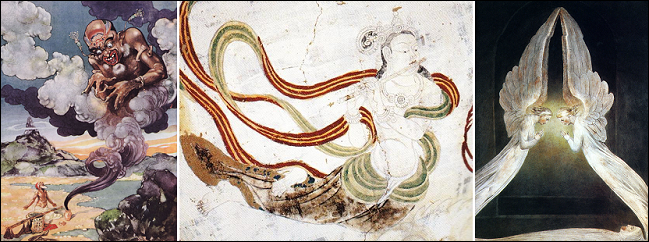
And what of the gandharvas and apsaras — middle panel — the celestial musicians and airy dancers who move to their music? Is there any poet who can claim never to have sensed them?

**

And thus we come to Robert Graves and the muse as he depicts her, in his book The White Goddess, and in many poems such as this:

In Dedication
.

Your broad, high brow is whiter than a leper’s,
Your eyes are flax-flower blue, blood-red your lips,
Your hair curls honey-colored to white hips.

All saints revile you, and all sober men
Ruled by the God Apollo’s golden mean;
Yet for me rises even in November
(Rawest of months) so cruelly new a vision,
Cerridwen, of your beatific love
I forget violence and long betrayal,
Careless of where the next bright bolt might fall.

**

But here the waters are getting deeper…

A second comment on Hegghammer & Lacroix

Sunday, April 28th, 2013

[ by Charles Cameron — because the Bene Gesserit understand the power of Mahdism and jihad ]
.

Further reading:

  • Frank Herbert, Appendix II: The Religion of Dune
  • Peter Tarchin, The ‘Dune Hypothesis’
  • Peter Tarchin, Psychohistory and Cliodynamics
  • Peter Tarchin, Science on Screen: DUNE
  • Peter Tarchin, How to Overthrow an Empire – and Replace It with Your Own
  • Ibn Khaldun, The Muqaddimah: An Introduction to History
  • Doris Lessing, Canopus in Argos: Archives
  • **

    As T Greer, friend of this blog, notes in a comment to that last Tarchin post, his explorations would fit in nicely with the work at Grand Blog Tarkin


    Switch to our mobile site