zenpundit.com » africa

Archive for the ‘africa’ Category

Introducing myself to ETHOS

Tuesday, June 5th, 2012

[ by Charles Cameron — games and complexity, Joseph Kony, think tanks, need for a new analytic institution ]
.

I just introduced myself to the Ethos Network — their motto: Collaboration, Trust, Moderation — a group of mainly UK-based mil, biz & creativ types a good friend pointed me to, partly responding to an earlier conversation about Kony on their platform, partly laying out my own interests…

And with a suggestion thrown in there that we could really use a new analytic setup of some sort, a point I’ll return to.

Here, then, is my introduction as posted there:

*****************************************************************************

Hello:

A few words of introduction are probably in order, before I dive in…

You might say I live at the intersection of complexity and games, and work at the intersection of religion and violence.

1.

My interest in complexity comes from a sense that the problems facing us contains many diverse and conflicting tensions to be resolved in some sort of continuous, shifting balance, and that we as humans face them with a complexity of our own, the complexity of our individual tensions, preferences, desires, interrests, hopes, fears, assumptions, resistances and so forth.  

So both within each one of us, and in groups, we have a situation where many points of view, many voices should if possible be heard, taken into account, adjusted for.

As social beings, we need to let the voices of other stakeholders, other constituencies, other points of view be heard, so that we can move towards win-win balances — I won’t call them solutions — wherever possible.

As humans, we need to let some of our own quieter, slower, deeper voices emerge — and that’s the purpose of inward listening, meditation, taking a break, the Sabbath, sleeping on it, relaxing, reverie — to bring out some of the voices that add insight, to give the aha! time to develop and space to show itself…

And in both cases, it’s the voices that go unheard, the parts of the web of tension unattended to, which can come back and bite us.

So… two things.  

One:  I am interested in developing ways to map conversations that are many voiced — literally “polyphonic” — such that, as with the music of Bach and Handel (and hey, Dylan and the Band), multiple voices can be heard at once, held in a shifting tension, with conflict arising and moving into resolution as they do when Glenn Gould plays Bach or Eric Clapton jams with Billy Preston…  I have games I’ve designed that do this…

Two: I am interested in what we’re not paying attention to, to our blind spots, to the undertows of our own and other cultures, to the stuff we easily dismiss.

Which brings me to…

2.

I am specifically interested in the contribution of religion, of religious emotion, to contemporary violence.

Religious violence is obviously not the only aspect of violence — but materiel is easier to quantify than morale, and all too often we miss religious signals in others (and in those on our own side) which turn out to have been powerful drivers of conflict.

Joseph Kony is the example of “religious violence” that I’ve seen mentioned here, and given my interest in jihad — I’d been tracking jihadist groups since before the turn of the millennium — he popped up on my screen and claimed some real estate in my attention in May 2005, when I downloaded DFID Media Fellow Maya Deighton’s report in the then-DFID journal, Developments, in which she wrote:

The rebels’ leader is a religious fanatic called Joseph Kony, who hides out for most of the time in southern Sudan.

Kony manages to combine a heady blend of occultism, born-again Christianity, and most recently, a much-proclaimed conversion to Islam, with his campaign of terror and child abduction.

At about the same time, I dowloaded a Chalcedon Foundation file containing Lee Duigon’s piece, “Uganda’s War with ‘the Devil’” — Chalcedon is the late “dominionist” theologian Roussas John Rushdoony’s outfit, and preaches the imposition of the full Old Testament law of Moses, stoning of adulterers included, in the United States (and ultimately the world) — hence my interest.

In any case, it would have been Kony’s “much-proclaimed conversion to Islam” that likely caught my interest in Deighton’s article, and it may well have been Duignon’s piece that first brought Kony to my attention. 

I have tried to keep a wary eye out for news of Kony and the LRA ever since, and for my own purposes, the most informative materials that I have run across in the interim are the notes taken by LTC Richard Skow, published by the New York Times in December 2010.

I have blogged at least twice on Kony, once after Rush Limbaugh, an American media presence on the right, described Kony and the LRA approvingly as “Christians … fighting the Muslims”, and the other time to note (among other things) Kony’s connection with Alice Lakwena.

But Kony’s not the point, and indeed Kony’s wider context, with its multiple drivers in terms of resources, warlords, moral issues, the whole shebang, isn’t the point either.

The point is that I work a seam that’s very little noticed by western analysts, and that runs through the heart of pretty much every insurgency and terrorist movement in recent memory.

The LTTE, for what it’s worth, included.

3.

Al-Qaida’s the prime example of course — but when Omam Hammami’s made his video presentation just last week, how many people noticed that he defined jihad as an act of worship?  And who had an inkling of what that meant?

That was the topic of my most recent blog-post on Zenpundit, but it’s just the most recent instance of a trend that’s both significant and significantly under-appreciated.  It’s in one of our blind spots.

There are times when I’m hugely thankful for the work of people like Nelly Lahoud at the Combating Terrorism Center (CTC) at West Point — her preliminary report on the “history of jihad” written by bin Laden’s personal secretary came out today — or Will McCants at the Center for Naval Analyses.  But there are other times when I’m equally frustrated, knowing how many bright scholarly voices with valuable insights to offer go unheard.

The think tanks are pretty much all heavily politicized: twitter and blogs are the go to places to keep up with cutting edge thinking — and still, just today, a rising star like Aaron Zelin can tweet about another, in this case Gregory Johnsen:

Is it me or has  predicted everything re: AQAP/Yemen/US policy the past 4-5 yrs? Yet no1 in gov is listening to him. Stupid.

— and pretty much everyone who knows about Yemen agrees…  

This, too, while hugely knowledgeable people like JM Berger of Intelwire are in all likelihood too independent-minded and truth-driven to fit into one of those politicized tanks!  A place for bright, oddball, curious analysts to work without the pressures of group think or authority is very much needed.

But I rant!  And to get back to my own area of special interest – who’s paying attention to the Khorasan motif, to the idea that Afghanistan is where the Mahdi’s army will come from, to the significance of black flags (sometimes Mahdist signals, sometimes “just a cigar”), to the end game in Jerusalem — and for that matter to the notion, likewise found in hadith and widely proclaimed on populist Pakistani videos, that there’s a prong of attack — the Ghazwah-e-Hind — that sweeps from Pakistan down into India, until the victorious flag of Pakistan flies over the Red Fort?

4.

Well, I’ve pointed you towards my own areas of interest, and I do want to indicate that they are extremely focused — that in my view they constitute one important and often overlooked strand in a much larger weave, a strand that needs to be braided along with many others into a larger picture that I make no claim to see.

I am frankly ignorant about what doesn’t interest me, and frankly a very quick study in what piques my curiosity.  And I learn — and forget — more with each passing day.

Any place where Oink’s friends gather grabs my attention. I already see a number of friends here, Greg Esau, Richard Hodkinson, Peter Rothman, John  Kellden, Bryan Alexander, Gregory McNamee… 

So.

How can I be of service?

*****************************************************************************

So that’s what I wrote for Ethos — and one of my analytic buddies already sent me a comment:

There is def a vacuum that needs to be filled that intersects relevant research with a level of independence for writers. Something between academia and a think tank.

I think that’s an important issue — but it shouldn’t remain at the issue level, it should be acted on.

Any ideas about that?

Between the warrior and the monk (iii): poetry and sacrament

Friday, May 25th, 2012

[ by Charles Cameron — a warrior, a monk, and (still to come, in a fourth and final post) where that leaves me ]
.


.

How I have loved that handwriting! How I loved that man! How I have loved that book…

*

I am fifteen, seventeen years old. I walk a few hundred yards in the chill English dawn to our little parish church to “serve Mass” at 6am, for this man whose intense gaze and tireless care for those he is with made him take of his hat to Mrs Tutu, and ask Hugh what would get him out of his hospital bed fastest. He brings the same gaze and care to bear on me, and talks to me about the English Jesuit poet Gerard Manley Hopkins, whose work he loves.

Trevor Huddleston taught me to love poetry when he showed me Hopkins, and I cannot exactly tell this story without “reading” you a bit of the man’s work, because it gets to the heart of the matter.

Hopkins has a very brilliant poem, As king fishers catch fire, which requires quite a bit of “unpacking” since Hopkins writes poetry as though packing an intolerable amount of sound and meaning into a very small space. The poem is about what Hopkins calls “selving”: being the self you are, ie being true not just to your possibilities, but to your flavor, your individuality. In the theological termino0logy of Duns Scotus: hacceitas.

Here’s how Hopkins expresses it:

Each mortal thing does one thing and the same:
Deals out that being indoors each one dwells;
Selves — goes itself; myself it speaks and spells,
Crying What I do is me: for that I came.

We selve, we become ourselves — we deal out into the world that being which dwells indoors, inside, within us.

The second half of the poem goes like this:

I say more: the just man justices;
Keeps grace: that keeps all his goings graces;
Acts in God’s eye what in God’s eye he is —
Christ. For Christ plays in ten thousand places,
Lovely in limbs, and lovely in eyes not his
To the Father through the features of men’s faces.

Let me try at least to unpack this much:

The man who is just, he’s saying, goes about doing acts of justice (there’s no difference between his nature and his deeds), he is tethered to grace (has an inward center with which he is perpetually in touch), and that tether is what ensures his actions (“goings”) are of the quality of grace.

He — and here Hopkins tell us what this is really all about, from his own perspective as a deeply religious man and a Catholic priest in the Jesuit order — acts Christ, for that is how God sees him. Each one of us is, in God’s eye, Christ, “for Christ plays in ten thousand places”. That’s the great gift Hopkins brings us, the understanding that being made in the image of God, we play here on earth like so many Christs, each with its own character and “self”, each one capable of grace… and thus, each individual beautiful to God “through the features of men’s faces”.

Here, should you care to read it, is the whole poem.

*

Trevor offers his hands and voice as a priest at Mass to the great poetical transformation of “bread” into “body” and “wine” into “blood” that stands at the heart of the Christian mystery, and eats, digests, the divine presence among us, and offers that divine presence in the appearance of a wafer of bread and sip of wine to whoever “partakes of communion” with him.

And walking to Mass, or walking back from Mass, he talks to me about South Africa, and the kids he knew there — Desmond and Hugh among them no doubt, though I learned those particular stories far later — and the pass laws which penalized his students when they were late getting home from work in a “white” part of town, and his fights in the courts and in the press for young people he loved — Hugh or Desmond or Oscar or whoever goes to Mass, receives Christ on his tongue, and that “keeps all his goings graces” — because “Christ plays in ten thousand places”, and Sophiatown, a shanty town just outside Johannesberg, is one of them.

Father Trevor, school teacher, photo credit Constance Stuart Larrabee

Am I making any sense? It was Trevor’s love, which “saw” the divine in each individual child he taught and coached and loved, which could not tolerate apartheid, which could not stop at a boy’s skin color and segregate or tolerate segregation.

*

Loving the individual before him with that gaze and care, he loved and taught me, for seven or eight years, in four hundred wonderful letters and many visits, Masses, days spent flyfishing for trout, voyages by car or train to visit a friend or a cathedral…

And if I could express the essence, it was this: that you tether yourself to the divine on the inside, by belief, by ritual, above all by contemplation — and then you move through the world infused with that sense of the sacred in and around you, and do whatever is needful to bring about a more just society.

You justice, you keep grace. That keeps all your goings graces.

Christ the King, Sophiatown, photo credit Eliot Elisofon

Not surprising, then, that his devotion to the kids of a shanty town in South Africa led him into court battles, into association with Luthuli and Mandela, into becoming one of a handful of “white” signatories of the African National Congress, into the award of the Isitwalandwe, the writing of his great book, Naught for your Comfort [link is to a free download] — which was smuggled out of the country to be published just a day ahead of the Special Police impounding all his papers — to bestsellerdom, to stirring the conscience of the world, to the Presidency of the Anti-Apartheid Movement, and finally to an archbishopric and a knighthood.

He saw Christ, which was his name for love, and served him.

Simple.

*

Father Trevor Huddleston wrote what I think must be among the most powerful words of eucharistic theology I have ever read in Naught for Your Comfort — and they convey as nothing else can the immediacy with which he connects his ritual gestures and acts as a priest with the political necessity to overthrow the apartheid regime in his beloved South Africa — and for that matter, any and all hatred and oppression everywhere…

On Maundy Thursday, in the Liturgy of the Catholic Church, when the Mass of the day is ended, the priest takes a towel and girds himself with it; he takes a basin in his hands, and kneeling in front of those who have been chosen, he washes their feet and wipes them, kissing them also one by one. So he takes, momentarily, the place of his Master. The centuries are swept away, the Upper Room in the stillness of the night is all around him: “If I, your Lord and Master, have washed your feet, ye ought also to wash one another’s feet.” I have knelt in the sanctuary of our lovely church in Rosettenville and washed the feet of African students, stooping to kiss them. In this also I have known the meaning of identification. The difficulty is to carry the truth out into Johannesberg, into South Africa, into the world.

Between the warrior and the monk (ii): Fr Trevor Huddleston

Friday, May 25th, 2012

[ by Charles Cameron — a warrior, a monk, and where that leaves me ]
.

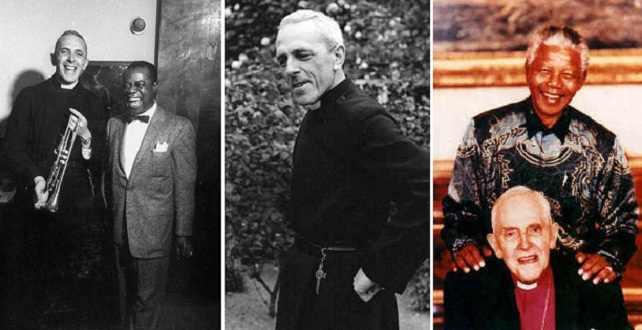
In the first part of this post I introduced you to my father, Captain OG Cameron DSC, RN, the man who fueled my keen interest in gallantry and the martial side of things. The other great influence in my early life was Fr. Trevor Huddleston CR, pictured below:


.

Trevor Huddleston CR:

Archbishop the Most Reverend Sir Ernest Urban Trevor Huddleston CR, KCMG – it’s hard even to know how to string his titles together, this monk, priest, schoolteacher, activist, archbishop, finally knighted by Her Majesty towards the end of his long and eventful life was the man who became a second father, guardian, mentor and spiritual guide to me shortly after my father died when I was nine.

That’s the man as I knew him, Father Trevor — simple, caring, intelligent, perhaps a little austere even — in the middle image above.

Austerity, simplicity: two more words to set beside gallantry in the lexicon of admiration and gratitude.
.

Satchmo:

To the left in the same image, he’s shown with Louis Armstrong — Satchmo — who has just presented him with a trumpet.

The story goes like this: as a monk in an Anglican monastic order, the Community of the Resurrection popularly known as the Mirfield Fathers, Father Trevor was sent to South Africa while still a young man, and worked in Sophiatown, just outside Johannesberg, as a priest and teacher.

A young black kid in one of his classes, Hugh, aged 12 or 13, fell ill and was taken to hospital, where Trevor Huddleston visited him. Trevor asked him what he would like more than anything in this world, what would so thrill and please him that he would have the greatest possible motive for getting better, getting out of the hospital and back to school. Hugh said, “a trumpet, Father” — so Trevor got hold of a trumpet which he then presented to the boy: now known the world over as the great jazz trumpeter, Hugh Masekela.

That wasn’t quite enough, though. A year or three later, Trevor was in the United States, and met Satchmo, who asked if there was anything he could do to help… Trevor told Satchmo he’d started a jazz band for the kids in his school, and knew a boy who would just love a trumpet…

Trevor was a hard man to refuse.
.

Hugh Masekela:

Here’s Hugh Masekela, just a little older, with the trumpet Trevor brought him from Louis Armstrong:

And here’s the sound…

When I was maybe 15, and Trevor had returned from South Africa to England, he gave me a 7″ “45” record of the Huddleston Jazz Band — now long lost. Imagine my amazed delight to be able to hear that sound again, fifty years later, through the good graces of the internet —

Hugh Masekela and the Huddleston Jazz Band play Ndenzeni na?


.

Desmond Tutu:

Another story I like to tell about Trevor and his time in South Africa has to do with a lady…

It seems this young black kid aged about 8 or 9 was sitting with his mother on the “stoop” outside his house in a South African shanty-town when a white priest walked by and doffed his hat to the boy’s mother.

The boy could hardly grasp how this had happened — his mother was a black woman, as one might say, “of no special acount”. But the priest in question was Trevor Huddleston, and it was a natural courtesy for him to lift his hat in greeting a lady…

The young boy never quite recovered from this encounter. We know him now as the Nobel Peace laureate, Archbishop Desmond Tutu.

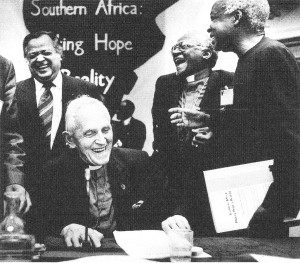
Here’s a photo of four old friends — Huddleston, Tutu, Julius Nyerere of Tanzania, and former Commonwealth Secretary General Shridath Ramphal.
.

From individuals to the world:

These are two simple stories of how Fr Trevor simply and straightforwardly loved whomever was before him, regardless of the enormous pressure at the time to discriminate between “real” and “insignificant” people — a love which made an indelible mark on those whose lives it touched.

And when Father Trevor touched you, as Lord Buckley might say, you stayed touched.

Thus far I’ve been focusing on individuals that Trevor touched. I do not think he in fact saw more than one person at a time, and his responses to situations were geared directly to the service of his love.

It was because of this that while he was in South Africa, Trevor repeatedly and quite literally put his life on the line in defence of the very simple proposition that the color of a person’s skin was immaterial in view of the love that was possible between any two people — so perhaps here’s where I should mention some of that history and some of the honors it brought him. After all, Trevor did pretty much take on the government of the South Africa he so loved, and lived to see it change.
.

Bishop Trevor of Sophiatown

Trevor Huddleston was a founding member of the African National Congress, the author of the first non-fiction work (Naught for Your Comfort, more on that later) to critique his beloved South Africa’s apartheid policy, reviled publically for meddling in politics by an Archbishop of Canterbury who later declared he had been in error and that Fr Trevor was about as close to a saint as one could find.

In 1955, Father Trevor, along with Yusuf Dadoo and Chief Albert Luthuli, was awarded the Isitwalandwe, the highest award given by the African National Congress. He was awarded the United Nations Gold Medal in recognition of his contribution to the international campaign against apartheid, the highest awards from both Zambia and Nigeria, the Dag Hammerskjold Award for Peace, the Indira Gandhi Memorial Prize, and ten honorary doctorates, including that of his alma mater, Oxford.

Archbishop Huddleston initiated the “International Declaration for the Release of Nelson Mandela and all Political Prisoners” in 1982, took part in the televised “International Tribute for a Free South Africa” held at Wembley Stadium, London in 1990 during which he introduced the address by Nelson Mandela (see below), entered South Africa House, Trafalgar Square, London in 1994 to vote in the first South African democratic election, and was a guest at President Mandela’s inauguration in Pretoria that year.

He received the KCMG (Knight Commander of the Order of St. Michael and St. George) in the 1998 New Year Honours list, for “Services to UK-South African Relations”, and attended an Investiture at Buckingham Palace on March 24th, 1998, to receive this honour from HM the Queen.

He chose the designation, “Bishop Trevor of Sophiatown”.
.

Nelson Mandela:

But let’s go back to individuals, and to Nelson Mandela in particular.

Mandela and Trevor were comrades in the fight against apartheid from the beginning — and the richness of their friendship is visible in the photo of Mandela with his arms on Trevor’s shoulders in the right hand panel at the top of this page.

In his autobiography, Long Walk to Freedom, Mandela tells the story of a time when he and Walter Sisulu were approached by a group of South African police who had been ordered to arrest them. Trevor, who was talking with with the two of them, called out to the cops, “No, you must arrest me instead, my dears.”

It’s that “my dears” that gives the game away. I can hear those words in Trevor’s voice. Even the cops were dear to Trevor: he might be utterly opposed to what they were doing, and risk his life to oppose them – but they were children of God.

Here’s a video of Trevor’s speech introducing Mandela at Wembley — a political speech, to be sure, but one powered by religious conviction:


.

Mandela’s tribute:

I’m saving the best of what Fr. Trevor taught me for the third post in this series, and hope to wrap the series up with some of my own reflections in a fourth; here I’d like to close with the words Mandela wrote about his friend after Trevor’s death in 1998:

It is humbling for an ordinary mortal like myself to express the deep sense of loss one feels at the death of so great and venerable figure as Father Trevor Huddleston.

Father Huddleston was a pillar of wisdom, humility and sacrifice to the legions of freedom fighters in the darkest moments of the struggle against apartheid. At a time when identifying with the cause of equality for all South Africans was seen as the height of betrayal by the privileged, Father Huddleston embraced the downtrodden. He forsook all that apartheid South Africa offered the privileged minority. And he did so at great risk to his personal safety and well-being.

On behalf of the people of South Africa and anti-apartheid campaigners across the world, I convey my deepest condolences to his Church, his friends and his colleagues. Isithwalandwe Trevor Huddleston belonged to that category of men and women who make the world the theatre of their operation in pursuit of freedom and justice.

He brought hope, sunshine and comfort to the poorest of the poor. Not only was he a leader in the fight against oppression. He was also father and mentor to many leaders of the liberation movement, most of whom now occupy leading positions in all spheres of public life in our country. His memory will live in the hearts of our people.

Query: COIN Manual Conference Feedback

Wednesday, May 16th, 2012


Was the COIN  Manual conference at Fort Leavenworth last week a success or a failure?

I have heard backchannel that the focus of the rewrite of FM 3-24 was going to be on “tactics” and but that a “light footprint option” had to be included to appease policy makers. Some good suggestions were made at SWJ by Colonel Robert C. Jones, but not much has been said yet online that I have seen. USACAC bloseriously could use some updating on a more frequent basis.

I’m curious where they went with this. Opinions and comments solicited.

Magic, mediums and Mugabe

Monday, April 9th, 2012

[ by Charles Cameron — religion and politics in Africa – “fire burn and cauldron bubble” ]
.

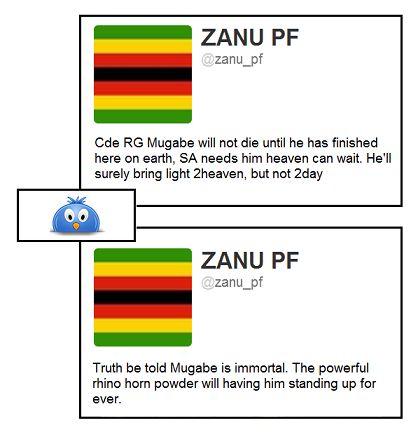
Among the marvels delivered recently by Twitter:

*

SAIS graduate Daniel Morris provided some context in this Globe and Mail article written a few years back about the 2008 elections, Mugabe plays the God card:

The story starts as far back as March of 1898, when Rhodesia’s British occupiers hanged a 36-year-old woman named Charwe for allegedly murdering a colonial officer. But Charwe was no ordinary woman. She was the spiritual medium for Nehanda, the first female ancestor of the Shona tribe.

In his study of Charwe’s life and death, historian D. N. Beach of the University of Zimbabwe has concluded that she may well have been innocent of the murder. But she had a reputation as an anti-colonial fighter and refused to co-operate with the British. Charwe herself knew that these offences, as much as any murder, would warrant execution under the colonial government’s conception of justice.

Nehanda had been believed to be the spiritual guardian of Shona lands ever since committing ritual incest with her brother centuries before. Aware of the powerful inspiration she provided, the British were happy to believe she died with Charwe.

They soon learned, however, that the Shona spirits do not expire so easily. Nehanda didn’t just survive the hanging – her memory became mixed up with that of Charwe, and she was soon remembered as a potent symbol of colonial resistance. In the past few decades, she has experienced a popular revival, commemorated in “statues, street names, a hospital, posters, songs, novels and poems, and … the subject of a full-length feature film,” according to Prof. Beach.

Four out of five Zimbabweans are Shona, including Robert Mugabe. Since his beginnings as a guerrilla fighter against colonial rule in the 1970s, he has incorporated Nehanda into his political rhetoric, praising her as a martyr and heroine. In Guns and Rain, a book on spirit mediums in Zimbabwe, historian David Lan quotes a news report from Oct. 10, 1983, saying that Mr. Mugabe, “swearing by the name of the legendary anti-British spirit medium Ambuya [Grandmother] Nehanda, vowed that his government would confiscate white-owned land for peasant resettlement if [prime minister Margaret] Thatcher suspends promised British compensation.”

And:

The world already knows Mr. Mugabe is cynical and dangerous. But to understand the enduring, if waning, support he has been able to maintain for decades, the story goes beyond modern politics. The current battle for the presidency of Zimbabwe is taking place in the spiritual world as well, where the soul of a religious ancestor continues to be used as a political weapon.

*

It would be all too easy to ignore the influence of “the spiritual world” and “the soul of a religious ancestor” in the name of secular modernity — but which world is more vivid to many of the people of Zimbabwe?

Before we go overboard condemning African spiritual practices, it’s worth recalling that Prof. Ralph Kirsch of the Department of Medicine in the University of Cape Town Medical School was quoted in a 1995 British Medical Journal article as saying:

Traditional healers are a very caring people, and extraordinarily skilled in psychotherapy and counselling. Some of them do a damn good job. Of course there are certain horrible ones who poison their patients at every turn…

I’m sure that those more familiar with the literature could find more and more recent articles to the same effect.

Here as elsewhere, the “distinctions that make a difference” are in the details…

*

Ironic ADDENDUM:

Meanwhile @Aynte tweets:

#Zimbabwe leader Rober #Mugabe critically ill at a #Singapore hospital


Switch to our mobile site