zenpundit.com » europe

Archive for the ‘europe’ Category

R2P is a Doctrine Designed to Strike Down the Hand that Wields It

Saturday, September 3rd, 2011

There has been much ado about Dr. Anne-Marie Slaughter’s ennunciation of “Responsibility to Protect” as a justification for the Obama administration’s unusually executed intervention (or assistance to primarily British and French intervention) in Libya in support of rebels seeking to oust their lunatic dictator, Colonel Moammar Gaddafi. In “R2P” the Obama administration, intentionally or not, has found it’s own Bush Doctrine, and unsurprisingly, the magnitude of such claims – essentially a declaration of jihad against what is left of the Westphalian state system by progressive elite intellectuals – are beginning to draw fire for implications that stretch far beyond Libya.

People in the strategic studies, IR and national security communities have a parlor game of wistfully reminiscing about the moral clarity of Containment and the wisdom of George Kennan. They have been issuing tendentiously self-important “Mr. Z” papers for so long that they failed to notice that if anyone has really written the 21st Century’s answer to Kennan’s X article, it was Anne-Marie Slaughter’s battle cry in the pages of The Atlantic.

George Kennan did not become the “Father of Containment” because he thought strategically about foreign policy in terms of brutal realism. Nor because he was a stern anti-Communist. Or because he had a deep and reflective understanding of Russian history and Leninism, whose nuances were the sources of Soviet conduct. No, Kennan became the Father of Containment because he encapsulated all of those things precisely at the moment when America’s key decision makers, facing the Soviet threat, were willing to embrace a persuasive explanatory narrative, a grand strategy that could harmonize policy with domestic politics.

Slaughter’s idea is not powerful because it is philosophically or legally airtight – it isn’t – but because R2P resonates deeply both with immediate state interests and emotionally with the generational worldview of what Milovan Djilas might have termed a Western “New Class”.

While it is easy to read R2P simply as a useful political cover for Obama administration policy in Libya, as it functioned as such in the short term, that is a mistaken view, and one that I think badly underestimates Anne-Marie Slaughter. Here is Slaughter’s core assertion, where she turns most of modern diplomatic history and international law as it is understood and practiced bilaterally and multilaterally by sovereign states in the real world (vice academics and IGO/NGO bureaucrats) on it’s head:

If we really do look at the world in terms of governments and societies and the relationship between them, and do recognize that both governments and their citizens have rights as subjects of international law and have agency as actors in international politics, then what exactly is the international community “intervening” in?

…For the first time, international law and the great powers of international politics have recognized both the rights of citizens and a specific relationship between the government and its citizens: a relationship of protection. The nature of sovereignty itself is thus changed: legitimate governments are defined not only by their control of a territory and a population but also by how they exercise that control. If they fail in that obligation, the international community has the responsibility to protect those citizens.

Slaughter is a revolutionary who aspires to a world that would functionally resemble the Holy Roman Empire, writ large, with a diffusion of power away from legal process of  state institutions to the networking informalities of the larger social class from whom a majority of state and IGO officials are drawn, as a global community. In terms of policy advocacy, this is a brilliantly adept move to marry state and class interests with stark moral justifications, regardless of how the argument might be nibbled to death in an arcane academic debate.

As with Kennan’s X Article, which faced a sustained critique from Walter Lippmann who realized that Containment implied irrevocable changes in the American system, R2P has attracted criticism. Some examples:

Joshua Foust –Why sovereignty matters

Much as advocates of the “Responsibility to Protect,” or R2P, like to say that sovereignty is irrelevant to the relationship of a society to its government (which Slaughter explicitly argues), it is that very sovereignty which also creates the moral and legal justification to intervene. For example, the societies of the United States and NATO did not vote to intervene in Libya – their governments did.

Foreign Affairs – The Folly of Protection

….RtoP, responding to the sense that these domestic harms warranted international response, solidified the Security Council’s claims to wider discretion. Yet it also restricted its ability to sanction intervention to the four situations listed in the RtoP document — genocide, war crimes, ethnic cleansing, and crimes against humanity — and thus precluded, for example, intervention in cases of civil disorder and coups. Although the resolution authorizing force against Libya will certainly further entrench the principle of RtoP, it will not completely resolve the tension between RtoP — in itself only a General Assembly recommendation — and the UN Charter itself, which, according to the letter of the law, limits action to “international” threats.

Dan Trombly –The upending of sovereignty and Responsibility to Protect Ya Neck

Beauchamp, along with Slaughter, have revealed R2P for what it actually is: a doctrine based on regime change and the destruction of the foundations of international order wherever practically possible. After all, are intervening powers really fulfilling their responsibility if they fail to effect regime change after intervening? This is exactly why I believe R2P is far more insidious than many of its advocates would have us believe or intend in practice. It is essentially mandating a responsibility, wherever possible, to seek the sanction, coercion, or overthrow of regimes which fail to meet a liberal conception of acceptable state behavior. Even if R2P is never applied against a major power, it is hard to see why such behavior would not be met with just as much suspicion as humanitarian intervention and previous Western regime change operations were. Indeed, a full treatment will reveal there is immense pressure for R2P to initiate the more fundamental, and more universal, impulse to revert to the potential ruthlessness inherent in international anarchy.

Understandably, such critiques of R2P are primarily concerned with sovereignty as it relates to interstate relations and the historical predisposition for great powers to meddle in the affairs of weaker countries, usually with far less forthrightness than the Athenians displayed at Melos. It must be said, that small countries often  are their own worst enemies in terms of frequently providing pretexts for foreign intervention due to epic incompetence in self-governance and a maniacal delight in atavistic bloodshed. Slaughter is not offering up a staw man in relation to democide and genocide being critical problems with which the international community is poorly equipped and politically unwilling to counter.

But R2P is a two edged sword – the sovereignty of all states diminished universally, in legal principle, to the authority of international rule-making about the domestic use of force is likewise diminished in it’s ability to legislate it’s own internal affairs, laws being  nothing but sovereign  promises of state enforcement. Once the camel’s nose is legitimated by being formally accepted as having a place in the tent, the rest of the camel is merely a question of degree.

And time.

As Containment required an NSC-68 to put policy flesh on the bones of doctrine, R2P will require the imposition of policy mechanisms that will change the political community of the United States, moving it away from democratic accountability to the electorate toward “legal”, administrative, accountability under international law; a process of harmonizing US policies to an amorphous, transnational, elite consensus, manifested in supranational and international bodies. Or decided privately and quietly, ratifying decisions later as a mere formality in a rubber-stamping process that is opaque to everyone outside of the ruling group.

Who is to say that there is not, somewhere in the intellectual ether, an R2P for the the environment, to protect the life of the unborn, to mandate strict control of small arms, or safeguard the political rights of minorities by strictly regulating speech? Or whatever might be invented to suit the needs of the moment?

When we arrest a bank robber, we do not feel a need to put law enforcement and the judiciary on a different systemic basis in order to try them. Finding legal pretexts for intervention to stop genocide does not require a substantial revision of international law, merely political will. R2P could become an excellent tool for elites to institute their policy preferences without securing democratic consent and that aspect, to oligarchical elites is a feature, not a bug.

R2P will come back to haunt us sooner than we think.

ADDENDUM:

Doug Mataconis at Outside the Beltway links here in a round-up and commentary about R2P posts popping up in the wake of the Slaughter piece:

The “Responsibility To Protect” Doctrine After Libya

….It’s understandable that the advocates of R2P don’t necessarily want to have Libya held up as an example of their doctrine in action. Leaving aside the obvious contrasts with the situation in Syria and other places in the world, it is by no means clear that post-Gaddafi Libya will be that much better than what preceded it. The rebels themselves are hardly united around anything other than wanting to get rid of Gaddafi and, now that they’ve done that, the possibility of the nation sliding into civil and tribal warfare is readily apparent. Moreover, the links between the rebels and elements of al Qaeda that originated in both Afghanistan and post-Saddam Iraq are well-known. If bringing down Gaddafi means the creation of a safe haven for al Qaeda inspired terrorism on the doorstep of Europe, then we will all surely come to regret the events of the past five months. Finally, with the rebels themselves now engaging in atrocities, one wonders what has happened to the United Nations mission to protect civilians, which didn’t distinguish between attacks by Gaddafi forces or attacks by rebels.

….Finally, there’s the danger that the doctrine poses to American domestic institutions. If Libya is any guide, then R2P interventions, of whatever kind, would likely be decided by international bodies of “experts” rather than the democratically elected representatives of the American people. American sailors and soldiers will be sent off into danger without the American people being consulted. That’s not what the Constitution contemplates, and if we allow it to happen it will be yet another nail in the coffin of liberty.

Read the rest here.

Anonymous and Master Roger, a review

Tuesday, August 30th, 2011

 by J. Scott Shipman

master-roger.jpeg

Anonymous and Master Roger, Anonymous, Notary of King Béla The Deeds of the Hungarians, Master Roger’s Epistle to the Sorrowful Lament upon the Destruction of the Kingdom of Hungary by the Tartars

 Back in June Zen posted a couple of mini book reviews, and David Schuler posted this comment: 

 “For moderns inclined to romanticize war in antiquity may I recommend The Epistle to the Sorrowful Lament upon the Destruction of the Kingdom of Hungary by the Tartars?  It became available in English translation fairly recently and constitutes a first-hand account of the Mongol invasion of Hungary.  The violence, not only against persons and property, but against the land itself is notable and eye-opening.”

The title was enough to pique my interest, and since I knew very little of this period I went to Amazon UK and purchased a copy (US versions are prohibitively expensive) . That said, I didn’t expect to get around to reading for some time, but if I don’t “buy” a book while it is still on my mind, I’ll likely forget as the pile continues, “without ceasing” (to wax Biblical) to grow. For an obscure text, the introduction drew me in and I was hooked enough to read a few pages a day.

The book has ample and informative introductions to each work. The stories are presented in Latin on one page and English on the facing page.

The narratives are very different, Anonymous was a Notary to King Béla (circa 1196), and he recounts the deeds of Hungarian royalty, and the behind the scenes machinations of the royal court. Anonymous’ account was laced with both biblical and classic texts and was quite tedious, predictably obsequious but while at the same time offering up little snippets here and there—and often in the notes. A note in the section titled 40. The Victory of Prince Árpád, Anonymous wrote: “…for thirty four days and in that place the prince and his noblemen ordered all the customary laws of the realm and all its rights.” The editors included the following footnote with respect to “rights.”

 “The translation of ius (in contrast to lex, “law”) is a problem that is not only linguistic. Translators of Roman legal texts often retain ius, as it implies law, justice, rights along with all their connotations. Modern English does not distinguish lex from ius, Gesetz from Recht, or loi from droit, which may explain the generally supine Anglo-Saxon attitude towards the law and authority in general…”

Schuler was right in his description of Master Roger’s first hand account of the Tartar invasion (1241/42); horrific comes to mind. There is no romance. The brutality and ruthlessness of the Tartars is awe-inspiring and fearful 900 years removed. The tactics of the Tartars are textbook examples of psychological warfare before the term was coined—and their ability to “get inside” their adversaries decision-making loop (OODA, anyone?) was remarkable.

The ancient Sorrowful Lament story was reassuring of the power and resilience of the human spirit. The deprivations experienced by the Hungarians were not unique in human history, but serve to illustrate how resilient a people can be when things truly go to hell in a hand basket. When their leaders failed, the Hungarians found way to live in spite of their feckless unprepared leaders, and in spite of a ruthless, blood and booty thirsty enemy.

Anonymous and Master Roger is recommended to anyone wanting to understand the human condition, whether royalty, peasant, bureaucrat, or barbarian. This is an important book…for a “sorrowful lament” has much to teach us about the human condition and how little man changes. This highly eclectic little title comes highly recommended and many thanks to Dave for sharing.

Postscript: One remarkable thing about this book, printed in Hungary, is the high quality construction using good paper and string.

There are no references to share for this volume, however if this volume is indicative of their work, Central European Medieval Texts are to be commended and followed.

BTW, Joey recommended Millenium by Tom Holland and I’m about half-way through—excellent thus far!

Oslo and Utoya: further readings II

Friday, August 5th, 2011

[ by Charles Cameron — various angles on Breivik, continuing ]

.

“There’s always a mystery.”

Dr. Dalrymple is holding forth on what we can — and can’t — know about the mind of a mass murderer like the Oslo shooter, Anders Behring Breivik. “I don’t think we’ll ever understand” what makes a person capable of this kind of premeditated murder, Dr. Dalrymple tells me over lunch. What’s more, he says, “we don’t even know what it is to understand. At what point do you say, ‘Aha! Now I understand!'” he asks.

That’s a [pseudonymous] British prison psychiatrist, interviewed in the Wall Street Journal.

*

A few things have happened since my previous batch of posts on Oslo and Utoya: some other reading – I’m betting one of them is that a lot of people have arrived that their “Aha! Now I understand!” moment on Breivik, and aren’t particularly interested in alternate views. Their eyes may still be caught by a sensational headline, perhaps, they may still be fascinated by police procedural accounts of the investigation and trial – but they’ve arrived at closure on “who he is and why he did it” and that’s it, case closed.

Dr. Dalrymple’s suggests there is “always a gap between what is to be explained and your alleged explanation. So there’s always a mystery, and I think that’s going to remain.”

In this post, I’ll begin to list some of the more remarkable and/or worthwhile reading I’ve come across since my previous post. Let’s begin with Thomas Hegghammer:

When Thomas Hegghammer writes about Breivik, which he has finally done, we get the chance to read one of the world’s finest Al Qaeda scholars writing about one of his fellow Norwegians. I mentioned his tweets as passed along by Will McCants in my first “some other reading” post. Hegghammer’s NYT op-ed, The Rise of the Macro-Nationalists, claims that Brevik’s 2083 manifesto “reveals a new doctrine of civilizational war that represents the closest thing yet to a Christian version of Al Qaeda”. If anyone should, Hegghammer should know.

So that would be my number one pick.

And then…

An American Apology to Norway . . . sorry about that, from MilPub.  Written by Seydlitz, a friend of — and recent guest poster on — this blog.  Personal and touching.

Moving farther afield, this one caught my eye:

Joan Acocella, Stieg Larsson and the Scandinavian Right, on the New Yorker’s Book Bench: “The major subplot of the stories on the massacre is what many people are now describing as the indifference of the government and press corps in Norway — and, by extension, in Scandinavia and the West as a whole — to native right-wing movements and their potential for violence.” Acocella closes with the words, “Larsson died before those developments, but he’s up there somewhere saying, ‘I told you so.'”

Of all the people on that Scandinavian right, Breivik quoted the blogger known as Fjordman most frequently – so this interview with Fjordman (under his own name, Peder Jensen) is key. Most telling quote, strangely enough: “After the terrorist attack and his blog being cited as an influence, Jensen says he will never use the alias «Fjordman» again.”

I wasn’t intending to use this post to do much in the way of propagating my own ideas, bur many of the items that follow have to do with who influenced or inspired Breivik, and thus with the issues of free speech, inspiration, incitement, and slippery slopes. Earlier today I responded to a ZP comment with an aphorism playing off the phrase “correlation is not causation” – so that phrase was already prepped and ready in my head, and what nudged its way into consciousness as I was tapping out this quick write-up for Fjordman was another:

Quotation is not causation.

I think that’s important in a way that parallels the importance of “innocent until proven guilty”.

Back to my list.

Oslo anthropologist Thomas Hylland Eriksen, Anders Behring Breivik: Tunnel vision in an online world, in The Guardian, comments on Norway’s “subculture of resentment”:

Breivik must willingly have allowed himself to be brainwashed by Islamophobic and extreme rightwing websites. However, had he instead been forced to receive his information through a broadsheet newspaper, where not all the stories dealt with Europe’s loss of confidence and the rise of militant Islam, it is conceivable that his world would have looked slightly different. Perhaps one lesson from this weekend of shock and disbelief may be that cultural pluralism is not necessarily a threat to national cohesion, but that the tunnel vision resulting from selective perusal of the internet is.

Okay, Stormfront next. I won’t link there, but I visited, and they had a thread titled Please post ALL items about the “Oslo killer” in this thread! which already ran to 51 pages shortly after the event. Conspiracy is stranger than fiction – consider this intriguing suggestion from the first page:

White Brothers from Norway, let us know the truth. It sounds like a Mossad operation to me. Another, 9/11, Mumbai, 7/7, Spain, Shoe Bomber or Ball bomber. This has the tell tale signs of a Mossad operation.

Pastebin / Anonymous. Worth quoting in full:

Operation UnManifest:

As Anders Behring Breivik wants to use the cruel action of killing over 90 young people to promote his 1516-page manifesto, also with the help of the internet, Anonymous suggests following action:

1. Find the Manifest of Anders Behring Breivik : 2083 – A European Declaration of Independence
2. Change it, add stupid stuff, remove parts, shoop his picture, do what you like to…..
3. Republish it everywhere and up vote releases from other peoples, declare that the faked ones are original
4. Let Anders become a joke, such that nobody will take him serious anymore
5. Spread this message around the internet and real life, translate it
6. Have a moment for the victims of his cruel attacks

We all are anonymous,
We all are Legion,
We all do not forgive murder,
We all do not forget the victims.

Time for a quick detour on Anonymous? — in the words of NYU’s Garbriella Coleman, in the most detailed account I’ve seen (h/t Shannon Trosper) of that curious entity, Anonymous: From the Lulz to Collective Action:

Anonymous functions as what Marco Deseriis defines as an improper name: “The adoption of the same alias by organized collectives, affinity groups, and individual authors.”

And while we’re on the subject of names — “We are Legion” is likely an echo of the response a biblical demon gave to Jesus when commanded to leave a crazed man: “My name is Legion; for we are many” (Mark 5.7).

Back to our Breivik materials…

Anders Sandberg is someone I respect and have been reading for years – currently at a futuristic tank at Oxford I believe, an old-time gamer, well acquainted with heremetic and kabbalistic traditions, and pretty clear-headed in not always expected ways. His piece here — Blaming victims, individuals or social structures? — is worth reading in full, but the sting is in its tail:

It is worth considering that the number of victims of terrorism and individual hate-crime over the past century (perhaps of the order of hundreds of thousands) is minuscule compared to the number of victims of institutionalized democide and war (of the order of hundreds of millions victims). While terrorism is horrific and personal, it is when mistrust or hatred of out-groups become institutionalized they become truly dangerous. In this regard any political ideology or institution that does not try to reduce its out-group bias ought to be viewed as far more potentially dangerous than any individual, no matter how hate-filled or destructive.

*

Okay, I clearly need more than one post to do justice to my materials, so I’ll leave it at that for now, and be back soon.

2083 Graphics — a first look

Sunday, July 24th, 2011

[ by Charles Cameron — index of graphics, first 800 or so pages of the “2083 European Declaration of Independence”, with some analysis ]

.

A great deal of work needs to be done on the 2083 European Declaration of Independence, and I thought a useful place to start would be a catalog of images.

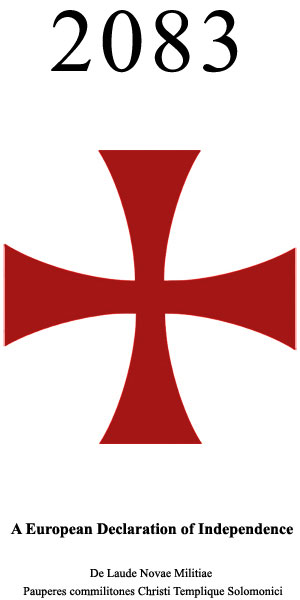
The document opens with a graphical title:

000-2083-cross-tp.jpg — title page —

That’s probably the largest single graphic in the entire work, and it puts the work squarely in the context of the Knights Templar — with e Templar cross and the full name of the order, “Pauperes commilitones Christi Templique Solomonic” or Poor Fellow-Soldiers of Christ and of the Temple of Solomon.  The Templars were a Western Christian chivalric order strongly associated with the Crusades — and the topic more recently of much historical, occult and fictional speculation.

The date 2083 is a date SFE (in the Science Fictional Era) as was 1984 before it — but it was almost certainly chosen for its echo of the 1683 Battle of Vienna, which is commonly taken to represent the turning back of the Ottomans by the Habsburgs, and thus the victory of Christendom over Islam.  Two maps show the Umayyad Conquests:

umayyad-conquests-p-228.jpg — p 228 —

and the Second Islamic Wave, turned back in Spain and at the gates of Vienna:

243-1683-second-islamic-wave-p-243.jpg — p 243 —

These can fruitfully be contrasted with a map of “tomorrow”:

demain-p-487.jpg — p 487 —

it being the author’s contention that France will be the first European country to fall to Islamic dhimmitude.  I suspect much the same is implied in this version of the French tricolore:

flag-face-p-781.jpg — p 781 —

There are some pointed attacks on leftist intellectuals:

033-academic-reform-p-33.jpg — p 33 —

and on media perceived as left-leaning, notably the BBC:

bbc-flag-w-crescent-p-384.jpg  — p 384

— that’s the Saudi flag mashed up with the BBC logo and star and crescent — and:

804-bbc-02-p-804.jpg  — p 804 —

giving both “ancient” and “modern” variants on the theme…

There are some strange items which I’ll drop in here for a breath of fresh air…

free-pluto-equal-gravity-for-all-planets-p-381.jpg  — p 381 —

which appears to be a commentary on the respective attractions of Venus and Mars, since it’s situated in a commentary on Feminism…

this really is a strangely mythic document… and…

global-warming-voidka-p-657.jpg

with its reference to “mind control agents” — and those whose minds have been controlled are clearly sheep:

wake-up-p-803.jpg — p 803 —

which may be the right moment to mention that the British, too, come in for a measure of contempt, via a quotation from none other than Osama bin Laden:

when-people-see-a-strong-horse-p-707.jpg  — p 707 —

“When people see a strong horse and a weak horse, by nature they will like the strong horse”.  Perhaps its unsurprising that the author is something of an admirer of bin Laden’s means, if not his ends.

Of course, that’s largely the fault of the Labour party:

labour-declares-multiculturalism-is-a-blessing-p-373.jpg

But that’s probably enough for one post — in my next, I’ll consider how weak we are, what the jihadist strategy against us is, and how the new Templars hope to turn the tide

against:

worst-threats-to-mankind-p-674.jpg — p 674 —

the worst threats to mankind.

Diesel Boats Forever! or ever?

Thursday, July 14th, 2011

German and Italian Type 212

Modern German Diesel Electric Submarines (Type 212)

by J. Scott Shipman (diesel electric submarines, naval strategy, Taiwan, Republic of China, submarines)

David Trombly at the new Fear, Honor, and Interest blog posted a thought provoking article on Taiwan, sea denial, and the bounding of US dominance.

This post caught my eye for several reasons, not the least of which is that in another life I rode submarines (ballistic missile subs: USS VON STEUBEN (SSBN-632) and the commissioning crew of USS PENNSYLVANIA (SSBN-735). Another is I attended on behalf of a former employer in 2001/2002 an industry day event soliciting interest in the US production of diesel electric submarines for the use of Taiwan (Republic of China, or ROC). US production was authorized (see background: here) because the ROC was having difficulty purchasing through European diesel boat manufacturers. Germany, Sweden, and France have proven platforms, as do the Russians and their KILO class. All of these nations export submarines, but few want to antagonize the ROC’s increasingly global neighbor China.

The industry day event was well attended, but as I sat there I had little confidence there would ever be a diesel electric submarine produced in a US shipyard. Here’s why: the US Navy is heavily vested in nuclear powered submarines which are incredibly expensive, with the most modern VIRGINIA Class coming in at around $2B a copy. When compared to modern diesel boats which run between $200-$300M, Big Navy understandably wants to avoid any possible comparisons—or for the question even to be raised. The industry event was more a public show of supporting Congress and the president than a serious inquiry, and nothing more than slides were produced (which is often the case in Washington, btw).

The USN is overextended by almost any measure, our national shipbuilding infrastructure is perhaps at its lowest point and our Fleet has less ships (about 283) than any time since WWI. We have about 70 submarines (18 OHIO Class of which 4 are guided missile submarines, 7 VA Class, 3 SEAWOLF, and about 43 older Los Angeles Class). These boats spend about half their time deployed, which drives up maintenance costs and cost to crew separated from family [the OHIO Class ships rotate crews about every 90 days] Our submarines are built exclusively in Groton, CT, and Newport News, VA. We have naval shipyards for heavy modifications, nuclear refueling/overhauls in Norfolk, Portsmouth, Bremerton, and Pearl Harbor (though I don’t believe Portsmouth or Pearl are authorized refueling facilities).

In this environment of increased op-tempo, and low numbers of ships/boats we have continuing challenges to the maritime domain, including China’s increasingly muscular approach in the South China sea and that age old naval scourge, piracy. (H/T Feral Jundi at Facebook)

These realities, combined with an ally in need (and perhaps many more potential customers) seem to form a perfect storm of need for a small fleet of stealthy, American-made diesel electric submarines. If the Obama administration wanted to strengthen it bonafides in East Asia and with the American public, it would reengage on the Taiwan submarine issue and this time, instead of a deal neither side could abide (our side the very thought and insane requirements, their side appropriating the funds). If Taiwan is willing to pay for R&D, allow the building shipyard to keep the design, and find an American suitor, that all translates into that three letter word Joe Biden is so fond of: jobs. Jobs that would have little to no reliance on the increasingly precarious federal government and shrinking defense budgets. Taiwan and the region would gain stealthy deterrents to potential Chinese mischief, the US could invigorate a fairly inbred shipbuilding industry with new talent, new ideas, and new competition, and maybe, just maybe we could build a few boats for those missions too mundane or cost-prohibitive for our nuke boats (like the piracy problem for a starter).

Postscript: As a former nuclear navy submariner, I am intimately familiar of the many positives nuke boats offer (I once spent 82 days submerged). My musing here is not a call for replacement, but rather to point out yet again (see this analysis), that our navy should have room for both in our increasingly complex world.

Please read my exchange with David at the Fear, Honor, and Interest post, as some innovative ideas not included in this post are presented. But I thought I’d share with the zenpundit audience as we spend a great deal of time talking strateegery here, but rarely naval issues, and I don’t post often enough…


Switch to our mobile site