zenpundit.com » intellectuals

Archive for the ‘intellectuals’ Category

Announcement: America 3.0

Monday, November 28th, 2011

Hearty congratulations to Lexington Green and James Bennett of Chicago Boyz on their book deal!

America 3.0

James C. Bennett, author of The Anglosphere Challenge (Rowman & Littlefield, 2004), and Michael J. Lotus (who blogs at Chicagoboyz.net as “Lexington Green”), are proud to announce the signing of a contract with Encounter Books of New York to publish their forthcoming book America 3.0.

America 3.0 gives readers the real historical foundations of our liberty, free enterprise, and family life.  Based on a new understanding our of our past, and on little known modern scholarship, America 3.0 offers long-term strategies to restore and strengthen American liberty, prosperity and security in the years ahead.

….America 3.0 shows that our current problems can be and must be transcended with a transition to a new America 3.0, based on modern technology, decentralized communities, and self-reliant families, and a reassertion of fiscal responsibility, Constitutionally limited government and free market economics.   Ironically the future America 3.0 will in many ways be closer to the original vision of the Founders than the fading America 2.0.

America 3.0 gives readers an accurate, and hopeful, assessment of our current crisis.  It also spotlights the powerful forces arrayed in opposition to the needed reform.  These groups include ideological leftists in media and the academy, politically connected businesses, and the public employees unions.  However, as powerful as these groups are, they have become vulnerable as the external conditions change.  A correct understanding of our history and culture, which America 3.0 provides, shows their opposition will be futile.  The new, pro-freedom, mass political movement, which is aligned with the true needs and desires of Americans, is going to succeed….

Read the rest here.

More Commentary on COIN is Dead

Friday, November 25th, 2011

SWJ Blog – COIN is Alive: Know When to Use it!

In his opinion piece, COIN is Dead:  U.S. Army must put Strategy Over Tactics published November 22 in World Politics Review, Colonel Gian Gentile appears to base his argument on the premise that COIN is not a strategy, but rather a collection of methods and tactics. Given his extensive combat experience and his impressive academic accomplishments, it is clear why his analyses of recent operations carry significant weight with leaders at all levels of our Army. However, I am unconvinced that his desire to reduce COIN from doctrine to a collection of methods and tactics is prudent at a time when we appear to be on the cusp of a scientific understanding of what fuels violent group behavior and the establishment of a strategic framework to determine when and where COIN may be best applied.

The scientific approach to the study of war has resided in the backwaters of military theory since the years immediately following the First World War. However, recent advances in evolutionary biology led by Harvard sociobiologist E.O. Wilson are providing insights to what generates warlike behavior within, between, and among groups of the social species, including our species Homo sapiens. Today, evolutionary behavior can be rudimentarily characterized by adaptations that are considered either beneficial toward the individual and their kin, or to a larger group or even a species….

Rethinking Security –COIN-Ish Thoughts

….First, it is a bit too soon for us to hail or mourn the death of COIN. What this represents is the end of COIN as practiced and theorized by elements within the Army and Marine Corps from 2006-2010, just as the Kennedy-era idea of counterinsurgency within elements of the US defense establishment died with Vietnam. The United States has faced insurgencies, terrorists, armed rebellions, guerrillas, partisans, and irregular raiding forces since the early days of colonization. It will continue to do so in the near future as long as American allies, clients, and proxies face irregular threats, although the shape of the response will vary.

Second, COIN, for all of the heat and noise about it, is still rather poorly understood in Iraq and Afghanistan. So much of the debate is weighted down with external baggage, mainly because it was never entirely about Iraq or Afghanistan. Rather, the COIN debate was often a proxy for many different political, professional, interdepartmental, and other battles within the United States political and defense establishments. Ollivant’s paper, and newer research highlights significant uncertainty to cause and effect in both sides of the COIN debate that will likely not be definitely settled soon.

Colin Clark (AOL Defense) –U.S. Military To Scrap COIN; Focus on Pacific, Says Vice Chairman

Omaha: The United States, which rushed to replace and rebuild its ability to wage counter insurgency warfare over the last decade, must plan for a new future in the Pacific and leave COIN behind.

“We are not likely to have as our next fight a counterinsurgency,” he said. While America has been teaching its troops Arabic and other regional languages, training them how to win friends and influence people at the village and provincial levels, “the world has changed,” Winnefeld said. America’s enemies and competitors are “coming up with new asymmetric advantages. They’ve been studying us closely…,” he said. So, “we need to avoid the temptation to look in our rear view mirror.”

Our future conflicts, the vice chairman said, will probably occur “in a far more technically challenging environment.” As he described it, the fight will be much closer to a conventional military conflict, characterized by “intense electronic warfighting,” swarm attacks and cyberwar.

All this is occurring as 20th century’s warfare, characterized by state clashes over “nice bright Westphalian borders” fades to black. Now, “borders are simply fading away,” with cyber best exemplifying this trend. “The border between near and far…has been obliterated by the Internet…,” the admiral said. The border between public and private is fading, as is the divide between companies and countries, with “some companies acting as countries” and some individuals being used by countries as “proxies.”

It is extremely difficult to free military bureaucracies, which are budget-centric, turf-conscious and institutionally track career incentives to the former, from the tyranny of either-or thinking. Bureaucracies as complex organizations are sustained and steered culturally by cherishing and reinforcing simple narratives.

A very few astute individual leaders can shape changes in the organization’s outlook while counterintuitively using the reforms a career accelerant. CIA Director General David Petraeus is both widely admired and bitterly disparaged for having pulled off this rare neat trick with re-establishing COIN within the US Army while rising to four stars, theater and combatant command and Washington “player” status.

Normally, institutional change-agents are like Colonel John Boyd, mavericks, who opt to do something important at the career cost of being somebody important. They try to create something new, sometimes do, but metaphorically perish in the process.

Most members of any organization, civilian or military, simply go with the flow and color within the lines they are given.

The Forum and The Tower, a review

Sunday, November 20th, 2011

[by J. Scott Shipman]
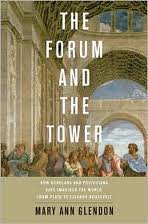
the-forum-and-the-tower.jpeg

The Forum and The Tower by Mary Ann Glendon

“The relationship between politics and the academy has been marked by mutual fascination and wariness since the time of Plato.”

The first sentence on the flap of the dust jacket of this very good and informative small book. Professor Glendon, who is the Learned Hand Professor of Law at Harvard Law school, set out to write a book for her students that would answer ageless questions such as:

“Is politics such a dirty business, or are conditions so unfavorable, that couldn’t make a difference? What kinds of compromises can one make for the sake of getting and keeping a position from which one might be able to have influence on the course of events? What kinds of compromises can one make for the sake of achieving a higher political goal? When does prudent accommodation become pandering? When should one speak truth to power no matter what the risk, and when is it acceptable, as Burke put it, to speak the truth with measure that one may speak it longer? When does one reach the point at which one concludes, as Plato finally did, that circumstances are so unfavorable that only the reasonable course of action is to “keep quiet and offer up prayers for one’s own welfare and for that of one’s country”?”

Professor Glendon answers these questions and more through brief examinations of the lives and works of some of history’s most important figures:

Plato

Cicero

Justinian, Tribonian, and Irnerius

Machiavelli

Thomas Hobbs and Edward Coke

John Locke

Jean-Jacques Rousseau

Edmund Burke

Tocqueville

Max Weber

Oliver Wendell Holmes

Eleanor Roosevelt and Charles Malik

All in all, I believe Professor Glendon has provided a uniquely valuable book to help her students and other readers to answers those questions. In short but focused chapters of about 20 pages each, she provides mini-biographies of the subjects above and how they answered the some of the questions both in their lives and in their philosophy. Some of her subjects were thinkers lacking the abilities for the public square, Plato, for instance, but were enormously influential just the same. Rare were those like Cicero and Burke who were equally comfortable in the political arena or the academy.

My favorite chapters were on Plato, Cicero, Machiavelli, and Burke—mostly because I’ve read a respectable amount of their work. That said, I have not read Plato’s The Laws—and Professor Glendon suggests it is much better than The Republic—which I have read and did not much enjoy. Not surprisingly, The Laws will be on my list for this winter.

The inclusion of Eleanor Roosevelt and Charles Malik was something of a surprise, but Professor Glendon is weaving a sub-story through each chapter and illustrating how Roosevelt and Malik’s work on the Universal Declaration of Human Rights was something of culmination and extension of over 2,000 years of thinking and political action—not in the context of human progress towards a utopia of sorts, which she wisely rejects,  but rather a reflection the common threads of political thought throughout history.

While this is not criticism, I would have liked to have seen a chapter on John Adams and Thomas Jefferson, and a chapter on Karl Marx, whom she frequently mentions.

This is a book that is approachable and readable, and in our tumultuous domestic and global political climate, important.

She closes with this illuminating sentence:

“If one message emerges from the stories collected here, it is that just because one does not see the results of one’s best efforts in one’s own lifetime does not mean those efforts were in vain.”

Professor Glendon is to be commended for a job “well done!”

The book comes with my highest recommendation and may be the best book I’ve read this calendar year. Add this book to your must read list.

.
Referenced works you may find of interest (some of these works are out of print and expensive—for simplicity I’ve used Amazon links): 

The Laws of Plato, translated by Thomas Pangle

Cicero: The Life and Times of Rome’s Greatest Politician, by Anthony Everitt

Cicero, A Portrait, by Elizabeth Rawson (Glendon praised this book.)

A Panorama of the World’s Legal Systems, John Henry Wigmore

The Life of Nicolo Machiavelli, Roberto Ridolfi

The Prince, translated by Harvy Mansfield

Machiavelli, by Quentin Skinner

The Lion and the Throne, Catherine Drinker Bowen

The Spirit of Modern Republicanism, by Thomas Pangle

Statesmanship and Party Government, by Harvy Mansfield

The Great Melody, A Thematic biography of Edmund Burke, by Conor Cruise O’Brien (I read this wonderful book in 1992 when it was released: highly recommended.)

Book

Sunday, November 20th, 2011

Thinking in Time by Richard Neustadt and Ernest May

Picked up this classic work on metacognition, history and strategic decision making for the astronomical price of…..$ 4. Including shipping.

The diminuition of the teaching of history in elite universities after the 1960’s, when the old undergraduate canon was chucked in deference to demands by student and faculty radicals for an a la carte system (to replace the old core with politicized race-gender-crit rubbish), has contributed to the decline in American strategic thinking.

K2: Kissinger on Kennan

Monday, November 14th, 2011


George F. Kennan: An American Life by John Lewis Gaddis

Former SECSTATE and grand old man of the American foreign policy establishment, Dr. Henry Kissinger, had an outstanding NYT review of the new biography of George Kennan, the father of Containment, by eminent diplomatic historian John Lewis Gaddis:

The Age of Kennan

….George Kennan’s thought suffused American foreign policy on both sides of the intellectual and ideological dividing lines for nearly half a century. Yet the highest position he ever held was ambassador to Moscow for five months in 1952 and to Yugoslavia for two years in the early 1960s. In Washington, he never rose above director of policy planning at the State Department, a position he occupied from 1947 to 1950. Yet his precepts helped shape both the foreign policy of the cold war as well as the arguments of its opponents after he renounced – early on – the application of his maxims.

A brilliant analyst of long-term trends and a singularly gifted prose stylist, Kennan, as a relatively junior Foreign Service officer, served in the entourages of Secretaries of State George C. Marshall and Dean Acheson. His fluency in German and Russian, as well as his knowledge of those countries’ histories and literary traditions, combined with a commanding, if contradictory, personality. Kennan was austere yet could also be convivial, playing his guitar at embassy events; pious but given to love affairs (in the management of which he later instructed his son in writing); endlessly introspective and ultimately remote. He was, a critic once charged, “an impressionist, a poet, not an earthling.”

For all these qualities – and perhaps because of them – Kennan was never vouchsafed the opportunity actually to execute his sensitive and farsighted visions at the highest levels of government. And he blighted his career in government by a tendency to recoil from the implications of his own views. The debate in America between idealism and realism, which continues to this day, played itself out inside Kennan’s soul. Though he often expressed doubt about the ability of his fellow Americans to grasp the complexity of his perceptions, he also reflected in his own person a very American ambivalence about the nature and purpose of foreign policy.

John Lewis Gaddis was George Kennan’s official biographer, a relationship that can contradict and complicate the task of a historian to tell us “like it really was” by growing too close and protective of the subject. On the other hand, Kennan’s unusual longevity and undimmed intellectual brilliance into his tenth decade permitted Gaddis a kind of extensive engagement with Kennan that was exceedingly rare among biographers.

I will be reading this book. Incidentally, Kennan’s own writings, notably his memoirs and his analysis of a totalitarian Soviet regime, Russia and the West under Lenin and Stalin are classics in the field of modern American diplomatic history, alongside books like Dean Acheson’s Present at the Creation. They are still very much worth the time to read.

The Gaddis biography will stir renewed interest and wistful nostalgia for Kennan at a time when the American elite’s capacity to construct or articulate persuasive grand strategies have become deeply suspect. Kennan himself would have shared the popular pessimism, having nursed it himself long before such a mood became fashionable.

ADDENDUM:

Cheryl Rofer weighs in on Kennan at Nuclear Diner

….Although the telegram and article did not deal explicitly with nuclear weapons, they were the basis for the strategy of containing, rather than rolling back, the Soviet Union and thus the arguments in the 1950s against attempting to eliminate the Soviet nuclear capability and in the 1960s against the same sort of move against China. Similar arguments continue today with regard to Iran.  

 Kissinger writes a sketch of Kennan himself and adds some of his own thoughts on diplomacy. The historical context of Kennan’s insights that he presents is worth contemplating in relation to today’s situation. How much of Cold War thinking can be carried into today’s thinking on international affairs, and how should it be slowly abandoned for ideas that fit this newer world better?

Addendum II.

Some fisking of Henry the K. by our friends the Meatballs:

Kissinger refers to Dean Acheson as “the greatest secretary of state of the postwar period.”  False modesty or a ghostwriter?  Gotta be one or the other, but we are leaning towards the former because no Kissinger Associates staffer would risk the repercussions from making a call like that.

Kissinger – the great Balance of Power practitioner – admired that Kennan (at least at times) shared his Metternich-influenced approach:

Stable orders require elements of both power and morality. In a world without equilibrium, the stronger will encounter no restraint, and the weak will find no means of vindication.

(…)

It requires constant recalibration; it is as much an artistic and philosophical as a political enterprise. It implies a willingness to manage nuance and to live with ambiguity. The practitioners of the art must learn to put the attainable in the service of the ultimate and accept the element of compromise inherent in the endeavor. Bismarck defined statesmanship as the art of the possible. Kennan, as a public servant, was exalted above most others for a penetrating analysis that treated each element of international order separately, yet his career was stymied by his periodic rebellion against the need for a reconciliation that could incorporate each element only imperfectly


Switch to our mobile site

