zenpundit.com » intellectuals

Archive for the ‘intellectuals’ Category

The US Army War College National Security Seminar 2011

Sunday, June 12th, 2011

warcollege.jpg

As noted previously, I was fortunate to attend the National Security Seminar at the the US Army War College this year and wanted to relay my impressions while they were still fresh.

First, in terms of reception and cordiality, I have rarely experienced such an extensive and personal outreach as was demonstrated by the War College staff, faculty, administration and students. Every new member had a “sponsor” – a student, usually a colonel or Navy captain, who acted as a liason and personal guide from the time their plane touched down until the moment they returned to the airport. My sponsor, the former commander of the WolfhoundsColonel Richard “Flip” Wilson, whom I consider a friend, really extended himself on my behalf, making me feel welcome and a full member of Seminar Group 20. Most of the students have multiple tours of duty in Iraq and Afghanistan under their belt and many can report the same for the first Gulf War, Panama, Bosnia or Kosovo.

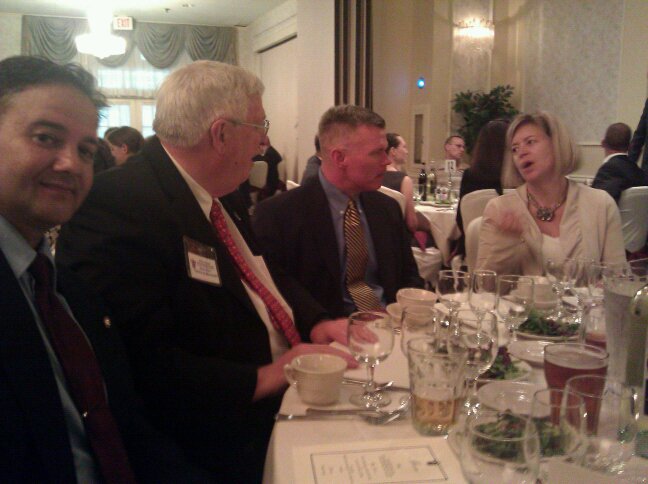
The War College, the Commandant and the Seminar Group all hosted receptions and dinners designed to get students and civilian new members to mix and further discuss issues raised in the seminar sessions or lectures. At these events I had the opportunity to meet and talk to the leadership of the Army War College including the Commandant Major General Gregg Martin, the Deputy Commandant for International Affairs, Ambassador Carol Van Voorst, the Executive Director of the Army Heritage Foundation, Mike Perry, the Director of SSI, Dr. Douglas Lovelace,  the Chief of Staff and numerous faculty and seminar members. The New Members such as myself were exceedingly well fed at these events as I suspect the Army was attempting to prove that it really does march on it’s stomach.
                                                                                                                                                                                                                                                                                                                

warparty.jpg

warparty2.jpg

The serious business of the National Security Seminar was divided into two segments, the talks given by distinguished speakers to the entire class of 2011 and the New Members and the Seminar Group sessions of approximately twenty students, New Members, academics and foreign visitors. We received a brief on the war in Afghanistan from the ISAF Chief of Staff, who was standing in last minute for General Petraeus who was called to meet with senior adminstration officials; and a very interesting concluding talk by Foreign Affairs Editor Gideon Rose, author of How Wars End, which covered issues of strategy, grand strategy and the disconnect with policy.

warseminar.jpg

  The National Security Seminar is run strictly on a non-attribution basis, in order to encourage candor and frank exchange of views, which handicaps my ability to discuss specifics here. I can say that my views on Pakistan ( which I compared to “North Vietnam” ) riled more than a few people – Pakistan is the only country in the world given 2 exchange student slots at the Army War College at the request of the most senior leadership of the US Army – and several students and faculty members took the time, outside of seminar sessions, to make certain I heard countervailing POV regarding Pakistan’s value as an ally. Other topics included, but were not limited to:

Defense budget cuts and force structure
Narco-cartels in Mexico: Insurgency or No?
Civil-Military Relations
Repeal of DADT
AfPak War
al Qaida and GWOT/US Strategy
COIN
Critical thinking and Leadership
Logistics
Libya and NATO
AWC Strategy Curriculum/Program
What the US public expects from their military
China as a peer competitor
Effects of ten years of war on officer corps/military
Illegal combatants and international law
PTSD
Battle of Gettysburg and Grand Strategy
Cyberwar
Differences in Armed Services strategy, command climate, discipline, leadership
The Arab Spring
US Global leadership and Economics
Interagency Operational jointness

Most of the discussion took place in the seminar groups, with Q&A periods in the mass sessions with featured speakers. I came away deeply impressed with the seriousness and insights as practitioners that AWC students brought to the table. The AWC strategic studies program seeks to broaden students who are assumed to arrive with tactical expertise and prepare them for higher command that carries operational, strategic and even policy responsibilities (at least in terms of interpreting and executing within policy guidelines). Many students were articulating ideas associated with Thomas P.M. Barnett, the “mission order” and “commander’s intent” style of leadership or Clausewitzian strategic premises during debates and discussion.

The National Security Seminar Week was for me, an enlightening and exceptionally enjoyable experience, one I would highly recommend to readers who may have such opportunities in future years.
Book Review: The Shaping of Grand Strategy

Tuesday, May 24th, 2011

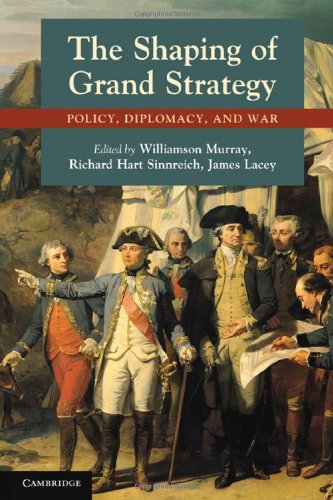
The Shaping of Grand Strategy: Policy, Diplomacy, and War by Williamson Murray, Richard Hart Sinnreich and James Lacey (Ed.)

As readers of this blog know, grand strategy is an important and timely subject that speaks directly to the difficulty American leaders have had in navigating the ship of state in the waters of the international arena. The Shaping of Grand Strategy: Policy, Diplomacy, and War by Williamson Murray, Richard Hart Sinnreich and James Lacey (Ed.) and contributing authors Colin S. Gray, Marcus Jones, Jeremy Black and John A. Lynn III postulates what grand strategy is and explain from historical case studies how statesmen struggled to fashion one in peace and war.

The Shaping of Grand Strategy has a number of strengths to recommend it to the serious student of history or strategic practitioner:

Focus: The case studies are all anchored in the Westphalian state system starting with the early modern period of European absolutism and apex of “national” monarchies and transitions through a Bismarckian 19th century to finish with the West’s cataclysmic 20th century battle with totalitarianism. This gives the chapters by different scholars a sense of cohesion and chronological succession.

Balance: The Shaping of Grand Strategy gives scholarly treatment from both the theoretical, strategic studies perspective as well as the historical case study. I learned some things about Louis XIV’s Europe and the Great Britain of the Pitts and the Hanoverian dynasty of which I was unaware. Theory bookends history in this tome.

Nuance: Each scholar gives his subject an adult treatment. Controversial points are interesting rather than shrill and each author engages an impressive synthesis of historiographic material as they cover a broad ground in investigating grand strategy. Each chapter is sound and engaging.

Limitations, such as they are, to be considered:

Absent: Powerful non-Western case studies. The ancient world.  Revolutionary war (French, Soviet or Islamist insurgent) as a grand strategy. Geoeconomics asnd political economy as a foundation for grand strategy. 

Weak: Insufficient treatment of the impact of nuclear weapons and deterrence on grand strategy, which frankly deserved a chapter of it’s own.

If you are composing a syllabus for a class on grand strategy or strategy, The Shaping of Grand Strategy would serve as an excellent generalist core for the course, supplemented by cognate, specialist or subtopical readings.

Some things that struck me while reading The Shaping of Grand Strategy:

  • Colin Gray’s distillation of the strategic dilemmas faced by Truman and an almost Boydian implicit explanation of what grand strategy is and why it needs a compelling moral power:

High policy does not emerge in a vacuum, though it can be invented in a hurry without much forethought when necessity presses. Policy requires a North Star for guidance that can inspire, yielding to would-be leaders the fuel they require to recruit and satisfy their followers

  • James Lacey’s realistic and granular treatment of the relationship between military strategy and grand strategy in the WWII Anglo-American Alliance and his generally admiring assessment of FDR as a strategist vs. a critical treatment of George Marshall.
  • Marcus Jones’ emphasis of the importance of the strategist himself and the uncertainty of decision making in his chapter on Otto von Bismarck.
  • The drawing of historical parallels with today  by John Lynn and Richard Sinnreich as well as the investigation of the reasons for grand strategic failure of British appeasement by Williamson Murray.

The Shaping of Grand Strategy is a tight, concise and focused academic book that furthers the discussion of grand strategy by providing coherent and detailed examples as well as a readable an interesting analysis from which both the professional or the the student can profit.

Strongly recommended.

Anglosphere Rising? The New Joint National Security Strategy Board

Tuesday, May 24th, 2011

Aaron Ellis of Egremont alerted me to this story today in The Guardian:

Barack Obama agrees to form joint national security body with UK

Barack Obama will announce during his first state visit to Britain this week that the White House is to open up its highly secretive national security council to Downing Street in a move that appears to show the US still values the transatlantic “special relationship”.

A joint National Security Strategy Board will be established to ensure that senior officials on both sides of the Atlantic confront long-term challenges rather than just hold emergency talks from the “situation room” in the White House and the Cobra room in the Cabinet Office.

….Britain believes that co-operation between the British and US national security councils marks a significant step. One British government source said: “The US and UK already work closely together on many national security issues. The new board will allow us to look ahead and develop a shared view of emerging challenges, how we should deal with them, and how our current policy can adapt to longer-term developments.”

The new board is a rare step by the White House, which guards the secrecy of the national security council. Founded in 1947 by Harry Truman, the NSC was in 1949 placed in the executive office of the president, who chairs its meetings.

Cameron tried to replicate the council when he established a body with the same name on his first full day as prime minister. It is chaired by the prime minister and designed to co-ordinate the work of the three Whitehall departments responsible for foreign affairs – the Foreign Office, the Ministry of Defence and the Department for International Development.

One government source said that Ricketts and Donilon would have to tread with care. “There is a little bit of disconnect between the two. The US national security adviser is a political appointment, whereas Sir Peter Ricketts is a civil servant. But this does make sense. We have a highly developed relationship with the USA where our military and intelligence officials work closely together. This is a useful move…

It is a start and I am heartened by the decision to formally include “strategy” as the body’s brief, that and the transatlantic nature coupled with bureaucratic differences may lead the new board to concentrate to a greater degree on looking at isues a strategic perspective rather than the S.O.P of wading into granular bureaucratic minutia. Given that I recently floated the idea of a Grand Strategy Board here ( along with Aaron), I can only be pleased to see a trend in that general direction from the Obama administration and our British allies.

Aaron was first on this story at Egremont, but he expresses some deep skepticism:

The Special Relationship lacks a purpose for the 21st century

….What immediately came to mind was the Combined Chiefs of Staff which, had it continued, might have become such a board. The engine to drive the Special Relationship forward. However, unless the UK is willing to throw away 40 years of foreign policy, the National Security Board (NSB) could be nothing more than a fair weather institution. The shared strategic interests that kept the alliance alive in the 20th century disappeared at the end of the Cold War. Other countries may prove more useful partners this century.

The given rationale for a NSB is to keep senior officials in touch with the broader challenges that face the two countries. Unfortunately, there are reasons why it might not succeed.

As global power shifts eastwards and emerging Asian states challenge US hegemony, Washington will be increasingly concerned with security and stability in the western Pacific. This is their broader challenge and President Obama is pursuing the correct policies in that region. The UK does not have a similar strategic clarity. If we want to enjoy the kind of relationship we enjoyed last century then our defence and foreign policies must expand east of Suez. Professor Michael Clarke, the head of the RUSI, has written that such a radical move “would represent the most judicious, and audacious, use of the hard/soft power combination yet seen in contemporary politics”. So far, however, the Government has shown no sign that it plans to make as big a shift as this in its ‘Big Picture’ thinking. Yet without it the NSB may prove fit only for fair weather.

….Nor do I see how the NSB can solve the institutional problems that I outlined last month. The board is supposed to move beyond crisis management, with senior officials from each side of the Atlantic focusing on the bigger picture. Given both countries’ bureaucracies have been promoting problem solvers at the expense of strategists, it isn’t evident that thinking will suddenly become more long-term. The same people will be shaping things, just this time sharing hats with Anglo-Saxon cousins. As with the Grand Strategy Board, the NSB’s utility also depends on the extent to which it taken seriously by our leaders. “You can organise government all you like, but strategy is an essentially political process that comes from the top,” Julian Lindley-French told MPs last September.

I think Aaron is spot on with the last paragraph.

Strategy is the crystallization of a kind of thinking process that needs to be present in the room or what you will have in the NSSB is a “coordination council” rearranging the deck chairs instead of charting the course. The British Cabinet and the Obama administration should strongly consider adding a few mutually acceptable wise men who do not have to juggle the supremely hectic schedules of a Foreign Secretary or a National Security Adviser, or at least some executive staffers recommended for the excellence of their strategic thinking.  It will help lean against the relentless and universal gravitational pull of bureaucratic and political culture toward the short term time horizon and the tactical details.

Walter Russell Mead on our Oligarchical and Technocratic Elite

Saturday, May 14th, 2011

I am still busy with several posts and a couple of book reviews, none of which are finished and some offline activities. In the interim, Lexington Green sent me this post by Walter Russell Mead. It is long but brilliant, spot on and thoroughly devastating:

Establishment Blues

….By contrast, we have never had an Establishment that was so ill-equipped to lead.  It is the Establishment, not the people, that is falling down on the job.Here in the early years of the twenty-first century, the American elite is a walking disaster and is in every way less capable than its predecessors.  It is less in touch with American history and culture, less personally honest, less productive, less forward looking, less effective at and less committed to child rearing, less freedom loving, less sacrificially patriotic and less entrepreneurial than predecessor generations. 

 Its sense of entitlement and snobbery is greater than at any time since the American Revolution; its addiction to privilege is greater than during the Gilded Age and its ability to raise its young to be productive and courageous leaders of society has largely collapsed.

…We have had financial scandals before and we have had waves of corporate crime.  We have had pirates and robber barons.  But we have never seen a collapse of ordinary morality in the corporate suites on the scale of the last twenty years.  We have never seen naked money grubbing among our politicians akin to the way some recent figures in both parties have cashed in.  Human nature hasn’t changed, but a kind of moral grade inflation has set in and key segments of the American Establishment are increasingly accepting the unacceptable as OK.  Investment banks betray their clients; robo-signers essentially forge mortgage documents day after day and month after month; insider traders are lionized.   Free markets actually require a certain basic level of honesty to work; if we can’t be more honest than this neither our markets nor we ourselves will remain free for very long.

Many problems troubling America today are rooted in the poor performance of our elite educational institutions, the moral and social collapse of our ‘best’ families and the culture of narcissism and entitlement that has transformed the American elite into a flabby minded, strategically inept and morally confused parody of itself….

[ Emphasis mine]

….A leadership class is responsible for, among other things, giving a voice to the feelings of the nation and doing so in a way that enables the nation to advance and to change.  Most of the American establishment today is too ignorant of and too squeamish about the history and language of American patriotism to do that job.  In the worst case, significant chunks of the elite have convinced themselves that patriotism is in itself a bad and a dangerous thing, and have set about to smother it under blankets of politically correct disdain.

This will not end well.

Read the rest here.

I have written about the deficiencies of the elite before, mostly in their inability to think strategically and create a coherent foreign and national security policies but their increasingly oligarchical attitudes of favoring self-dealing fiscal, regulatory and social policies, at the expense of their fellow citizens or the national interest is cause for great alarm.For example a legion of recent national security officials from the current and previous administration, a few barely out of office, have just accepted large wads of lightly laundered Saudi cash to lobby on behalf of the Mujahedeen-e Khalq, a nutty, cultish, Marxist terrorist group that formerly worked for Saddam Hussein. This with no sense of embarrassment or shame that they are putting a dingy cast on their prior public service or awareness that doing so conflicts with solemn oaths some of them have made to the Constitution of the United States. 

How many are also taking Chinese money, I wonder?

We need a new elite

Guest Post: Shipman Reviews The New Digital Storytelling by Bryan Alexander

Thursday, May 12th, 2011


J. Scott Shipman, the owner of a boutique consulting firm in the Metro DC area that is putting Col. John Boyd’s ideas into action, is a longtime friend of this blog and an occasional guest-poster.

Book Review: The New Digital Storytelling

by J. Scott Shipman

Bryan Alexander’s  The New Digital Storytelling, Creating New Narratives With New Media is an excellent, highly readable, and comprehensive treatment of storytelling in our digital world. Dr. Alexander manages in 230 pages of text to capture the universe of available methods, processes, resources and tools available to storytellers, as of 2010. His 36 pages of notes and bibliography includes an exhaustive list of websites and sources used.

Dr. Alexander aimed his book at “creators and would-be practitioners,” storytellers looking for new digital ideas, to include teachers, marketers, and communications managers. Whatever your background, he assures in the introduction, “herein you will find examples to draw on, practical uses to learn from, principles to apply, and some creative inspiration.” I can’t speak for those in the target audience, but as one with but a casual interest in storytelling, I can say Dr. Alexander delivered! Over the course of the couple of days of reading, I came up with about a half-dozen ideas and discovered my MacBook Pro has a lot more under the hood than I ever appreciated or used.

That said, Dr. Alexander warns that his book is not a “hands-on manual” on the tech media discussed. In fact, he assumes the reader will not “be a technologist” and the material is presented accordingly. He says:

The New Digital Storytelling straddles the awkward yet practical divide between production and consumption, critique and project creation.”

The book is divided into four parts:

Part I Storytelling: A Tale of Two Generations

In Chapter 1 Dr. Alexander provides an unambiguous meaning to digital storytelling: “Simply put, it is telling stories with digital technologies.” The medium providing this review to you is my digital story about the book. But that is just the beginning; just about every digital device imaginable is being used to tell stories; blogs, social media, videos, and even in Twitter’s 140 character limit, storytelling genres are emerging [readers at zenpudit.com will recall Charles Cameron’s use of Twitter feeds following UBL’s death]. As Alexander points out, “no sooner do we invent a medium than do we try to tell stories with it.”

In Chapters 2 & 3, Dr. Alexander provides a history of digital storytelling in two parts; part one is what he calls “the first wave.” From foundations in the 70’s and 80’s (his reference to the 1983 movie War Games brought back memories) to the evolution and importance of hypertext. Alexander asks, “How do hypertexts work as digital stories? Users—reader—experience hypertext as an unusual storytelling platform. We navigate along lexia (“multiple readable chunks”) picking and choosing links to follow.” This point truly “clicked” for me; one of the pleasures of reading zenpundit.com is the ubiquity of supporting links and how sometimes these links lead to unexpected, but valuable adventures. Often I’ve landed in a place I would never have found if not for the first “story.” Alexander writes that Web 2.0 has allowed for “the ability to create content for zero software cost is historically significant, and now par for the course.” He points out with the ubiquity of hardware (both PCs and mobile devices) and the social element (social media, for example) a means of of delivery and an architecture are in place where potential storytellers have a low barrier to entry—to get their story out. Alexander includes gaming devices (mobile and console) in the review of the Web 2.0 phenomena.

Part II New Platforms for Tales and Telling

Chapter 4 is a comprehensive review of Web 2.0 storytelling and the fragility of systems existing today, but perhaps gone tomorrow. Dr. Alexander covers distinct types of blogs used in sharing stories; blogs are ubiquitous and the barriers to entry negligible. He covers epistolary novels and diary/journal-based stories and provides numerous examples. One example was News from 1930, which “posts selections from each day’s Wall Street Journal” during the early days of the Great Depression—in essence, a blog as a realtime history lesson. But as we know, the blogosphere is bigger than history, there also exists a market for various fictional stories which include reader interaction/collaboration. Also included are examples of character blogging (as Alexander notes: “Bloggers are characters”) where personalities are revealed over time in a serial nature. Twitter has developed into a unique format for storytelling, forcing the user to pack as much as possible in precious few words/characters. Wikis, social images and Facebook are also covered and explained in ways that made me think about “how” I use social media.

Chapter 5 covers in detail social media storytelling…and this is one of my favorite chapters. Alexander explains podcasts in a way that was accessible and in a way that made me want to “do” a podcast! A podcast is limited to audio, but a web video places a whole new spin on our ability to digitally tell our stories. Chapter 5 is rich in resources and insight.

In chapters 6 and 7 Alexander discusses gaming and storytelling. This may be the part of the book that was over my head (I’m dubious of the real utility of “gamification” in a meaningful/productive way). One sentence did jump off the page: “One key aspect of game-based storytelling is the immersion of the player in the story’s environment.” Indeed, “intimacy” is an enormous missing ingredient in more than storytelling and absolutely necessary in proficiency in just about any endeavor. One other sentence made a big impression: “Children also learn a deep secret about art, which is that the less detailed the representation of a character, the easier it is for us to identify with him or her.” I believe guys like the internet Oatmeal guy and the creator of Zen’s recent post  have figured out this phenomena isn’t limited to children.

Part III Combinatorial Storytelling; or, The Dawn of New Narrative Forms

Chapters 8 through 11 covers the networked book, mobile devices, and alternate reality games. The networked book resonated with me because of something from my distant career on submarines (early 80’s); we would write a story where periodically storytellers would add a sentence and half to an evolving text. The results were always amusing and never predictable. Networked books sound very similar to our collaborative efforts 30 years ago, but with the ubiquity of digital tools, opportunities abound. For example “transmedia storytelling,” where “story content is distributed across multiple sites and media; the movie trilogy, an anthology of animated films, comics, computer games, a massively multiplayer online game, Web content, and additional DVD content.” This dispersion of story content and the variety of venues allows users a more “immersive experience”—-the intimacy Alexander described earlier. Mobile devices are literally changing just about every aspect of our world from political meetings, classrooms, clinics “now that those present can hit the Web for fact checking or peer support.” An excellent recent example was the squashed attempt of the United States Naval Institute’s board to change the organization’s mission. Platforms like Twitter, Facebook, and LinkedIn were used to get the word out to members who took action. New tablet devices will continue to drive this phenomena. Alexander’s treatment of alternate reality games revealed “worlds” created with our world by game participants of such products as Second Life.

Part IV Building Your Story

In the final chapters, Dr. Alexander provides example of “how to” build a digital story, using the classic Center for Digital Storytelling workshop model. For me, this was the most thought-provoking section. The description of how a workshop is conducted, the questions used to prompt creative/insightful “story-able” thought is worth the price of the book. Alexander inventories the software available for audio, images, video editing, publication, concept mapping, and other production tools. This inventory of tools describes the appropriateness of each with respect to the level of experience of the storyteller. Digital storytelling in education is covered in Chapter 14 and is a rich resource for parents and educators who want to leverage the digital world.

The New Digital Storytelling should be the standard guide for anyone who wants to use all the new digital gadgets available to tell their story; this book is an excellent one-stop resource. I plan to use what I’ve learned in the expansion of my family tree history to an A/V platform and have already built a to-do list to get started.

One closing thought; the irony isn’t lost that this “book” about digital storytelling is made of paper, glue, and ink. I can only imagine what an adventure this would be if presented digitally where all the links were connected…a digital story on how to tell digital stories.

The New Digital Storytelling comes with my highest recommendation. Get this book, use those tools, and tell your stories.


Switch to our mobile site
