Longtime reader Isaac recently alerted me to an important article in the most recent edition of PARAMETERS. Some excerpts:
“Deconstructing our Dark Age Future” by LTC. P. Michael Phillips
….This article suggests that the system of Westphalian states is not in decline, but that it never existed beyond a utopian allegory exemplifying the American experience. As such, the Dark Age thesis is really not about the decline of the sovereign state and the descent of the world into anarchy. It is instead an irrational response to the decline of American hegemony with a naïve emphasis on the power of nonstate actors to compete with nation-states. The analysis concludes that because the current paradigm paralysis places a higher value on overstated threats than opportunities, our greatest hazard is not the changing global environment we live in, but our reaction to it.
….The state as described in this article differs greatly from the ideal imagined in the Westphalian paradigm. States do not universally enjoy unrestricted sovereignty. Nor are they equal. In fact, the sovereignty of a great number of the states in the international system is merely ascriptive.27 Because these imperfect conditions have more or less existed since long before 1648, it may be more helpful to think of any observed chaos in the international system as the natural condition, rather than a decline into disorder. If the system is not melting down, are so-called nonstate actors as significant for the long-term as they appear to be for the present?
….For some observers, this so-called NSA victory over a modern state underscores their warnings of impending global chaos. But in making this declaration, they fail to appreciate the source of Hezbollah’s strength: its dependent relationship with Iran, and to a somewhat lesser extent, Syria. Hezbollah did not create out of whole cloth its impressive array of modern weapons, nor did it independently develop the tactics, techniques, and procedures to employ them. Instead, Iranian weapons completed Hezbollah’s impressive arsenal, and Iranian Revolutionary Guard Corps advisers created the command and control center that coordinated the militiamen’s missiles.
Read the whole thing here.
This was an interesting read for me; many points with which to agree and disagree. A few thoughts in no particular order:
I am sympathetic to Col. Phillips’ criticisms of the overly abstract and detached nature of IR in regard to the nature of international law and sovereignty. You can certainly see that “arid” and “imperialistic” attitude in many academics and NGO activists who like to present their novel theories and interpretations as “international law” when they lack any historical basis whatsoever (and are usually gamed to be highly restrictive on the authority of Western sovereign states to use force and permissive/exculpatory of the actions of Marxist/radical/Islamist terrorists or insurgents). Much of Phillips’ condemnation of IR smacking of unreality from a practitioner’s perspective is spot on.
That said, while definitely fuzzy and spottily adhered to in practice international law is not entirely “illusory”, nor is it a byproduct of 20th century Wilsonian American exceptionalism as Phillips argued. Perhaps Hugo Grotius rings a bell? Or Alberico Gentili? Or the long history of admirality courts? Like common law or an unwritten tribal code, international law has evolved over a very long period of time and does exert some constraint upon the behavior of sovereigns. Statesmen and diplomats think about policy in terms of the impression it will make on other sovereigns, and international law is one of the yardsticks they contemplate. Admittedly, at times the constraint of international law is quite feeble but in other contexts it is strong. An American military officer, who can see firsthand the effect of creeping JAG lawyerism on command decisions on the battlefield ( in my view, greatly excessive and harmful ) and in the drafting of byzantine ROE, should know better than to make such a silly statement.
Phillips main argument is about the direction of international relations and non-state actors and he comes down firmly on the supremacy of states, at least the Great Powers and regional power states enacting an age-old realpolitik. Non-state actors are an overhyped and trendy threat and really amount to a continuation of traditional proxy warfare, where powers harass each other by subsidizing barbarian “raiders”; Phillips makes much use of Hezbollah as a modern example. Juxtaposed against the more extreme claims of the 4GW school or of Martin van Creveld, Phillips criticism looks reasonable because it is easy to make an empirical case that falsifies the absolutist claim that all states everywhere are in decline or that war is endemic. They are not and war is not.
Matched against the real world however, Phillips’ argument suffers. In terms of sovereignty and legitimacy, the globe is a ball of swiss cheese – in what Thomas P.M. Barnett terms “the Gap” there are deep holes in Africa, Asia and even Latin America where states could be but are not. Somalia has not had a state since 1991. The Congo is a vast swath of warlordism and democide on a scale of millions (!). The Lebanese government is the de facto junior partner in Lebanon to the Hezbollah militia. Mexico next door is increasingly militarizing its law enforcement apparatus toward full-blown counterterrorism and COIN because of the erosion of state authority vs. the anarchy being spread by the narco-cartels. Are sovereign states more stable and authoritative than fifty years ago? Some are. Many are not. Others are relatively fragile potemkin villages. This is why 4GW theory, while historically flawed, retains analytical strategic resonance – in some regions of the world, the premises of 4GW apply very well. Better in fact, than the traditional schools of thought.
Again, Phillips has written an interesting and thought-provoking article with salient ideas. My problem rests more with the length to which he takes some of his assertions. Phillips swings the pendulum a little too far in the opposite direction where a synthesis would serve better.
ADDENDUM:
Dr. Charli Carpenter at The Duck of Minerva, weighs in on Phillips with Westphalian Illusions.


 the reader to an understanding how bottom-up, “blind”, systems work and the principles behind them. Highly readable and next to no jargon. Probably due soon for an updated edition though, given the scientific advances in research in network and complexity studies.
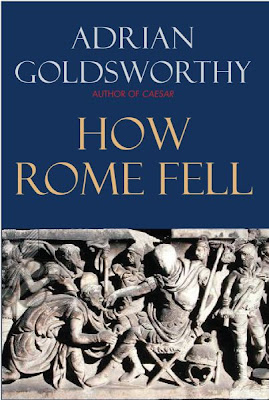
 centuries as it was during the golden age of philosopher-warrior-emperor Marcus Aurelius. Or that there was no fall of the empire at all, just a gentle “transformation” into something new. Goldsworthy discusses the likelihood of Late antquity “paper legions” of Roman armies which, in any event, scarcely resembled in elan, tactics or fighting strength the ones that Julius Caesar wielded in Gaul. A tour de force marred only by a weird epilogue that ranges from pedestrian to ( in it’s last sentences) truly awful – was it it tacked on as an afterthought? Did the editor of the rest of the book die before it was completed? Regardless, How Rome Fell is a worthy addition to an collection of popular ancient histories.
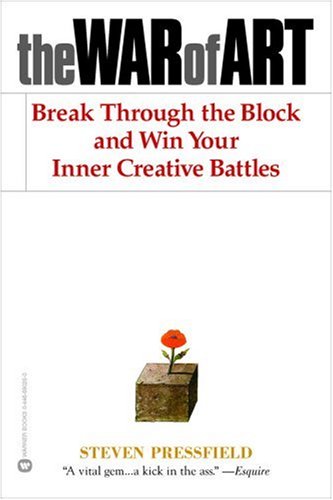
 is brilliant but because it is profound. Utilizing select personal vignettes and other anecdotes, Pressfield distills in everyday language the essence of what creative people need to understand if they are to succeed – concepts of “resistance”, which seductively undermine your efforts, and being a “professional”, which is the mindset that will get you there.
 . Where Goldsworthy was more closely tied to his primary sources in his earlier work, How Rome Fell gives him greater scope for both synthesis and analysis as Goldsworthy draws on his knowledge of the subject to evaluate theories of causation as well as to entertain and inform the reader.
 General David Petraeus and the American Military Adventure in Iraq, 2006-2008

