History as a Gen Ed Credit for Engineering Students Aspiring to Naval Leadership
Tuesday, February 15th, 2011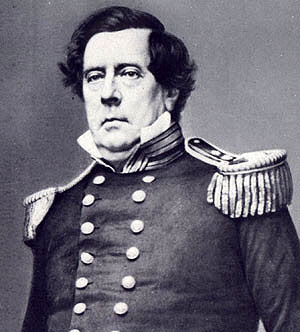
Commodore….errr….what’shisnameagain???
As a rule, I generally do not write about US Navy affairs because it is not an area of expertise for me and I think Galrahn covers that territory admirably well without my poor help. Every so often though, an item from our sea-roving friends catches my eye that I am qualified to speak about and today is one of those days.
Teaching naval history has become an inconvenience to those entrusted with training our nation’s future captains and admirals because they need to get the budgetarily “sexy” topic of “cyber warfare” into the US Naval Academy curriculum. Yes, that’s right. Because someday, in the midst of battle, the combatant commander of PACOM will be furiously barking out HTML code at the bridge of the Eisenhower, above the cries of wounded men.
Gentlemen, gentlemen….in matters of education, fundamentals come before esoterica!
I strongly recommend this post by LCDR Benjamin “BJ” Armstrong, historian, pilot and Navy officer who tackled this subject with an enviable grace and eloquence at the USNI blog:
….More than policy or naval strategy, Mahan believed in teaching officers the best ways to approach the challenges of command. He saw his job as a Naval War College plankowner in those terms, about teaching command, and to do so he turned to history. But, it wasn’t just senior officers who needed grounding in our naval past. He wrote in his very first published article, winning third place in “Proceedings” annual essay contest, that history was also a key foundation for learning at the Naval Academy.
When he said that history “lies at the foundation,” it wasn’t just a convenient turn of phrase. He believed that before subjects like gunnery, engineering, or even cyber-warfare, could be taught a Midshipman needed to know why he was learning them. Why did any of it matter? The best way to show a student why hitting the target in gunnery class was important was to teach him the history that showed what happened when crews weren’t drilled properly. Perhaps he would teach the Midshipman about Captain James Lawrence sailing Chesapeake out of Boston harbor with a green and undrilled crew in 1813 to face HMS Shannon, a short time later uttering his final command, “Don’t give up the ship” just before he succumbed to his wounds and the British boarding party swarmed aboard in victory. Maybe the Midshipman would recognize the words…from the battle flag bearing the phrase in Memorial Hall that was flown at the Battle of Lake Erie. Mahan felt that once a Midshipman understood the importance of mastering the craft, of studying their trade, a subject like weapons systems engineering would become important even to the lowly humanities major.
The second part of Mahan’s statement is also important, “all sound military conclusions and practices.” In our age of checklist leadership and officers educated as engineers there is a desire to approach leadership challenges as equations where certain inputs are guaranteed to give you the desired results. But Mahan doesn’t say all “correct” military conclusions and practices, he says “sound.”
Mahan recognized that both naval strategy (conclusions) and combat leadership (practices) were art, not science. In his book “Naval Strategy: Compared and Contrasted with the Principles and Practice of Military Operations on Land,” published in 1911, Mahan compared naval officers to artists. He wrote that artists had to learn certain techniques, mediums and certain skills, but that wasn’t what made their artwork great. In the end “art, out of materials which it finds about, creates new forms in endless variety,” artists take those foundation basics and then mix and match them based on inspiration and experience to create a masterpiece. History helps us understand that frequently there are no right answers to military questions of strategy or leadership. There are only “sound conclusions,” which are drawn from understanding basics and history. Demonstrating this great truth to Midshipman early in their education, say as a Plebe before they have taken three years worth of engineering classes that teach them there is always an equation and a correct answer, is much more valuable than having them learn it after years of service.
Bravo!
This decison is wrong on so many levels it amounts to pedagogical malpractice. It should be reversed.
What kind of mind do we want our Navy officers to have in the moment of decision? An admiral in command of a carrier task force has more destructive power at his disposal than any man on earth except for the ruler of Russia and the President of the United States. At a crisis point, it is too late to roll back the clock to gain the benefit of a career of professional reading, discussion and reflection on the lessons of naval warfare, strategy and statesmanship. EE courses are good things, and demonstrably useful, but they do not inculcate the same habits of mind as does the learning of history.
Historically, the US Navy was the plenipotentiary service of the United States with it’s admirals and commodores assuming extremely sensitive diplomatic or even proconsular duties alongside their responsibilities of military command. The careers of Farragut, Perry, Dewey, Leahy, King, Nimitz and others of lesser rank attest to how naval command has always been deeply entwined in American history with statesmanship and keen political insight. The 21st century will be no different.
The lessons of history are a sword and shield.


 by
by 
 by Stuart Brown, MD
 by Joseph Tainter
 by Steve Coll
 by Diane Ravitch

