Archive for the ‘21st century’ Category
Tuesday, May 21st, 2013
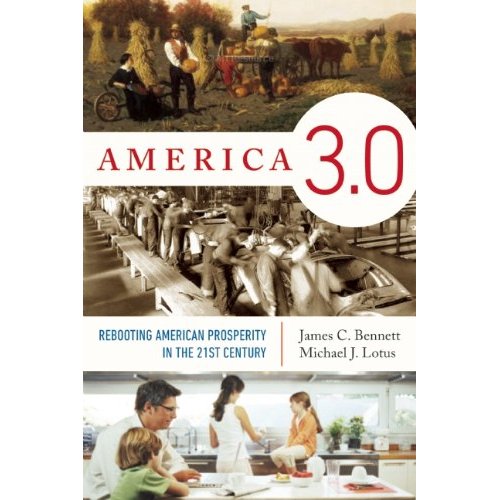
America 3.0: Rebooting American Prosperity in the 21st Century – why America’s Best Days are Yet to Come by James C. Bennett and Michael Lotus
I am confident that this deeply researched and thoughtfully argued book is going to make a big political splash, especially in conservative circles – and has already garnered a strong endorsement from Michael Barone, Jonah Goldberg, John O’Sullivan and this review from Glenn Reynolds in USA Today :
Future’s so bright we have to wear shades: Column
….But serious as these problems are, they’re all short-term things. So while at the moment a lot of our political leaders may be wearing sunglasses so as not to be recognized, there’s a pretty good argument that, over the longer time, our future’s so bright that we have to wear shades.
That’s the thesis of a new book, America 3.0: Rebooting American Prosperity In The 21st Century.The book’s authors, James Bennett and Michael Lotus, argue that things seem rough because we’re in a period of transition, like those after the Civil War and during the New Deal era. Such transitions are necessarily bumpy, but once they’re navigated the country comes back stronger than ever.
America 1.0, in their analysis, was the America of small farmers, Yankee ingenuity, and almost nonexistent national government that prevailed for the first hundred years or so of our nation’s existence. The hallmarks were self-reliance, localism, and free markets.
At the end of the 19th century and the beginning of the 20th, people were getting unhappy. The country was in its fastest-ever period of economic growth, but the wealth was unevenly distributed and the economy was volatile. This led to calls for what became America 2.0: an America based on centralization, technocratic/bureaucratic oversight, and economies of scale. This took off in the Depression and hit its peak in the 1950s and 1960s, when people saw Big Government and Big Corporations as promising safety and stability. You didn’t have to be afraid: There were Top Men on the job, and there were Big Institutions like the FHA, General Motors, and Social Security to serve as shock absorbers against the vicissitudes of fate.
It worked for a while. But in time, the Top Men looked more like those bureaucrats at the end of Raiders Of The Lost Ark, and the Big Institutions . . . well, they’re mostly bankrupt, or close to it. “Bigger is better” doesn’t seem so true anymore.
To me, the leitmotif for the current decade is supplied by Stein’s Law, coined by economist Herb Stein: “Something that can’t go on forever, won’t.” There are a lot of things that can’t go on forever, and, soon enough, they won’t. Chief among them are too-big-to-fail businesses and too-big-to-succeed government.
But as Bennett and Lotus note, the problems of America 2.0 are all soluble, and, in what they call America 3.0, they will be solved. The solutions will be as different from America 2.0 as America 2.0 was from America 1.0. We’ll see a focus on smaller government, nimbler organization, and living within our means — because, frankly, we’ll have no choice. Something that can’t go on forever, won’t. If America 2.0 was a fit for the world of giant steel mills and monolithic corporations, America 3.0 will be fit for the world of consumer choice and Internet speed.
Every so often, a “political” book comes around that has the potential to be a “game changer” in public debate. Bennett and Lotus have not limited themselves to describing or diagnosing America’s ills – instead, they present solutions in a historical framework that stresses the continuity and adaptive resilience of the American idea. If America”s “City on a Hill” today looks too much like post-industrial Detroit they point to the coming renewal; if the Hand of the State is heavy and it’s Eye lately is dangerously creepy, they point to a reinvigorated private sector and robust civil society; if the future for the young looks bleak, Bennett and Lotus explain why this generation and the next will conquer the world.
Bennett and Lotus bring to the table something Americans have not heard nearly enough from the Right – a positive vision of an American future that works for everyone and a strategy to make it happen.
But don’t take my word for it.
The authors will be guests Tuesday evening on Lou Dobb’s Tonight and you can hear them firsthand and find out why they believe “America’s best days are yet to come“
Posted in 2013, 21st century, America, analytic, anglosphere, anthropology, authors, barone, blog-friends, blogosphere, book, britain, business, capitalism, change, chicago boyz, cultural intelligence, culture, defense, democracy, economics, education, Evolution, fiscal conservatism, foreign policy, futurism, globalization, government, historiography, history, horizontal thinking, ideas, innovation, intellectuals, justice, leadership, legitimacy, lexington green, military, military reform, national debt, national security, politics, reading, reform, Republic, resilience, rule-sets, science, security, social science, social services, society, strategy, synthesis, theory, Writing | 9 Comments »
Thursday, May 16th, 2013

I have been reading Nassim Nicholas Taleb’s latest book, Antifragile . It’s a highly intriguing book and I will give it a full review soon, but Taleb’s core concept of antifragility is important and lends itself to wide application. Here’s Taleb on what constitutes “antifragility” – things that gain or improve with disorder – which he was careful to distinguish not just from “fragility” but also from “robustness” and “resilience”:
Almost all people answer that the opposite of “fragile” is “robust”, “resilient” , “solid”, or something of the sort. But the resilient, robust (and company) are items that neither break nor
improve, so you would not need to write anything on them – have you ever seen a package with
“robust” stamped on it? Logically, the exact opposite of a “fragile” parcel would be a package on which one has written “please mishandle” or “please handle carelessly”. It’s contents would not just be unbreakable, but would benefit from shocks and a wide array of trauma. The fragile is the package that would be at best unharmed, the robust would at best and at worst unharmed. And the opposite of fragile is therefore what is at worst unharmed. [31]
Italics in original.
Taleb uses a number of metaphors – the Phoenix, the Hydra – as well as examples to get across the point that an antifragile entity overcompensates in reaction to stress/damage/disorder by becoming better, growing stronger, more powerful, adaptively improving itself. Think of the effects of weight training in building muscle or a wildfire spurring bountiful growth in an ecosystem. There’s more to Antifragile than this but the gist is sufficient for now.
Which brings me to the question, “Are insurgencies antifragile?”

The study of insurgency, terrorism and revolution, while important and useful tend to suffer from several drawbacks. One is compartmentalization and academic specialization. As Robert Bunker pointed out in Narcos Over the Border, a problem like “criminal-insurgency” attracts very different reactions from Law enforcement, intelligence analysts, the military, counter-terrorism officials and other experts (to say nothing of politicians) which makes consensus over a common analytic framework very difficult. Sometimes even defining the problem across domains is frustrating. As a result, many studies are too narrow and the few admirably ambitiously broad ones are deeply stamped in the political lens of the era in which they were researched and written – i.e. imperialist Small Wars, the Cold War, the War on Terror, Pop-centric COIN of Iraq and Afghanistan wars etc. It is a subject that requires both more (and more intellectually creative) scholarship and a greater degree of synthesis.
In the meantime, I’d like to offer some speculation in an effort to answer the question:
- The characteristics of “antifragility” in terms of at least some kinds of insurgency bears a striking resemblance to that of “wicked problems“, which has also been used to categorize some enduring irregular conflicts. Particularly in the sense of not having natural stopping points , manifesting complex interdependencies and resistance to simple, silver bullet solutions that could destroy it.
- Moreover, most successful insurgencies are not, contrary to Maoist theory, autochthonous – they draw many resources from external sources – black globalization, foreign patrons, legitimate trade, fundraising – and from the very state waging counterinsurgency warfare against them. The Afghan Taliban would be a much poorer military force without the vast amount of American aid passing through the hands of Pakistan and the Karzai regime
- An insurgency’s claim to being “antifragile” may rest as much or more upon the general political and socioeconomic environment being relatively chaotic than on the nature of the insurgent organization itself. The Chinese, Russian and Lebanese civil wars, Mexico’s narco-insurgency, West Africa and Afghanistan in the 1990’s, the Congo basinand Iraq in the 2000’s all had polycentric and disorderly environments that allowed irregular groups to rapidly rise and fall on a local and regional basis. By contrast, “bilateral” insurgency vs. state dynamics can stabilize conflict for decades
- An insurgent organization may lose antifragility as it restructures itself over time to become either more robust (ex. –Hezbollah) subnational entity or to accept greater fragility in order to acquire state-like hierarchical advantages ( political discipline and specialization). Note that “fragile” does not mean “weak”, it means “vulnerable”. States can be very strong and concentrating massive amounts of resources and coercive force, yet be strangely vulnerable to internal coups, popular uprisings, economic collapse, strategic myopia or even natural disasters. One of the great dangers today are complex systems that combine epic power with extreme fragility – small disruptions by irregulars yield huge ROIs.
- States might be able to seek a strategic advantage over insurgencies by improving their robustness and smother the relatively ineffectual kinetic attacks of guerrillas or terrorists with inertia, refusing to “feed” the growth of an antifragile insurgent opponent, starving them of material resources and political oxygen. India has trucked along with something like seventeen ongoing insurgencies and episodic acts of major terrorism for decades without the Indian state remotely being in jeopardy of being overthrown by, say, the Naxalites, Sikh extremists or Kashmiri Islamists. Compare that with the rapid collapse or retreat of the state in places like Somalia, Yemen, Libya, Mali, Syria and so on.
- The effects of globalization and information technology, the ability to have John Robb’s “open source” decentralized, fast-evolving, insurgencies, give an an impetus to insurgencies becoming antifragile. At a minimum, it improves the odds.
Comments welcomed
Posted in 19th century, 20th century, 21st century, 3 gen gangs, 4GW, Afghanistan, africa, analytic, antifragile, COIN, complex systems, counterinsurgency, counterterrorism, dystopia, extremists, Failed State, Foreign Internal Defense, government, ideas, insurgency, intellectuals, john robb, law enforcement, Mexico, military, national security, non-state actors, open-source, organizations, society, state failure, Strategy and War, synthesis, terrorism, theory, war | 19 Comments »
Monday, May 13th, 2013
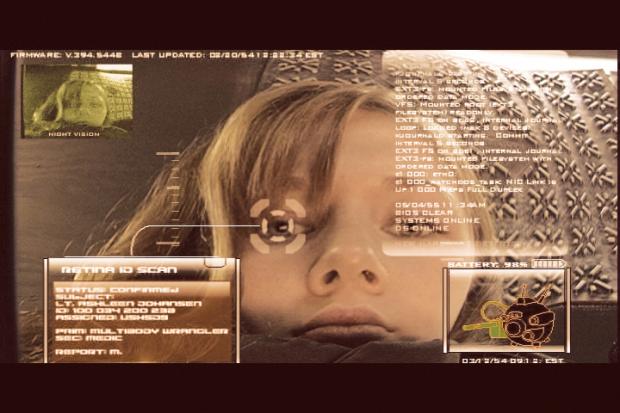
WIRED magazine so far is the only outlet to report on this nasty Creepy-State digital authoritarianism buried in the cosmically awful proposed Immigration “Reform”bill:
Biometric Database of All Adult Americans Hidden in Immigration Reform
….Buried in the more than 800 pages of the bipartisan legislation (.pdf) is language mandating the creation of the innocuously-named “photo tool,” a massive federal database administered by the Department of Homeland Security and containing names, ages, Social Security numbers and photographs of everyone in the country with a driver’s license or other state-issued photo ID.
Employers would be obliged to look up every new hire in the database to verify that they match their photo.
This piece of the Border Security, Economic Opportunity, and Immigration Modernization Act is aimed at curbing employment of undocumented immigrants. But privacy advocates fear the inevitable mission creep, ending with the proof of self being required at polling places, to rent a house, buy a gun, open a bank account, acquire credit, board a plane or even attend a sporting event or log on the internet. Think of it as a government version of Foursquare, with Big Brother cataloging every check-in.
“It starts to change the relationship between the citizen and state, you do have to get permission to do things,” said Chris Calabrese, a congressional lobbyist with the American Civil Liberties Union. “More fundamentally, it could be the start of keeping a record of all things.”
….“The most worrying aspect is that this creates a principle of permission basically to do certain activities and it can be used to restrict activities,” he said. “It’s like a national ID system without the card.”
For the moment, the debate in the Senate Judiciary Committee is focused on the parameters of legalization for unauthorized immigrants, a border fence and legal immigration in the future.
The committee is scheduled to resume debate on the package Tuesday.
This provision is flatly unconstitutional, but the Bill of Rights is not held in high esteem by most members of Congress or the largest donors to the Democratic and Republican parties. Big Data corporations intend to make enormous profits helping advocates of Big Government transform the “normal” of American life into what formally used to be considered appropriate for inmates in a minimum security prison.
Could a far less intrusive scheme be devised to validate employment status? Sure, but that would not hand bureaucrats and stringpullers of the Oligarchy enormous leverage to use someday over every man, woman and child in the United States.
Imagine, you have offended some local worthy with your letter to the editor or your campaign donation to their opponent and suddenly….your debit and credit cards stop working, your employer can no longer issue you your paycheck, you can’t enter any public facilities (the biometric scan rejects you as a “security threat”), the local hospital can’t provide you with medical care (“Access to records denied”). Maybe your driver’s license is suddenly void and the authorities therefore remotely disable your “smart car”. In a keystroke, you can be cyberoutlawed.
To where will you go to escape a powerful person manipulating an omnipresent data system? Or fix a “simple” computer error that is putting your entire life on hold? Or if a hacker gains access to your biometric records? There are few good and reasonable uses for this kind of system, an enormous number of bad ones and none at all that justify being incorporated into an even a semi-free society.
The digital road to serfdom is being legislated one deceptively presented unread bill at a time.
Posted in 21st century, America, Creepy-state, dictator, dystopia, extremists, Failed State, government, internet, Oligarchy, state failure, tech, threat, totalitarianism | 39 Comments »
Thursday, May 9th, 2013
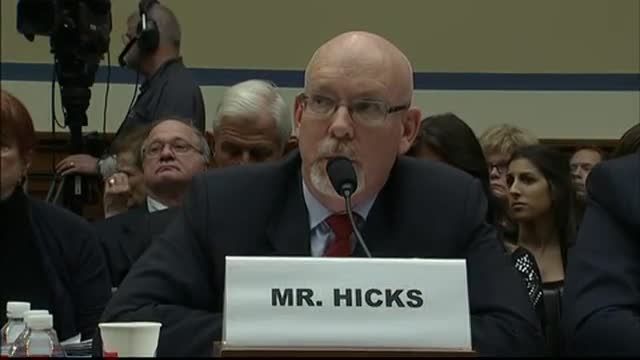
There is legitimate room for debate if there could have been an effective military reaction to the attack in Libya by al Qaida terrorists that killed Ambassador Stevens and other US personnel. One was apparently never seriously entertained by senior White House, State Department and Pentagon officials. I think there ought to have been an effort to move heaven and earth and far, far greater willingness to inflict massive casualties on an attacking Libyan mob than existed, but in fairness to the Obama administration, a seat-of-the-pants, unsupported, undermanned response could also have been a replay of Blackhawk Down or Desert One. It’s a tough judgment call for any President.
That’s not why the Obama administration is in trouble today.
Poorly supported security and inept decision making by the State Department in Libya was likewise, disappointing but politically survivable and sadly, unsurprising.. We have seen similar bungling before and after 9/11 by most of our major national security departments and agencies at one time or another. It is a bipartisan phenomenon, albeit one we take far too lightly.
No, as damning testimony today made clear, the Obama administration is in trouble because their poor but not remarkably so handling of Benghazi was shielded by a ridiculous lie told entirely for partisan gain and to protect the overrated reputations and overweening egos of various administration bigwigs, most notably the former Secretary of State, Hillary Clinton.
Is there anyone today – anyone at all – who still believes that Benghazi occurred because of an obscure crackpot’s video on youtube?
Had the administration manfully said “This attack is a terrible tragedy and we dropped the ball but you can believe we won’t make a similar mistake tracking down the people who did this and make them pay” most Americans would have accepted that. No, not rabid partisan Republicans, but most Americans would have wanted to back the President, any President, in the wake of such terrorism which is directed, in the last analysis, at all of us.
They did not – and much of the rest of their reaction indicates that the real concern at State and the White House was and still is with the temerity of their political opponents in daring to demand they account for their actions as if we lived in a Republic or something.
In American politics, it is the self-inflicted wounds that fester and turn gangrenous
Posted in 21st century, America, barack obama, foreign policy, government, islamic world, islamist, Libya, mideast, military, mob, myth, national security, obama, politics, Republic, state department, terrorism | 1 Comment »
Wednesday, May 1st, 2013
My friend Dave Schuler who blogs at the excellent The Glittering Eye and on foreign policy at Dr. James Joyner’s Outside the Beltway , queried me as to what I thought of the Boston Bombers in light of the concept of the Superempowered Individual.
For those not familiar with the concept, the term “superempowered individual” originated in phrase coined by Thomas Friedman and quickly gained traction and evolved in the .mil/strategy/defense blogosphere and communities of interest after 9/11 turned everyone’s attention to the potential reach of catastrophic terrorism. Many people, including myself have written on the topic and while no single, agreed upon, definition of SEI exists, there is a consensus around an individual having the capacity to multiply the scale of the harm they can cause by leveraging or disrupting complex systems, be they mechanical, social, cyber or some combination. I defined SEI’s this way:
To qualify as a superempowered individual, the actor must be able to initiate a destructive event, fundamentally with their own resources, that cascades systemically on a national, regional or global scale. They must be able to credibly, “declare war on the world”.
Using that definition, Dzhokhar and Tamerlan Tsarnaev are far from superempowered individuals. They were not “super” anything and rather than being masters of complexity, they ginned up some primitive IEDs and blundered miserably after their attack on the Boston Marathon. The younger of the two accidentally ran over his own brother with a car, killing him, which gives some idea of the operational amateurism of these culprits. If Islamist terrorism has a Darwin Award, the Brothers Tsarnaev are contenders
Yet the cost of their attack, the Boston bombing, allegedly tops $330 million dollars? Why?
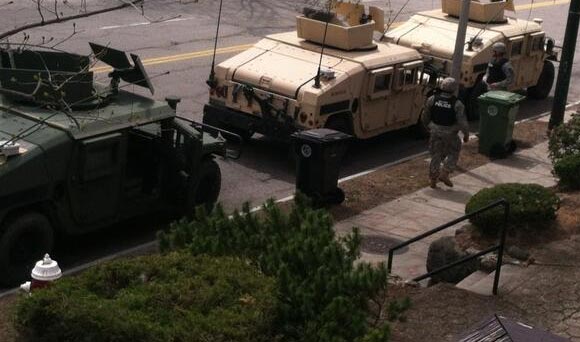
I would argue that the US is systematically “superdisempowering” itself by VASTLY multiplying the costs of any given act of terrorism with absurd and outrageous levels of costly security theater and glitzy paramilitarization of law enforcement that continue to cascade and accumulate long after sorry nitwits like Richard Reid, Dzhokhar Tsarnaev or the amazingly incompetent “Underwear Bomber“ have become obscure historical footnotes. It is incredibly counterproductive in every sense and has overwhelmingly negative effects that only add significantly to the costs of terrorism
Timothy McVeigh, in a much more heinous act of terrorism, blew up a Federal building and killed 168 people and injured 800 others with a massive truck bomb and America did not feel a need to dress our police officers like extras in Starship Troopers or it’s airport security like customs officials from a minor Fascist puppet regime. This is not a criticism of police officers who do a dangerous job with professionalism and bravery but of a national policy of paternalism and creeping authoritarianism that is slowly morphing them into asphalt soldiers.
The attacks on September 11 were thirty times worse and far more spectacular than McVeigh’s bombing, transfixing the attention of the whole world, but somehow we got along without President Bush declaring martial law and closing New York city and sending troops door to door to roust citizens in their homes without warrants or probable cause.
We need to take a healthy step back and put the brakes on our own policy and security responses to terrorism and dial them down to a rational minimum level required for investigative effectiveness. If not because these policies have become dangerously injurious to liberty and American democracy or because they are mostly wasteful government spending then we should do it because we have become so expert at making the costs of any act of terror extremely expensive by our own reaction that we are providing the enemy and itinerant crazies with a tremendous incentive to attack us more.
Seriously.
The only thing superempowered right now is own own lack of strategic sense.
Posted in #FAIL, 2013, 21st century, counterintuitive, counterterrorism, definitions, economics, extremists, freedom, glittering eye, government, ideas, islamist, law enforcement, national security, non-state actors, politics, risk, schuler, security, society, strategy, terrorism, theory | 24 Comments »


