zenpundit.com » 21st century

Archive for the ‘21st century’ Category

The power of network visualization

Sunday, December 12th, 2010

[ by Charles Cameron ]

We’ve been having an intriguing discussion recently in the comments here on Zenpundit about mapping / modeling complex situations in a way that leaves us humans more liable to come to nuanced understandings and less liable to unintended consequences, and one point that keeps on cropping up is the need to pare down the number of nodes in our mapping without losing sight of the subtleties…

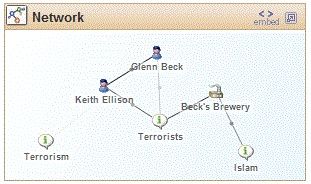
I was thus delighted to find, as I was doing my morning trawl of usual and unusual news sources, that Glenn Beck had come out with his estimate of how many Muslim terrorists there are in the world (10% of the global Muslim population, ie 157 million), Fareed Zakaria had refuted him — and there was even a helpful Silobreaker network diagram to show me how the relevant nodes under discussion fit together:
Beck Muslims and Brewery

I was delighted to see that (Mormon) Glenn Beck is more closely associated with (Muslim) Rep. Keith Ellison than he is with terrorists, and sorry to note that Beck’s Brewery and Islam are somehow linked… But naturally, once I had seen this much I wanted to drill down even deeper — so I entered the appropriate keywords at Silobreaker and found this:
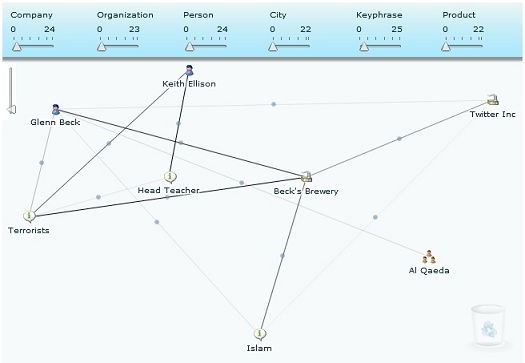
silobreaker beck islam

You’ll see that Beck’s link with Al Qaeda is, thankfully, a weak one. And I think you’ll agree with me that even shifting from a six node to an eight node graph considerably ups the sophistication of analysis required to fully comprehend the issues portrayed.

*

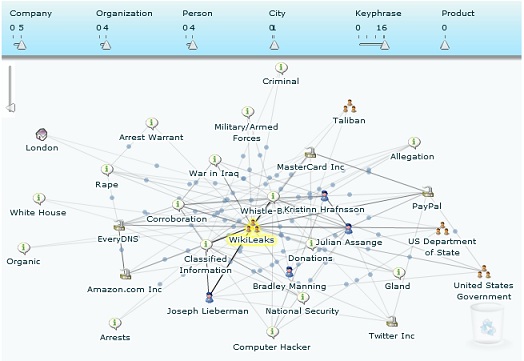
In any case, I thought it might be appropriate to post Silobuster’s more detailed map of the current situation with WikiLeaks here:
Wikileaks Silobreaker

All becomes clear, eh?

I particularly like the node labeled “Gland” (it’s almost hidden but not quite, you’ll find it lower right, between PayPal and Twitter)– that might be the one I’d zero in on to get a fuller appreciation of the complexities of the situation.

And for the record, this post is an example of British “humor” — or as we prefer to call it, “dry wit”.
WikiLeaks: Counterpoint at the State Department?

Wednesday, December 8th, 2010

[ by Charles Cameron ]

[ note: all links are to youtube videos ]

The pianist Glenn Gould is celebrated for his ability to bring the different and at times positively oppositional voices in a fugue by Bach to our attention, so that we follow each one separately while hearing all at the same time as a single whole. What is less known is that he liked to sit at a table in a truck stop and listen to the different conversations at the other tables and booths, mentally braiding their pale or brightly colored threads of human together into an analogous tapestry — one voice harmonizing with or conflicting against another, here a new subject introduced, there an echo of an earlier idea heard in a fresh context, with the murmurings of waitresses punctuated by the kaching! of the cash register, the hydraulic hiss of a door closing — conversation as counterpoint.

Organizations and individual alike, we all have different and at times dissonant voices, and strive to bring them to some kind of resolution. The many stakeholders debating an issue in town halls, blogs or letters to the editor, the many drives within each one of us, idealistic, hopeful, defeated, paralytic, angry, evasive, sluggish, vengeful, curious, alert, defiant, all have voices, all constitute an experience of polyphony, a “music of many voices”, in point counter point.

One of my interests is to find a way to score these many fugues, these musics of meaning.

My DoubleQuotes, then, can be considered as two-part inventions, attempts to show the multiple tracking of the mind — whether of a single individual, as in this case, or of a group, a community, a world divided – so that something of the music begins to be visible, and some of the dissonances can move towards necessary resolution.

*

QUOwikileaks

*

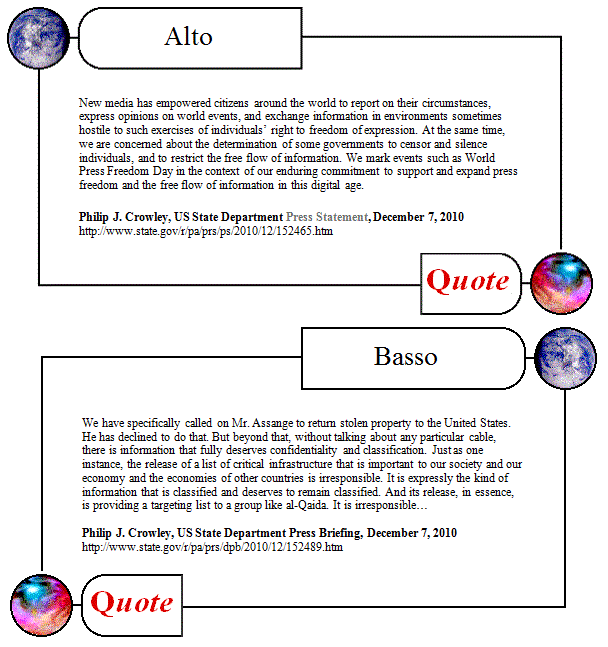
I believe there is unresolved irony between these two statements, made on the same day by Philip J Crowley, the US State Department’s Assistant Secretary, Bureau of Public Affairs – but each has its reasons, and there are arguments to be made for both transparency and opacity, diplomacy and publicity, secrets and revelations.

Between them lies the possibility I think of as a virtual music of ideas.

*

Bach published a series of two-part inventions, BWV 772–801, and wrote of them that he intended to offer them as an honest method

by which the amateurs of the keyboard – especially, however, those desirous of learning – are shown a clear way not only (1) to learn to play cleanly in two parts, but also, after further progress, (2) to handle three obligate parts correctly and well; and along with this not only to obtain good inventions (ideas) but to develop the same well; above all, however, to achieve a cantabile style in playing and at the same time acquire a strong foretaste of composition…

Later comes the Art of Fugue.

Israeli fires: the blame game

Tuesday, December 7th, 2010

[ by Charles Cameron ]

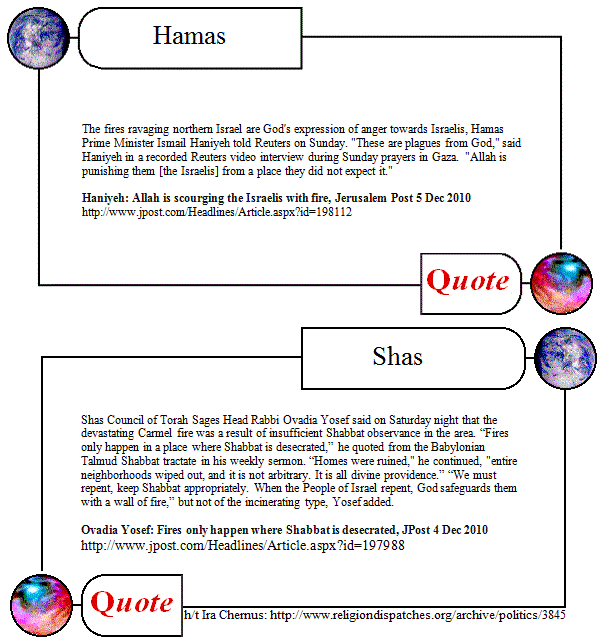
QUOIsraelFires

If it were me, I’d pray for rain.

Simplification for Strategic Leverage

Sunday, December 5th, 2010

Remember this much ridiculed visual monstrosity?:

Excessively complex representations, much less the bureaucratic systems in practice, are poor vehicles for efficient communication of strategic conceptualizations to the uninformed – such as those downstream who must labor to execute such designs. Or those targeted by them for help or harm.  In addition to the difficulty in ascertaining prioritization, the unnaturally rigid complexity of the bureaucracy generally prevents an efficient focus of the system’s resources and latent power. The system gets in it’s own way while eating ever growing amounts of resources to produce less and less, leading to paralysis and collapse.

Does it have to?

Here’s an interesting, very brief take on analytical simplification from a natural scientist and network theorist Dr. Eric Berlow on how to cull simplification – and thus an advantage – out of complex systems by applying an ecological paradigm.

Cognitive simplification will be a critical strategic tool in the 21st century.

Update: Wikileaks and Cryptographic Mythology

Saturday, December 4th, 2010

[ by Charles Cameron ]

It seems my intuition of a Lovecraft connection with WikiLeaks was right, as was Jean’s suggestion that the MARUTUKKU quote is “more specific and extensive and ‘mythological'” than the translations of Enuma Elish she’d found on the net. I dropped Anders Sandberg a line letting him know I’d quoted him in my earlier post, and he graciously responded with this clarification of the mystery:

I think the MARUTUKKU name/description is from the Simon Necronomicon, which did its best to shoehorn mythology into the mythos, and might explain the different translation. Of course, one might argue that that book is a real, a hoax posing as real, real posing as a hoax, or both at the same time.

Anders, currently a staff member with the Future of Humanity Institute at Oxford (which name strikingly reminds me of the Bright Futures Institute in Qom, Oxford’s parallel in the Iranian universe), is also known for his writings on Mage: the Ascension and other role-playing games — see for instance this account of the Asatru in M:tA.

*

Bryan Alexander Steve Burnett

The bearded, theremin-wielding mage Steve Burnett [left] also noted the origin of the MARUTUKKU quote in the Simon Necronomicon in his comment on my no-less-bearded mage-friend [right] Bryan Alexander‘s blog Infocult — which features a rich vein of gothic imaginings and runs with the subtitle “We haunt every medium we make”.

Delighted to find an excuse to post that photo, btw. My warm regards to all…


Switch to our mobile site

