zenpundit.com » military history

Archive for the ‘military history’ Category

How to Lose a War: A Primer

Sunday, July 28th, 2013
[by Mark Safranski a.k.a. “zen“]

Since Pakistan is now attempting to get its victory over the United States in Afghanistan formally ratified, now seemed to be a good time to reflect on the performance of American statesmen, politicians and senior generals.

It has occurred to me that we have many books and papers outlining how to win wars. Certainly the great classics of The Art of War, The History of the Peloponnesian War and On War are the foremost examples, but there are also other useful classics in the strategic canon, whole libraries of military histories, memoirs of great commanders and an infinite number of PDFs and powerpoint briefs from think tanks and consultants. Strangely, none of these have helped us much. Perhaps it is because before running this war so few of this generation’s “deciders” read them en route to their law degrees and MBAs

We should engage in some counterintuitive thinking:  for our next war, instead of trying to win, let’s try to openly seek defeat. At a minimum, we will be no worse off with that policy than we are now and if we happen to fail, we will actually be moving closer to victory.

HOW TO LOSE A WAR

While one of these principles may not be sufficient cause for losing an armed conflict, following all of them is the surest road to defeat.

1. War is the Continuation of Domestic Politics:

The point of politics is to acquire, hold and enjoy using power. When we lose sight of this fact due to romantic notions of “national interest” or “duty” and spend too much attention prosecuting a war against foreign armies then our real enemies – the political opposition – can take advantage. What good is overseeing a global victory over an epochal tyranny if the result is you get immediately voted out of office like some hapless loser? While on the surface, it might seem wise during a war to staff a government with able statesmen, experienced generals, capable diplomats and other experts, the truth is that if you do so you will have very few plum jobs left with which to reward the cronies, ideologues, campaign consultants, activists, wealthy grafters and partisan hacks who got you into power in the first place. Without their continued support, you will not be long for political office.

The fact is that the nation can survive many lost wars far longer than your career will survive lost elections.  Once you view the war solely through the prism of how any action might impact your fortune in domestic politics, you will have a marvelous clarity that the war is the best pretext upon which to expand your power at the expense of the opposition and the people.

2. Policy is the True Fog of War:

Having a clearly defined, coherently articulated policy based upon vital interests and empirical facts that sets a few realistic objectives in a way that makes possible shared understanding and broad political support is no way to go about losing wars.

Keeping in mind #1, the point of war policy is to generate a set of politically compelling slogans that remain ill-defined enough to serve as an umbrella  under which many contradictory and competing agendas can cohabit until some of them can be opportunistically realized. These agendas may not be realistic – in fact, it is easier to put them forward as attractive fantasies for the public if your administration is unburdened with officials with genuine expertise in warfare, economics, foreign cultures, history and other inconvenient information that the media and the political opposition will only be too happy to seize upon. The more abstractly and arcanely expressed the policy the harder it is for critics to demolish and the  better it is for losing wars. “Unconditional surrender” for example, is bad because it is too concrete and easily evaluated – either an enemy is totally defeated and in your power or he is not. “Make the world safe for Democracy” by contrast,  is better as it is more ill-defined and subjective, permitting a larger range of politically tolerable bad outcomes.  “Responsibility to Protect” and “War on Terror” are even more abstract, being essentially unlimited, open-ended, process goals that do not have any point of “victory” whatsoever and can thus not only potentially bring about losing wars but very long ones.

3.  Strategy is a Constraint to be Avoided:

Strategy is about lining up Ends-Ways-Means to construct a theory of victory. While that might give us hope of prevailing over an enemy in an armed conflict, forging a strategy – any strategy -comes with a severe cost: namely the discipline of the government adhering to a strategy requires choices be made about the use of limited resources rather than keeping “all options open” to react  to transient and trivial political concerns on a moment’s notice. Strategy for the nation equates with diminished political flexibility and mobility for the politician.

In other words, having a strategy might require elected officials expend their precious political capital in order to pursue it without getting anything in return that might expand their powers or further their personal careers.  Doing strategy would mean prioritizing winning the war over other possible objectives and putting key decision-makers in the uncomfortable position of having to say “No” or “Not now” to powerful and influential people or factions. Worse, having a strategy also implies that the results can be quantified and evaluated for success, costs, failure and ultimately, personal accountability for leaders.

Obviously locking ourselves into a strategy is something to be avoided if we wish to stay in power, so “strategy” is only invoked rhetorically to mean a wide and confusing array of other non-strategy things – tactics, goals, operational art, planning,  public relations, nation-building,  diplomacy, policy, routine procedures, withdrawal dates, theories, fantastical pipe dreams and so on.  When “strategy” means anything and everything it ultimately means nothing.

4. All Lost Wars are based on Self-Deception: 

It is not enough to avoid strategy, there must also be a collective political determination to avoid reality enforced from the inception until the bitter end.

Wars have real and physically destructive consequences for the people who fight them, but unless you are engaged in a desperate struggle to repel a foreign invader, chances are the battlefield is far away from your home territory. This gives political leaders wiggle room to manipulate perceptions – most importantly their own – to political advantage by controlling information about the war and shaping the ideological boundaries of acceptable public discourse. This will eventually lead to a vicious cycle of bad decisions as misinformation and deceit corrupts the OODA Loop, but political leaders will maintain their political advantage over their critics, at least until the day of reckoning arrives.

Here we must begin with an insistence of a position of firmly held ignorance regarding the prospective enemy, their military capabilities, economic resources, the geographic characteristics, their cultural attitudes toward conflict and their history as a people. Should such information become widely known, it might result in popular skepticism about the wisdom of the entire enterprise, the difficulties that might be encountered and the prospects for success. If you wish to lose a war ignominiously, the less you know the better.

Likewise, once war has begun, the initial jingoistic overconfidence that greeted the war will quickly fade unless actively sustained by preventing an honest analysis of  events and providing a steady stream of rationalizations for the gullible public. It would be a good idea to ban discussion that accurately characterizes the form of warfare  or the nature of the enemy, though these things alone will not be sufficient. The intelligence process itself should be corrupted when possible to provide the “right” answers and censored or circumvented when it is not; while public assessments should use irrelevant metrics divorced from their  context so that they will not have to be gamed later.  Critics, truth-tellers, whistleblowers and those not towing the party-line should be retired, fired, demonized and punished.

5. Isolate the War and those Fighting it from the People: 

A war forgotten by the folks at home is a war that is much easier to quietly lose.

At the outset of the war, ask no sacrifice of the people because that will give them too much of a stake in a victorious outcome and raise expectations about your own leadership. Neither raise their taxes (at least not for the war at any rate) nor conscript their sons. Do not even issue a national call to the colors for volunteers, instead encourage people to be at ease and go about their business. Supplement your small regular army that increasingly feels itself a caste apart with highly paid mercenaries and foreign paramilitaries while neglecting the needs of your own troops. Speaking of the troops, always lavish the soldiers with superficial public pieties about service, sacrifice and heroism, but cynically break faith when it comes to your obligations to look after their interests.

6.  Complexity= Opacity and Micromanagement= Power

Most things in war are simple, but they are not easy. By deliberately making everything incredibly complicated, war can also become impossible too

While adding superfluous complexity does not help win wars, it does offer a number of immediate benefits for the political class. First, in real life the consequence of increasing complexity in any governmental endeavor (not just war) is that you will have more jobs and contracts to hand out to followers as bureaucracy and regulations require new inspectors, secretaries, managers, clerks, lawyers, advisers and in a military context, also new commands, staff officers, promotions, headquarters, increased budgets and so on. Chances are, most of these new jobs will continue on, if not forever, for a very long time.

Secondly the sheer complexity and number of offices, bureaus, agencies, departments, teams, commands, commissions and committees offer excellent “cover” for carrying out unpopular or illegal actions “under the radar” and with diffusion of responsibility, should these antics come to light.  If everyone is in charge, then no one is.  So if your military, intelligence agencies, diplomats, cultural advisers, aid and development people and senior administration officials talk and behave as if they are all hailing from different planets, you are well on your way to losing the war.

Third, the control of people at the top is reinforced by excessive complexity because the initiative of lower levels is strangled by micromanagement. If every idea from the field ( or even basic actions) requires two, three or more levels of command approval with consultation with lawyers at each step the answer is always going to be “No” or a very delayed “Yes” long past the point of being useful. This, plus making examples of those who exercise initiative and act without orders, teaches everyone in the system to eschew risk, value passivity, play it safe and wait for higher-ups to spoon-feed them instructions. With modern, networked online communications every colonel, brigadier to three-star can play company commander while the President of the United States can ride virtual shotgun on SEAL team raids.

7.  Enormous Tail, Tiny Tooth: the Worse the ROI the Better

When you regularly use hundred million or billion dollar platforms to kill illiterate tribesmen with AK-47s and RPGs and build food courts in the Hindu Kush, something is eventually going to give.

Generally, a reasonably well governed country at war can afford to employ either a massive military force for a short campaign or a small, “light footprint“, force for the long haul. What few nations in history can afford, unless it is Persia under Xerxes, is to field a massive force disproportionately composed of rear echelon support troops and what used to be called “camp followers” and “auxiliaries” for years on end. There are two ways this can bring you to defeat.

First, obviously, fielding an enormous army for too long can lead to bankruptcy as costs of the war exceed tax revenues and the state begins to rely on various forms of credit, foreign bankers and debasing the currency to carry on. This does not guarantee an economic collapse or hyperinflation as war can also greatly stimulate production and other variables are always in play, but the risk of dire negative economic effects is significantly increased.

The second issue is that if you are moving your armed host into a desperately poor region to wage war against an impoverished enemy, the passage and encampment of your own military introduces the economic surplus to the local economy the enemy needs to afford to wage war. You are like a red hot iron in a bucket of ice water. Through bribery, extortion and theft the enemy will siphon from you money, arms and contraband and eventually, corrupt your own officials and officers.

 8. Cultivate Hatred and Contempt:

If you wish to lose a war, be hated but not feared.

While most principles of losing a war  are political, strategic or operational in nature and therefore the province of incompetent politicians and generals, cultivating contempt and hatred in all observers can be done at anytime by anyone regardless of rank, experience or status. Technology has revolutionized this sphere of losing warfare: where once undermining an entire war effort could only be done by an arrogant national blowhard, today any grinning idiot on a battlefield with a smart phone is only a tweet away from an international media firestorm.

It is import in cultivating hatred to remember that mere violence, an inevitable part of all wars, is not sufficient. One can respect and admire an honorable but fierce opponent. Conveying a bullying attitude of casual cruelty to all onlookers by mistreating prisoners and civilians, especially if you humiliate and abuse them is a surefire goad to hatred while also alienating allies and neutrals, especially when doing so contradicts the nation’s deeply held values.  Hatred can also be stirred in less dramatic ways, from posing with Nazi flags to widespread ignorance of and expressions of disdain for local customs and mores. Disrespect has legs.

Contempt by contrast, is earned more by exhibiting moral weakness and truckling appeasement of the enemy and his sympathizers. For example, have your own PA and diplomatic organs in speaking to the media, repeat enemy propaganda against your own soldiers and abuse the military justice system to prosecute soldiers for splitsecond combat decisions in order to appease these critics. Loudly trumpet the “culturally appropriate meals” to the guys you are going to waterboard and appoint enemy sympathizers as “cultural advisers” and “liaisons” to government security and law enforcement agencies. Do nothing as your own heavily infiltrated host nation “ally” repeatedly frags your soldiers.

9. Protect that Which is Most Unimportant:

Organizations signal what they really value not by what they say, but what they spend time and money on.

Make sure that as the war is steadily being lost that top brass and their civilian overseers frantically emphasize politicized trivialities and institutional martinet nonsense. Reflector belt mania, giving everyone and their brother breathalyzer tests, cultural sensitivity training, counterproductive regs for MEDEVAC helicopters, promoting the gender equality of foreign societies and gender-neutrality of our own should bump out boring, old training exercises for future combat deployment in terms of priority. Remember, the military is not really there to win wars – it is a captive social engineering project for things the wackier members of Congress wish they could impose on their constituents were it not for those damned free elections.

10. Level the Playing Field: Paralyze Your Own Tactical Advantages.

While a war is often lost by having a bad strategy or no strategy at all, the power of crapping away your tactical advantages to no purpose ought not be underestimated. There are thousands of ways to do this but if you are cutting the enemy repeated breaks you can’t go wrong.

First and foremost, you wish to avoid bringing all of your combat power to bear on the enemy’s weakest point in a combined arms assault because he very well may break and then where the hell will you be? You can hardly lose a war if the enemy dies or surrenders first.

Treat your combat arms, services and host nation military as separate, autonomous and almost unrelated units, each with their own objectives and set of ROE guidance more restrictive than required by the Laws of War (while mixing in allied and host nation forces of varying levels of capability and different ROE). Make it difficult for fire support, armor and air to work with your infantry commanders dealing with unforseen circumstances, who you should also spread thin over remote operational areas the size of, say, Iowa to maximize their vulnerability. If a battalion is needed, send a company. If a company is called for, send a squad. Allow the enemy to have safe havens in adjacent countries whose military power is dwarfed by your own by many orders of magnitude. Make sure that your intelligence and public diplomacy services are shorthanded on personnel  fluent in the languages used by the enemy, whom you allow to practice perfidy without punishment.

Remember, there are no guarantees in war. No matter how badly you screw up, the enemy might still be more poorly led and less adaptive than are you. That said, if you practice these ten principles you can become a master of the art of defeat.
D-DAY, June 6, 1944

Thursday, June 6th, 2013

“Soldiers, Sailors and Airmen of the Allied Expeditionary Force! You are about to embark upon a great crusade, toward which we have striven these many months. The eyes of the world are upon you. The hopes and prayers of liberty loving people everywhere march with you. In company with our brave Allies and brothers in arms on other fronts, you will bring about the destruction of the German war machine, the elimination of Nazi tyranny over the oppressed peoples of Europe, and security for ourselves in a free world.

Your task will not be an easy one. Your enemy is well trained, well equipped and battle hardened, he will fight savagely.

But this is the year 1944! Much has happened since the Nazi triumphs of 1940-41. The United Nations have inflicted upon the Germans great defeats, in open battle, man to man. Our air offensive has seriously reduced their strength in the air and their capacity to wage war on the ground. Our home fronts have given us an overwhelming superiority in weapons and munitions of war, and placed at our disposal great reserves of trained fighting men. The tide has turned! The free men of the world are marching together to victory!

I have full confidence in your courage, devotion to duty and skill in battle. We will accept nothing less than full victory!

Good Luck! And let us all beseech the blessings of Almighty God upon this great and noble undertaking.

— Gen. Dwight D. Eisenhower “

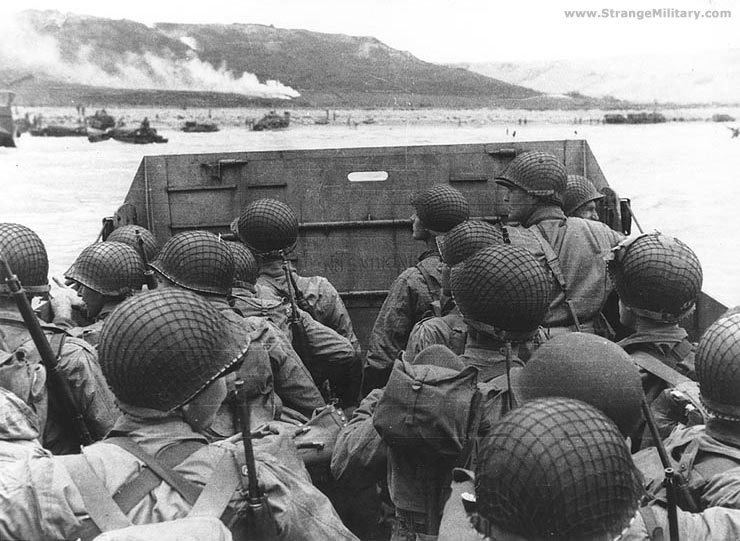
Sixty-nine years ago over 9,000 American men, some hardly older than boys, laid down their lives on the beaches of Normandy in the greatest military operation in the history of the world. The white crosses stand row upon row in Colleville-sur-Mer,  in silent testimony of their supreme sacrifice.

Others who scrambled ashore on bloody Omaha Beach, or who climbed the rocky cliffs of Pointe du Hoc or who parachuted behind enemy lines with the 82nd and 101st Airborne lived to fight their away across France and across the Rhine into the heartland of Germany to break the power of the Third Reich forever. Others who survived the terrible ordeal of D-Day and fought on were not so lucky and did not come home.

The median age of WWII veterans now stands at 92. The “Greatest Generation” is receding into history in increasing numbers with each passing year but their deeds are destined to become legend.

….The men of Normandy had faith that what they were doing was right, faith that they fought for all humanity, faith that a just God would grant them mercy on this beachhead, or on the next. It was the deep knowledge – and pray God we have not lost it – that there is a profound moral difference between the use of force for liberation and the use of force for conquest. You were here to liberate, not to conquer, and so you and those others did not doubt your cause. And you were right not to doubt.

You all knew that some things are worth dying for. One’s country is worth dying for, and democracy is worth dying for, because it’s the most deeply honorable form of government ever devised by man. All of you loved liberty. All of you were willing to fight tyranny, and you knew the people of your countries were behind you.

The Americans who fought here that morning knew word of the invasion was spreading through the darkness back home. They fought – or felt in their hearts, though they couldn’t know in fact, that in Georgia they were filling the churches at 4:00 am. In Kansas they were kneeling on their porches and praying. And in Philadelphia they were ringing the Liberty Bell.

Something else helped the men of D-day; their rock-hard belief that Providence would have a great hand in the events that would unfold here; that God was an ally in this great cause. And so, the night before the invasion, when Colonel Wolverton asked his parachute troops to kneel with him in prayer, he told them: “Do not bow your heads, but look up so you can see God and ask His blessing in what we’re about to do.” Also, that night, General Matthew Ridgway on his cot, listening in the darkness for the promise God made to Joshua: “I will not fail thee nor forsake thee.”

…..Here, in this place where the West held together, let us make a vow to our dead. Let us show them by our actions that we understand what they died for. Let our actions say to them the words for which Matthew Ridgway listened: “I will not fail thee nor forsake thee.”

Strengthened by their courage and heartened by their value [valor] and borne by their memory, let us continue to stand for the ideals for which they lived and died.

Thank you very much, and God bless you all. ”

– Ronald Wilson Reagan, President of the United States, June 6, 1984

New Book: The Guns at Last Light

Sunday, June 2nd, 2013

The Guns at Last Light: The War in Western Europe, 1944-1945 by Rick Atkinson 

Just received a review copy courtesy of Callie  Oettinger and Henry Holt and Company.

I have not read the first two books in Atkinson’s well-regarded Liberation Trilogy, but Guns at Last Light is a deeply researched work with over two hundred pages of end notes and selected bibliography, which feature a very substantial amount of primary source material. The campaign maps are richly detailed and photographs are ample.  The author has aimed to satisfy academic critics, military history buffs and popular audience alike.

In vol. III Atkinson is telling the story of WWII from D-Day to the aftermath of Hitler’s suicide in defeated Berlin to overcome the savage but futile resistance of the Germans:

Although the National Redoubt in the Alps was a brown pipe dream, makeshift bastions here and there stoked SHAEF’s fear of a Germany bent on self-immolation. In Aschaffenberg, Bradley reported that ” women and children lined the rooftops to pelt our troops with hand grenades” while wounded veterans hobbled from their hospital beds into the firing line. In Heilbronn, on the Neckar River, already smashed by years of bombing, German officers shot down Hitler Youth detachments when they broke under American mortar fire 

An anecdote that is the same spirit of what can be read in Ian Kershaw’s The End. The Third Reich was ruled to the last by fanatical Nazi bitter-enders who kept the war going long past the point of any hope of a moderate defeat, much less a victory.

Looks like a good read.

Is 4GW Dead?: Point-Counterpoint and Commentary

Tuesday, May 28th, 2013

4GW theory has always attracted overenthusiasts and  raging haters ever since the concept emerged way back in 1989, so debates about the merit of 4GW are nothing new; in fact, the arguments became so routine that they had largely gone sterile years ago.  After T.X. Hammes published his excellent  The Sling and the Stone and John Robb  went to the next level with Brave New War , it seemed that  little new was left to be said. In the late 2000’s, intellectual energies shifted to arguing the nuances and flaws of Pop-centric COINwhich proved in time to be even more bitter than those about 4GW.

Generations of War Theory Visualized by Chet Richards

What is different recently is that the person taking the affirmative on the question “Is 4GW dead?” was Dr. Chet Richards, who for years ran the premier but now defunct 4GW site, D-N-I.net, now archived here by the Project on Government Oversight.  Richards is no Clausewitzian true-believer or Big Army MBA with stars, but a former collaborator with John Boyd and a leading thinker of the 4GW school who had written several books with that strategic theme.

Therefore, not a critic to be dismissed lightly. Here’s Chet:

Is 4GW Dead? 

….The first thing to note is that 4GW is an evolution from 3GW, which they equate to maneuver warfare and the blitzkrieg as defined in MCDP 1 and Boyd’s Patterns of Conflict. These are styles of warfare conducted by state armies against other state armies, although the paper does invoke the notion of transnational terrorists near the end.

At some point in the late 1990s, the theory bifurcated. Bill Lind and Martin van Creveld began to emphasize the decline of the state and focus on transnational guerrilla organizations like al-Qa’ida. Tom Barnett called this the “road warrior” model. T. X. Hammes, on the other hand, characterized 4GW as “evolved insurgency” and envisioned the techniques described in the paragraphs above as also useful for state-vs-state conflicts.

….The 9/11 attacks, by a transnational guerrilla movement, seemed to confirm 4GW in both of its forms. In the last few years, however, everything has gone quiet. Transnational insurgencies, “global guerrillas” as John Robb terms them, have not become a significant factor in geopolitics. “Continuing irritation” might best describe them, whose primary function seems to be upholding national security budgets in frightened western democracies. The state system has not noticeably weakened. So it might be fair at this point to conclude that although 4GW was a legitimate theory, well supported by logic and data, the world simply didn’t develop along the lines it proposed.

A prominent critic of 4GW, Antulio J. Echevarria, may have been correct:

What we are really seeing in the war on terror, and the campaign in Iraq and elsewhere, is that the increased “dispersion and democratization of technology, information, and finance” brought about by globalization has given terrorist groups greater mobility and access worldwide. At this point, globalization seems to aid the nonstate actor more than the state, but states still play a central role in the support or defeat of terrorist groups or insurgencies.

Why? I’ll offer this hypothesis, that the primary reason warfare did not evolve a fourth generation is that it didn’t live long enough. The opening of Sir Rupert Smith’s 2005 treatise, The Utility of Force, states the case….

Chet’s post spurred a sharp rebuttal from William Lind, “the Father of Fourth Generation Warfare”:

4GW is Alive and Well 

So “the world simply didn’t develop along the lines it (4GW) proposed”? How do you say that in Syriac?

The basic error in Chet Richards’ piece of April 19, “Is 4GW dead?” is confusing the external and internal worlds. Internally, in the U.S. military and the larger defense and foreign policy establishment, 4GW is dead, as is maneuver warfare and increasingly any connection to the external world. The foreign policy types can only perceive a world of states, in which their job is to promote the Wilsonian nee Jacobin, follies of “democracy” and “universal human rights.” They are in fact, 4GW’s allies, in that their demand for “democracy” undermines states, opening the door for more 4GW.

In most of the world, democracy is not an option. The only real options are tyranny or anarchy, and when you work against tyranny, you are working for anarchy. The ghost of bin Laden sends his heartfelt thanks.

Third Generation doctrine has been abandoned, de facto, if not de jure, by the one service that embraced it, the U.S. Marine Corps. The others never gave it a glance. The U.S. military remains and will remain second generation until it disappears from sheer irrelevance coupled with high cost. That is coming much sooner than any of them think.

….In many of these cases, including Egypt and Pakistan, the only element strong enough to hold the state together is the army. But the “democracy” crowd in Washington immediately threatens aid cut-offs, sanctions, etc., if the army acts. Again, the children now running America’s foreign policy are 4GW’s best allies.

Fourth generation war includes far more than just Islamic “terrorism,” and we see it gaining strength in areas far from the Middle East. Gangs have grown so powerful in Mexico, right on our border, that I predict the state will soon have to make deals with them, as the PRI has done in the past. Invasion by immigrants who do not acculturate is a powerful form of 4GW, more powerful than any terrorism, and that is occurring on a north-south basis (except Australia) literally around the world. Remember, most of the barbarians did not invade the Roman Empire to destroy it. They just wanted to move in. In fact, most were invited in. Sound familiar?

What should concern us most is precisely the disconnect between the internal and external worlds. Externally, 4GW is flourishing, while internally, in the US government and military, it does not exist. This is the kind of chasm into which empires can disappear….

Fabius Maximus – who is a both a pseudonymous blogger and a group blog, also responded:

Update about one of the seldom-discussed trends shaping our world: 4GW 

One of the interesting aspects of recent history is the coincidence of

  1. the collapse of discussion about 4GW in US military and geopolitical circles,
  2. victories by insurgents using 4GW methods over foreign armies in Iraq and Afghanistan, &
  3. most important, the perhaps history-making victory by Bin Laden’s al Qaeda.

The second point is important to us, but the usual outcome since WW2 (after which 4GW became the dominate form of military conflict; see section C below).  The third point is the big one. Based on the available information, one of Bin Laden’s goals was to destabilize the US political regime. Massive increase in military spending (using borrowed funds). The bill of rights being shredded (note yesterday’s House vote to tear another strip from the 4th amendment). Our Courts holding show trials of terrorists — recruited, financed, supported by our security services. Torture and concentration camps.

….We — the Second American Republic — have engaged in a war with nationalistic, Islamic forces using 4GW.  So far we are losing.  For various reasons we are unable to even perceive the nature of the threat. In DoD the hot dot is again procurement of high-tech weapons — new ships, the F-35, the hypersonic cruise missile, etc.  All useless in the wars we’ve fought for the past 50 years, and probably in those of the next 50 years….. 

A few comments.

4GW has been heavily criticized – and accurately so – for making selective use of history, for unsupported maximal claims, for an excessively and ahistorically linear argument and for shifting or vaguely defined terms. Presented rigidly, it is relatively easy for critics to poke holes in it simply by playing “gotcha” (some of the criticism of 4GW did not get beyond ad hominem level garbage, but more intellectually serious detractors made very effective critiques of 4GW’s flaws).

That said, there were a number of useful elements or insights in the body of 4GW writings that retain their utility and I think are worth recalling:

  • Whatever one thinks of 4GW as a whole, the school drew attention to the threat of non-state irregular warfare, failed states and the decline of state vs. state warfare and did so long before it was Pentagon conventional wisdom or trendy Beltway talking head spiels on Sunday morning news programs.
  • While the state is not in decline everywhere in an absolute sense, it sure is failing in some places and has utterly collapsed elsewhere. Failed, failing and hollowed out states are nexus points for geopolitical problems and feature corruption, black globalization, insurgency, tribalism, terrorism, transnational criminal organizations and zones of humanitarian crisis. Whether we call these situations “irregular”, “hybrid”, “decentralized and polycentric”, “LIC”, “4GW” or everyone’s favorite, “complex” matters less than using force to achieve political aims becomes increasingly difficult as the interested parties and observers multiply. Some of the advice offered by the 4GW school regarding “the moral level of war”, de-escalation and the perils of fighting the weak in such a conflict environment are all to the good for reducing friction.
  • The emphasis of the 4GW school on the perspective of the irregular fighter and their motivations not always fitting neatly within state-centric realpolitik, Galula-ish “Maoist Model” insurgency, Clausewitzian best strategic practice or the Western intellectual tradition, were likewise ahead of their time and contrary to S.O.P. Even today, the effort to see the world through the eyes of our enemies is at best, anemic. Red teams are feared more than they are loved. Or utilized.
  • The bitter criticism the 4GW school lodged of the American political elite being allergic to strategic thinking and ignorant of strategy in general was apt; that American strategy since the end of the Cold War has been exceedingly inept in thought and execution is one of the few points on which the most rabid 4GW advocate and diehard Clausewitzian can find themselves in full agreement.

The lessons of 4GW will still be relevant wherever men fight in the rubble of broken societies, atomized communities and failed states.

Two Readings, and If You Read It, Why Not Review It?

Thursday, May 23rd, 2013

[by J. Scott Shipman]

One Hundred Days, The Memoirs of the Falklands Battle Group Commander, Admiral Sandy Woodward

For professional reasons, many trusted colleagues have recommended One Hundred Days, and I finally finished it a few weeks ago. They reminded me the Falklands War “was the first modern anti-access/area-denial (A2/AD) war, pitting a joint expeditionary force against a regional power with modern land, air, and sea capabilities.” [sourced from Proceedings magazine, May 2012, by Commander Jim Griffin, U.S. Navy—strongly recommended] In other words, the scrap in the South Atlantic in 1982 was the last time a “modern” expeditionary force faced a credible adversary with modern capabilities. 

Admiral Woodward reminds that no one expected Argentina to invade the Falklands, and even if they did, no one expected the UK to respond with force (even the Royal Navy (RN) was surprised, and many had to find the islands on a map). Woodward departed with the two remaining UK carriers, the Hermes and Invincible which were already on the chopping block due to budget problems (sound familiar?). Fighting was such a distant memory for the RN, having not engaged in significant action since WWII, and Woodward recounts that many of his men had difficulty making the transition from “a sea-going job” to fighting, and possibly dying. I wondered as I read if the U.S. Navy has prepared/is prepared for this transition; and truly both officer and rates proved susceptible. The personal nature of Woodward’s account was bit of a surprise, but provides valued insight into the challenges and frequent frustrations faced by naval leaders.

Commander Griffin’s account in Proceedings referenced above has a very good list of lessons learned, and a few observations and questions are added for consideration:

  1. Naval warfare is war of attrition. Attrition can occur as a result of sinking or disabling an opponent. In the case of the Brits, many of their ships sustained non-fatal hits that, for practical purposes, removed the ship from any offensive or defensive action. Many of our enemies, while not sophisticated, understand and plan accordingly. As a result numbers are important; numbers of ships and weapons.
  2. In the age of the missile, response times were/are measured in seconds, so ships and aircraft will be lost…often, quickly.
  3. Are our systems susceptible to electro-magnetic interference (EMI)? 
  4. Could our ships navigate or fight without GPS or other satellite-dependent technologies?
  5. Can sailors onboard fix systems when they break (and they will break, see #6 below)? One RN ship had a contractor embarked who made the difference, which was blind luck. Over the last 20 years, the USN has tended towards “operators” over technicians.
  6. “Murphy” is alive and well. When things can fail (including technologies), they will, at the worst possible time.
  7. Is the theater commander in command? In the Falklands, Woodward had command of ships, but not submarines—which hampered the effectiveness of his battle group.
  8. Ship preservation (preventive maintenance) is often paid for in battle. At least two RN ships were unable to use weapons because of salt corrosion rendering missile hatches inoperable. This is engineering problem, too, to be sure, but also an example of how preventive maintenance can pay-off when it counts.
  9. Damage control training for all-hands; rigorous and often. RN sailors did a masterful job of saving several of their wounded ships.
  10. Anti-missile capabilities on logistic/support ships.
  11. Homefront politics and posturing provides fog in war as does the enemy. One curse of modern communications; having the White House Situation Room second-guessing/micromanaging the war.
  12. The press is often not your friend. On a couple of occasions, the BBC broadcast orders of battle and goals, and the Argentineans planned and acted accordingly.
  13. The motto of Captain John Coward, RN, of HMS Brilliant, “The essence of war is violence. Moderation in war is imbecility.”

Woodward’s book is the clearest account we have of naval warfare in the missile age. If it is not already, One Hundred Days should be required reading for every naval officer. Strongest recommendation.

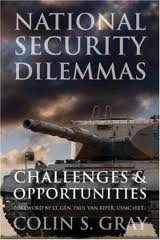
National Security Dilemmas, Challenges & Opportunities, Colin S. Gray

Colin Gray is no stranger to the readers of Zenpundit. I read this title over the Christmas break, and have returned to review with some frequency. In fact, my copy is so littered with underlining and marginalia, these periodic “reviews” can take a couple of hours. As the title suggests, Gray outlines the challenges and opportunities facing policymakers, and in so doing provides an accurate glimpse of our current state of political-military affairs. He encourages policymakers to reacquaint themselves with the importance of the concept of victory, and on how to successfully navigate a transition of our military from our previous focus of regular warfare to the realities introduced by enemies using irregular methods. Gray discusses “revolutions in military affairs (RMA)” and deterrence and the implications of both in our thinking and planning. Gray’s concluding section on preemption and preventative war is exceptionally well-presented.

For example, Gray’s section on Achieving Decisive Victory includes:

  1. Better armies tend to win.
  2. No magic formula for victory.
  3. Technology is not a panacea.
  4. The complexity of strategy and war is the mother of invention.
  5. Know your enemies.

This book is imminently quotable, so I’ll share a few with my highest recommendation.

The idea that strategy has an essence is deeply attractive. Strategy sounds incredibly rare and valuable, like something that could be bottled and sold. Unfortunately, American understanding of and sound practice in strategy is desperately rare. Strategic thinking and behavior are endangered activities in the United States. This is hardly a stunningly original insight. However, familiar though the criticism should be, it loses none of its bite for reason of longevity. Much as the U.S. defense community periodically is prodded by irregularist anxiety to worry about insurgency and terrorism, so from time to time it remembers the value of strategy. Though American defense professionals do not know what strategy is or how it works, they know that it is a matter of grave importance. The pattern has been one wherein a politician or a senior official with a personal interest has lit the fire of genuinely strategic discussion. The fire briefly flare brightly but then dies away for want of fuel. The fire is not fed, because there is not much demand for the heat and light of truly strategic argument in the United States. Although America is not quite a strategy-free environment, such a characterization would err in the right direction. (page 169 of paperback edition)

Since, inter alia, warfare is a competition in learning between imperfect military machines, fortunately one need only be good enough. (page 178; this is a personal favorite of mine)

There needs to be a continuous, albeit “unequal,” dialogue between civilian and soldier. War and warfare are permeated with political meaning, and consequences. A competent supreme command knows this and behaves accordingly. However, this relationship carries implications for civilian participation in military decisions in wartime that run contrary to the traditional American way in civil-military relations. If the strict instrumentality of force is not to be neglected, there has to be a constant dialogue between policymaker and soldier. Policy is a nonsense if the troops cannot perform “in the field,” while the troops may be so effective in action that policy is left gasping far behind unexpected opportunities by events. (page 179, emphasis added)

Gray’s National Security Dilemmas is a must read for policymakers and practitioners. [btw: it has been my custom to provide selected referenced works in book reviews. Gray’s bibliography is so excellent and comprehensive, I could not make a list that would do it justice.]

That said, I’ll close with more questions, and an apology: Does anyone read anymore? I’m rereading Manchester’s classic American Caesar after an absence of 30+ years, and I’d forgotten how much time both MacArthur the Elder and MacArthur the Younger (Douglas) spent reading. That said, how often do we see military leaders review the books they recommend? A reading list is one thing, explaining why the book made the cut another. With blogs, the internet, and social media, there are no barriers to entry. Recommendation to senior officers, including the General Officers and Flag Officers who post required reading lists: let your folks know why, write it down, explain it—the exercise will do you good, and give your subordinates insights into your thinking.

Now for the apology: there are four of us here at Zenpundit, but I’ve been the anchor man. This is my first post in too long, and I apologize to my colleagues and you, the reader. I’ve been on a tear reading naval stuff, mostly associated with my business endeavors. That said, I’ll endeavor to eat my own cooking and review what I read/have read with greater frequency.


Switch to our mobile site