zenpundit.com » art

Archive for the ‘art’ Category

Three self-references already, and its only 8am

Tuesday, October 4th, 2016

[ by Charles Cameron — with an eye for form, paradox, self-reference ]
.

I’ve found three self-references already today, and its only 8am.

Unless of course you count architect Matteo Pericoli‘s building design to illustrate the structure of Friedrich Dürrenmatt’s mystery novel The Judge and His Hangman:
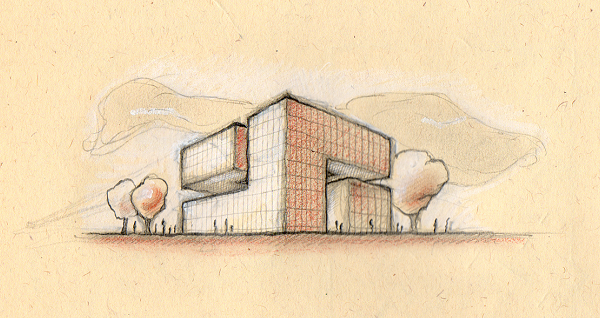
perspective

— in which case, I’ve found four. Pericoli comments:

As in the novel — with its surprise ending that flips everything upside down, transforming the structure we had taken for granted into a profound moral and existential dilemma — in the building, what seemed to obscure now illuminates, what once concealed now is hidden, what seemed to give support is now nothing but a weight to bear and understand.

Now tell me, is that self-referential and ouroboric, or merely boustrophedonic or enantiodromic?

For Greek fun, wait till the end of this post*.

**

On firmer self-referential ground, my first self-referential account has to do with a Nobel Prize, just awarded. Gina Kolata and Seawell Chan in the New York Times explain:

Yoshinori Ohsumi, a Japanese cell biologist, was awarded the Nobel Prize in Physiology or Medicine on Monday for his discoveries on how cells recycle their content, a process known as autophagy, a Greek term for “self-eating.” It is a crucial process.

Self-eating: even the ouroboros can’t say it plainer than that.

**

The second comes from an article on artist Jennifer Trask titled Death and Decay Lurks Within These Stunning Works of Art in the Smithsonian magazine. The description of Jennifer and her work begins:

Those who encounter a piece by Jennifer Trask are likely first struck by its elegance: a baroque gold-coated necklace or an intricate floral broach. But a closer look reveals much more happening below the gilt surface: antlers woven into the necklace; snake vertebrae used as the “petals” of the broach’s flower, giraffe femurs…

Death, here, as in earlier artistic tradition, is a reminder of the fickleness of life. The article gives us the self-referential paradox as it explains:

Trask draws on the tradition of vanitas — moralistic paintings that were popular in 16th- and 17th-century Netherlands. She says her interest is now focused on the “symbolism and the ironic nature” of the paintings, and “how the vanitas itself ultimately became another of the luxurious objects they were meant to warn against.”

**

And the third might even count as two recursions — one analogous to the other.

You may have read the New Yorker‘s profile, Sam Altman’s Manifest Destiny: Is the head of Y Combinator fixing the world, or trying to take over Silicon Valley?, and you may just be cooler than I, and either way you may already know that the Y Combinator is the startup starter-upper par excellence.

Here’s the self-ref, from their FAQ:

Why did you choose the name “Y Combinator?”

The Y combinator is one of the coolest ideas in computer science. It’s also a metaphor for what we do. It’s a program that runs programs; we’re a company that helps start companies.

A hat-tip here to Steven H. Cullinane, whose Log 24 blog today pointed me to this particular quote.

**

*It’s all Greek to me:

  • ouroboros, a snake or dragon devouring its tail, standing for infinity or wholeness
  • boustrophedon, written from right to left then left to right, as in ploughing with oxen
  • enantiodromia, tendency of things to change into their opposites, as a natural principle
  • **

    Well, it’s past 9am now, but I haven’t been scouting around for further examples since I began this post.
    When are look-alikes alike, eh?

    Friday, September 30th, 2016

    [ by Charles Cameron — a questiom for Cath Styles and Emily Steiner ]
    .

    It’s my proposal here that look-alikes are in the eyes of the beholder, perhaps more so than other forms of likeness.

    Consider:

    Do they look like Darth Vader and C3PO to you, frankly — or more like each other?

    **

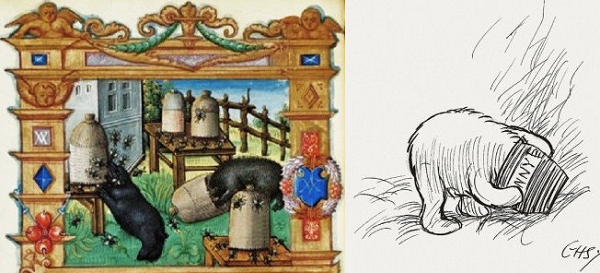
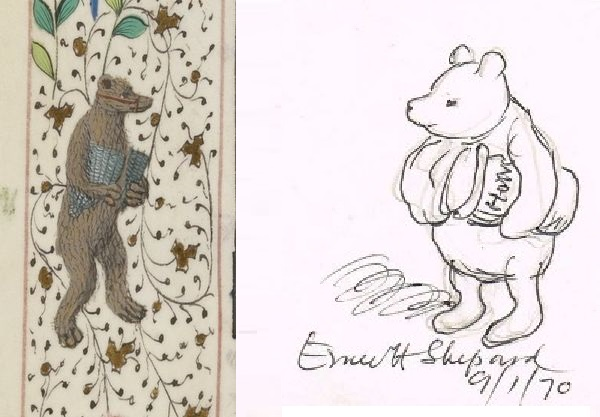
    One really does have to wonder how medieval monastics got hold of copies of Winnie the Pooh:

    honey-bear-02-600

    and:

    honey-bear-01-600

    With a double hat-tip to the immensely followable twitter feed of PiersatPenn

    **

    And what about this?

    It probably takes some historical knowledge to appreciate the similarities here — the comparison is not entirely visual.

    **

    Are mathematically or verbally juxtaposable similarities equally subject to human comparative bias?

    Perhaps because I’m looking for the tauromachia

    Thursday, September 15th, 2016

    [ by Charles Cameron — Syria echoes Guernica ]
    .

    This, from JM Berger today, offers a glimpse of Syria that is neither war, nor peace, if I might put it this way, but war longing for peace:

    Irresistibly, it reminds me of this:

    Isn’t that a bull’s head in cloth, hanging right above the shoulder of the leaping boy in the Syrian image — and isn’t that alnmost exactly Picasso’s swooping white head, again in cloth, just to the right of it? The illusion of their similarity is enhanced by the aspect ratio of the Twitter image from Syria, which cuts off a stretch of green in the original photo, just below the image as you see it here..

    **

    But it may be I’m seeing this because the bullfight and tauromachia have been on my mind recently — mythic combats of man pitted agains one of his worthiest opponents. There’s an archaic resonance there that’s inmportant in some way, but the actual killing of the bull, blood in the sand, horrifies me, the animal descending from grandeur to humiliation, its bowed head propped on one horn as it awaits finality — terrible.

    And I was accordingly happy to recall the less violent version of the sport, still pitting man’s skill against adversary — in the bull-leaping of Knossos:

    and its latter-day practice, shown here at the San Fermin Festival in Pamplona:

    **

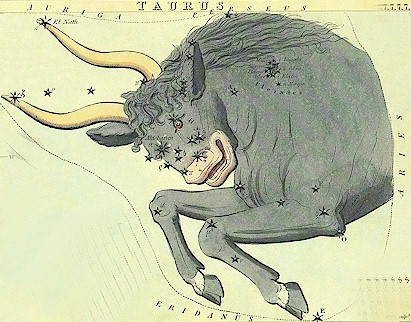
    Taurus:

    taup
    This image comes from the fabulous Constellations of Words site.

    Muhammad Ali, the Navaho and the Tibetans

    Saturday, September 3rd, 2016

    [ by Charles Cameron — a knockout triple DoubleQuote from Maidu country ]
    .

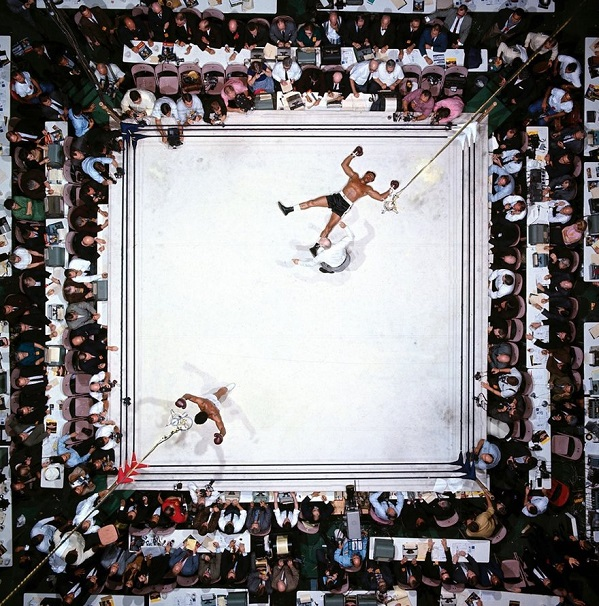
    This:

    Ali mandala of victory

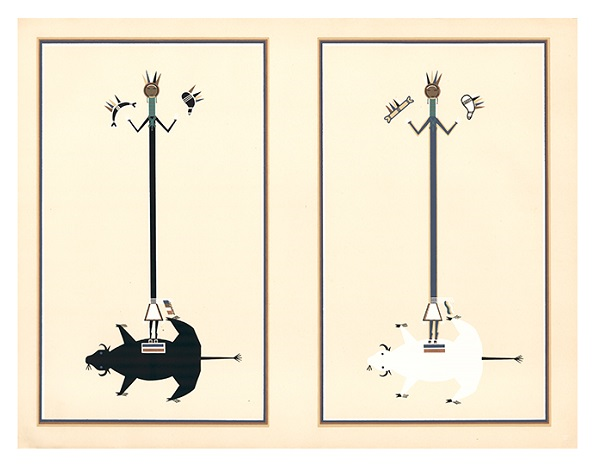
    reminds me of this:

    Sand Painting Jeff King

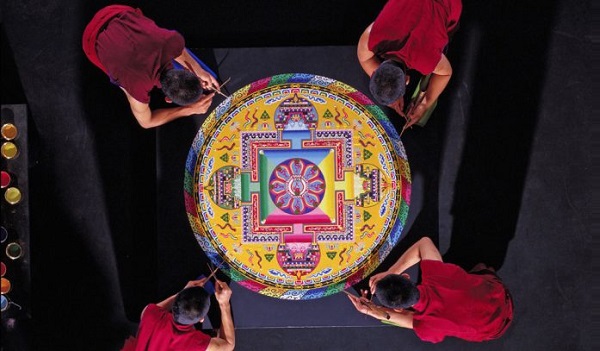
    but also of this:

    mandala-sand-painting-tibetan-monks-asia-society-texas-696x407

    **

    In fact, we have three potential DoubleQuotes here:

  • the stytlized figures in Neil Leifer‘s celebrated photo of Muhammad Ali evokes the stylized figures of Jeff King‘s sandpainting for the Navaho war ceremonial Where the Two Came to Their Father.
  • Jeff King‘s Navaho sandpaintings in turn easily summon memories of their Tibetan Buddhist equivalents, shown here in a photo of the Drepung Loseling monks.
  • And the symmetries of the overhead shot of Ali and that of the Drepung monks forms yet a third pair.
  • **

    Muhammad Ali at one point wanted “his people” to return to Africa, away from the deadly white man, and no doubt it has occurred to some Navajo from time to time to wish the white man would return to Europe — while Puebloans may on occasions have wished the Navajo had remained with their Athabaskan kin in Canada..

    But then, I’m Scots by heritage, British by subsequent conquest, and have invaded the United States myself in person, with a view to finding what American poet Gary Snyder calls “a sunny spot under a pine tree to sit at” here in California.

    In what I understand to have been Nisenan Maidu country.

    Hope as slogan, hope as navigation

    Sunday, August 7th, 2016

    [ by Charles Cameron — a visual DoubleQuote on the difference between artist and politician ]
    .

    As you may have gathered, I’m an admirer of the artist Alyce Santoro‘s work, and yesterday I came across her Existential Navigational Chart, with its little note in the bottom left corner:

    Soundings in the Unfathomable at Mean Low Water (MLW)

    In any case, it reminded me of the enormous difference between a political slogan and an artist’s insight.

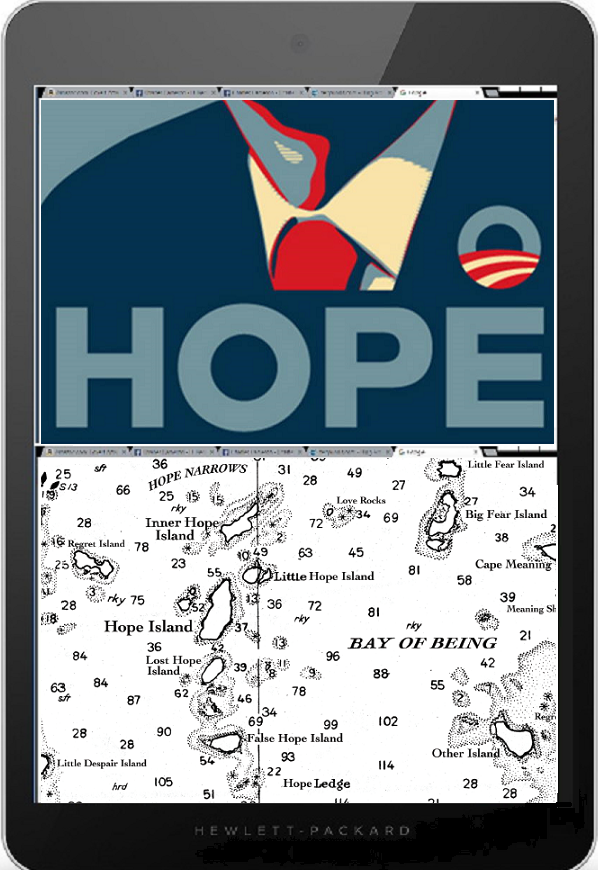
    Obama‘s HOPE (upper panel, below) was a lure, an appeal to an ideal in the sea of practical politics — and opinions are divided as to how well he managed to fulfill that one-word promise:

    Tablet DQ 600 hope and hope islands

    Alyce‘s navigational mapping of area surrounding the the Hope Islands (lower panel, above) on the other hand, is both more fanciful and more realistic — a wonderful combination if you think about it. Notice the nuance she manages to pack into her map, with Inner Hope Island, Little Hope Island, Hope Island, and on southwards to Lost Hope Island, False Hope Island, and Hope Ledge — and all so close to both Little Despair Island, and Love Rocks —

    Who, truly alive, has not been stranded on one or more of those islands, nor dashed against Love Rocks?

    **

    You can download a print quality, high resolution file of Alyce’s chart without cost, or click through to her Philosoprop shop to purchase a signed copy.


    Switch to our mobile site