zenpundit.com » art

Archive for the ‘art’ Category

Serpent logics: the marathon

Sunday, November 24th, 2013

[ by Charles Cameron — oh, the sheer delightful drudgery of finding patterns everywhere ]
.

I’ll start this post, as I did the previous one to which this is a sort of appendix, with a (deeply strange, tell me about it) example of the…

Matrioshka pattern:


That’s a piece of jewelry made out of disembodied pieces of Barbies from the extraordinary designer’s mind of Margaux Lange, FWIW.

**

This post is the hard core follow up to my earlier piece today, Serpent logics: a ramble, and offers you the chance to laugh and groan your way through all the other “patterns” I’ve been collecting over the last few months. My hope is that repeated (over)exposure to these patterns will make the same patterns leap out at you when you encounter them in “real life”.

Most of the examples you run across may prove humorous — but if you’re monitoring news feeds for serious matters, my hunch is that you’ll find some of them helpful in grasping “big pictures” or gestalts, noting analomalies and seeing parallels you might otherwise have missed.

Have at it!

**

Here’s another Matrioshka, from the structural end of lit crit that my friend Wm. Benzon attacks with gusto over at New Savannah:

**

Enantiodromia:

You’ll recall this is the pattern where something turns into its opposite… as described in this quote from the movie Prozac Nation:

I dream about all the things I wish I’d said.
The opposite of what came out of my mouth.
I wish I’d said
“Please forgive me. Please help me.
I know I have no right to behave this way?”

Here are a few examples…

Ahmed Akkari Repents Violent Opposition to Danish Cartoons Lampooning Islam:

After a Danish newspaper published cartoons satirizing the Muslim Prophet Muhammad, Ahmed Akkari spearheaded protests that ultimately cost the lives of 200 people. Now he says he’s sorry. Michael Moynihan on what changed Akkari’s mind.

That’s impressive!

That one’s run of the media mill…

And this one’s from my delightful, delicious boss, Danielle LaPorte:

**

A friend sent me this:

**

Let’s just plough ahead…

Nominalism:

Nominalism is the category where the distinction between a word and what it represents gets blurry — a very significant distinction in some cases —

How’s this for naming your donkey after your President?

Consider this one, another instance of nominalism in action, from the French justice system:

A mother who sent her three-year-old son Jihad to school wearing a sweater with the words “I am a bomb” on the front, along with his name and ‘Born on September 11th’ on the back, was handed a suspended jail sentence on Friday for “glorifying a crime”. A court of appeal in the city of Nimes, southern France, convicted Jihad’s mother Bouchra Bagour and his uncle Zeyad for “glorifying a crime” in relation to the terrorist attacks in the United States on September 11th 2001.

The classic nominalist image — with which I’d compare and contrast the French three-year-old with the unfortunate name and tsee-shirt — is Magritte’s cdelebrated “Ceci n’est pas une pipe”:

And here’s one final nominalist example:

**

The spiral:

Here’s a potential downwards spiral, for those watching India:

**

Straight parallelism:

This one’s from Jonathan Franzen:

And meanwhile the overheating of the atmosphere, meanwhile the calamitous overuse of antibiotics by agribusiness, meanwhile the widespread tinkering with cell nucleii, which may well prove to be as disastrous as tinkering with atomic nucleii. And, yes, the thermonuclear warheads are still in their silos and subs.

**

Simple Opposition:

**

Some of these categories seem pretty fluid — or to put that another way, some of these examples might fit with equal ease into several doifferent categories. Here’s another oppositional class:

Arms crossed:

From Ezra Klein and Evan Solta blogging at WaPo’s Wonkbook: The Republican Party’s problem, in two sentences:

It would be a disaster for the party to shut down the government over Obamacare. But it’s good for every individual Republican politician to support shutting down the government over Obamacare.

A great “values” juxtaposition:

And hey, nice phrasing:

**

Here’s an example of one of the central patterns of violence and justice:

Tit for Tat:

[ the account this tweet came from, which was a media outlet for Shabaab, has since been closed — hence the less than euqal graphical appearance of this particular tweet… ]

**

And here, without too much further ado, is a whole concatenation of…

Serpents biting their tails:

[ … and that last one of Nein‘s appears to have been withdrawn from circulation ]

This one I love for its lesson on biblical pick-and-choose:

This one is also a DoubleQuote:

when closely followed by:

And this one really bites:

**

To close the series out with more of a bang than a whimper, here’s Serpent bites Tail with apocalypse & gameplay for additional spice:

Monk Wirathu’s 969 quotes the Dalai Lama’s Kalachakra

Sunday, October 27th, 2013

[ by Charles Cameron — a Buddhist instance of the widespread use of sacred texts as offering sanction for religious violence, with Muslims depicted as the enemy on this occasion ]
.

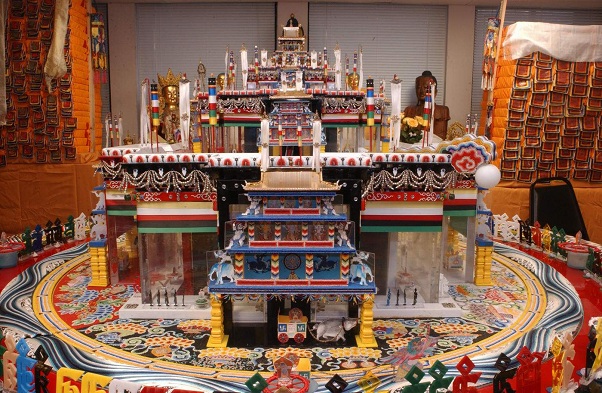
Three dimensional Kalachakra mandala by Arjia Rinpoche, photo credit kalachakranet.org

.

I have commented a couple of times on texts from the Kalachakra Tantra literature about a future war between Buddhism and Islam, first in In a time of Religious Arousal and later more fully in Apocalypse Not Yet? — and today I ran across a reference to the same texts on the web page of the 969 movement in Myanmar.

969 is the monk-led Buddhist movement which has been rioting recently against the Rohingya Muslims, and the monks concerned are Therevadins. The Kalachakra Tantra is the empowerment HH the Dalai Lama gives in the cause of peace, and the tantras are Vajrayana teachings. I think this para from the current Wikipedia article on Buddhism gives the relevant distinctions in a non-contentious form:

Two major branches of Buddhism are generally recognized: Theravada (“The School of the Elders”) and Mahayana (“The Great Vehicle”). Theravada has a widespread following in Sri Lanka and Southeast Asia (Cambodia, Laos, Thailand, Myanmar etc.). Mahayana is found throughout East Asia (China, Korea, Japan, Vietnam, Singapore, Taiwan etc.) and includes the traditions of Pure Land, Zen, Nichiren Buddhism, Tibetan Buddhism, Shingon, and Tiantai (Tendai). In some classifications, Vajrayana — practiced mainly in Tibet and Mongolia, and adjacent parts of China and Russia — is recognized as a third branch, while others classify it as a part of Mahayana.

I won’t go into the theological, philosophical and ritual differences, which are considerable, complex — and somewhat contested.

**

To refresh your memory of the relevant details regarding the Kalachakra’s treatment of “holy war”, here are my key paragraphs on the topic from Apocalypse Not Yet?:

Alexander Berzin has been tutored by HH the Dalai Lama and HHDLs own tutors on the interpretation of the Kalachakra Tantra, and served for some years as HHDL’s translator when HHDL was giving the Kalachakra initiation: indeed his book on the Kalachakra initiation carries a Foreword by HHDL.  His writings are thus among the most scholarly and trustworthy available in the western world on the topic of the initiation which the Dalai Lama will impart for world peace again this July.

Berzin’s words introducing the topic of Holy Wars in relation to the Kalachakra, Buddhism and Islam, are therefore important:

Often, when people think of the Muslim concept of jihad or holy war, they associate with it the negative connotation of a self-righteous campaign of vengeful destruction in the name of God to convert others by force. They may acknowledge that Christianity had an equivalent with the Crusades, but do not usually view Buddhism as having anything similar. After all, they say, Buddhism is a religion of peace and does not have the technical term holy war.

A careful examination of the Buddhist texts, however, particularly The Kalachakra Tantra literature, reveals both external and internal levels of battle that could easily be called “holy wars.” An unbiased study of Islam reveals the same. In both religions, leaders may exploit the external dimensions of holy war for political, economic, or personal gain, by using it to rouse their troops to battle. Historical examples regarding Islam are well known; but one must not be rosy-eyed about Buddhism and think that it has been immune to this phenomenon. Nevertheless, in both religions, the main emphasis is on the internal spiritual battle against one’s own ignorance and destructive ways.

Specifically, he writes:

In The Abridged Kalachakra Tantra, Manjushri Yashas explains that the fight with the non-Indic people of Mecca is not an actual war, since the real battle is within the body. The fifteenth-century CE Gelug commentator Kaydrubjey elaborates that Manjushri Yashas’s words do not suggest an actual campaign to kill the followers of the non-Indic religion. The First Kalki’s intention in describing the details of the war was to provide a metaphor for the inner battle…

**

That, then, is the context — “the fight with the non-Indic people of Mecca is not an actual war” but a metaphorical one. Here, by contrast, is the interpretation given to the same text by the 969 movement in an article titled Kalachakra Tantra and 969, posted on their website two months ago (Sept 1st, 2013):

The Kalachakra is a Tibetan Buddhist doctrine on the cycles of time. In addition to being a text, meditation practice, and initiation ritual, Kalachakra is a prophecy for the victory of the Buddhist religion in a war with Islam.

Beginning in 712AD and continuing through 1030AD, India was subject to massive annual invasions from Muslims who eventually conquered and destroyed much of the cultural heritage of India. In a final desperate act to annihilate Buddhism, in 1193, Nalanda University which was home to the greatest center of learnings in the East was destroyed, with thousands of monks beheaded. The destruction of the temples, monasteries, centres of learning at Nalanda and northern India to be responsible for the demise of ancient Indian scientific thought in mathematics, astronomy, alchemy, and anatomy. Much of what modern scholarship of Buddhist studies puzzles over today was contained in the manuscripts and minds of those who were lost during this calamity. However as the Kalachakra Tantra shows, the war between Dhamma and Islam is not over, nor is it. The prophecy includes detailed descriptions of the future invaders as well as suggested ways for the Buddhist teachings to survive these onslaughts.

The Dalai Lama has stated that the public exposition of this tantra is necessary in the current degenerate age. The initiation may be received simply as a blessing for the majority of those attending, however, many of the more qualified attendees do take the commitments and subsequently engage in the practice.

In a phrase, “Kalachakra is a prophecy for the victory of the Buddhist religion in a war with Islam”.

That’s the opening of the article, clearly identifying the Kalachakra as a text about Buddhism vs Islam. There follows a curious incomplete sentence:

We must be diligent in reminding the

I’d love to know what the author wanted to remind us of, and what the rest of that paragraph — or group of paras? — had to say about the Kalachakra, but the rest of the text as printed is no longer talking about warfare, but explaining some basic notions in Buddhism:

It is important to notice what Alexander Berzin wrote how “Karmic potentials, in fact, give rise to a broad array of impulses that affect our lives. Collective karmic potentials from previous actions of a huge number of beings – including ourselves – give rise, for example, to the impulse for a universe to evolve with specific environments and life forms into which we and these beings subsequently take rebirth.” Collective karma can be seen as the actions that have generated us in our present bodies, from the decisions of our parents, ancestors, and peers that gives us the appearance of our lives (Janaka kamma or the kamma that determines birth). We are all recipients of karma beyond our control. Put in another way, our DNA contains a vast storehouse of kamma.

This sad state of affairs is where the Kalachakra initiation takes its cue. By harnessing ritual and intention, the Kalachakra initiation at its highest level bestows a daily practice for awakening that an army of practioners around the world are also engaging in. This collective kamma has the subtle effect of making the conditions of purifying bad kamma’s and unwholesome dhamma’s into virtuous ones.

Ultimately we feel this will have the eventual effect of producing a Dhamma centered world based on the natural laws of mind that the founders of the 969 Movement are striving to achieve.

Whether or not warfare, as suggested in the first section of the article, is compatible with Buddhism, as expressed in the second, is a matter for Buddhist theological debate — as is the nature of “war” as envisioned in the Kalachakra itself.

My own purpose in making this post is to point out that the 969 movement, led by Buddhist monks in Myanmar, is now quoting a prophecy of war against Islam, found in the Kalachakra literature, which in turn is taught as a instrument of peace by HH the Dalai Lama. To my ears, that sets up a howl of cognitive dissonance.

Book Review: The Authentic Swing by Steven Pressfield

Wednesday, September 25th, 2013

[by Mark Safranski a.k.a “zen”]


The Authentic Swing by Steven Pressfield 

Callie was kind enough to send me a review copy of Steven Pressfield’s new non-fiction book, The Authentic Swing. Much like the title implies, it is a book with an arc.

The Authentic Swing continues a theme Pressfield began with his excellent The War of Art, continued with Do the Work and Turning Pro of helping struggling writers, artists and others conquer their resistance and acquire the mature habits of mind to become creative, productive professionals. While the previous books were advice, The Authentic Swing is a demonstration. Pressfield breaks down for the reader the gestation and evolution of his first successful novel, The Legend of Bagger Vance and applies a granular eye to the creative process but does so without tipping his hand or writing a “cookbook”. Steve is employing all his gifts as a storyteller to lead and nudge the reader into understanding.

There are many parts in the book that I like, but the following is in my view the most important, despite being less colorful and more straightforward than others:

When Robert McKee was a young writer/director in New York, he got the chance to interview Paddy Chayefsky, the only person to have one two Academy Awards for original Screenplay (Marty and Network) Chayefsky shared this priceless nugget:

As soon as I figure out the theme of my play, I type it out in one line and scotch tape it to the front of my typewriter After that, nothing goes into the play that isn’t on-theme.

If  there is a single more powerful piece of wisdom for any writer, artist or entrepreneur, I don’t know what it is.

Theme.

Theme is everything.

Once we know the theme we know the climax, we know the protagonist, we know the antagonist, we know the supporting characters, we know the opening, we know the throughline.

I said before that I have a file in my computer titled NEW IDEAS. I have another THEME.  for each new project, I open a new file and title it THEME. I go back to this file over and over. I pile paragraph on paragraph, trying to answer the question, “What the hell is this book about?”

It’s hard.

Theme not only drives art, it drives a coherent life. It makes the disparate connected and gives actions unity. We see theme in great innovative companies, in the curriculum of our best university programs, at the core of great religions, in revolutionary political movements and a nation’s grand strategy. Charles Hill, drew on themes of classical literature to teach that very point about foreign policy. This advice is worth the price of the book alone.

The theme here is authenticity and allowing yourself to express it. Pressfield demonstrates this frequently by parable and metaphor, moving the reader toward the process of discovering authenticity without making the fact that it is a process confuse the reader with the expectation that it will be linear or easy, only natural. I don’t want to give away too much because it is fun to see how the vignettes unfold on build upon one another, obviously golf and the cultural context the sport provided for Bagger Vance is a large part of the book but that will not be a surprise. I will say that The Authentic Swing is a very elegant method of teaching.

Steve’s best non-fiction book since The War of Art.

Most intriguing game-theoretic comment of the year thus far

Friday, September 20th, 2013

[ by Charles Cameron — at the intersection of zero-sum and non-zero sum games ]
.

And the hands-down winner is — opening today’s Washington Post to the op-ed page — President Hassan Rouhani of Iran, who says:

The world has changed. International politics is no longer a zero-sum game but a multi-dimensional arena where cooperation and competition often occur simultaneously. Gone is the age of blood feuds. World leaders are expected to lead in turning threats into opportunities.

I think he’s right, though I’ll leave the question of whether he means it TBD — but if he does, that’s a.. that’s a.. that’s a Major Game Changer — and verra interesting in any case:

  • What’s the non-zero-sum strategy when there may be one or more zero-sum players in the game?
  • **

    For your further edification, here’s what a genuine game-changer, in both literal and metaphoric sense of the phrase, looks like:
    .


    .

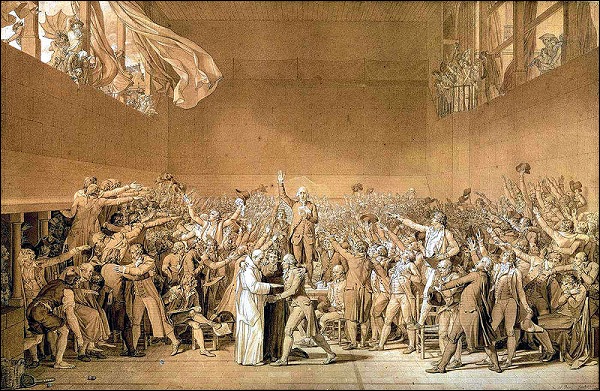
    The court is a tennis court, the game in play is revolutionary politics, the event is the Tennis Court Oath, where the members of the National Assembly gathered to swear “not to separate, and to reassemble wherever circumstances require, until the constitution of the kingdom is established” — the drawing is by Jacques-Louis David.

    Pope Francis and the artists who move him

    Thursday, September 19th, 2013

    [ by Charles Cameron — Dostoevsky, Hopkins, Caravaggio, Mozart, Bach, Fellini, Cervantes — that’s who! ]
    .

    For context and contrast, first read this:

    Pope Francis decided at the last minute not to attend a Beethoven concert last evening, Fox News and others reported. Fox News comments, “Unlike his predecessor Benedict, who was well-known as a music lover, Francis has shown scant interest in music, liturgical or otherwise.” The concert, an event long planned for the Year of Faith, included Beethoven’s 9th symphony with choir and orchestra.

    Pope Francis supposedly said “I am not a Renaissance prince who listens to music instead of working,” Vatican Insider first reported, later softening its report to preserve the general sense without quoting the pope directly.

    — then this, from the first extended interview of Pope Francis, which has just been released.

    While I’m sure plenty of others will mull over other aspects of what he has to say for himself, I’m taking my own insights into his character from the artists in whose work he finds inspiration:

    I have really loved a diverse array of authors. I love very much Dostoevsky and Hölderlin. I remember Hölderlin for that poem written for the birthday of his grandmother that is very beautiful and was spiritually very enriching for me. The poem ends with the verse, ‘May the man hold fast to what the child has promised.’ I was also impressed because I loved my grandmother Rosa, and in that poem Hölderlin compares his grandmother to the Virgin Mary, who gave birth to Jesus, the friend of the earth who did not consider anybody a foreigner.

    I have read The Betrothed, by Alessandro Manzoni, three times, and I have it now on my table because I want to read it again. Manzoni gave me so much. When I was a child, my grandmother taught me by heart the beginning of The Betrothed: ‘That branch of Lake Como that turns off to the south between two unbroken chains of mountains….’ I also liked Gerard Manley Hopkins very much.

    Among the great painters, I admire Caravaggio; his paintings speak to me. But also Chagall, with his ‘White Crucifixion.’ Among musicians I love Mozart, of course. The ‘Et incarnatus est’ from his Mass in C minor is matchless; it lifts you to God! I love Mozart performed by Clara Haskil. Mozart fulfils me. But I cannot think about his music; I have to listen to it. I like listening to Beethoven, but in a Promethean way, and the most Promethean interpreter for me is Furtwängler. And then Bach’s Passions. The piece by Bach that I love so much is the ‘Erbarme Dich,’ the tears of Peter in the ‘St. Matthew Passion.’ Sublime. Then, at a different level, not intimate in the same way, I love Wagner. I like to listen to him, but not all the time. The performance of Wagner’s ‘Ring’ by Furtwängler at La Scala in Milan in 1950 is for me the best. But also the ‘Parsifal’ by Knappertsbusch in 1962.

    We should also talk about the cinema. ‘La Strada,’ by Fellini, is the movie that perhaps I loved the most. I identify with this movie, in which there is an implicit reference to St. Francis. I also believe that I watched all of the Italian movies with Anna Magnani and Aldo Fabrizi when I was between 10 and 12 years old. Another film that I loved is ‘Rome, Open City.’ I owe my film culture especially to my parents who used to take us to the movies quite often.

    Anyway, in general I love tragic artists, especially classical ones. There is a nice definition that Cervantes puts on the lips of the bachelor Carrasco to praise the story of Don Quixote: ‘Children have it in their hands, young people read it, adults understand it, the elderly praise it.’ For me this can be a good definition of the classics.

    **

    Mozart, Et incarnatus est:

    Mozart, played by Clara Haskil:

    Bach, Erbarme dich, from the Matthew Passion:

    Fellini, La Strada, innocence:

    Fellini, La Strada, despair:

    No wonder, then, that he loves the poetry of his fellow Jesuit, the poet Gerard Manley Hopkins:

    No worst, there is none. Pitched past pitch of grief,
    More pangs will, schooled at forepangs, wilder wring.
    Comforter, where, where is your comforting?
    Mary, mother of us, where is your relief?
    My cries heave, herds-long; huddle in a main, a chief
    Woe, wórld-sorrow; on an áge-old anvil wince and sing —
    Then lull, then leave off. Fury had shrieked ‘No ling-
    ering! Let me be fell: force I must be brief.”‘

    O the mind, mind has mountains; cliffs of fall
    Frightful, sheer, no-man-fathomed. Hold them cheap
    May who ne’er hung there. Nor does long our small
    Durance deal with that steep or deep. Here! creep,
    Wretch, under a comfort serves in a whirlwind: all
    Life death does end and each day dies with sleep.

    — nor the works of Caravaggio, whose rap sheet was impressive to say the least:

    Arriving in Rome in 1595 at the age of 25, the hot-headed painter’s police dossier — hand-written in Latin and vernacular Italian and bound in great volumes that were stored in the archives until now — makes Caravaggio come across as almost compulsive in his lawlessness. For instance, the man was weapon-obsessed, sporting a sword, dagger, and pistol at various times. He was twice thrown in the clink for carrying arms without a permit, and known for beating strangers in late-night fights and pelting police with rocks.

    The documents add fresh color to well-known parts of the Caravaggio legend. Regarding the 1606 brawl during which the artist killed one Ranuccio Tommassoni, leading the artist to flee Rome and causing Pope Paul V to issue a death warrant, the documents reveal that the fight was over a gambling debt, and not a woman, as some accounts have suggested.

    It is all the more appropriate, then, to close this post with Caravaggio’s own meditation on the martyrdom by crucifixion of the first Pope, St Peter, whose chair Francis now holds:

    _______________________________________________________________________________

    .

    h/t Damian Thompson, who tweeted “I never thought I’d hear a Pope rave about Haskil’s Mozart, Furtwängler’s Beethoven and Knappertsbusch’s legendary 62 Parsifal.”


    Switch to our mobile site