zenpundit.com » authors

Archive for the ‘authors’ Category

The East Rising

Sunday, July 3rd, 2011

Gifts from a generous Meatball:


Hardcovers too. Nice.

The Party: The Secret World of China’s Communist Rulers by Richard McGregor

Monsoon: The Indian Ocean and the Future of American Power by Robert D. Kaplan

I have already dived a few chapters into the McGregor book and it is very good. What makes it good is that is running counter to the message of the herd in terms of popular Sinology, which is to emphasize that China is a) uniquely Chinese with deeply introspective Confucian civilizational traditions (that’s modern PC-speak for “inscrutable”) and b) the brave new world of liberal, globalized, capitalism with a benign technocratic face.

Now there’s important truths in both of the popular mass messages on China, incompatible as they can be with one another. The economic rise of China in a globalized economy is the most important story of the last quarter of the 20th century and the first quarter of the 21st ( collapse of the USSR is second; the Soviets were beaten before they imploded and imploded largely because they knew they were beaten). China is also not like America, not even when they imported stock options, blue jeans, McDonald’s and the American jobs that used to create all those things. China’s civilization is truly of a dizzying depth, complexity and scale that is best compared to Europe rather than a specific country. That in itself, is important because it points to how ignorant the average American policy maker is, never mind the average American, about what makes their Chinese counterpart tick.

[ Sidebar: Perhaps the Obama administration assembling a new senior “China/East Asia” diplomatic and national security team that does not include a single official with any professional knowledge of China was unwise? How is that better than the Bush II administration shunning Arabists during the run up to and occupation of Iraq? It is not that these diplomats and officers are poor, they are smart and experienced, but none of them are China specialists. Or Japan specialists, for that matter and only one has expertise in Korean affairs. These are the region’s great powers! This is like turning EU/NATO policy over to diplomats who speak Hindi and Swahili ]

What McGregor is doing in The Party that is important is reminding Westerners that the Soviet experience, particularly the Leninist Party model, is still deeply embedded in China’s political DNA. Not in an ideologically Marxist, Khrushchevian, shoe-pounding sense but in a functional sense. In a structural sense. In an instrumental governance sense. In a networking theory sense. And all these characteristics, which are largely innately hostile or indifferent to the values of liberal democracy, continue to shape Chinese policy, leadership succession, national security, defense strategy and geopolitical outlook to this day.

That doesn’t mean China is itching for a war with the United States, but it means they are playing a longitudinal strategic game where the first goal is to stay in power forever and the next is to advance one’s position relative to others.

We are the other.

China is not an enemy but she is no friend or ally of the United States either, yet it is the most important relationship the US has to manage for the next thirty years – and that relationship in a strategic context with rising India, Japan, South Korea and Australia.

It might help if America brought a team to the table that included people who could tell Han Fei Tzu from Mencius or spoke Chinese.

A Library vs. a Collection

Thursday, June 30th, 2011

Recall the “antilibrary ” discussion some years back, prompted by Nassim Nicholas Taleb?

The other day, I was having a conversation in the comments section regarding ancient Chinese philosophers with my learned friend Lexington Green, when I had cause to quote Nassim Nicholas Taleb, from his most recent book The Black Swan: The Impact of the Highly Improbable:

The writer Umberto Eco belongs to that small class of scholars who are encyclopedic, insightful, and nondull. he is the owner of a large personal library ( containing thirty thousand books), and separates vistors into two categories: those who react with ‘Wow! Signore professore dottore Eco, what a library you have! How many of these books have you read?’ and others – a very small minority- who get the point that a private library is not an ego boosting appendage but a research tool. Read books are far less valuable than unread ones. The library should contain as much of what you do not know as your financial means, mortgage rates, and the currently tight real estate market allow you to put there. You wil accumulate more knowledge and more books as you grow older, and the growig number of unread books on the shelves will look at you menacingly. Indeed, the more you know, the larger the rows of unread books. Let us call the collection of unread books an antilibrary.

A passage that immediately made me feel better about having resigned myself to falling further and further behind in reading the books that I keep purchasing ( I’m now also periodically finding myself going to IKEA to buy shelf extensions. I’ve resigned myself to that too).

Taleb was advocating building a library – an organized assemblage of books on a wide range of topics, of which the unread portion was your antilibrary. Libraries, private or public, are wonderful things, functioning in an earlier time as the poor man’s university. Andrew Carnegie endowed public libraries for that purpose and in past ages, wealthy patrons opened the doors of their private libraries to their favored scholars, like King George III did for Samuel Johnson.

My library is sizable but disorderly and eclectic. There are books on Turkic kingdoms and network theory, art history and classical economics, political memoirs and diplomatic papers, the “great books” and sci fi. And of course a great deal of books on strategy and history. My friends Lexington Green and Dave Schuler have far larger personal libraries and Lex’s, I can say firsthand, seems to be much better organized than mine ( though, admittedly, that would not be hard).

Recently, one of my uncles, an academic, decided he wanted to make me the eventual recipient of a major portion of his library, along with the funds to transport and shelve the books. This generous offer came with a proviso – that his collection is to be kept intact and passeed on only to someone else who would agree to keep it so. And it is really a collection and not a library. Naturally, I agreed

The difference between a library and a collection is puposeful focus and quality. My uncle decided on the advice of one of his mentors to really become a collector and decided to target the Hanoverian period of British history and only read and collect books that related directly in some way to the book previously read. He also specifically wanted to acquire rare editions and copies with the marginalia of important people from the period for purchase. My uncle also made a habit of going to the best rare and used bookstores (when he visits Illinois, Bookman’s Alley is his faviorite) wherever he happened to be. The uncle has been doing this for at least thirty+ years and has read his way forward to the early 20th century and in recent years, developed an extensive sub-collection dedicated to T.E. Lawrence.

Interestingly enough, none of this has anything remotely to do with his area of academic expertise (he has two doctorates; in a hard science and another in a medical specialty) but he’s made himself into more of an expert on the historiography of this period of British history than are most professional historians.The reason is a tunnel-like focus, which is the primary distinguishing characteristic between a building a general library and building a collection. There’s a comprehensiveness to a collection that becomes an end in itself.

books.jpg

Mini-Reviews: Liddell-Hart and Keeley

Saturday, June 25th, 2011


The German Generals Talk by BH Liddell-Hart

War Before Civilization by Lawrence Keeley

The German Generals Talk

A must-read book for those interested in strategy, the history of the Third Reich or the military history of WWII. That said, The German Generals Talk as a text must be treated very cautiously due to the author’s lack of objectivity, the disadvantage of his interview subjects at the time of their captivity and Liddell-Hart’s well documented efforts to use his interview subjects for self-promotional purposes.  Nevertheless, the commentaries by major Wehrmacht generals and field marshals, especially Gerd von Rundstedt, Wilhelm Ritter von Thoma, Hasso von Maneuffel, Günther Blumentritt and Heinz Guderian, are informative and at times, provocative. Liddell-Hart’s critiques of German military campaigns are often insightful, usually colorful, frequently sycophantic, but usually to the point – though they often used as a foil for advancing Liddell-Hart’s strategic ideas.

War Before Civilization

Two of the smarter, myth-debunking books I have read in the past year or so have been older, still in print, works by academic archaeologists. Much like Joseph Tainter’s The Collapse of Complex Societies, Lawrence Keeley overturns dogmatic archetypes about “primitive” warfare in prehistoric and pre-contact societies held by social scientists and military historians in War Before Civilization. Not only was prehistoric warfare more violent, more “total” and less restrained than modern warfare but Keeley argues that primitive “warriors” tended to best disciplined “soldiers” in wars when all other things were equal, except when the “soldiers” enlisted their own savage proxies (or adopted morally unconstrained  primitive tactics). It was a sliding scale; the barbaric Vikings terrorized “civilized” European and English men-at-arms, but were in turn themselves routed and expelled by the more savage Native Americans and Inuit warriors of North America.

The Profession

Saturday, June 18th, 2011

The Profession by Steven Pressfield 

My friend Steven Pressfield has a new novel out, one that touches on many themes and issues discussed here at ZP, SWJ Blog, Global Guerrillas, Feral Jundi and the rest of this corner of the blogosphere. Sometimes fiction can be a lot more fun 🙂

You can read the first chapter here.

Will have commentary and review at a later date.

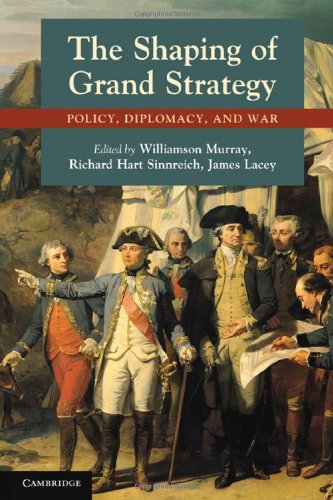
Book Review: The Shaping of Grand Strategy

Tuesday, May 24th, 2011

The Shaping of Grand Strategy: Policy, Diplomacy, and War by Williamson Murray, Richard Hart Sinnreich and James Lacey (Ed.)


As readers of this blog know, grand strategy is an important and timely subject that speaks directly to the difficulty American leaders have had in navigating the ship of state in the waters of the international arena. The Shaping of Grand Strategy: Policy, Diplomacy, and War by Williamson Murray, Richard Hart Sinnreich and James Lacey (Ed.) and contributing authors Colin S. Gray, Marcus Jones, Jeremy Black and John A. Lynn III postulates what grand strategy is and explain from historical case studies how statesmen struggled to fashion one in peace and war.

The Shaping of Grand Strategy has a number of strengths to recommend it to the serious student of history or strategic practitioner:

Focus: The case studies are all anchored in the Westphalian state system starting with the early modern period of European absolutism and apex of “national” monarchies and transitions through a Bismarckian 19th century to finish with the West’s cataclysmic 20th century battle with totalitarianism. This gives the chapters by different scholars a sense of cohesion and chronological succession.

Balance: The Shaping of Grand Strategy gives scholarly treatment from both the theoretical, strategic studies perspective as well as the historical case study. I learned some things about Louis XIV’s Europe and the Great Britain of the Pitts and the Hanoverian dynasty of which I was unaware. Theory bookends history in this tome.

Nuance: Each scholar gives his subject an adult treatment. Controversial points are interesting rather than shrill and each author engages an impressive synthesis of historiographic material as they cover a broad ground in investigating grand strategy. Each chapter is sound and engaging.

Limitations, such as they are, to be considered:

Absent: Powerful non-Western case studies. The ancient world.  Revolutionary war (French, Soviet or Islamist insurgent) as a grand strategy. Geoeconomics asnd political economy as a foundation for grand strategy. 

Weak: Insufficient treatment of the impact of nuclear weapons and deterrence on grand strategy, which frankly deserved a chapter of it’s own.

If you are composing a syllabus for a class on grand strategy or strategy, The Shaping of Grand Strategy would serve as an excellent generalist core for the course, supplemented by cognate, specialist or subtopical readings.

Some things that struck me while reading The Shaping of Grand Strategy:

  • Colin Gray’s distillation of the strategic dilemmas faced by Truman and an almost Boydian implicit explanation of what grand strategy is and why it needs a compelling moral power:

High policy does not emerge in a vacuum, though it can be invented in a hurry without much forethought when necessity presses. Policy requires a North Star for guidance that can inspire, yielding to would-be leaders the fuel they require to recruit and satisfy their followers

  • James Lacey’s realistic and granular treatment of the relationship between military strategy and grand strategy in the WWII Anglo-American Alliance and his generally admiring assessment of FDR as a strategist vs. a critical treatment of George Marshall.
  • Marcus Jones’ emphasis of the importance of the strategist himself and the uncertainty of decision making in his chapter on Otto von Bismarck.
  • The drawing of historical parallels with today  by John Lynn and Richard Sinnreich as well as the investigation of the reasons for grand strategic failure of British appeasement by Williamson Murray.

The Shaping of Grand Strategy is a tight, concise and focused academic book that furthers the discussion of grand strategy by providing coherent and detailed examples as well as a readable an interesting analysis from which both the professional or the the student can profit.

Strongly recommended.


Switch to our mobile site