zenpundit.com » government

Archive for the ‘government’ Category

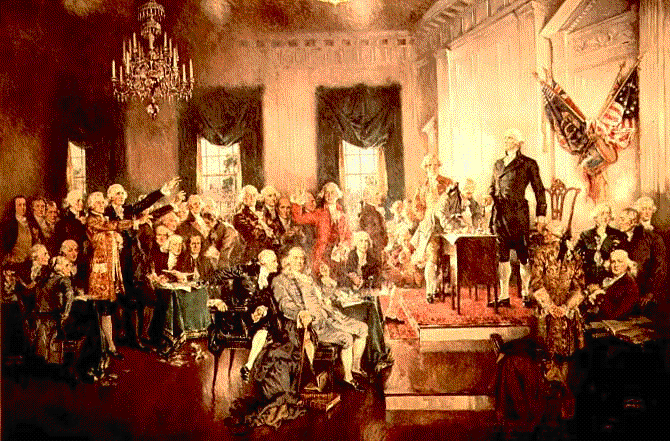
“We Hold these Truths to be Self-Evident….”

Wednesday, July 4th, 2012

In CONGRESS, July 4, 1776.
 

The unanimous Declaration of the thirteen united States of America,
When in the Course of human events, it becomes necessary for one people to dissolve the political bands which have connected them with another, and to assume among the powers of the earth, the separate and equal station to which the Laws of Nature and of Nature’s God entitle them, a decent respect to the opinions of mankind requires that they should declare the causes which impel them to the separation.

We hold these truths to be self-evident, that all men are created equal, that they are endowed by their Creator with certain unalienable Rights, that among these are Life, Liberty and the pursuit of Happiness.–That to secure these rights, Governments are instituted among Men, deriving their just powers from the consent of the governed, –That whenever any Form of Government becomes destructive of these ends, it is the Right of the People to alter or to abolish it, and to institute new Government, laying its foundation on such principles and organizing its powers in such form, as to them shall seem most likely to effect their Safety and Happiness. Prudence, indeed, will dictate that Governments long established should not be changed for light and transient causes; and accordingly all experience hath shewn, that mankind are more disposed to suffer, while evils are sufferable, than to right themselves by abolishing the forms to which they are accustomed. But when a long train of abuses and usurpations, pursuing invariably the same Object evinces a design to reduce them under absolute Despotism, it is their right, it is their duty, to throw off such Government, and to provide new Guards for their future security.


-Such has been the patient sufferance of these Colonies; and such is now the necessity which constrains them to alter their former Systems of Government. The history of the present King of Great Britain is a history of repeated injuries and usurpations, all having in direct object the establishment of an absolute Tyranny over these States. To prove this, let Facts be submitted to a candid world.

  • He has refused his Assent to Laws, the most wholesome and necessary for the public good.
  • He has forbidden his Governors to pass Laws of immediate and pressing importance, unless suspended in their operation till his Assent should be obtained; and when so suspended, he has utterly neglected to attend to them.
  • He has refused to pass other Laws for the accommodation of large districts of people, unless those people would relinquish the right of Representation in the Legislature, a right inestimable to them and formidable to tyrants only. 
  • He has called together legislative bodies at places unusual, uncomfortable, and distant from the depository of their public Records, for the sole purpose of fatiguing them into compliance with his measures. 
  • He has dissolved Representative Houses repeatedly, for opposing with manly firmness his invasions on the rights of the people.
  • He has refused for a long time, after such dissolutions, to cause others to be elected; whereby the Legislative powers, incapable of Annihilation, have returned to the People at large for their exercise; the State remaining in the mean time exposed to all the dangers of invasion from without, and convulsions within.
  • He has endeavoured to prevent the population of these States; for that purpose obstructing the Laws for Naturalization of Foreigners; refusing to pass others to encourage their migrations hither, and raising the conditions of new Appropriations of Lands.
  • He has obstructed the Administration of Justice, by refusing his Assent to Laws for establishing Judiciary powers.
  • He has made Judges dependent on his Will alone, for the tenure of their offices, and the amount and payment of their salaries.
  • He has erected a multitude of New Offices, and sent hither swarms of Officers to harrass our people, and eat out their substance.
  • He has kept among us, in times of peace, Standing Armies without the Consent of our legislatures.
  • He has affected to render the Military independent of and superior to the Civil power.
  • He has combined with others to subject us to a jurisdiction foreign to our constitution, and unacknowledged by our laws; giving his Assent to their Acts of pretended Legislation:
  • For Quartering large bodies of armed troops among us:
  • For protecting them, by a mock Trial, from punishment for any Murders which they should commit on the Inhabitants of these States:
  • For cutting off our Trade with all parts of the world:
  • For imposing Taxes on us without our Consent: 
  • For depriving us in many cases, of the benefits of Trial by Jury:
  • For transporting us beyond Seas to be tried for pretended offences
  • For abolishing the free System of English Laws in a neighbouring Province, establishing therein an Arbitrary government, and enlarging its Boundaries so as to render it at once an example and fit instrument for introducing the same absolute rule into these Colonies:
  • For taking away our Charters, abolishing our most valuable Laws, and altering fundamentally the Forms of our Governments:
  • For suspending our own Legislatures, and declaring themselves invested with power to legislate for us in all cases whatsoever.
  • He has abdicated Government here, by declaring us out of his Protection and waging War against us.
  • He has plundered our seas, ravaged our Coasts, burnt our towns, and destroyed the lives of our people. 
  • He is at this time transporting large Armies of foreign Mercenaries to compleat the works of death, desolation and tyranny, already begun with circumstances of Cruelty & perfidy scarcely paralleled in the most barbarous ages, and totally unworthy the Head of a civilized nation.
  • He has constrained our fellow Citizens taken Captive on the high Seas to bear Arms against their Country, to become the executioners of their friends and Brethren, or to fall themselves by their Hands. 
  • He has excited domestic insurrections amongst us, and has endeavoured to bring on the inhabitants of our frontiers, the merciless Indian Savages, whose known rule of warfare, is an undistinguished destruction of all ages, sexes and conditions. 

In every stage of these Oppressions We have Petitioned for Redress in the most humble terms: Our repeated Petitions have been answered only by repeated injury. A Prince whose character is thus marked by every act which may define a Tyrant, is unfit to be the ruler of a free people.

Nor have We been wanting in attentions to our Brittish brethren. We have warned them from time to time of attempts by their legislature to extend an unwarrantable jurisdiction over us. We have reminded them of the circumstances of our emigration and settlement here. We have appealed to their native justice and magnanimity, and we have conjured them by the ties of our common kindred to disavow these usurpations, which, would inevitably interrupt our connections and correspondence. They too have been deaf to the voice of justice and of consanguinity. We must, therefore, acquiesce in the necessity, which denounces our Separation, and hold them, as we hold the rest of mankind, Enemies in War, in Peace Friends. 
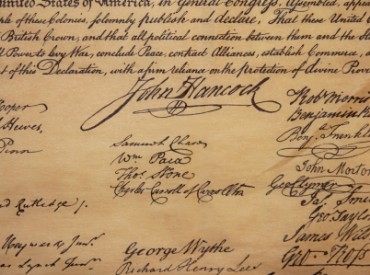
We, therefore, the Representatives of the united States of America, in General Congress, Assembled, appealing to the Supreme Judge of the world for the rectitude of our intentions, do, in the Name, and by Authority of the good People of these Colonies, solemnly publish and declare, That these United Colonies are, and of Right ought to be Free and Independent States; that they are Absolved from all Allegiance to the British Crown, and that all political connection between them and the State of Great Britain, is and ought to be totally dissolved; and that as Free and Independent States, they have full Power to levy War, conclude Peace, contract Alliances, establish Commerce, and to do all other Acts and Things which Independent States may of right do. And for the support of this Declaration, with a firm reliance on the protection of divine Providence, we mutually pledge to each other our Lives, our Fortunes and our sacred Honor.
The Russians are Not Coming….Nor are they Going Away

Monday, June 25th, 2012

Now that Vladimir Putin has resumed the Presidency of Russia, it merits looking at the defense discussion that appeared under his name in Rossiiskaya Gazeta. Virtually everyone agrees that the condition of the Russian Army is parlous and that Putin’s program of difficult military reform to transform the Russian military from a conscripted army to a modernized professional force has not borne fruit. Therefore it is interesting to look at how Putin’s regime articulates it’s defense challenges with a mixture of bravado and brutal strategic realism we would never hear from an American politician.

Excerpts of the article are in bold while my commentary is in normal text.

 Being Strong 

…..The world is changing, and the transformations underway could hide various risks, often unpredictable risks. In a world of economic and other upheaval, there is always the temptation to resolve one’s problems at another’s expense, through pressure and force. It is no surprise that some are calling for resources of global significance to be freed from the exclusive sovereignty of a single nation, and that this issue will soon be raised as a “matter-of-course.”

There will be no possibility of this, even a hypothetical one, with respect to Russia. In other words, we should not tempt anyone by allowing ourselves to be weak. 

While some of this is boilerplate, it does demonstrate Putin’s astute view of Western elite noises about “global governance” as an effort to erode historic Westphalian legal norms of sovereignty for a self-aggrandizing reasons.

I am including paragraphs here from different parts of the paper where President Putin deals with nuclear weapons, though the first one continues from where the last excerpt left off.:

It is for this reason that we will under no circumstances surrender our strategic deterrent capability, and indeed, will in fact strengthen it. It was this strength that enabled us to maintain our national sovereignty during the extremely difficult 1990s, when, lets’ be frank, we did not have anything else to argue with.

….I remember in 2002 when the Chief of the General Staff proposed liquidating a base for strategic ballistic missile submarines on the Kamchatka Peninsula. Understandably, this proposal was motivated by dire circumstances. This would have deprived Russia of its naval presence in the Pacific Ocean. I decided against this. Due to the lack of the required budgetary funding, we had to ask private companies for help. I would like to thank them for that. Both Surgutneftegaz and TNK stepped up to provide the required funding for the base’s initial reconstruction. Budgetary allocations were later disbursed. Today, we have a modern base in Vilyuchinsk where next-generation Borei class submarines will soon be deployed.

….We have greatly increased the capabilities of our early missile warning system. Tracking stations have been launched in the Leningrad and Kaliningrad Regions and in Armavir, and a similar facility is undergoing tests in Irkutsk. All aerospace defence brigades have been equipped with the Universal-1S automation systems, and the Glonass satellite group has been deployed.

The land, sea and air components of our Strategic Nuclear Forces are reliable and sufficient. The proportion of modern land-based missile systems has grown from 13% to 25% over the past four years. The rearmament of 10 missile regiments with the Topol-M and Yars strategic missile systems will be continued.  Long-range aviation will maintain the fleet of strategic Tu-160 and Tu-95MS bombers; work is underway to modernise them. They will be equipped with a new long-range cruise missile system. Russia’s strategic aviation resumed combat patrols in their zone of responsibility in 2007. A new aircraft is being designed for strategic long-range aviation.

New-generation Borei class strategic submarines are being put on combat duty. These include the Yury Dolgoruky and Alexander Nevsky which are undergoing state trials.

….In the coming decade, Russian armed forces will be provided with over 400 modern land and sea-based inter-continental ballistic missiles, 8 strategic ballistic missile submarines…. 

This does not sound  like Putin puts much stock in his predecessor’s endorsement of Global Zero or President Obama’s goal of eliminating nuclear weapons. Or that a drastic unilateral American cut in nuclear weapons proposed by Global Zero to “break the triad” contemplated by the Obama administration would be reciprocated by Russia. Or any other nuclear power state.

Given that Pakistan, India, North Korea, Israel and China are reportedly increasing and improving their nuclear arsenals, it begs the question of whether the Obama or the Putin administrations have the most realistic view about nuclear weapons and their currency in international relations. Or what the Obama administration would use as bargaining chips to negotiate reductions in foreign nuclear arsenals after making gratuitously slashing unilateral cuts. And if the paper was not clear enough, Putin was more blunt about the strategic situation two days ago:

“With regard to further steps in the sphere of nuclear weapons, these further steps should be of a complex character, and this time all the nuclear powers should be involved in this process. We cannot disarm indefinitely while some other nuclear powers are building up their arsenal. It is out of the question!” 

On the subject of Russia’s land forces:

….There are no undermanned units in the Russian armed forces any more. The Army has over 100 combined and special brigades. These are full-scale military units with the requisite personnel and equipment. Their alert reaction time is one hour and they can be deployed to a potential theatre of war within 24 hours.

In the past, it took up to five days to prepare for combat readiness. The deployment and equipment of all the armed forces to wartime conditions could take nearly a year, even though most armed conflicts now last from a few hours to several days.

Why have we chosen the brigade as the main tactical unit? First of all, we have relied on our own experience in the Afghan and other wars, where mobile combat and assault groups reinforced with air and other support units have proved  more efficient than regiments and divisions.

The new brigades are smaller than divisions in the number of personnel but have a bigger strike capability, better firepower and support, including artillery, air defence, reconnaissance, communications, and so on. Brigades can operate both autonomously and jointly with other units. I admit that the quality is not perfect in all instances. We need to achieve the required standards in the near future. 

A Russian Army brigade numbers slightly over 4000 soldiers (vs. 3000-5000 in American and NATO militaries) and moving to a brigade structure is intended to make the Russian Army more versatile, flexible, deployable and mobile. The US essentially did the same thing with the “modularity” reforms for a brigade team force structure. However, I find it dubious that the Russian version is anything other than an aspirational work in progress or that Russia today could muster a force remotely approaching 100 combat brigades on short notice or keep them in the field for more than thirty days.

The old Soviet Red Army in the 80’s at the peak of it’s power was a military long on officers and critically deficient in NCOs  and the 90’s cratered the main force quality of what remained of the Soviet armies. Russia will not have a deployable fighting army for anything other than brief Georgia type raids and SPETSNAZ operations until it builds a proportionate NCO corps and modernized logistical support system.

On future war and it’s strategic context:

….The probability of a global war between nuclear powers is not high, because that would mean the end of civilisation. As long as the “powder” of our strategic nuclear forces created by the tremendous efforts of our fathers and grandfathers remains dry, nobody will dare launch a large-scale aggression against us.

However, it should be borne in mind that technological progress in many varied areas, from new models of weaponry and military hardware to information and communications technology, has dramatically changed the nature of armed conflicts. Thus, as high-precision long-range conventional weapons become increasingly common, they will tend to become the means of achieving a decisive victory over an opponent, including in a global conflict.

The military capability of a country in space or information countermeasures, especially in cyberspace, will play a great, if not decisive, role in determining the nature of an armed conflict. In the more distant future, weapons systems based on new principles (beam, geophysical, wave, genetic, psychophysical and other technology) will be developed. All this will, in addition to nuclear weapons, provide entirely new instruments for achieving political and strategic goals. Such hi-tech weapons systems will be comparable in effect to nuclear weapons but will be more “acceptable” in terms of political and military ideology. In this sense, the strategic balance of nuclear forces will play a gradually diminishing role in deterring aggression and chaos.

We see ever new regional and local wars breaking out in the world. We continue to see new areas of instability and deliberately managed chaos. There also are purposeful attempts to provoke such conflicts even within the direct proximity of Russia’s and its allies’ borders.

The basic principles of international law are being degraded and eroded, especially in terms of international security. 

Here we see much of the same keen interest Western military experts have had in RMA/”transformation” but more as new domains in which to fight or weapons to fight with, but Putin’s assumptions about the roots of international conflict remain exceedingly traditional in Clausewitzian and Machiavellian realpolitik senses. There’s no idea here that war’s political nature is being transformed by technological advances or even that breakdowns in order in other nations flow primarily from indigenous social forces  than from strategic conspiracies and manipulations of foreign powers hell-bent on humiliating Russia.

This is a worldview of cynical realism salted with nationalism and a paranoia induced by the lessons of centuries of Russian history. International relations, it follows, hinge primarily on power in all it’s manifestations, a few rules that separate the law of nations from the law of the jungle and that states exert power to accomplish rational strategic objectives. Furthermore, in an echo of Tsarist Russia’s last modernizer, Petr Stolypin, what Putin has put forth as a political program for his domestic audience (sincere or not) is “a great Russia”.

The good news is that President Putin is, unlike his Soviet predecessors, is uninterested in grand ideological crusades that would destabilize the world order and that Russia currently would be incapable of carrying any out. The bad news is that Putin is a shrewd strategic thinker, one who views the US as a long-term adversary of Russia and one who is likely to be highly antagonized and partially misread (and thus miscalculate)  the tactical geopolitics of intervention pursued by America’s R2P moralizers.

From Putin’s perspective, we are currently crusaders rather than deal-cutters grounded in reality. America does not need to appease other power,s but we’d further our own interests faster if we spent a little time looking at the world through the eyes of others

Hat tip to Lexington Green

A House of Horrors for Autistic Children but Cash for Democratic Pols

Monday, June 4th, 2012

This may rank among the most bizarre and appalling education stories I have ever heard in twenty years as a professional educator. And I have heard quite a bit.

You may have caught a blip about the UN Special Rapporteur for Human Rights calling in to question practices at some institution in America and read no further. I didn’t. Unfortunately, it turns out, the UN is right. There’s a taxpayer supported independent school in Massachusetts run by a radical B.F. Skinnerian cult called the Judge Rotenberg Center that makes a practice of giving frequent and intense electric shocks to severely autistic children in order to moderate their disruptive or self-isolating behaviors.

To be clear even under “enhanced interrogation” methods approved by the Bush administration, this could not be done to al Qaida captives.  We would never do it to the most hardened convicts in the Federal prison system. Yet taxpayers are footing the bill to do it to disabled students. Sometimes for hours on end.

Having worked with such students in my classroom, words fail me.

Steve Hynd, the progressive blogger at The Agonist and Newshoggers.com did some digging and discovered The Judge Rotenberg Center has deep and exclusive financial ties to a powerful coterie of Massachusetts Democrats:

Electro-Shock Torture School Donates Exclusively To Mass. Dems 

….I noted at the time that there must be some heavy political juice behind the Judge Rotenberg Center, which declared earnings of over $52 million in 2010, 99% of which came from “Fees and contracts from government agencies”. Now, The Agonist has seen information which shows a pattern of donations by directors and officials to Massachusett state Democrats – and exclusively to Democrats.

To date, the Center has spent over $16 million on legal services according to Senator Brian A. Joyce (D-MA), spending which has been very successful in keeping the school open and operating. Earlier this year the man at the head of the Center, psychologist Matthew Israel, “agreed to step down rather than face trial for his alleged role in destroying tapes showing a night in 2007 when two teenagers wrongfully received electrical shocks based on a prank phone call.” Meanwhile, Mass. Governor Deval Patrick’s administration passed new legislation that stopped the Center practising its voodoo psychology on new admissions – but didn’t stop “aversive therapy” treatments for as many as two thirds of the existing students.

The cash-rich Center certainly hires the best when it comes to protecting its ability to torture autistic children. It’s PR firm is Boston heavyweight Regan Communications Group, where it’s file is handled by Crisis Communications head and former spox for the Boston P.D. Mariellen Burns. Regan Communications was started by George K. Regan, former spokesman to Democratic Boston mayor Kevin White. Their legal firm is Bracewell & Giuliani (yes, that Giuliani) of New York. Their lobbyists are the firm of Malkin & Ross, a company headed by Donald K. Ross, the chair of the board of Directors of Greenpeace USA. In 2010, they were Malkin & Ross’ fifth largest client, paying $112,200 to, among other things, lobby the U.S. Congress to stop a bill that would have outlawed their treatment methods.

It also donates to the local Democratic Party. The Agonist has seen an email alleged to be from the Center to it’s legal and lobbyist firms, dumped on pastebin by the Anonymous collective in March of this year. The email seems to comprise information sent to those firms as part of an exercize in damage control. If it’s the real deal, then the Center’s directors have made personal donations totalling $13,305 to Massacusetts Dem heavy-hitters since 2008. The recipient list is a who’s-who of powerful local Democratic players, and there is not a single Republican on the list.

The alleged list of recipients:

Deval Patrick, currentGovernor of Massachusetts, who served as an Assistant United States Attorney General under President Bill Clinton.

Timothy Murray, Lieutenant Governor of Massachusetts.

Salvatore F. “Sal” DiMasi, former Speaker of the Massachusetts House of Representatives indicted and found guilty 2011 on 7 of 9 Federal charges, including conspiracy to defraud the federal government, extortion, mail fraud and wire fraud.

Patricia A. Haddad, current Speaker pro Tempore of the Massachusetts House of Representatives.

Robert A. DeLeo, Speaker of the Massachusetts House of Representatives.

James Vallee, Majority Leader of the Massachusetts House of Representatives.

Harriette L. Chandler, current Majority Whip of the Senate and the Vice-Chair of the Joint Committee on Public Health.

Joan M. Menard, Senate Majority Whip 2003-2011, now vice president for work force development, lifelong learning, grant development and external affairs at Bristol Community College.

Steven Tolman, Dem member of Mass. State Senate to 2011, now president of the Massachusetts AFL-CIO.

Michael Morrissey, Dem member of the Massachusetts State Senate until 2011, now Chair of Massachusetts AFL.

Steven Panagiotakos, State Senator 1997 to 2011, was chair of Ways and Means Committee. Now Vice Chair, Massachusetts AFL.

Barry Finegold, Massachusetts Senate.

Garrett Bradley, Massachusetts House of Representatives.

Kathi-Anne Reinstein, Massachusetts House of Representative

Would this “school” stay open without this kind of impressive political clout behind them? How do these guys sleep at night? What is happening at The Judge Rotenberg Center seeminglyviolates Federal Law and international law. Where is the FBI?

Steve, who has always put his principles above partisanship, has a FOXnews video about the Judge Rotenberg Center’s “aversive therapy” via electro-shock [warning graphic].  The Center attempted to keep this material under seal but failed.

Massachusetts has the reputation of being the most liberal of liberal Democratic states but her pols are protecting a school whose philosophy makes Benito Mussolini look like a libertarian.

All the President’s NSCs

Monday, May 28th, 2012

Rei Tang, who I had the pleasure of meeting and breaking bread with at the last Boyd & Beyond Conference, is guest-posting at Rethinking Security on a topic dear to my heart, presidential national security decision making. Mr. Tang nailed it here and I give his post a very strong endorsement as a “must-read”:

Guest Post: Essence of Decision (Part I of III)

“Maximize the President’s optionality.” Spoken in bureaucratese, this is what Thomas Donilon wanted to do as he took over the role of President Barack Obama’s national security adviser. Like most bland things in national security, this phrase is loaded. Graham Allison compares Donilon to Robert F. Kennedy who protected President John F. Kennedy’s options during the Cuban Missile Crisis. It speaks to how the president sees his relationship to the executive branch, his inclinations and limits. It speaks to how the president chooses and trusts his advisers and officers.

For a confident new president who respected national security pragmatists like Jim Jones, Joe Biden, Robert Gates, Hillary Clinton, Leon Panetta, and Dennis Blair, making national security policy should have been straightforward. Obama and, former NATO supreme allied commander and marine commandant, General Jones created an open and orderly national security policy process—layers of interagency committees teeing up options to the National Security Council. Every department and agency would have a chance to say something. This would lead to good policy. But it ran into problems. In the NSC staff, now the “national security staff,” those who had been through the campaign with Obama had their access to the president downgraded. In the Afghanistan surge decision, the Department of the Defense and the military had boxed in the president. The more open the process, the more policy became stuck in the bureaucracy. In crisis decision-making, which takes up an extraordinary amount of bandwidth and which is politically delicate, bureaucracy can’t be allowed. 

The president came to find out this is not what he wanted. As the president gained experience, what he did want shows in the people who survived and thrived in the administration. They understand politics. Donilon, Panetta, Biden, and McDonough have worked on campaigns and understand the imperative of mitigating Obama’s political problems on national security. They’ve not only put in place the national security policy structure, but they control it—the information, the direction. They’ve expanded the president’s space to make careful, deliberate decisions. And to have “no leaks.”

Read the rest here.

It is interesting that in coming into office, President Obama, a deliberative and elite academic lawyer by education and temperament, set up a formal, Sherman Adams-ish NSC process befitting President Eisenhower and instead gravitated to a looser, more “politicized-personalized” model favored by Presidents Kennedy and (to a lesser extent) Nixon. This evolution suited Mr. Obama’s much grubbier, bareknuckles experience from his early days as a cog in Chicago’s Democratic Daley Machine, where politics is king and the ur-Rules are “Don’t back no losers” and “We don’t want nobody that nobody sent”.

A president always gets the NSC he wants but very seldom the NSC his office deserves. A corollary to this is that a totally dysfunctional NSC is no bar to having foreign policy success. During the Nixon administration, when Henry Kissinger was National Security Adviser, the machiavellian NSC decision process with the various principals was less in need of an orderly manager than a competent psychiatrist ( and this was, at times, seriously considered!); yet the co-dependent partnership between Nixon and Kissinger yielded numerous strokes of brilliance and strategic coup d’oeil in foreign policy.

The statutory requirements of the NSC are skeletal, which permits every POTUS flesh out the system he desires by selection of personnel and the initial executive orders issued to guide the business and interagency work of the NSC.  A president who feels uncomfortable with picking qualified “outsiders” -i.e. academic stars (Kissinger, Brzezinski) will have an NSC that is going to rely heavily upon foreign service officers, military officers and IC personnel “on loan” or after retirement from their perspective departments and agencies.  This will not be an NSC that will be apt to challenge bureaucratic conventional wisdom when preparing option papers,  but at it’s best this kind of NSC can be an honest broker and competent enforcer of presidential decisions because the staff is wise to bureaucratic tricks to stymie or delay administration policy. Eisenhower and Bush I were extremely comfortable with NSCs staffed by “professionals” and demanded very close working relationships with and between principals (SECSTATE, SECDEFENSE etc.).

An NSC dominated by gifted outsiders and political loyalists offers the opportunity for more creative and effective exercise of presidential prerogatives in foreign policy.  The president will have more options and a more critically thorough vetting of policy proposals from State, Defense and the IC.  As a result, because the NSC is trying to be both policy advocate as well as referee, the interagency friction and malicious leaking against bureaucratic rivals is apt to be very high – as was seen during the Nixon, Carter and Reagan administrations ( the last administration saw six NSC advisers in eight years, a factor of instability that added to the friction).

In either case, presidents sometimes attempt to “operationalize” policy that is particularly important to them from the NSC, which is not really designed or budgeted for such tasks. This has had mixed results, historically, with successes like the China Opening, bringing into custody the Achille Lauro highjackers and the operation to kill Osama bin Laden as well as political debacles like Iran-Contra or the secret invasion of Cambodia. The need to work through other bureaucracies makes the NSC doing “end runs” risky and vulnerable to hostile leaks and critical Congressional reaction (particularly if oversight had been circumvented).

To understand a president’s NSC is to comprehend how the administration really works.

SUGGESTED READINGS:

Brown, Cody. The National Security Council: A Legal History of the President’s Most Powerful Advisers. Project on National Security Reform/Center for the Study of the Presidency. 1020 19th Street, NW, Suite 250. Washington, DC. 2008.

Cramer, Drew & Mullins, Grant. “Lessons Learned from Prior Attempts at National Security Reform“. The Project on National Security Reform, Overarching Issues Working Group, College of William & Mary

Daalder, Ivo H. In the Shadow of the Oval Office: Profiles of the National Security Advisers and the Presidents They Served–From JFK to George W. Bush. Simon & Schuster, New York, NY. 2009

Federation of Atomic Scientists. “History of the National Security Council 1947-1997”. http://www.fas.org/irp/offdocs/NSChistory.htm

Dalleck, Robert. Nixon and Kissinger: Partners in Power. Harper Perennial. New York, NY. 2007

Gates, Robert. From the Shadows. Simon & Schuster. New York, NY. 1996.

Kissinger, Henry. White House Years. Simon & Schuster. New York, NY. 2011.

Menges, Constantine. Inside the National Security Council. Touchstone Books. 1989.

Selil’s Cyber Paradigm

Thursday, May 24th, 2012

Now, in order to understand it, go here:

Information assurance and security and cyber warfare is muskets in a sharks with lasers world 

….I think that we’re diverging significantly from the old world of cyberspace into a newer set of taxonomical and ontological concepts. Perhaps we’re finally beginning to mature the thinking of the domain. The focus on offense is not yet nearly the focus we need. In my opinion we do focus to much on defense. The problem is we have continued to focus on information security as if that is a form of cyber war. The focus on computer security artificially limits what could be considered valid forms of attack and most obviously has nothing to do with nation state attackers. In reverse the language of war being applied to the management principles of information systems causes inappropriate risk calculations, increases costs outside the requirements, and inhibits innovation and efficiency at significant social costs. 

Basically, information security is a form of management and cyber war is a form of conflict. That they happen in the same domain and have different goals is no different than the gate guards that protect your gated community from bad guys. The Wackenhut security guys carry guns, but their entire mission set is quite different from the rather impressive troops of say Seal Team 6. As a community of interest we continue to conflate these two roles at extreme cost and significant increase in strategic level risk.

Excellent!  Read the rest here.

Hat tip to Adam Elkus


Switch to our mobile site

