zenpundit.com » government

Archive for the ‘government’ Category

One quick illustrated quote from Secretary Clinton

Wednesday, March 14th, 2012

[ by Charles Cameron — sometimes i post things so obvious they might actually be useful ]
.

One quick annotated quote from Sec. Clinton‘s speech at the U.S. Institute of Peace China Conference, March 7th:

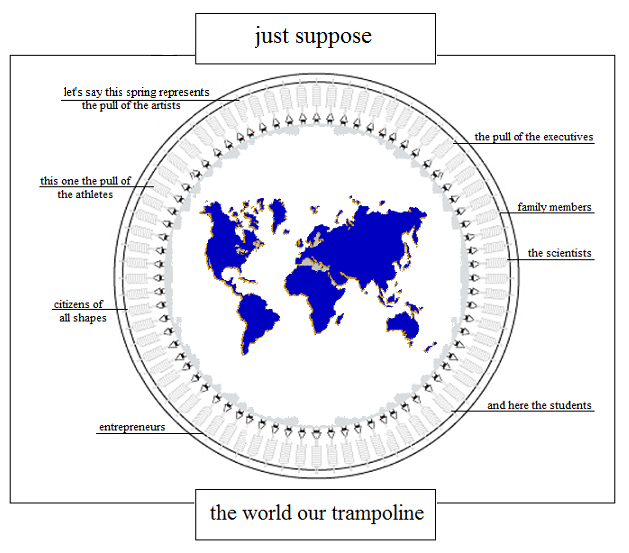
Now when I say “we,” I do not mean only our governments, as important as they are. Every day, across both of our countries, executives and entrepreneurs, scientists and scholars, artists and athletes, students and teachers, family members and citizens of all kinds shape and pull and add to this relationship. Together, they represent a vast range of priorities, concerns, and points of view. And they are all stakeholders in how we build toward a shared future.

It’s really that list I’m after…

There are seven billion individuals bouncing up and down on our trampoline, some of them holding hands, some of them in gangs that want to trip up rival gangs, or make a clearing for themselves and themselves alone, some too weak to bounce much at all…

and each time each one of us lands, we impact the trampoline from a different angle, stretch it a different way – tugging it to the will of the artist, the entrepreneur, the child, the retiree, the curious, the aggressive, the meek…

As we know, the earth is round, which is to say three-dimensional – but the tugs on it, the tensions, are more complicated than that, in fact they’re complex, n-dimensional – and constantly shifting.

Hilary Clinton wants to wake up in the morning, have coffee – and model that! – along with, and in balance with, her counterpart in another huge mass of population, half a globe and at least six philosophies away…

The coffee’s good, but it’s not enough — what we all could use is a new mode of thinking.

*

Maps courtesy of www.theodora.com/maps used with permission

The Era of the Creepy-State is Here

Tuesday, March 6th, 2012

George Orwell was more right than he knew….

Congress passed a law – by unanimous consent in the Senate and by a suspension of rules in the House – to permit the Federal government to arbitrarily arrest and imprison for up to ten years members of the serf class (formerly known as “American citizens”) whose presence annoys or offends specally designated members of the elite and foreign dignitaries. A list that will no doubt expand greatly in future legislation to include very “special” private citizens.

Think about that, future “Joe the Plumbers” or Cindy Sheehans, before you ask an impertinent question of your betters or wave your handmade cardboard sign. Is ten seconds of glory on your local ABC affiliate news at 5 o’clock worth that felony arrest record and federally funded anal exam?

No? Then kindly shut your mouth, sir. Learn your place.

Two nebbish Representatives, one Republican and one Democrat, distinguished only by their lack of legislative or political importance, sponsored the bill on behalf of the big boys who fast-tracked it under the radar (they learned from the SOPA debacle). Forget ideology or boasts about carrying a copy of the Constitution in the breast pocket of their suit, whether you are in an archconservative Congressional district or an ultraliberal one, almost every member of Congress voted “aye” to trash multiple amendments in the Bill of Rights.

Almost every one.

This is an accelerating trend in recent years and in particular, a bipartisan theme of the 112th Congress, which views Constitutional rights of nobodies as an anachronistic hindrance to the interests (or convenience) of their powerful and wealthy political supporters. Our elected officials and their backers increasingly share an oligarchic class interest that in important matters, trumps the Kabuki partisanship of  FOXnews and MSNBC and inculcates a technocratic admiration for the “efficiency” of select police states.

It is from this demographic-cultural root of incestuous corruption that our creeping – and increasingly creepy – manifestations of authoritarianism in American life springs. The SOPA/PIPA internet censorship bills, naked scanners at airports, Stasi-like expansion of expensively wasteful TSA security theater, proposed 24/7 monitoring of  every American’s online activities, migration of police powers to unaccountable private firms, replacement of elected municipal governments with “emergency managers” (favoring financiers over taxpayers), Federal agencies monitoring political critics , the Department of Justice retro-legalizing corporate racketeering, fraud, perjury and conspiracy on a national scale, plus other infringements of liberty or gross corruption that I could list, ad nauseum.

We have reached the point where we as Americans need to stop, step back from moment by moment fixation on nonsensical, “white noise” fake political issues like “contraception” ginned up to keep the partisans distracted and become seriously involved in determining the direction in which our nation is headed. Our elite are telegraphing their strong preference for a “soft dictatorship” but we still have time to check their ambitions and rein in their looting.

It is almost quaint these days to pick up Friedrich von Hayek’s classic,  The Road to Serfdom and thumb through it. The libertarian antistatists of the 20th century were so focused on the clear and present dangers of totalitarianism that the idea of a weak state that endangered liberty through a mixture of corruption and regulatory capture eluded them. The Westphalian state at it’s apex was so overweening that the enemy of free societies, after foreign monsters like Hitler and Stalin, could be ambitious intellectual pygmies like Harold Laski or Tom Hayden. The state was so omnipotent that even it’s efforts at benevolence, to build a “Great Society” of the Welfare State were injurious to individual freedom because the expanse of statism crowded and weakened civil society , the market and private life. The argument gained political traction because, to varying degrees, it was true and looked prophetic when the Welfare-state began to crash economically in the 1970’s on stagflation.

Give the Welfare-state liberals and Social Democrats of the past their due though, their intentions by their own lights were benign. They wanted to make a safer, more secure, more equal, more just life through a more powerful state (whether that was a good idea or a realistic endeavor was the central political question between right and left). The current elite in comparison is so inferior in moral character and overconfident in their abilities that they may soon make us yearn for the former’s return.

What have now in our ruling class,  are the  builders of a Creepy-state and their intentions are not benign, except toward themselves, for as long as the looting of the American economy can last.

Unlike the Welfare-state, the Creepy-state, shot through with corruption, is  not omnipotent  because it is to be the servant and gendarme of the emerging oligarchy and not their master – but it is to be omniscient and omnipresent, constantly watching, monitoring, investigating, recording, interrogating, coercing, sorting, muzzling, gatekeeping and shearing the sheep on behalf of the shepherds.

Or the wolves.

The Creepy-state is not there to protect you or give you a higher standard of living or ensure justice or democracy, but to maintain a hierarchical public order from “disruption” (formerly known as “politics” or “democracy”). If the classical liberal ideal was the night watchman state, this state is the shadowy and ill-disposed watcher in the night.

The American political elite, Democrat and Republican, Conservative and Liberal, are in are largely in consensus that the government should, in regard to the American people:

Read your email
Listen to your phone calls
Track your movements on GPS
Track your online activity
Track your spending
Track your political activity
Read your medical records
Read your financial records
Scan your body
Scan your house
Scan your DNA
Keep you under video surveillance in public
Detain you at random in public places for security checks
Close off public spaces for private use
Seize private property for private use
Censor your speech
Block your access to judicial relief
Determine your educational and career path
Regulate your diet, place of residence, lifestyle and living standards (ever downwards)
Charge you with secret crimes for breaking secret regulations
Share or leak information about you at will

Is this the America we wish for our children or grandchildren? One that epitomizes the values of our Constitution or Declaration of Independence, or is it some kind of tawdry and shameful dime store fascism of a small Latin American country? Perhaps life is finally imitating fiction?

Fortunately, it is not too late. Irrevocable changes in the constitutional order have yet to be engineered. Our politicians are followers, not leaders here. They are a small and cowardly lot for the most part and will recoil in fear from this authoritarian ethos if a sufficiently large number of elected officials are thrown out of office at once. We can still roll this back – at least the most egregiously anti-American aspects – if we get sufficiently angry come November.

Self-interest is their only lodestone.

A Wound That Does Not Cease to Bleed: The War in Vietnam

Wednesday, February 29th, 2012

Amigo of ZP blog, West Point military historian Colonel Gian Gentile, throws down the gauntlet in his review of Lewis Sorley’s new biography, Westmoreland: The General Who Lost Vietnam, in The National Interest:

The Better War That Never Was

DID GENERAL Westmoreland lose Vietnam? The answer is no. But he did lose the war over the memory of the Vietnam War. He lost it to military historian Lewis Sorley, among others. In his recent biography of William C. Westmoreland, Sorley posits what might be called “the better-war thesis”—that a better war leading to American victory was available to the United States if only the right general had been in charge. The problem, however, is that this so-called better war exists mostly in the minds of misguided historians and agenda-driven pundits.

In the battle over the memory of the Vietnam War, Sorley annihilates Westmoreland and leaves his character and reputation in smoldering ruins. Yet Sorley’s victory in the fight for the memory of Vietnam has not brought us a balanced historical biography of Westmoreland.  

 ….The better-war thesis argues that if only the U.S. Army had concentrated from the start on building up the South Vietnamese armed forces and winning the hearts and minds of the South Vietnamese people through limited applications of military force, we would have won the war. But the question remains: Precisely how could tactical adjustments early in the war have overpowered the political constraints placed on the army by the Johnson administration, which kept it from taking the fight to the North Vietnamese? Or the dysfunctional nature of the South Vietnamese government and military that precluded them from standing on their own? Or the declining popular support and political will in the United States as the war dragged on without a decent end in sight? Or, perhaps most importantly, how could tactical adjustments toward better methods of counterinsurgency have overpowered a communist enemy that fought the war totally while the United States fought it with limited means? In his Westmoreland biography, Sorley essentially ignores these questions.

Could the United States have prevailed in Vietnam? Yes, but it would have had to commit to staying there for generations, not a mere handful of years. The Vietnam War was an attempt at armed nation building for South Vietnam. Nations and their societies, however, are not built overnight, especially when they are violently contested by internal and external enemies. Thus, to prevail in Vietnam, the United States would have needed the collective will that it mustered to win World War II and would have had to be able to maintain it for generations. That kind of will—or staying power—was never a real possibility.

In war, political and societal will are calculations of strategy, and strategists in Vietnam should have discerned early on that the war was simply unwinnable based on what the American people were willing to pay. Once the war started and it became clear that to prevail meant staying for an unacceptable amount of time, American strategy should have moved to withdraw much earlier than it did. Ending wars fought under botched strategy and policy can be every bit as damaging as the wars themselves.

Well worth the read, not least for Gian’s model of how one historian carefully dismantles the thesis of another.

We are a mere three years from the fiftieth anniversary of Lyndon Johnson’s escalation of the Vietnam War, less than two years from the fiftieth anniversary of the assassination of John F. Kennedy that brought LBJ into power and a year from the fiftieth anniversary of the infamous coup d’etat against American client, President Ngo Dinh Diem, that JFK had approved. Finally,  fifty years ago, Kennedy drastically increased the American military advisory mission to South Vietnam to just under 10,000 men and signed off on clandestine operations against North Vietnam.

All those fiftieth anniversaries amount to a golden jubilee of rancor.

The bitterness sown by the lost war in Vietnam still burns in American politics like red hot coals. Less bright perhaps than the open flame of 1968, but if you scratch the surface, you will find with no less heat. The war spawned division and polarization that twisted our politics and poisoned public debate to this day, echoing now as farce as much as tragedy.

During the 1980’s, Vietnam historiography was virtually a cottage industry. It was the subject that ate the profession as a generation of academics who cut their academic teeth during the era of antiwar protest on campus acquired tenure, middle-aged paunches and lost hair while nursing their political grievances in their scholarship. I personally recall, as an  undergraduate, the war being referenced (usually along with vitriolic abuse of Ronald Reagan) in every humanities class, no matter how remote the course, with some professors being known for the quality of their off-topic rants.

While Westmoreland bears heavy responsibility for his part in a losing a war, even as theater commander in Saigon he was only an executor, not a maker, of strategy, much less national policy. Westmoreland did not lose Vietnam in a stunning battlefield capitulation, so Gentile is right to defend “Westy” from being scapegoated for the poor strategic reasoning hatched in the Oval Office. Where Westmoreland was at fault was in his inability to either intellectually comprehend the bigger strategic picture in which he found himself struggling (most likely) or if he did, to effectively articulate the strategic environment in Southeast Asia to a domineering President who was stubbornly determined to brook no contrary advice (possible). Had Westmoreland tried, he likely would have failed (Brute Krulak’s effort in this regard got him physically ejected from the Oval Office by the seat of his pants by Johnson himself. I am dubious that LBJ would have been any happier with contradiction of policy from Westmoreland).

Gentile, much like my professors of yore, is deeply interested in the congruence between events in his own time with those of the Vietnam era., in particular, the salience of counterinsurgency doctrine in the wars of Iraq and Afghanistan. There is, of course, some continuity between the Vietnam era and today present, a historical thread seized by the COINdinistas themselves in their veneration of Galula and slurping knife-blade portions of soup, but the continuity has limits. I suspect a Millennial generation vet of Kandahar or Fallujah, should they venture to become a historian, will frame and seek to explain their wars without much reference to the societal touchstone that is Vietnam.

Perhaps by then, for American society, Vietnam will have finally ceased to bleed.

Syria, Iran and the Risks of Tactical Geopolitics

Monday, February 13th, 2012


Mr. Nyet 

World affairs are much more like spider’s web than the neat little drawers of an apothecary’s cabinet. In the latter,  the contents of each drawer are cleanly isolated and conveniently compartmentalized. What you do with the contents of one drawer today has no bearing on what you do next week with those of another. By contrast, with a spider’s web, when you touch a web at any point, not only do you find it to be sticky in a fragile sort of way, but your touch sends vibrations through every centimeter of the lattice.

Which alerts the spiders.

The great foreign policy panjandrums of the United States and the Western allies – with assorted Middle-Eastern clients who have real skin in the game-  are attempting to muddle through two overlapping but different crises with Syria and Iran through the medium of international diplomatic organizations. In the case of Syria, whose Baathist-Alawite dictatorship of Bashar Assad is trying to crush a widespread uprising by pacing the body count of their atrocities to what CNN viewers can tolerate, the effort by SECSTATE Clinton and Ambassador Rice to rally the UN Security Council to issue a forceful resolution against Syria was itself forcefully rebuffed by the double-veto of Russia and China. A highly predictable event that left Ambassador Rice “disgusted” but we hope, not surprised.

The case of Iran, which incidentally is one of Syria’s few allies, involves the long-running dispute over Iran’s complex and semi-clandestine nuclear activities which, in violation of the NPT and IAEA agreements, appear designed to pressure the West by giving Iran, at a minimum, a “breakout” capacity to make some nuclear weapons.  This decade long “crisis” has recently escalated, with the EU and United States applying punishing new economic sanctions while an unknown party that everyone knows to be Israel is engaging in a campaign of  sabotage and assassination against Iran’s IRGC-run nuclear establishment. Iran for it’s part has taken hostages, blustered about closing the straits of Hormuz and threatened unspecified new breakthroughs in nuclear activities.

To say that Russia and China have been less than helpful in halting Iranian nuclear weapons-related activity is like saying Pakistan’s ISI might be involved with assisting the Taliban.  Another situation the American foreign policy establishment consistently has trouble puzzling out.

The problem with current US policy or it’s advocates is not target selection. Syria, Iran, Libya and various other states have nasty, disruptive and anti-Western regimes. Giving them the heave-ho, in the abstract, makes sense if advancing American interests  (or basic decency in governance) is the objective. However, unlike the aforementioned apothecary cabinet drawers, states and their regimes do not exist in the abstract, moving according to arid principles of conduct, but in the real world with a society of states which constantly are evaluating and re-evaluating each other’s conduct in light of interest. Which means, as with many things, in foreign policy, timing matters.

The West recently dispatched over the objections of two great powers, Colonel Gaddafi, a ruler who was also an unpopular and violent lunatic with a long pedigree of terrorism and cruelty.  That in itself was tolerable and comprehensible, if not welcome, to Moscow and Beijing, but we rubbed salt in the wound in two ways. First, simply stomping on the Realpolitik economic interests of Russia and China in Libya, as Walter Russell Meade eloquently put it:

….Russia has some specific grievances connected to Libya.  What seems to really enrage the Russians is less the overthrow of the Great Loon than the cancellation of his many contracts with Russia and the refusal of the new government to give Russia a slice of the Libyan pie.  Russia always thought the west’s democratic agenda in Libya was a laugh — and the antics of the thuggish new regime and the array of torturers and thieves now running rampant in that country has done little to dispel that view. (Again, the Putin/KGB worldview would suggest that the hard realists at the core of Washington’s power structure released the ninnies to dance themselves into a frenzy of humanitarian and democratic ecstasy while the cold purposes of the DC machine were advanced.)

But what Russia thought it expected and deserved in return for its abstention on the Libya vote was due consideration for its commercial interests in Libya.  France, Britain and Qatar seem to be dividing that pie enthusiastically among themselves and nobody is thinking about Russia’s share and Russia’s price.

Secondly, was icing Gaddafi under the moral banner of R2P, which would seem – in theory of course – to be applicable to governments very much like those run by the allies of….Moscow and Beijing. To say nothing of , Moscow and Beijing themselves, which already see the “color revolutions” as subversive Western elite sock puppets with a democracy stage show kit.  To be frank, Russian and Chinese leaders see R2P as a doctrine or policy that potentially can be used not only against their nation’s interests, but their own hold on power, which they view, accurately, as a violation of sovereignty.

So it can hardly be reassuring to Moscow or Beijing that when the dust has yet to settle in Libya, that the United States and it’s NATO allies are now pressing for new UN resolutions designed to justify military intervention in Syria to overthrow Bashar Assad. Like the late and unlamented Colonel Gaddafi, Bashar Assad is a cold-blooded murderer, but unlike the crazy Colonel, Assad is a client of Russia and close Syrian ties to Moscow go way back to the earliest days of his father’s dictatorship. There’s no way, in such a short amount of time, that an American effort to topple Assad – however justified morally – that Vladimir Putin and to be truthful, many ordinary Russians, would not view that as a Western attempt to humiliate Russia. And R2P would indicate still more humiliations to come! As Dan Trombly wrote:

….that is precisely why the United States should drop even lip service to the Responsibility to Protect. Honestly stayed, the doctrine requires intervention after intervention, and its strategic advantage to the United States relies on consistency, because without consistency the supposed normative benefits it creates quickly evaporates. Yet R2P, far from strengthening the international order, actually demands continually more resources and, each time it is employed or contemplated, calls into question the rest of the international order the United States promulgates. If the goal is to “expand and strengthen an effective international order,” why would increasing the visibility of Responsibility to Protect, a doctrine that divides the United States and Western Europe from Central Europe, the rising democracies of Brazil, South Africa, and India – not to mention, of course, the major powers China and Russia and exhausts an already overburdened and shrinking Western military capability? 

In that context, the idea that Russia and China would support a UNSC resolution to intervene in Syria and depose Assad borders on the bizarre.  Advocates of R2P, like Anne-Marie Slaughter, would counter here, arguing that both Russia and China previously accepted R2P, so their cooperation in support of a UNSC resolution on Syria should have been a manageable enterprise. It wasn’t, largely because the Russians do not seem to give R2P much weight as a part of international law, the Russian Defense Ministry being even more blunt than their diplomatic counterparts:

….Russia’s Defense Ministry on Thursday reiterated its position stated earlier by the Foreign Ministry: Russia will do its best to avoid military intervention in Syria.

 “As for Syria, we see that harsh discussions are going on in New York and we are just giving backup to our colleagues from the Foreign Ministry who are tackling these problems. Of course, we think it is necessary to prevent military intervention in Syria,” Deputy Defense Minister Anatoly Antonov told Vesti 24 TV channel.

 Russia has firmly supported Syrian President Bashar al-Assad during the uprising against his regime. Russia and China vetoed a UN Security Council resolution on Syria, backed by the Arab League and Western nations, to prevent a repetition of “the Libyan scenario.

Joshua Foust, writing in The Atlantic, addressed the situation with admirable clarity:

….A big reason for Russia and China’s intransigence is the NATO coalition that led the intervention, which badly overstepped the range of permissible actions stipulated in the UN Security Council Resolution that authorized intervention. Russia was an early critic of such actions as France’s weapons shipments to the rebels — criticism that could have been accounted for (Moscow never made any secret of its concerns) but which seemed to be ignored in the rush to intervene. President Obama made a rapid transition from saying “regime change is not on the table” last March (part of the bargain to get Russian abstention from the UNSC vote) to publicly calling for his ouster. France and the UK used similar language, ignoring the politics of getting UN approval for intervention.

….Many states, none of whom are free, worry that the West’s renewed love of intervention might one day be focused upon them. This is a critical consequence of rejecting sovereignty and declaring governments unfit to rule through a mixture of expediency and opportunity. Powerful states with poor human rights records — Russia and China included — look at what happened in Libya and see disaster, not freedom. And they are taking steps to avoid it.

The problem is not  intervention per se but an otherworldly posture of Western policy makers that embraces tactical geopolitics – i.e.  each intervention (Libya, Syria, Afghanistan, Iraq), undertaken whenever chance arises somehow exists on it’s own terms, in splendid isolation. It doesn’t, except in NATO capitols. Any nation not seeing itself as safe and impregnable is constantly calculating their opportunities and dangers based on our actions. If we continue to pursue intervention at the current tempo, blind to the perspectives and interests of others, we will get pushback on a more strategic level. And we will rue it.

NATO has been around so long, it is so enshrouded in hazy nostalgia and circumlocational love of diplomatic process, that we forget it was originally a radical departure for Americans and Europeans alike. Soviet postwar behavior under Stalin was so menacing, so intransigent, so relentlessly pressuring that the US set aside it’s traditional isolationism and the French and British their justified loathing of the defeated Germans, to make common cause against Soviet Communism. The West, on the defensive and backed into corner after corner in one tactical scenario after another by Moscow – Poland, Czechoslovakia, Greece, Iran, Berlin – took the conflict with the Kremlin to the next level by forming an enduring supranational, nuclear-armed, military alliance that ensured the next war in Europe meant WWIII.

That turned out to be more conflict than Uncle Joe Stalin was eager to buy.

We are now the ones backing others into corners. Iran, North Korea, Syria, Zimbabwe and other states ruled by kleptocrats and monsters act as buffers for China and Russia. Aside from the benefits these failed states can bring as customers for military hardware or sellers of raw materials, the attention of Western statesmen and human rights activists are diverted by the cause du jour in these hellholes, rather than being focused on what Beijing and Moscow might be up to at home or abroad.  Every dismantling of an anti-Western dictatorship, from their perspective, is a step closer to their direct confrontation with the West’s hyperactive, erratic, morally hypocritical, meddling, ruling elite who will be no more able to ignore “grave injustices” in Wuhai or Kazan than they could in Aleppo or Benghazi.

This is not an argument that we should not press our claims, or not try to keep nukes out of the hands of religious fanatics or refrain from crushing states that attack us with terrorist proxies; we can and should do all of these things with vigor. But when possible, much is to be gained by pursuing our interests in a manner that permits other great powers to at least save face. Destroying Iran’s government because of it’s nuclear activities, for example, is not a strategic “win” if  the way we do it convinces China and Russia to form a military alliance against the United States.

There is no need to forge ahead stupidly just because it is faster not to think matters through to their logical conclusions. America is heading down a road, led by an insular foreign policy clique of lawyers, activists and ex-academics, that eschews the need for maps because all that matters is that we drive well enough to take every short-cut.

Nagl: “COIN is not Dead!”

Monday, February 6th, 2012

 Octavian Manea continues his excellent series at SWJ, interviewing the leading theorists, practitioners and critics of pop-centric COIN.  This most recent interview is with Dr. John Nagl, formerly president of CNAS, author of Learning how to Eat Soup with a Knife and currently a professor at the Naval War College.

Nagl has been, it hardly need be said, one of the major proponents of pop-centric COIN and an important figure in the debate over the “Surge” in Iraq and it’s second iteration in Afghanistan:

COIN Is Not Dead: An Interview with John Nagl 

Q: Have we basically relearned, in Iraq and Afghanistan, the old lessons and principles in countering an insurgency? Are the broad historically proven principles of countering an insurgency, still valid guidelines for today?

Nagl: History does not repeat itself, but it rhymes. I am currently teaching a course at the US Naval Academy on the history of modern counterinsurgency campaigns. And it is interesting to see how the same principles continue to present and reassert themselves, that the same mistakes are made early as armies adapt to the challenges of counterinsurgency and they learn the same lessons time and time again. They learn lessons like the importance of being keenly sensitive to the human terrain, of understanding its hierarchy of needs, of comprehending the culture, the ethnicity, the religion of the insurgents and of the population. Protecting the population is the key to success. It is important to get the population on your side in order that you can derive intelligence from them on who the insurgents are. It is important that you reform governance to give people hope that if they do side with the government and the counterinsurgents, their lives will be better. It is important to provide inducements to the insurgents. Very rarely are you going to kill or capture every insurgent, although you may coerce some of them away from the fighting. All of those lessons could be drawn from the headlines of the past few weeks on the fight in Afghanistan. I am increasingly convinced that the classic historically tested counterinsurgency principles broadly apply across cases and they continue to apply today, although with variations for the particular country, region, ethnicity, and grievances faced by the population.

[….]

Q:What would you respond to the many critics that point out that pop-centric COIN is just a “collection of tactics” and techniques not a strategy in itself?

Nagl: I would say that they missed the first chapter of the FM 3-24. The strategy is to strengthen the government while weakening the insurgents in order to reach an end state in which the government with minimal outside assistance can defeat internal threats to its security. There are a number of tactics required to achieve that, both the killing and capturing of insurgents, strengthening host nation security forces, and improving governance. It all adds up to diminishing the strength of the insurgency, increasing the capabilities of the government and its forces and reaching a crossover point where the host nation forces can carry on with minimal outside assistance. We are about to test this hypothesis in Afghanistan over the course of the next two years.

Read the whole interview here.

It may be that Dr. Nagl uses the word “strategy” in a different sense than I do, or perhaps in a much narrower, context.

Strengthening a third-party government could be a broad US policy expressed in a variety of ways.  Or it may mean, the US military training and equipping certain host nation agencies for particular tactical skills, or leading these allies in counterinsurgency operations.  By itself, “strengthening” appears to me to be better described as a form of “Ways” in the classic “Ends-Ways-Means” triad of strategy. It may or may not be the best option to take – some governments are truly their own worst enemies.

Whether it is a good idea for the US to take upon itself the task of strengthening the host nation state in the first place, is a more strategic question.


Switch to our mobile site