First impressions
Monday, August 5th, 2013[ by Charles Cameron — how “first impressions count” applies to print media, an egregious case ]
.

Both panels (above) are screenshots from the same WaPo post, at the same magnitude. FYI.
[ by Charles Cameron — how “first impressions count” applies to print media, an egregious case ]
.
Both panels (above) are screenshots from the same WaPo post, at the same magnitude. FYI.

The recent post on Is 4GW Dead? stirred a great deal of interest, so I would like to extend the discussion on a point that that is critical not only for those who have responsibility for conducting military campaigns, but for statecraft and policy as well.
One of more important tenets of 4GW was the importance of “the moral level of war”, drawn from Colonel John Boyd’s thinking on the strategic impact of a combatant’s behavior, immoral or exemplary, on all observers – belligerents, civilian noncombatants, neutral third parties, the media, the combatant’s own soldiers and citizens back home. Here is Boyd:
Morally our adversaries isolate themselves when they visibly improve their well being to the detriment of others (allies, the uncommitted), by violating codes of conduct or behavior patterns that they profess to uphold or others expect them to uphold.
· Morally we interact with others by avoiding mismatches between what we say we are what we are and the world we have to deal with, as well as by abiding by those other cultural codes or standards we are expected to uphold.
In a Reader’s Digest version of Boyd, heroic, noble and magnanimous behavior is admirable and attractive while hypocrisy, cruelty and cowardice are repulsive and antagonizing characteristics. While the former won’t guarantee your victory and the latter, unfortunately, won’t ensure your defeat, they will be a significant factor in ameliorating or generating friction. The impression given by an army impacts the will of the enemy to fight, the morale and discipline of the soldiers, the restiveness of the civilians, the loyalty of allies and the goodwill of neighbors.
Boyd developed his thinking about the moral level of war in Patterns of Conflict all the way up to grand strategy and above. The rub about the moral level is that war is a crucible that puts every “cultural code” or “standard” to the test, as well as the character of the men fighting it and their leaders upon whom great responsibility rests. Even with the best of intentions in policy and careful generalship in the field, the horrors of war can erode moral fiber and military discipline in an army, in a company or in the heart of one man. Nor does every army begin with good intentions and effective discipline – some fighting forces are scarcely to be regarded as “armies” at all while others embrace the darkness as a matter of policy.
In terms of warfare, let us define “moral degeneration” as a degraded state of moral decline where a belligerent has effectively abandoned the operational and tactical restraints on conduct mandated by the Laws of War (i.e. war crimes are SOP) and in some instances, the vestiges of civilization.
A textbook example of this kind of moral degeneration came to light a few weeks ago when a jihadi lunatic in Syria, a rebel commander Khalid al-Hamad, who goes by the name of “Abu Sakkar”, cut out the heart of a (presumably) dead government soldier and ate it on video. Charles Cameron expounded at length upon this minor atrocity here. I am not, to say the least, a fan of radical, revolutionary, transnational Sunni Islamism but I cannot honestly say that its proponents like Abul Mawdudi , Sayid Qutb, Abdullah Azzam, Osama bin Laden and their ilk ever openly advocated cannibalism. It is much more likely that Mr. al-Hamad’s behavior is explained by the ferocity of the civil war in Syria eroding customary norms of the combatants than it is by Islamist ideology.
Moral degeneration in war seems to spring from two directions:
a) As a calculated act of Policy, from the top down, enforced by the leadership by military discipline and bureaucratic control.
b) As a spontaneous reaction by soldiers or fighters, appearing from the bottom up, without orders and frequently, in spite of them, possibly due to a breakdown in the chain of command, an erosion of discipline or sheer mutiny for the age-old purpose of reprisal, pillage and rapine.
The first category often occur with war as a convenient cover rather than a cause of grave crimes against humanity that leaders and ideologues had long wished to carry out. The Armenian Genocide, as John Keegan wrote, belongs properly to the history of Ottoman imperial policy than it did WWI; in truth, the Genocide was the greatest and worst in a long succession of vicious pogroms that the Ottomans had launched against their Armenian Christian subjects during the reign of Abdul Hamid and the Young Turks. The Holocaust (which had some inspiration in Hitler’s mind, from the fate of the Armenians) was more closely tied to the evolution of Nazi war policy but once Operation Barbarossa opened up the vast spaces of Soviet Eurasia, “the East” in Nazi parlance, the war itself increasingly took a backseat to expediting Hitler and Himmler’s ghastly and murderous racial priorities. This is a pattern of a priori planning, an escalating ideological radicalization of society that tends to be present with most of the large scale democides and genocides. It is the organizational powers of coercion utilized by the state, or a mobilized faction of , it that makes the enormous scale of death possible, not the war.
What is different and also dangerous about moral degeneration from the bottom-up, is that it is cultural evolution driven by the psychological effects of extreme violence at work and, unlike an act of policy, more likely to be diffused widely across society as a permanent change for the worse. Too many German soldiers in WWI, former peasants and artisans and boys from middle-class families, returned from the Western Front morally coarsened and addicted to the adrenalin rush of combat and became in succession Freikorps paramilitaries, Communist streetfighters, Nazi Stormtroopers and SS men. The World War also gave Russia the men of the Cheka, the Red terror and the first Gulags on the Bolshevik Left and brutal and mad warlords on the White Right.
In more recent two decades, the break-up of Yugoslavia unleashed atavistic passions of ethnic hatred and atrocity, while organized society in Western African states and central Africa broke down entirely in transnational regional civil wars with unrestrained massacres and mass rape. As a result, there is little that is political but much that is primeval, at this juncture, to explain Joseph Kony’s motivations; he resembles nothing so much as a 21st century Kurtz. Mexico too is degenerating from the escalating violence of cartel insurgency and narco-cultas – there is not much tactical or strategic value in pagan death cults or human sacrifice but it is spreading:
…Our impression is that what is now taking place in Mexico has for some time gone way beyond secular and criminal (economic) activities as defined by traditional organized crime studies.3 In fact, the intensity of change may indeed be increasing. Not only have de facto politicalelements come to the fore-i.e., when a cartel takes over an entire city or town, they have no choice but to take over political functions formerly administered by the local government- but social (narcocultura) and religious/spiritual (narcocultos) characteristics are now making themselves more pronounced. What we are likely witnessing is Mexican society starting to not only unravel but to go to war with itself. The bonds and relationships that hold that society together are fraying, unraveling, and, in some instances, the polarity is reversing itself with trust being replaced by mistrust and suspicion. Traditional Mexican values and competing criminal value systems are engaged in a brutal contest over the ?hearts, minds, and souls‘ of its citizens in a street-by-street, block-by-block, and city-by-city war over the future social and political organization of Mexico. Environmental modification is taking place in some urban centers and rural outposts as deviant norms replace traditional ones and the younger generation fully accepts a criminal value system as their baseline of behavior because they have known no other. The continuing incidents of ever increasing barbarism-some would call this a manifestation of evil even if secularly motivated-and the growing popularity of a death cult are but two examples of this clash of values. Additionally, the early rise of what appears to be cartel holy warriors may now also be taking place. While extreme barbarism, death cults, and possibly now holy warriors found in the Mexican cartel wars are still somewhat the exception rather than the rule, each of these trends is extremely alarming, and will be touched upon in turn.
The crucible of war either tempers a people or it breaks them.
[ by Charles Cameron — with an assist from Wm Benzon, under-appreciated and brilliant film and literary critic, musician, author of Beethoven’s Anvil ]
.
Screen-time is valuable: movie directors don’t just throw it away.
Here are screen-grabs of two moments in Greg Barker‘s HBO bin Laden documentary, Manhunt, offered for your consideration:

and:

**
As you know from my review of Battle of Algiers (Pontecorvo) and Black Friday (Kashyap), I’m a film buff.
Screen time is the life-time of story: every second counts. And thus it is that if a director uses the same shot with variations at two or more points in a movie, they don’t just follow along, the way the elements in the narrative through-line follow along, one after another — they stack up. They “mean” cumulatively, synchronically…
Putting that in musical terms, they take on the function of rhythm rather than melody — and it is rhythm that can make the body dance, just as it is melody that can make the heart soar.
So, this repetition, this striking parallelism — why?
**
Here’s my friend Bill Benzon, writing about the use of parallelism in Apocalypse Now:
The Assassin and the Surfer
Now for the less obvious parallel: Willard and Lance, the only member of the boat crew to survive. One can’t miss the parallel killings nor Willard’s statement of kinship with Kurtz. This parallelism, on the other hand, is easy to miss. That is to say, it may well elude conscious notice. Unconscious notice, on the other hand … Well, what is that?
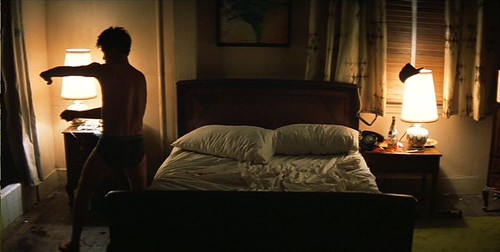
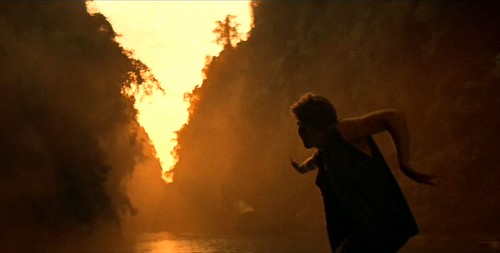
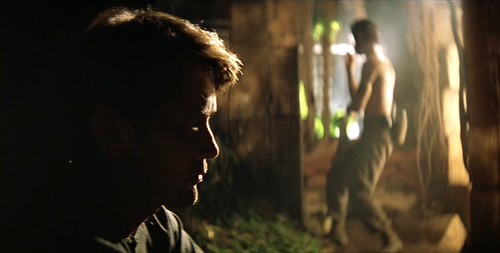
Here’s three frame-grabs that point up the parallel. The first is from the opening montage of Willard in Saigon just before he gets his orders:
The second shot comes much later in the film. Clean has been killed (bullet), then the Chief (spear). Lance is the one who floated the Chief’s body down the river. Now they’re heading upriver toward Kurtz again, with Lance in the bow of the boat:
He’s doing a martial arts dance. Not the same one as Willard did in the opening montage, but a martial arts dance. No one else in the film does such a thing. Clean does some dance moves while listening to the Rolling Stones, but they’re in an entirely different style; faster, jerkier, more angular.
Finally, we have this scene in Kurtz’s compound. Willard’s in the foreground, and Lance is in the background:
One might suggest that this parallel is a mere accident, one might. And perhaps it is. In cases like this, however, my default assumption is that it is not an accident. It may not be there by conscious intent and deliberate plan; but it is not there by accident. The people who made this movie are too skilled to do such things inadvertently.
That final remark of Benzon’s makes exactly the point I was hoping to make here, before commenting on those two screen-grabs from Manhunt:
The people who made this movie are too skilled to do such things inadvertently.
**
There’s actually a third shot in Manhunt with a view of a dangling rear-view-mirror ornament — let’s take a look:

This one’s from the van Peter Bergen and his cameraman, Peter Jouvenal, took in the docu’s re-enactment / flashback to their CNN interview with bin Laden, back in 1997. I don’t think this one is a rosary-like thing though it might be — I think it’s just the sort of tassel decoration you’ll find on saddle-bags, or decorating a camel or a car in Afghanistan.
The other two, however, seem clearly religious, both of them are shots of the cars in which American counter-terrorist folks would have gone to work during their efforts to track down bin Laden — and I find it significant that one features a (Christian) cross while the other very likely shows (Muslim) prayer-beads.
I say “very likely” because the beads could be (secular, Greek) worry-beads — but they look more like a tasbih to me. And why would that be interesting — why would a film-maker be interested in such a parallelism?
Besides the fact that these shots allow voice over and show us the various folk involved going to work, they specifically point up the fact that those working to defeat bin Laden were not all kuffar but included Ali Soufan of the FBI and “Roger” — the fellow described by Greg Miller in this March 2012 piece in WaPo, At CIA, a convert to Islam leads the terrorism hunt.
Am In right? I don’t know. But the subliminal message, if I am, is that the manhunt for bin Laden was indeed not a “Crusaders against Islam” affair.
**
May I recommend Wm. Benzon’s Beethoven’s Anvil to all who read here who have an interest in cognition and / or music?
For more on parallelism in cinema, see David Bordwell, Julie, Julia, & the house that talked, to which Benson also pointed me.
[ by Charles Cameron — human beings are a whole lot more interesting than was previously thought, evidence suggests ]
.
First, you should know that the English Defence League is, by its own account, “an inclusive movement dedicated to peacefully protesting against Islamic extremism.”
Now read on..
Or as Qur’an 49.13 puts it:
O mankind, We have created you male and female, and appointed you races and tribes, that you may know one another.
**
The Gospel suggests, Matthew 5.44:
Love your enemies, bless them that curse you, do good to them that hate you, and pray for them which despitefully use you, and persecute you…
and I am put in mind of this pair of images, both of which feature people I learned about for the first time in just the last couple of days:
**
Rev. Will D Campbell is the one shaking hands with Rev. Ralph D. Abernathy after the MLK assassination, in the top panel of the DoubleQuote above. He was a rare man — as the NYT puts is, “one of the few white clerics with an extensive field record as a civil rights activist” — which naturally reminds me, too, of my own mentor, Fr. Trevor Huddleston.
C.P. Ellis was a Ku Klux Klan leader until he met civil rights worker Ann Atwater, with whom he is pictured immediately below Abernathy and Campbell.
**
Wait, there’s more —
The first pair of images, above, comes from the UK, and the second pair from the US. So what’s the difference?
Apparently, the Brits serve tea while the Americans sip whiskey…
Abernathy’s reverend friend is the gentleman described in the lower panel here, the one who drinks whiskey with Klansmen. Go figure: love trumps hate.
**
To get the full charge of these various stories, you might want to read:
Woolwich Attacks: Muslim Leaders At York Mosque Invite EDL In For Tea EDL March With Muslims In Ipswich In Memory Of Lee Rigby Rev. Will D. Campbell, Maverick Minister in Civil Rights Era, Dies at 88 The Ann Atwater approach
**
Of course, the type of beverage you offer on these occasions must depend to some extent on the dietary habits and restrictions of both parties…
[ by Charles Cameron — thinking more in terms of challenge than of threat, and skipping via Chicago Law, Everest, and Handel’s Messiah to a Venn diagram of the workings of conscience ]
.
Well, I don’t always read the Chicago Law Review cover to cover, or even at all to be honest — but I confess I did like this opening paragraph from George Loewenstein† & Ted O’Donoghue†† (love those daggers after your names, guys):
If you ever have the misfortune to be interrogated, and the experience resembles its depiction in movies, it is likely that your interrogator will inform you that “we can do this the easy way or the hard way.” The interrogator is telling you, with an economy of words, that you are going to spill the beans; the only question is whether you will also get tortured — which is the hard way. In this Essay, we argue that much consumption follows a similar pattern, except that the torturer is oneself.
**
Here’s the easy vs hard contrast I was thinking about as I googled my way to the Law Review — as you’ll see, it has nothing to do with interrogation:

**
So, a little background. Jason Burke has been covering Everest for The Guardian lately, since it has been almost exactly sixty years since Hillary and Tenzing were the first to “conquer” the highest peak on earth — and one of his reports caught my eye — Everest may have ladder installed to ease congestion on Hillary Step:
It was the final obstacle, the 40 feet of technical climbing up a near vertical rock face that pushed Sir Edmund Hillary to the limit. Once climbed, the way to the summit of Mount Everest lay open.
Now, almost exactly 60 years after the New Zealander and his rope-mate, Sherpa Tenzing Norgay, stood on the highest point in the planet, a new plan has been mooted to install a ladder on the famous Hillary Step, as the crucial pitch at nearly 29,000ft has been known since it was first ascended. The aim is to ease congestion.
That’s what the upper panel, above, is all about — and I think it contrasts nicely with the bottom panel, which shows a rurp. Should you need one, you can obtain your own Black Diamond rurp here.
**
Rurps are awesome. Here are two descriptions of them, both taken from the mountaineering literature, and neither one of them focusing in too closely on the poetry of the name…
Steve Rope, Camp 4: Recollections of a Yosemite Rockclimber, p. 107:
Chouinard’s “rurp” was obviously something special. An acronym for “realized ultimate reality piton,” this ludicrously small fragment of heat-treated steel opened our eyes to untold possibilities.
and Chris Jones, Climbing in North America, p. 273:
It was about the size of a postage stamp. The business end was the thickness of a knife blade and penetrated only a quarter-inch into the rock. With several of these Realized Ultimate Reality Pitons, or rurps, Chouinard and Frost made the crux pitch on Kat Pinnacle (A4). It was the most difficult aid climb in North America.
Chouinard named this postage-stamp-sized thing the realized ultimate reality piton (RURP) because if you willingly and literally hang your life on that quarter-inch of steel, you’re liable to realize, well, ultimate reality.
Zen — yours for $15 and exemplary courage.
**
Here’s my question: should we make the hard way easier?
When is that a kindness, and when is it foolish?
**
In its own way, of course, a rurp is an assist — it makes the hard way a tad easier for the serious climber.
As indeed would the proposed “ladder” on Everest: here’s why it might be not-such-a-bad idea:
This year, 520 climbers have reached the summit of Everest. On 19 May, around 150 climbed the last 3,000ft of the peak from Camp IV within hours of each other, causing lengthy delays as mountaineers queued to descend or ascend harder sections.
“Most of the traffic jams are at the Hillary Step because only one person can go up or down. If you have people waiting two, three or even four hours that means lots of exposure [to risk]. To make the climbing easier, that would be wrong. But this is a safety feature,” said Sherpa…
Besides, the idea is to set it up as a one-way street…
Frits Vrijlandt, the president of the International Mountaineering and Climbing Federation (UIAA), said the ladder could be a solution to the increasing numbers of climbers on the mountain.
“It’s for the way down, so it won’t change the climb,” Vrijlandt told the Guardian.
Ah, but then there’s human nature to consider:
It is unlikely, however, that tired ascending climbers close to their ultimate goal will spurn such an obvious aid at such an altitude.
Bah!
**
Shouldn’t we just level the top off, as Handel and Isaiah 4.4 suggest, and as we’re doing in the Appalachians?
A little mountaintop removal mining, a helipad, and voilà — even I could make it to the summit!
**
But to return to Loewenstein† & O’Donoghue†† — their paper’s full title was “We Can Do This the Easy Way or the Hard Way”: Negative Emotions, Self-Regulation, and the Law — how can a theologian such as myself resist a diagram such as this?

Zenpundit is a blog dedicated to exploring the intersections of foreign policy, history, military theory, national security,strategic thinking, futurism, cognition and a number of other esoteric pursuits.
Customized Web Site & Blog Design