zenpundit.com » psychology

Archive for the ‘psychology’ Category

War, Games and morale

Sunday, December 20th, 2015

[ by Charles Cameron — on gaming “living and moral forces” — with a whiff or two of Montaigne ]
.

the-mind-is-a-dangerous-weapon-even-to-the-possessor

**

Let’s start with Clausewitz, On War.

He says — and we’d be wise to pay attention — “most of the matters dealt with in this book are composed of equal parts of physical and of moral causes and effects.” Earlier in the paragraph, he’d said, “The effects of physical and psychological factors form an organic whole which, unlike a metal alloy, is inseparable..” — which puts the physical and the moral on equal footing. He then tilts the board decisively in favor of the “moral” factors —

One might say that the physical factors seem little more than the wooden hilt, while the moral factors are the precious metal, the real weapon, the finely-honed blade.

Furthermore, these “moral factors” are “intangible” — or as Michael Handel puts it:

In contrast to the physical forces, which are relatively easy to estimate, the equally important moral forces are more difficult to gauge.

**

Deputy Secretary of Defense Bob Work and Gen. Paul Selva, Revitalizing Wargaming is necessary to be prepared for future wars:

For example, faculty and students at the Naval War College integrated wargaming into their entire course of study, analyzing the then-novel concept of carrier task force operations, the role of submarines in scouting and raiding, and how to provide logistics support to fleet operations spread over the vast Pacific Ocean. Wargames in classrooms at Quantico helped the Marine Corps develop new concepts for amphibious warfare and conceive of new techniques for capturing advanced naval bases. Wargamers at the Army War College explored how to employ tanks and artillery on infantry-dominated battlefields and examined the logistical challenges of fighting a war far from American shores.

and:

Most importantly, players should be able to observe and live with the consequences of their actions (where possible, based on previous rigorous analysis) in the face of a thinking and reacting competitor, and so come to understand dynamic military competition from the perspective of opposing sides. Actions taken by the players on both sides must have tangible consequences that are determined — where possible — by the actual performance of weapons and sensors in the real world, backed by a rigorous adjudication process using the best available analysis and professional judgment.

**

In the first of those paragraphs, we have “carrier task force operations”, “the role of submarines”, “logistics support”, “fleet operations”, “amphibious warfare”, “advanced naval bases”, “tanks and artillery”, infantry-dominated battlefields”, and more “logistical challenges”.

Now admittedly, that’s pre-WWII wargaming — but no mention there of the impact of upcoming psychological forces such as the Nuremberg rallies, Hitler’s obsession with Wagner and Bayreuth, Leni Riefenstahl, Himmler’s occult interests, and so forth — not because they were known or in existence at the time, they weren’t, but because they constituted in the event precisely the sort of intangible morale boost / force multiplier that can tip a battlefield and slide a war, as per Clausewitz.

Nary a mention of psychology, moral, morale, espirt, spirituality, religion, let alone Dempsey’s “apocalyptic, end-of-days strategic vision” which we now face in IS.

And that second paragraph, dealing with the present and near future — the move to consider dynamic interaction is to be lauded, but once again we’rew in the realm of “weapons and sensors in the real world”. I’m led to the suspicion that current wargaming doesn’t know quite how to deal with “tangible consequences” that are not determined “by the actual performance of weapons and sensors” but by, ahem, passion.

**

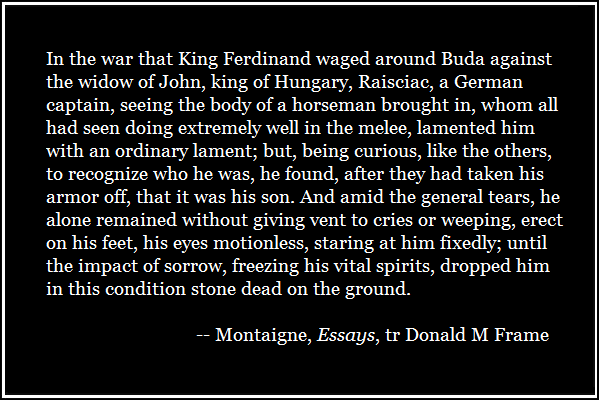
Raisciac

**

If moral causes and effects are as potent as weapons, or even, as Clausewitz said, are themselves “the real weapon, the finely-honed blade”, games focused not on performances of weapons but on moral causes and effects — games that game passions — must surely have a significant role to play in revitalizing wargaming.

FYI: Mike Sellers, game designer extraordinaire

Monday, December 14th, 2015

[ by Charles Cameron — game design, systems thinking, education ]
.

An old and valued friend just popped up in my feed:

Enjoy!

Red mercury as scam and symbol

Friday, November 20th, 2015

[ by Charles Cameron — CJ Chivers, nuclear nonsense, faux chemistry, and the alchemical imagination, with hat-tip to Cheryl Rofer ]
.

CJ Chivers, conflict journalist extraordinaire and author of a book about the Kalashnikov assault rifle, The Gun, today posted a remarkable account of what he terms The Doomsday Scam, with the subtitle “For decades, aspiring bomb makers — including ISIS — have desperately tried to get their hands on a lethal substance called red mercury. There’s a reason that they never have.”

A taste:

The Islamic State, he said, was shopping for red mercury.

Abu Omar knew what this meant. Red mercury — precious and rare, exceptionally dangerous and exorbitantly expensive, its properties unmatched by any compound known to science — was the stuff of doomsday daydreams. According to well-traveled tales of its potency, when detonated in combination with conventional high explosives, red mercury could create the city-flattening blast of a nuclear bomb. In another application, a famous nuclear scientist once suggested it could be used as a component in a neutron bomb small enough to fit in a sandwich-size paper bag.

and:

To approach the subject of red mercury is to journey into a comic-book universe, a zone where the stubborn facts of science give way to unverifiable claims, fantasy and outright magic, and where villains pursuing the dark promise of a mysterious weapon could be rushing headlong to the end of the world. This is all the more remarkable given the broad agreement among nonproliferation specialists that red mercury, at least as a chemical compound with explosive pop, does not exist.

Indeed, there’s a sidebar in Chivers’ post which sums the topic up nicely:

The shadowy weaponeer’s little helper, red mercury was the unobtainium of the post-Soviet world.

There’s much more, of course — with red mercury rumored to be found in old Singer sewing machines, which briefly raised the price of such machines in Saudi Arabia a thousandfold to $50,000 — and the whole extraordinary piece is more than worthy of your attention. It is also about a concrete, if counter-factual, reading of the term “red mercury.”

Cinnabar, aka mercury sulphide, anyone?

**

A centuries-old debate concerning alchemy has concerned the literal and metaphorical interpretations of alchemical texts.

Scholars up to and including Isaac Newton theorized about and practiced alchemy in their aptly named lab-oratories, at a time when literal and metaphorical “readings” were much less easily considered separately than is the case today. Alchemy was then for a while widely ridiculed as proto- and indeed pseudo-science — a tendency still prevalent in many circles today. And more recently, alchemy has been explored by Carl Jung and followers (and his predecessor, Silberer) as a field of imaginative, metaphorical inquiry illuminating spirituality, psychology and literature.

  • BJT Dobbs, The Foundations of Newton’s Alchemy
  • BJT Dobbs, The Janus Faces of Genius
  • Herbert Silberer, Problems of Mysticism and its Symbolism
  • CG Jung, Psychology and Alchemy
  • CG Jung, Alchemical Studies
  • CG Jung, Mysterium Coniunctionis
  • Marie-Louise von Franz, Aurora Consurgens
  • Titus Burckhardt, Alchemy
  • Jung’s reading of alchemical texts is a symbolic reading — in accordance with the principle “the stone which the builders rejected Has become the chief corner stone” (Psalm 118.22, cf Acts 411), he has taken precisely those materials in the alchemical tradition which modern chemistry rejected as ridiculous, and reclaimed them as symbolic, richly metaphorical expressions of psychological truth.

    **

    It is in that spirit that I turned from Chivers’ fascinating treatment of “red mercury” as an allegedly physical, albeit spurious, substance, with its intriguing narratives of scams from the Cold War to the present day and IS, to take a look at what I might find via a brief search in the Jungian literature. I say “quick” because I have neither the appropriate library nor the time for a more intensive search, but here’s what little I found:

    There’s a “red mercury” reference in Stanton Marlan, The Black Sun: The Alchemy and Art of Darkness, on p. 22:

    The idea is that the raw solar energy must darken and undergo a mortificatio process that reduces it to its prime matter. Only then can the creative energies produce a purified product. In this image the sperm of gold refers not to the ordinary seminal fluid of man but rather to “a semi-material principle,” or aura seminales, the fertile potentiality that prepares the Sun for the sacred marriage with his counterpart, darkness, which is thought to produce a philosophical child or stone and is nourished by the mercurial blood that flows from the wounding encounter of the Lion and the Sun. The blood — called red mercury — is considered a great solvent.

    Marlan then gives us what is effectively a translation of the paragraph above into contemporary therapeutic language:

    Psychologically, there is nourishment in wounding. When psychological blood flows, it can dissolve hardened defenses. This then can be the beginning of true productivity. In dreams the imagery of blood often connotes moments when real feeling and change are possible. The theme of the wound can also suggest a hidden innocence, which is also a subject of mortification. The green color of the lion, which is referred to as “green gold,” suggests something that is immature, unripe, or innocent, as well as growth and fertility. The alchemist imagined this innocence, sometimes called virgin’s milk, as a primary condition, something without Earth and not yet blackened. Typical virgin-milk fantasies are often maintained emotionally in otherwise intellectually sophisticated and developed people.

    **

    And then there’s what Jung would term synchronicity..

  • CG Jung & Wolfgang Pauli, The Interpretation of Nature and the Psyche
  • In my twitter stream within 3 minutes of my posting my first tweet re Chivers’ piece, & before I’d tweeted my follow up, I ran across this tweet containing the phrase “Drawing Blood will eat the sun”:

    Drawing Blood will eat the sun — just how synchronistically alchemical can Molly Crabapple and Twitter get?

    Military Reform through Education

    Tuesday, October 20th, 2015

    [by Mark Safranski, a.k.a. “zen“]
    Photo of Don Vandergriff instructing with a map

    Don Vandergriff facilitating Adaptive Soldier/Leader exercises at Fort Benning

    Fred Leland at LESC Blog recently had a guest post up by Dan Grazier from the Project on Government Oversight regarding the important work Don Vandergriff is doing to reform professional military education and training:

    Military Reform Through Education: From The Straus Military Reform Project, Something We In Policing Can Learn From

    ….I had the privilege of experiencing this process with a group of 30 soldiers and Department of Defense (DoD) civilians learning about adaptive leadership and mission command. All were teachers from various courses at Fort Benning sent by their senior leaders seeking to infuse new ideas into their organizations. They spent a week learning how to incorporate adaptability into their courses during a seminar taught by CDI military advisor Don Vandergriff and his colleagues with Yorktown Systems Group.

    The Adaptive Soldier/Leader Training & Education (ASLTE) seminar aims to move the Army away from outdated assembly-line training methods that teach soldiers to mindlessly execute checklists. Instead, the seminar shows soldiers how to incorporate creative and interactive methods that challenge both students and teachers. This results in empowered soldiers at all levels able to adapt to any situation. [….]

    ….Don Vandergriff, a retired Army major, has been on the front lines of personnel reform for many years. While he is most noted for his work at the service level, these seminars seek to transform the Army from the bottom up.

    Approximately 20 soldiers and 10 civilian educators spent the week learning various teaching methods through experiential learning, which flips the traditional method military students are used to. Most training today follows the “crawl, walk, run” theory all service members are familiar with. Students are generally expected to complete reading assignments, sit through a PowerPoint lecture, and then finally conduct field training to reinforce what they have learned.

    The seminar exposed students to new methods by putting the practical exercises first. For example, the seminar uses several Tactical Decision Games (TDGs) to encourage students to rapidly develop a plan for a military problem presented by the facilitators. TDGs can be created for nearly any kind of a situation, but this course mostly used actual battlefield problems like how to capture a bridge or defeat an enemy force entrenched on a hilltop. While working through these problems, the students are exposed to such concepts as Mission Command and the Observe, Orient, Decide, and Act decision cycle, commonly called the OODA Loop or Boyd Cycle.
    It is only after the practical exercises that they receive reading assignments about those concepts. Because they’ve encountered them during the exercises, the concepts become more tangible. The OODA Loop, for instance, explains an individual’s or an organization’s decision-making process. It is a difficult concept to truly understand, but it becomes easier when one first sees how it works and then reads about it. The idea is to give them a moment of discovery, that “Ah ha!” moment. Success using such methods is to have a student say, “So, that’s what you call that,” while reading.

    Don is making use of several powerful learning methodologies in his Adaptive Leadership philosophy – and I saying “learning” and not “teaching” because Don has properly put the emphasis on the student actively thinking and doing rather than on passively listening to a lecture or discussion. Lecture has a place in education, to explain or to set the student up for new learning experiences, but it should be used sparingly and in short bursts of time when the instructor has carefully set up a “teachable moment”. By having the students doing active problem solving first, they come to Vandergriff armed with their own questions, eager to have feedback.

    The use of games are also a very powerful learning tool, perhaps one of the most effective because the situational learning. tends to be transferrable rather than be compartmentalized and isolated information. The right kind of decision games are serious practice for life. This was noted by RAND social scientists way back during the early days of the Cold War:

    “The gamers argued that insights arose from immersion in play. In 1956 Joseph Goldstein noted that the war game demonstrated ‘ the organic nature of complex relationships’ that daily transactions obscured.War-gaming gripped its participants, whipping up the convulsions of diplomacy ‘ more forcefully…than could be experienced through lectures or books’.”

    ” A team from the Social Science Division [ at RAND ] posed a number of questions which they hoped the unfoldig month of gaming would resolve. Chief among them was whether gaming could be used as a forecasting technique ‘ for sharpening our estimates of the probable consequences of policies pursued by various governments’. Would gaming spark “political inventiveness“, and more importantly, how did it compare to conventional policy analysis? Did gaming uncover problems that might otherwise be neglected? And invoking the emerging touchstone of intuition, did the experience impart to policy analysts and researchers “ a heightened sensitivity to problems of political strategy and policy consequences?”

      Sharon Ghamari- Tabrizi, The Worlds of Herman Kahn

    Back to the article:

    ….Vandergriff’s teaching method incorporates recent research into adult learning, designed “to engage students in direct experiences which are tied to real world problems and situations in which the instructor facilitates rather than directs student progress.” This creates a situation where the students learn from one another. Unlike most other military classes, the ASLTE teachers use very few PowerPoint presentations. They also end up speaking far less than the students themselves.

    Vandergriff ran the class through the first TDG and led the discussion afterward. From that point forward, students took turns leading the class through After Action Reviews. Students gained confidence in leading such an exercise while the rest of the class bounced ideas off each other. The interactive nature of this kept the entire class engaged and gave all of them ownership of their own learning.

    The concept of ownership was a consistent theme throughout the seminar. According to Vandergriff, a good teacher “works to make his students better than himself and encourages them to take ownership of their development, to make them life-long learners.”

    Here Don is making use of the social pressure and reinforcement of a Peer to Peer (P2P) dynamic to maintain maximum student engagement while having them practice critical intellectual reflection, something that is a vital constituent of a professional culture of learning. A true professional embraces an honest discussion of ideas and both accepts and gives critical feedback on performance in hopes of learning and improving.

    Read more regarding Don Vandergriff’s adaptive leadership methods here and here.

    ISIS: Paganism with an Islamic Face?

    Wednesday, October 7th, 2015

    [by Mark Safranski, a.k.a “zen“]

    “And thou shalt not let any of thy seed pass through the fire to Moloch, neither shalt thou profane the name of thy God: I am the LORD.”

    – Leviticus 18:21 

    “They rejected the commandments of the Lord … and served Baal. They consigned their sons and daughters to the fire”

    – 2 Kings 17:16–17

    “And do not kill your children for fear of poverty. We provide for them and for you. Indeed, their killing is ever a great sin”

      – Qur’an 17:31

    In a recent comment section conversation with Charles Cameron and RAND scholar David Ronfeldt on the character of Fascism and its resurgence, I remarked that ISIS adopting a Fascist style in its propaganda and governance may be drawing upon a ghastly and ancient lineage:

    ISIS is really embracing Fascism. It’s ceremonial public executions actually supercede what the Nazis and Fascists did only symbolically with blood flags and heroic cenotaphs and so on. It is reaching back to something very dark and protean, human sacrifice, as a political symbol. I think [ Moshe] Halbertal’s book On Sacrifice, is a useful reference here on how deep this goes culturally, to the bronze age or earlier.

    ISIS has for some time been making quite a perverse spectacle of its executions of prisoners, combatant and non-combatant alike, releasing videos to international fanfare and glorying in the resultant horror and global infamy. The precedent for this macabre “propaganda of the deed“was initially set by the forefather of ISIS, the Jordanian jailbird upjumped to “terrorist mastermind”, the late Abu Musab al-Zarqawi, who originally led al Qaida in Iraq during the American occupation of Iraq. Prior to expiring after U.S. forces dropped a 500 lb bomb on his head, al-Zarqawi pioneered the use of  beheading videos, usually featuring himself being filmed incompetently and gruesomely sawing off an orange jumpsuit-clad captive’s head with a large knife, blood spraying everywhere.

    Zarqawi’s ghoulish innovation in terrorist messaging admittedly held a certain fascination for the psychopathic segment of Sunni Islamist extremists and it attracted foreign fighters of this nature to Iraq who in turn lionized Zarqawi as “the Sheikh of Slaughterers”; but the beheading videos also generally horrified public opinion in the Muslim world and repelled even hardened jihadis, earning Zarqawi a rebuke from al Qaida number two, Ayman al-Zawahiri:

    ….Among the things which the feelings of the Muslim populace who love and support you will never find palatable – also- are the scenes of slaughtering the hostages. You shouldn’t be deceived by the praise of some of the zealous young men and their description of you as the shaykh of the slaughterers, etc. They do not express the general view of the admirer and the supporter of the resistance in Iraq, and of you in particular by the favor and blessing of God.

    ….However, despite all of this, I say to you: that we are in a battle, and that more than half of this battle is taking place in the battlefield of the media. And that we are in a media battle in a race for the hearts and minds of our Umma. And that however far our capabilities reach, they will never be equal to one thousandth of the capabilities of the kingdom of Satan that is waging war on us. And we can kill the captives by bullet. That would achieve that which is sought after without exposing ourselves to the questions and answering to doubts. We don’t need this. 

    Zarqawi’s Iraqi bloodlust ended only because it was interrupted by the American military, but the leaders of ISIS have carried on. Far from accepting Zawahiri’s advice, they have doubled down, greatly upgrading the marketing of ritualistic murder from Zarqawi’s crude snuff films to slick videos with professional editing and high production values that have become central to the online “brand” of the ISIS “caliphate”. Like the hosts of a sinister game show, ISIS spokesmen have found the time to murder creatively in order to keep their audience of Islamist terrorist wannabes in the West tuned in and captivate the attention of the global media (though sometimes, things do not work  out as planned).


    However effective this circus of horrors has been at daunting their enemies and attracting the allegiance of “zealous young men” to ISIS, it reveals an atavistic impulse at play that no amount of Quranic hand-waving can paper over and conceal. Jurisprudence is absent here; not even the grim and rough Islamic “justice” of the Taliban is given to prisoners of ISIS, which violates the customary protections given under Islamic law or historical Muslim judicial practices. These choreographed and sensationalized executions by ISIS are really a cryptic revival of the ancient and terrible practice of human sacrifice, that in most cultures and religions had long been replaced by symbolic ritual, but once reigned supreme during the Bronze Age, not least in ancient Iraq, which if new findings are to be believed was like Aztec Mexico, a charnel-house of slaughter.

    Originating in the Stone Age, human sacrifice in the religious sense of an offering to the gods or God, lasted a surprisingly long time. Setting aside the preColumbian cultures of the New World, the ancient Romans, for example, did not formally outlaw human sacrifice until the first century BC, though the practice had become archaic and Rome vigorously sought to stamp it out among the Gauls and Britons, among whom human sacrifice was an accepted part of Druidic religion. Nor was human sacifice entirely unknown among the ancient Greeks of the classical period while child sacrifice was probably central to Carthaginian state rites to such a degree that other peoples of the time, including the Romans, found abhorrent.

    What occurred in many cases is that as civilizations evolved in social complexity, substitutionary practices for human sacrifice developed that served the same impulse, to propitiate and honor their God(s) and create powerful emotional bonds among the participants:  animal sacrifice, burial ceremoniesmysteries, religious ritual, necromancy, symbolism in theater and political matters of state religion. The Biblical tale of Abraham and Isaac is itself a scriptural admonition to the ancient Hebrews to adopt animal sacrifice as most pleasing to God, a practice the Israelites and Jews of the classical period continued until the destruction of the second temple by the Roman general Titus. From that point on, from the close of the first century AD, Jews and the early, still Judaic, Christians moved away from the practice of animal sacrifice and substituted prayer and theology of salvation, respectively. Sacrifice, especially human sacrifice, became a distinguishing mark of paganism and the subject of Christian crusades in the middle-ages, like the brutal war waged by the Teutonic Knights against the human sacrificing Old Prussians and Lithuanian barbarian tribes.

    The Binding of Isaac

    The end of late medieval European religious warfare and the rise of the Westphalian system after the Thirty Year’s War slowly shifted the symbolic moral center of sacrifice from God to the State, with divine right monarchy serving as a waystation for the incubation of modern nationalism. There was an epistemic shift, as Halbertal argues in On Sacrifice from a sacred and mystical “sacrificing to” the sovereign God borrowed from the examples of Jewish martyrdom by early Christians who shared in the Romans the same persecutors. This shift opened the gates of permissible sacrifices, legitimating a new secular and political “sacrificing for” the glory of the State.

    It is a profound difference but occurring within the same phenomena, as illustrated by two quotes:

    …And it came to pass after these things, that God did tempt Abraham, and said unto him, Abraham: and he said, Behold, here I am.

    And the Lord said, Take now thy son, thine only son Isaac, whom thou lovest, and get thee into the land of Moriah; and offer him there for a burnt offering upon one of the mountains which I will tell thee of.

                                                                                  – Genesis 22:2

    And:

    ….But, in a larger sense, we can not dedicate – we can not consecrate – we can not hallow, this ground – The brave men, living and dead, who struggled here, have hallowed it, far above our poor power to add or detract. The world will little note, nor long remember what we say here; while it can never forget what they did here.

    It is rather for us, the living, we here be dedicated to the great task remaining before us – that, from these honored dead we take increased devotion to that cause for which they here, gave the last full measure of devotion – that we here highly resolve these dead shall not have died in vain; that the nation, shall have a new birth of freedom, and that government of the people, by the people, for the people, shall not perish from the earth.

         – Abraham Lincoln

    Gettysburg and Antietam were not Mount Moriah. Neither were the Somme or Stalingrad the same as the Tophet. From time of the Patriarch Abraham to the presidency of Abraham Lincoln, nations of men ceased to sacrifice usually helpless others but moved to sacrifice themselves in what they reckoned as the highest cause. Movement away from human sacrifice as practiced by ancient Carthaginian or animal sacrifice as practiced by most peoples of antiquity, including the Jews, to gentler substitutionary practices, Moshe Halbertal has called the “cataclysmic shift” in the history of civilization.

    If so, it is a shift that ISIS has begun to reverse.

    In their outstanding ISIS: The State of Terror, counterterrorism scholars Jessica Stern and J.M. Berger analyze the dark obsession ISIS has demonstrated in its propaganda messaging with exquisitely orchestrated executions:

    ….As we have noted, ISIS’s psychological warfare is directed at its potential victims. But it is also directed at those it aims to control. It is deliberately attempting to blunt its follower’s empathy by forcing them to participate in or observe acts of brutality. Over time, this can lead to secondary psychopathy, or a desire to harm others, and contagion of violence. Beheadings are one such tool for blunting empathy.

    Berger and Stern are likely correct that the methodical character of ISIS demonstrations of brutality are intended to desensitize the participants and (as they further explained) a tendency to cultivate secondary psychopathology in ISIS recruits, especially the young. A similar process occurred during the Holocaust with Nazi Einsatzgruppen and reserve unit police battalions detailed to assist the SS mobile killing squads on the Eastern front. Many serving in these units, already fanatical National Socialists, became inured to the suffering of women, children and the old who were shot and dumped still alive into mass graves, though some SS men showed signs of PTSD, depression and higher rates of severe alcoholism, desertion and suicide.

    The comparison between the genocidal cruelty of the SS and ISIS, while natural, is limited by a very important distinction. However zealous their ideological fanaticism and dedicated in their murderous mission to exterminate European Jewry, the SS lacked the context of moral certainty and the psychological reinforcement effects of religious exaltation enjoyed by ISIS killers. Even the malevolent Heinrich Himmler, in his secret speech to Nazi gauleiters and SS leaders, regarded the Final Solution as a terrible burden that the SS shouldered on behalf of the Fuhrer to assure Germany’s future; a “glorious” crime that Himmler believed must be kept forever hidden from history and the German people.

    Not so ISIS, which revels in its bloody terror. Worse, the repetition of garish executions as public celebrations by ISIS, with a vague but constant religious context, devoid of any shred of Islamic legality, inevitably acquire over time the theological characteristics of Halbertal’s “sacrificing to”  – what began as harsh jihadi jurisprudence and psychological warfare mutated under conditions of lazy, sociopathic brutality and totemic invocations of Islam into ritual “offering” by ISIS of its prisoners of war as human sacrifices in the manner of the ancient pagans. A perverse blasphemy, but one that draws on a powerful archetype deeply buried in the human psyche.

    ISIS leaders have not only looked into the Abyss, they have descended into and become one with it.
    Switch to our mobile site

