zenpundit.com » analytic

Archive for the ‘analytic’ Category

Change: a poem from The Poetry of the Taliban

Tuesday, May 8th, 2012

[ by Charles Cameron — poetry in time of war, symbolism / semiotics of blood and martyrdom, analogies with Jefferson and St Augustine, sacramental nature of reality ]
.
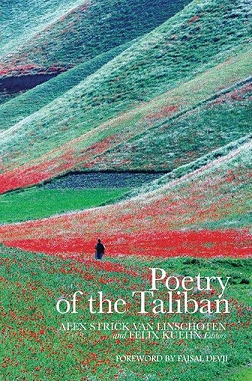
Felix Kuehn and Alex Strick van Linschoten’s book The Poetry of the Taliban (Hurst, Columbia UP) contains a remarkable poem composed in the 1990s by one Bismillah Sahar:
.

Change

The spring of change needs blood to rain down,
It requires the irrigation of the gardens with blood.
Valuing the blood of the people of the past
Requires the price of human blood.
Each drop of it has become a Nile of the dawn’s blood;
The Pharaohs want to fill the Nile with blood

Sitting here in California seven thousand miles and many cultures distant and more than a decade later, the phrase “spring of change” has an interesting ring to it – but it was likely not the not-yet-deposed Mubarak that Sahar was thinking of when he penned his lyric about the Pharaoh, but “the Oppressor” — whomever that might be. The imagery of the Pharaoh is a common enough trope, in fact, used for instance by the Taliban to describe President GW Bush in their magazine Al-Sumud [ link is to preview, relevant chapter of Master Narratives of islamist Extremism.

And while it is true that, as Asim Qureshi notes, “poetry links the ancient past with the modern day”, neither the trope itself nor the reference to the plight of the Jews in Egypt is exclusive to Afghanistan in specific or Islam in general. Indeed, Martin Luther King explicitly views himself as what theology would term a “type” of Moses when he says:

We’ve got some difficult days ahead. But it doesn’t matter with me now. Because I’ve been to the mountaintop. And I don’t mind. Like anybody, I would like to live a long life. Longevity has its place. But I’m not concerned about that now. I just want to do God’s will. And He’s allowed me to go up to the mountain. And I’ve looked over. And I’ve seen the promised land. I may not get there with you. But I want you to know tonight, that we, as a people will get to the promised land. And I’m happy, tonight. I’m not worried about anything. I’m not fearing any man. Mine eyes have seen the glory of the coming of the Lord.

These sacramental bleedings of the past into the present as in a palimpsest are native to the imagination and powerful in their poetic impact, as MLK’s life, final speech and death eloquently testify.

But there is a second layer of sacramental reality at work in the poem, and it lies in the repeated mention of blood. – the transition between past an present itself being presented in terms of blood spilled in the lines:

Valuing the blood of the people of the past
Requires the price of human blood.

The past requires a price from the present, then, and that price is paid in blood.

*

The poem is six lines long, and there is not a line of it that does not contain the word blood. Again:

The spring of change needs blood to rain down,
It requires the irrigation of the gardens with blood.
Valuing the blood of the people of the past
Requires the price of human blood.
Each drop of it has become a Nile of the dawn’s blood;
The Pharaohs want to fill the Nile with blood.

*

Zeus “poured bloody drops earthwards, honoring his own son, whom Patroklos was soon to destroy in fertile Troy far from his homeland”, Homer writes in the Iliad, 16.459, and the associations of rain with tears, and of spilled blood with spilled life, are ancient and pervasive.

Blood lust, blood sacrifice – the word blood is as powerful as any in the human vocabulary, so much less abstract that birth or death yet richly associated with both, while the sight or thought of blood stirs us at some archaic level of primal imagination. And what of the “irrigation of the gardens with blood”?

The gardens, first, are paradise. Next, they are paradise on earth, perhaps in one’s own village. I have written before of my memories of:

one small white-walled mosque way out on a dry stretch of road between Herat and Kandahar and its small, lush, green garden, all these years later: whatever it was to the inhabitants of that small village, to me it was “oasis” and “paradise” in perfect miniature, and it remains so in memory.

The rivers of Islam’s paradise flow with water, milk, honey and wines: so what place has blood there?

One answer would be found in the hadith, “Know that paradise is under the shade of swords”.

In his book The Shade of Swords: Jihad and the Conflict Between Islam and Christianity, named after the hadith in question, the noted journalist MJ Akbar writes:

The only reason why a person could ever want to leave paradise for this earth would be to get martyred again. Death was only a welcome release; there was no possible deed in this life that could equal jihad in reward after death. The Prophet urged Muslims to seek Firdaus, the best and brightest part of paradise, just below Allah’s throne. Allah had reserved one hundred grades of paradise only for the martyrs. The blood of the wounded would smell like musk on the day of resurrection; and nothing could interfere with Allah’s reward.

The blood of the wounded would smell like musk…

For more on musk, blood, martyrdom and the “odor of sanctity”, see my Of war and miracle: the poetics, spirituality and narratives of jihad.

And so blood is linked to paradise by martyrdom.

*

The spring of change “requires the irrigation of the gardens with blood” the poet tells us, much as Thomas Jefferson told William Stephens Smith in a letter of November 13, 1787:

The tree of liberty must be refreshed from time to time with the blood of patriots and tyrants. It is it’s natural manure.

But hold on, the same trope is found in St. Augustine‘s City of God, xx.7:

Through virtue of these testimonies, and notwithstanding the opposition and terror of so many cruel persecutions, the resurrection and immortality of the flesh, first in Christ, and subsequently in all in the new world, was believed, was intrepidly proclaimed, and was sown over the whole world, to be fertilized richly with the blood of the martyrs.

And the imagery continues, in the West, into our own day. When Pope Benedict XVI visited Mexico earlier this year, he was treading on “land that was wet with the blood of martyrs” according to Mgr. Fidel Hernández Lara, Episcopal Vicar of the Mexican Archdiocese of León.

*

The very earliest Christian accounts of martyrdom, indeed, have a distinctly sacramental flavor, as one sees by juxtaposing Ignatius of Antioch (quoted by Carolyn Forche in Susan Bergman, ed., Martyrs):

I am God’s wheat ground fine by the lion’s teeth to become purest bread for Christ

with Tertullian (Apologeticum in the translation by Lewis Carroll‘s father):

The blood of the Christians is their harvest seed

*

Joseba Zulaika subtitles his book Basque Violence — which Leah Farrall kindly pointed me to — with the words “Metaphor and Sacrament”.

Sacrament is a key word for me, obviously, and for the sake of those disinclined to religion, may I point to Gregory Bateson‘s comment in the first paragraph of the Introduction to his Mind and Nature:

Even grown-up persons with children of their own cannot give a reasonable account of concepts such as entropy, sacrament, syntax, number, quantity, pattern, linear relation, name, class, relevance, energy, redundancy, force, probability, parts, whole, information, tautology, homology, mass (either Newtonian or Christian), explanation, description, rule of dimensions, logical type, metaphor, topology, and so on. What are butterflies? What are starfish? What are beauty and ugliness?

The concept of “sacrament” occupies a place of honor second only to “entropy” in Bateson’s listing.

I am not arguing the pros and cons of publishing these poems, although I side firmly with the publisher on this. Nor am I attempting to assess the poetic value of the one poem I have quoted and examined. What I am trying to do is to give that poem the kind of reading I would want to give to any poem that interested me — one that seeks out its resonances in both local and world cultures as far as my wits can manage, showing, if possible, what power it gains from archetype, authority and form… If the poem were from the South English Legendary, for instance — which expresses similar sentiments — I’d have no hesitation calling its worldview “sacramental”.

But this is a poem from Afghanistan and Islam, not from medieval Christian England, so I should perhaps explain that in my view, any perspective which views the world as a series of legible “signs from God” — ayat, in the Arabic of the Qur’an — is a sacramental view, under the definition of sacrament that calls it “an outward and visible sign of an inward and spiritual grace”.

Blood is such a sign — of life, of its value, of its continuity by descent, and of its redemptive power even in death.

It is in sensing this semiotic / sacramental quality to Islam that we begin to grasp what translations such as these can point us to, but not directly reveal.

*****

Further reading:

From today’s NYT: Why Afghan Women Risk Death to Write Poetry
Poetry reading in Afghan culture: Reading Poetry In Kandahar
Afghan poetics: Poetry: Why it Matters to Afghans? Understanding Afghan Culture [.pdf], NPS, 2009
Talib poetry as propaganda: Johnson & Waheed, Analyzing Taliban taranas (chants): an effective Afghan propaganda artifact, Small Wars & Insurgencies, 2011
And finally, Afghans Build Peace, One Stanza at a Time

Key bin Laden para raises translation and other questions

Sunday, May 6th, 2012

[ by Charles Cameron — bin Laden on oath breaking, translation issues, failure of secular viewpoint to comprehend importance of Islam to jihadists, mild countering violent extremism issues, etc etc ]

.

This para from bin Laden writing as “Your brother, Zamray” to “Shaykh Mahmud, may God protect him” (ie Abu Abd al-Rahman Atiyyat Allah) on 21 October 2010 looks to me like an astounding windfall:

Perhaps you monitored the trial of brother Faysal Shahzad. In it he was asked about the oath that he took when he got American citizenship. And he responded by saying that he lied. You should know that it is not permissible in Islam to betray trust and break a covenant. Perhaps the brother was not aware of this. Please ask the brothers in Taliban Pakistan to explain this point to their members. In one of the pictures, brother Faysal Shahzad was with commander Mahsud; please find out if Mahsud knows that getting the American citizenship requires talking an oath to not harm America. This is a very important matter because we do not want al-Mujahidn to be accused of breaking a covenant.

*

This raises a whole number of issues for me. But first, let’s read another translation:

You have perhaps followed the media trial of brother Faisal Shahzad, may God release him, during which the brother was asked to explain his attack [against the United States] in view of having taken an oath [not to harm it] when he was awarded his American citizenship. He responded that he lied [when he took the oath]. It does not escape you [Shaykh `Atiyya] that [Shahzad’s lie] amounts to betrayal (ghadr) and does not fall under permissible lying to [evade] the enemy [during times of war]…please request from our Pakistani Taliban brothers to redress this matter…also draw their attention to the fact that brother Faisal Shahzad appeared in a photograph alongside Commander Mahsud. I would like to verify whether Mahsud knew that when a person acquires an American citizenship, this involves taking an oath, swearing not to harm America. If he is unaware of this matter, he should be informed of it. Unless this matter is addressed, its negative consequences are known to you. [We must therefore act swiftly] to remove the suspicion that jihadis violate their oath and engage in
ghadr.

That one is almost half as long again as the first, at 182 vs 122 words — and even with the bracketed words removed, runs to 156.

Both versions come from West Point’s CTC, the first from page 7 of SOCOM-2012-0000015 [link to single letter] in the folder of documents released [link opens .zip file], and the second, longer version from p. 36 of CTC’s accompanying report titled Letters from Abbottabad: Bin Ladin Sidelined? [link opens .pdf]

It seems to me that the second is far more informative than the first — essentially the first is a stepped down, pop version of the second, more easily reader-digested. All of which makes me wish I had ten additional years orthogonal to the time-stream in which to immerse myself in Arabic, but no dice.

Here’s the explanation, from page 10, footnote 3 of the CTC commentary:

The quality of the English translation provided to the CTC is not adequate throughout. When the translation was deemed inadequate, quotations cited in this report have either been amended or translated anew by Nelly Lahoud.

which leaves me wondering what a Nelly Lahoud translation of the entire batch would look like? — indeed, very much wishing I could read it — and who depends on the pop versions for their understanding of documents such as these? — myself all too often sadly included.

When in any case, as AP’s Matt Apuzzo tweeted (h/t Daveed G-R):

Drawing conclusions about Al Qaeda from these docs is like letting your ex-girlfriend go thru all your emails and choose 17 to release.

No complaints about the CTC from me, incidentally — their entire Harmony Program is nonpareil.

Okay, onward to the content (& contextual) issues.

*

The first has to do with the significance of religion to bin Laden, Al-Qaida, and the jihadist current more generally.

Leah Farrall gets succinctly to two readings that can be taken from this paragraph by western analysts:

It is very clear [that bin Laden was] trying to control acts of violence that fall outside of what he views as morally acceptable, but also that are counterproductive to Al Qaeda’s strategic agenda

There’s a public relations issue here for bin Ladin, in other words — but there’s also a moral issue from the standpoint of Islamic theology. Theology — not just any old ideology borrowed from Marx or whoever, but theology<, the logos pertaining to theos, and thus in Islamic terms transmitted and revealed Word of God, “an Arabic Qur’an that you might understand” (Q 12.2).

Note that the CTC analysis, unlike Leah’s, is focused entirely on the secular, PR side of things and fails to address the religious. Immediately before quoting the paragraph in question (the second version above) in their commentary, the authors write:

Bin Ladin was following Shahzad’s trial in the news and was disappointed by his performance, which he thought distorted the image of jihadis.

Immediately following it, we find:

This is not the only instance that Bin Ladin worried about jihadis violating their oaths. The letter addressed to Abu Basir in which he is asked to focus on operations inside the United States (instead of Yemen) alerted him to focus on Yemenis “who hold either visas or U.S. citizenships to carry out operations inside America as long as they did not take an oath not to harm America.” Underlying Bin Ladin’s thinking is a distinction between a visa (ishara), acquired citizenship — which involves taking an oath (`ahd) — and citizenship by birth — which does not entail taking an oath. From an Islamic law perspective, it is not lawful to violate one’s oath (naqd al-`ahd or naqd al-mithaq).

Bin Ladin wanted to promote the image that jihadis are disciplined and conform to Islamic Law. Faisal Shahzad’s boasting that he lied during his oath not to harm the United States, therefore, is antithetical to the image of jihadis that Bin Ladin wanted the world to see.

Bin Laden wants “to promote the image that jihadis are disciplined and conform to Islamic Law” — but doesn’t he also perhaps want them to “conform to Islamic Law” for the sake of Allah, who commanded that law, and in whose path they are fighting?

What is the Caliphate, if it makes Islamic law the law of the Islamic world, or of the world entire, and obedience to that law is a matter purely of appearances?

*

The second issue that this paragraph beings up for me is that of taqiyya or religiously sanctioned dissembling.

Shariah: The Threat to America (An Exercise in Competitive Analysis—Report of Team ‘B’ II) [link to .pdf], which I take to be the closest thing yet to an indepth, scholarly presentation of the Boykin-Gaffney-Woolsey-Yerushalmi view of Islam, makes a big deal of taqiyya, the Islamic doctrine that permits dissembling under certain circumstances, quoting the Qur’an (3:28):

Let not the believers take the disbelievers as friends instead of the believers, and whoever does that, will never be helped by Allah in any way, unless you indeed fear a danger from them. And Allah warns you against Himself, and to Allah is the final return.

and commenting:

it is imperative that those whose duty it is to protect the United States. from shariah grasp the centrality of taqiyya in the arsenal of its adherents. This is critical because the consequences of taqiyya extend to real world issues related, for example, to Muslim overtures for interfaith dialogue, peace and mutual tolerance – all of which must be viewed in the light of Islamic doctrine on lying.

Bin Laden, in his letter to Mahmud / ‘Atiyya, is not writing to a an audience of non-Muslims to deceive them, he is writing to a comrade in faith and in arms. And he clearly does not believe that either taqiyya or the necessities of war (which often involves deceit) give jihadists the option to lie under oath — even for purposes of jihad, even within the enemy camp. Taqiyya, in bin Laden’s mind, appears to be a far more restricted doctrine than Gaffney and cohort take it for…

As Juan Cole puts it, taqiyya is “not a license to just lie about anything at all, or to commit perfidy. It is just a permission to avoid dying uselessly because of sectarian prejudice.” Corrie ten Boom lying to the Gestapo to protect the Jews hiding in her house might be a somewhat similar situation — as an analogy worth considering, though, not an equation.

*

Then there’s the question of oaths. CTC not surprisingly is interested in exactly what oaths, pledges, promises or words of honor exactly are covered by this sort of restriction, noting:

Bin Ladin may also have had in mind the debate between Ayman al-Zawahiri and his former mentor, Dr. Fadl. The latter reneged on his jihadi views and among the accusations he made was that the 9/11 hijackers violated the terms of their visa, interpreting it as a form of aman (safe passage) from an Islamic law of war perspective. Thus, from Bin Ladin’s perspective, it is only when a Muslim takes an oath that he must be bound by it; a visa and citizenship by birth do not qualify as an oath.

It’s an intriguing question. Murad Batal Shishani @muradbatal tweeted yesterday:

#OBL against using ppl 2 attack US if they paid oath of allegiances 2 it. (what would some “experts” & “intel” say if u said that earlier?)

And what, I wonder, would Anwar al-Awlaki have said to Nidal Hasan if he’d read that particular paragraph?

Thinking about Nidal Hasan puts me in mind of at least two oaths that Hasan, an officer and a physician, presumably took — the US Army Oath of Commissioned Officers, which interestingly enough contains the phrasing:

I take this obligation freely, without any mental reservations or purpose of evasion … So help me God

— and the Hippocratic Oath required of all physicians.

What would their status be, I wonder? And would al-Balawi, the Jordanian physician and triple agent, have taken the Hippocratic Oath?

Come to that, would the Pledge of Allegiance bind those who — “under God” and with their hands on their hearts — recite it to refrain from attacking the United Sates?

I don’t know, but these are questions whose answers have significance in terms of what can and cannot be considered permitted or even obligatory within Islam — which is surely why both bin Laden and Dr. Fadl take the time to address the issue of visas. Such things are important to them.

They are what I’d call “mild” or “light touch” CVE issues — meaning issues to be aware of, not challenges to be shouted from rooftops or forced down anyone’s throat.

And I too would appreciate some answers, pointers, appropriate corrections, clarifications and further insight…

Educating Divided Minds for an Illiberal State

Friday, May 4th, 2012

Adam Elkus had well-constructed argument about the Thomas Friedman-Andrew Exum exchange:

Education and Security

Andrew Exum’s has a useful critique of Thomas Friedman’s recent piece. In a nutshell, Friedman makes the old argument that the US could buy friendship and allegiance by giving Middle Easterners more education and scholarship opportunities. To this, Exum has a rather terrific rejoinder:

“I am a proud graduate of the American University of Beirut, but do you know who else counted the AUB as their alma mater? The two most innovative terrorists in modern history, George Habbash and Imad Mughniyeh. U.S. universities and scholarship programs are nice things to do and sometimes forge important ties between peoples and future leaders, but they can also go horribly wrong and do not necessarily serve U.S. interests. There is certainly no guarantee a U.S.-style education leads to greater tolerance or gender and social equality.”

Habbash and Mughniyeh are hardly alone. Diego Gambetta and Steffen Hertog famously observed an distinct overrepresentation of scientists, engineers, and other highly educated professionals in both violent and nonviolent groups with illiberal ideologies. Gambetta and Hertog make an argument that the black-and-white mindset of certain technical groups correlate well with extremist ideologies, but I am unfamiliar with how this has been academically received so I won’t endorse their claims. To be sure, a look at 20th century history would also reveal a significant confluence of intellectuals in the humanities and social sciences being involved in either state or non-state illiberal movements. 

Indeed, the problem here may be the imbalance of educational systems that produce divided minds, where lopsided cultures of thought interact with enough disturbed individuals with a will to power. Stalin demonstrated what Communism looked like when a former Orthodox seminarian presided over a police state run by engineers; Mao one-upped him with Communism as the mystical rule of an all-powerful poet.

One of the more unfortunate trends among many bad ideas currently advertised as “education reform” is the denigration of the humanities and the reduction or elimination of the arts and history in public schools in favor of excessive standardized testing of rote skills and reasoning at the lowest levels of Bloom’s taxonomy, mostly due to Federal coercion. That this has become particularly popular with GOP politicians (though many elitist Democrats echo them) would have appalled erudite conservatives like William F. Buckley and Russell Kirk or old school libertarians who would have seen nationalization of k-12 education policy as worse than the status quo.

In an effort to appear genuinely interested in improving education, some politicians couple this position with advocacy for STEM, as the teaching of science has also been undermined by the NCLB regime and a grassroots jihad by religious rights activists against the teaching of evolution in high school biology classes. While STEM in and of itself is a good thing and better science instruction is badly needed, STEM is no more a substitute for teaching the humanities well than your left hand is a substitute for your right foot.

The modes of thinking produced by quantitative-linear- closed system-analytical reductionist reasoning and qualitative-synthesizing-alinear-imaginative -extrapolative are complementary and synergistic. Students and citizens need both. Mass education that develops one while crippling the other yields a population sharing a deeply entrenched and self-perpetuating lacunae, hostile and suspicious of ideas and concepts that challenge the veracity of their insular mental models. This is an education that tills the soil for intolerance and authoritarianism to take root and grow

Education should be for a whole mind and a free man.

“No one is really listening, they are just pretending.” – Madhu

Wednesday, May 2nd, 2012

[by J. Scott Shipman]

As mentioned recently, I’m reading Inventing Grand Strategy and Teaching Command, by Jon Tetsuro Sumida. Chapter 2 is complete, however Sumida included one sentence at the end of the Introduction that has been nagging me. Professor Sumida said, speaking of Alfred Thayer Mahan:

“It remains to be seen whether readers exist with the mind and will to accept his guidance on what necessarily is an arduous intellectual and moral voyage into the realm of war and politics.” (emphasis added)

The phrase “whether readers exist with the mind and will” jumped off the page. Over the last few days I’ve seen several articles of warning of the West’s decline, and while many shed light on symptoms that would indicate decline, most are tired old bromides masquerading as “new thought.” For instance, a few days ago, a friend on Twitter (an Army officer) shared a Tweet from The New Atlanticist of an article called, “Why We Need a Smart NATO.” He tweeted, “Call me a cynic, but haven’t we ALWAYS needed a smart NATO?” Good question. In my estimation, “smart NATO” is yet another venture into sloganeering. While it may call into question my judgement, my first thought on reading “smart NATO,” was a line from the cult movie Idiocracy (if you haven’t seen it, get it) and one scene where the time traveling protagonist is attempting to explain the importance of water to plants to people of the future who use a sports drink instead. Here is the clip:

but it’s got electrolytes…

We’re living in a world of unprecedented availability of information, yet our meta-culture seems indifferent to anything that takes more than a few minutes to consume. Among too many military colleagues I know, it is not uncommon to hear the phrase, “I’ve not read Clausewitz through….nobody does…” And I respond, “But if not you, then who will?” If the practitioners of a profession as serious as the profession of arms don’t read and think deeply, who will? And what will become of the timeless principles learned and recorded at the cost of blood and treasure and how those principles translate into how we fight? I have an abiding fear our military, not out of malice but neglect, is cutting the intellectual cord with the past by making it culturally acceptable to be intellectually indifferent and incurious, to sloganeer instead of think, allowing slogans and PowerPoint as woefully inadequate substitutes. There is no app for intellectual development.

We can’t afford to allow the profession of arms to be anything but intellectually robust and challenging. Zen wrote an excellent summation of the recent posts on disruptive thinkers (which may for some have the ring of sloganeering). However these posts are evidence a lot of the young guys “get it” and want more. Good news, but recognition of the problem is not enough; action is required. Action that may damage a career.

I’m a member of the US Naval Institute, and an on-going concern of the Institute is relevance to the young folks. Yep, relevance. Relevance with a mission statement like this:

“To provide an independent forum for those who dare to read, think, speak, and write in order to advance the professional, literary, and scientific understanding of sea power and other issues critical to national defense.”

Reading, thinking, speaking, and writing requires what Sumida referred to as “mind and will.” Leaders create this condition and desire by example, unambiguous expectations, and by listening, adapting, and sharing their knowledge with subordinates and encouraging them to push their intellect. Good leaders will create a space where deep thinking is expected, where curiosity isn’t the exception, but the rule. Many of our folks in uniform compete in the physical fitness arena and do the hard work necessary to be the best physically, but we need more intellectually rigorous competition in both formal schools and at the unit level. Leaders create this environment, for the best leaders want their people to think. Robert Leonhard in his excellent book, The Principles of War for the Information Age said it best:

“The greatest legacy that a leader can leave behind is a subordinate who is not afraid to think for himself.”

While we can’t pretend to be in good condition or physically fit, some may be tempted to pretend on the intellectual front. Which brings me back to Madhu’s quote: “No one is really listening, they are just pretending.” Doc Madhu, a blog friend and frequent commenter at zenpundit, was commenting on an excellent essay by Mike Few at Carl Prine’s Line of Departure. The essay was titled Finding Niebuhr, and Mike reminds us of Niebuhr’s famous Serenity Prayer:

“Lord, grant me the serenity to accept the things that I cannot change, the courage to change the things that I can, and the wisdom to know the difference.”

Courage and wisdom are virtues enabled by a well-developed, well-rounded, curious intellect. “Pretending” in the profession of arms can have deadly consequences, and more often than not, the pretenders are trying to “be someone” instead of “doing something.” More often than not, this is a group effort, enabled by a crippled culture dominated by groupthink.

Boyd’s challenge continues to ring true:

“To be somebody or to do something. In life there is often a roll call. That’s when you will have to make a decision. To be or to do. Which way will you go?”

This is cross-posted at To Be or To Do.

The Anti-Strategy Board Cometh

Wednesday, April 25th, 2012

President Barack Obama has established by an executive order an Atrocity Prevention Board.  After the 120 day study and planning period (which will determine the writ of the APB), the board will be chaired by Samantha Power, a senior White House foreign policy adviser, NSC staffer and an aggressive advocate of R2P .

This is not likely to end well.

Presidential boards, commissions, study groups and other executive branch bodies are political agendas that power has made into bureaucratic flesh. Some, like the Warren Commission or the Iraq Study Group were transient for an instrumental purpose; others, like the Defense Policy Board put down roots and become real institutions. Some are killed for partisan reasons by new administrations (as Rumsfeld did to DACOWITS by letting it’s charter expire and then remolding it) or from congressional pique (this terminated the Public Diplomacy Commission) while some linger on for decades in zombie status, politically irrelevant but still animate, due to the inertia of bureaucracy.

What is interesting about these various bodies is that without the statutory powers granted to agencies created by legislation, they are merely empty shells unless filled with influential figures with clout or blessed by the patronage of high officials. If this is the case, even very obscure bodies can be platforms for impressive political action. Creepy and cloying old Joe Kennedy parlayed a minor post on a maritime commission and his vast fortune to become successively FDR’s SEC Chairman and the Ambassador to the Court of St. James, where he dispensed bad geopolitical advice and pushed the future careers of his sons, netting a president and two senators. The role of the Defense Policy Board in the run-up to the Iraq War is well known and I am told that one can even launch a constellation of careers and a powerhouse think tank from something as mundane and thankless as writing a COIN manual 😉

It is safe to say that the new Atrocity Prevention Board is not going to be window decoration.

Many people who are seeing what I am seeing in this move are now uneasily prefacing their critical comments with “Well, who can be against stopping atrocities, right?”. Let me say with complete candor: I can. The Atrocity Prevention Board is a great sounding  bad idea that represents an impossible task in terms of Ways, unaffordable in terms of Means and unacheivable in relation to Ends. Worse, by holding the national security community hostage to the serendipity of governmental cruelty on a global scale, the intelligent pursuit of national interests are effectively foreclosed  and the initiative ceded to random, unconnected,  events. This worst kind of institutionalized crisis management time horizon also comes weighted with implicit theoretical assumptions about the end of national sovereignty that would, I expect, surprise most Americans and which we will soon regret embracing.

Given the ambitions and missionary zeal of some R2P advocates and their ADHD approach to military intervention, it is unsurprising that this new entity was not titled “The Genocide Prevention Board”. Genocide, which the United States has definitive treaty obligations to recognize and seek to curtail, is too narrowly defined and too rare an event for such a purpose. “Atrocities” can be almost any scale of lethal violence and could possibly include “non-lethal” violence as well. This is a bureaucratic brief for global micromanagement by the United States that makes the Bush Doctrine appear isolationist and parsimonious in comparison.

A while back, while commenting on R2P, I wrote:

…As Containment required an NSC-68 to put policy flesh on the bones of doctrine, R2P will require the imposition of policy mechanisms that will change the political community of the United States, moving it away from democratic accountability to the electorate toward “legal”, administrative, accountability under international law; a process of harmonizing US policies to an amorphous, transnational, elite consensus, manifested in supranational and international bodies. Or decided privately and quietly, ratifying decisions later as a mere formality in a rubber-stamping process that is opaque to everyone outside of the ruling group.

The president is entitled to arrange the deck chairs as he sees fit, and in truth, this anti-strategic agenda can be executed just as easily through the NSC or offices in the West Wing, but the creation of a formal board is the first step to institutionalizing and “operationalizing a R2P foreign policy” under the cover of emotionalist stagecraft and networking machinations. A doctrine of which the American electorate is generally unaware and the Congress would not support legislatively (if there was a hope in Hell of passage, the administration would have submitted a wish-list bill).

This will not be a matter of just going abroad looking for monsters to slay but of a policy machine that can spew out straw monsters at need even when they don’t exist.

ADDENDUM:

What others are saying about the APB:

Foreign Policy (Walt) –Is the ‘Atrocity Prevention Board‘ a good idea?

Duck of Minerva (Western) –Institutionalizing Atrocity Prevention 


Switch to our mobile site

