zenpundit.com » analytic

Archive for the ‘analytic’ Category

More on R2P, Second Thoughts by Slaughter? Plus, Drezner on Networks

Friday, September 30th, 2011

R2P is in the news while I slowly and laboriously wind my way through writing the next edition of the R2P is the New COIN series.

LATimes R2P and the Libya mission:When does ‘responsibility to protect’ grant countries the right to intervene?

The Palestinian bid for statehood and traffic congestion weren’t the only things going on in New York last week as the 66th U.N. General Assembly convened. One of the issues privately discussed by foreign ministers at the United Nations was the “responsibility to protect,” or R2P. This concept was central to the U.N. mandate to protect civilians in Libya, which led to NATO‘s aerial involvement there. As the dust settles in Tripoli, it has become necessary to refute a powerful myth that has developed among some pundits and politicians. That myth is that R2P bestows “the right to intervene” in Libya.Even though R2P features in just two paragraphs of the 40-page “outcome document” of the 2005 U.N. World Summit, historian Martin Gilbert has suggested that it constituted “the most significant adjustment to national sovereignty in 360 years.”R2P’s core idea is that all governments have an obligation to protect their citizens from genocide, war crimes, ethnic cleansing and crimes against humanity. It is primarily a preventive doctrine. However, R2P also acknowledges that we live in an imperfect world and if a state is “manifestly failing” to meet its responsibilities, the international community is obligated to act. It is not a right to intervene but a responsibility to protect.

The distinction is not diplomatic artifice. After the 1994 Rwandan genocide and the 1995 massacre in the Bosnian town of Srebrenica, the international community resolved to never again be a passive spectator to mass murder. Still, it would not have been surprising if R2P had quietly expired after 2005. The United Nations, after all, can be a place where “good ideas go to die.” Instead, within the U.N. the debate now is about how R2P should be meaningfully implemented, rather than whether such a responsibility exists….

If I were the House Chairman of the Foreign Affairs Committee or the Senate Armed Services Committee, I sure would like to know what those foreign ministers and especially our SECSTATE or UN Ambassador were saying about R2P! I might even suggest that,  in televised hearings, that before the US endorse or adhere to any newly fashionable concepts of sovereignty, the elected representatives of the people of the United States should be informed and consulted.

Simon Adams, like most commenters in the R2P debate, is focused on the impact an R2P doctrine as part of international law would have on military intervention, especially the frequency of American military intervention. This is reasonable because, logically, R2P implies much larger burdens and more frequent interventions overseas. But the flip side, if you look at the implication of “new sovereignty” as articulated by Dr. Slaughter, are changes to how we as Americans govern ourselves, transfers of power and authority to unelected officials, private interests and even foreigners, as well as  limitations on democratic consent.

[Limitations on the democratic consent of the unwashed masses seems to be popular lately with the political elite]

Speaking of Anne Marie Slaughter, she recently penned a curious op-ed about Afghanistan that is not a retreat from R2P, but comes across as at least a step back from seeking maximalist policy objectives with military force, in the face of messy realities:

Where the Afghanistan effort broke down

….For a long time I was convinced that the NATO intervention in Afghanistan could be successful at building a functioning Afghan government that would provide basic services to its citizens. My views were largely shaped by my regular conversations with my long-time friend Sarah Chayes, who lived in Kandahar for much of past decade running first a dairy cooperative and then a soap and fragrance business with Afghans. We were failing, in her view, because of the high NATO tolerance for the cancerous corruption that was sucking the life out of the country, starting at the top. Her book Punishment of Virtue tells the tale, describing how Afghans genuinely committed to rebuilding their country have been systematically driven out or killed by their compatriots who are profiting from the enormous in-flux of money and opportunity that inevitably accompanies large-scale Western intervention in a poor country. She thought, and I agreed, that the U.S. had had an opportunity to help rebuild a very different Afghanistan immediately after the invasion, and that it was still possible to empower the good guys if we were really willing to take on the bad guys profiting at the local, regional, and national level.

Over the past two years, I have reluctantly changed my mind. I have come to believe that where the problem is a predatory state, which the very presence of massive Western resources tends to fuel, it is essentially impossible for outsiders to spur or even effectively support a process of reform from within when we are a big part of the problem by being there in the first place. Stewart makes the argument succinctly and effectively: “the international community necessarily [lacks] the knowledge, the power, and the legitimacy to engage with politics at a local provincial level.”

I would add a much more personal dimension, one that is consistent with a 21st century focus on social actors and social relations as well as on governments and inter-governmental relations. The “international community” does not engage with Afghans. Individual men and women (mostly men) do. Those individuals – diplomats, soldiers, development professionals – develop personal relationships with Afghan officials at the national, provincial, and local level. They have to work together on common programs; moreover, the Americans or Europeans are doing their best to cultivate personal relationship in part to garner exactly the knowledge they know they lack. But once those relationships are established, how exactly is a general or a captain, an ambassador or a political counselor, a USAID Mission Director or a field development expert supposed to turn to his or her Afghan counterparts and interlocutors and explain that they should really stop taking bribes and looting the funds intended for their fellow Afghans? And once the denial is issued, as of course it must be, then what?  Accuse him or her of lying? The problems that are most central cannot even be talked about honestly. They are always someone else’s fault. But if they cannot be acknowledged, they cannot be resolved.

It is at this micro-level that policies must actually be implemented. And it is at this level that I conclude state-building military interventions are much more likely to fail than to succeed.

Slaughter, in my view, is more insightful with her empirical analysis of the granular mechanics of international relations than the theoretical and especially legal constructs she builds from them. Military force is a blunt instrument; whether you approach it from a Clausewitzian perspective or one partial to Sun Tzu, the ability to extract desired political concessions with violence – to compel the enemy to do your will – becomes more difficult and costly as your ends are at once both expansive and “fine-tuned”. We transformed and fine-tuned the societies of defeated Nazi Germany, Fascist Italy and Imperial Japan, but only after waging the greatest  total war since the Mongols sacked Persia. Bismarckian strategic talent to accomplish major ( but not maximalist) strategic goals at reasonably affordable ( but not cheap) costs is an extreme historical rarity.

Finally, Dan Drezner has re-engaged Slaughter on the point of networks in international relations and politics:

Do networks transform the democratic political process?

….As a social scientist, I must acknowledge that this is a powerful prima facie data point in favor of Slaughter.

And yet, it’s worth pushing the NYT thesis a bit. What happens when the coalition of like-minded individuals stop being of like mind? These sorts of protests can be very powerful on single-issue questions where a single policy change is desired. Maintaining this level of activism to affect the ongoing quotidian grubbiness of politics, however, is a far more difficult undertaking. Even if people can be mobilized behind the concept of “Policy X is Stupid!” getting the same consensus on “Policy Y is the Answer!” is harder. Over time, these kind of mass movements have an excellent chance of withering away or fracturing from within. See, for example, the Tahrir Square movement in Egypt.

Another thing, and this is important: unless the people in these movements actually vote in elections, then their agenda will be thwarted in the long run. Even if these kinds of networked movements are new, the political imperative to get elected and re-elected is not. If they don’t vote, then officials have a pretty powerful incentive to curry favor with the people who do vote, don’t take to the streets and don’t like these young whippersnappers with their interwebs have different policy preferences.

On the transformative nature of networks, I think Slaughter is, in the big picture, correct that scale free networks are different from hierarchies in important behavioral and structural ways. RAND scholar David Ronfeldt, a friend of this blog, has a paper that I would strongly recommend that looks at the sociopolitical nature of  tribes, hierarchies, markets and networks that has great relevance to this discussion. Drezner’s counter-point to Slaughter has traction because although networks are powerful, it is a matter of comparative advantage over other social forms in certain environments, but not all environments.

Moreover, a lot of what Slaughter is calling “networks” – especially the “governmental networks” that occur in and within IGOs are really organizations with the characteristic of modularity and are not naturally emergent scale free social networks like your twitter follower list. Secondly, networks have weaknesses as well as strengths and history is replete with networks – like political and social protest movements, peasant rebellions and revolutionary conspiracies – that were unceremoniously and thoroughly crushed by the power of ruling hierarchies. Third, and most important, the de facto existence of  tacit, dynamically evolving, social networks as political movers to be taken seriously is not itself a good reason to grant them de jure status in international law as legitimate, authority-wielding, actors.

In fact, I can think of many good reasons not to do so.

[Belated hat tips to Cheryl Rofer, Bruce Kesler, David Ronfeldt]

Open-Source Counterinsurgency in Mexico?

Thursday, September 29th, 2011

Are the Mata Zetas an open source counterinsurgency of loyalist paramilitaries, a “black hand” of frustrated state security personnel or an embryonic cartel?

Mexico Fears Rise of Vigilante Justice

MEXICO CITY-A self-styled drug-trafficking group calling itself the “Zeta Killers” claimed responsibility this week for the recent murders of at least 35 people believed to belong to the Zetas, Mexico’s most violent criminal organization.

The claim by the “Mata Zetas” has stoked fears that Mexico, like Colombia a generation before, may be witnessing the rise of paramilitary drug gangs that seek society’s approval and tacit consent from the government to help society confront its ills, in this case, the Zetas.

On Wednesday, Mexico’s national security spokeswoman Alejandra Sota vowed in a statement that the government would “hunt down” and bring to justice any criminal group that takes justice into its own hands.

….”Our only objective is the Zetas cartel,” said a burly, hooded man who said he was a Mata Zetas spokesman, in the video. The man said that unlike the Zetas, his group didn’t “extort or kidnap” citizens and were “anonymous warriors, without faces, but proudly Mexican” who would work “clandestinely” but “always to benefit Mexico’s people.”

The mysterious group appears to be part of the New Generation drug cartel, which operates in the northwestern state of Jalisco, according to an earlier video that showed some three dozen hooded men brandishing automatic rifles as a spokesman vowed to wipe out the Zetas in Veracruz. In that video, the spokesman lauded the work of the Mexican armed forces against the Zetas, and urged citizens to give information on their location to the military.

Given the small size and relatively meager investment in Mexico’s military, compared to it’s GDP, the endemic corruption of the Mexican police and judiciary, the scale and firepower of the cartels and the degree of violence unleashed, the real surprise is that paramilitary activity has not arisen sooner. Assuming that the Mata Zetas are a genuine, emergent, grassroots paramilitary group ( something that Mexico’s corrupt political elite would find more threatening than the narcos). Too soon to tell.

It is difficult to see how the Mexican state, left to it’s own resources, can regain the initiative in Mexico against the cartels without either adopting tactics similar to those employed by Colombia to beat back FARC and ELN or engaging in a military mobilization sufficient to create a crushing advantage in manpower.

ADDENDUM:

SWJ Blog – Mexican Cartel Strategic Note

Mapping our interdependencies and vulnerabilities [with a glance at Y2K]

Wednesday, September 28th, 2011

[ by Charles Cameron — mapping, silos, Y2K, 9/11, rumors, wars, Boeing 747s, Diebold voting machines, vulnerabilities, dependencies ]


www.fun1001.com | Send this image to your friend

The “bug” of Y2K never quite measured up to the 1919 influenza bug in terms of devastating effect — but as TPM Barnett wrote in The Pentagon’s New Map:

Whether Y2K turned out to be nothing or a complete disaster was less important, research-wise, than the thinking we pursued as we tried to imagine – in advance – what a terrible shock to the system would do to the United States and the world in this day and age.

1.

My own personal preoccupations during the run-up to Y2K had to do with cults, militias and terrorists — any one of which might have tried for a spectacle.

As it turned out, though, Al Qaida’s plan to set off a bomb at Los Angeles International Airport on New Year’s Eve, 1999 was foiled when Albert Ressam was arrested attempting to enter the US from Canada — so that aspect of what might have happened during the roll-over was essentially postponed until September 11, 2001. And the leaders of the Ugandan Movement for the Restoration of the Ten Commandments of God, acting on visionary instructions (allegedly) from the Virgin Mary, announced that the end of the world had been postponed from Dec 31 / Jan 1 till March 17 — at which point they burned 500 of their members to death in their locked church. So that apocalyptic possibility, too, was temporarily averted.

2.

Don Beck of the National Values Center / The Spiral Dynamics Group, commented to me at one point in the run-up:

Y2K is like a lightening bolt: when it strikes and lights up the sky, we will see the contours of our social systems.

— and that quote from Beck, along with Barnett’s observation, pointed strongly to the fact that we don’t have anything remotely resembling a decent global map of interdependencies and vulnerabilities.

What we have instead is a PERT chart for this or that, Markov diagrams, social network maps, railroad maps and timetables… oodles and oodles of smaller pieces of the puzzle of past, present and future… each with its own symbol system and limited scope. Our mapping, in other words, is territorialized, siloed, and disconnected, while the world system which is integral to our being and survival is connected, indeed, seamlessly interwoven.

I’ve suggested before now that our mapping needs to pass across the Cartesian divide from the objective to the subjective, from materiel to morale, from the quantitative to the qualitative, and from rumors to wars. It also needs a uniform language or translation service, so that Jay Forrester system dynamic models can “talk” with PERT and Markov and the rest, Bucky Fuller‘s World Game included.

I suppose some of all this is ongoing, somewhere behind impenetrable curtains, but I wonder how much.

3.

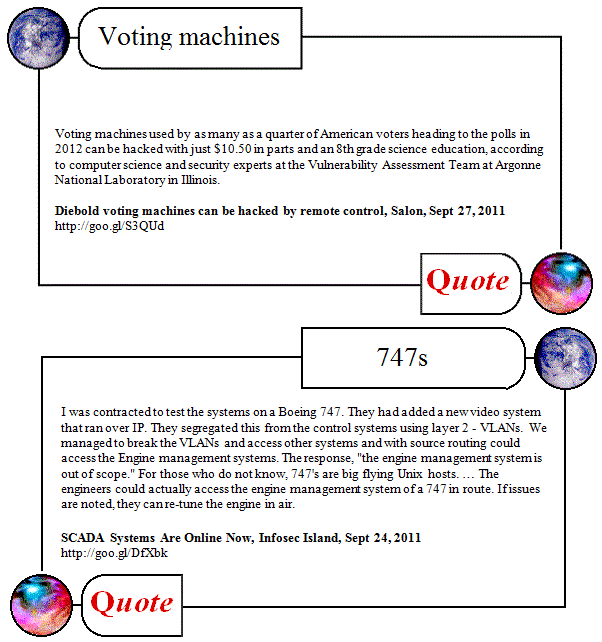
In the meantime, and working from open source materials, the only kind to which I have access – here are two data points we might have noted a litle earlier, if we had decent interdependency and vulnerability mapping:

quo-vulnerabilities.gif

Fear-mongering — or significant alerts?  I’m not tech savvy enough to know.

4.

Tom Barnett’s point about “the thinking we pursued as we tried to imagine – in advance – what a terrible shock to the system would do to the United States and the world in this day and age” still stands.

Y2K was what first alerted me to the significance of SCADAs.

Something very like what Y2K might have been seems to be unfolding — but slowly, slowly.

Are we thinking yet?

R2P is the New COIN: Slaughter on Authority and International Law

Monday, September 26th, 2011

Part II.

This is the second part of  a series analyzing Anne-Marie Slaughter’s ideas about “Responsibility to Protect” doctrine, based on her Stanford Journal of International Law article, “Sovereignty and Power in a Networked World Order“, to better understand and critique the assumptions on which R2P rests. The topic will be Dr. Slaughter’s uses and conceptualization of “Authority” as it relates to international law and state sovereignty.

Slaughter is particularly concerned with sovereignty and redefining it in international law so that national sovereignty is in harmony with R2P and other au courant academic concepts of “global governance” that are outside the scope of this post. While much of Slaughter’s paper relates to description of empirical trends in the behavior of regulatory bodies in transnational and IGO networks or works of theory, for R2P or “new sovereignty” to be meaningful, it has to be expressed as a legal argument. Furthermore, that legal argument for R2P/new sovereignty must gain acceptance by being expressed by source(s) or forms that a majority of the international community regards as authoritative and binding.

To the unininitiated, international law as a field is something of an intellectual wonderland that bears little resemblance to how positive law functions judicially inside of a sovereign state. First, there is no Hobbesian global leviathan that can enforce international law. The UN is not the “parliament of man” and neither the World Court nor the International Criminal Court can directly compel sovereign states to do anything, and sovereigns retain considerable discretion of interpreting for themselves what international law means and requires them to do or not do. International law theory therefore bears greater resemblance, at times, to mediating theological disputes than it does to the kind of law cases people ordinarily encounter.

International law is most accurately described as a body of competing centers of legal authority that possess varying degrees of legitimacy and that attract voluntary compliance ftom state actors, including: binding international covenants, customary international law, precedent, rulings from internationally sanctioned institutions like the UNSC, the World Court, the WTO or the Red Cross and the consensus of government officials and experts in in international law. These do not all have equal authority or legitimacy – a clause in the Geneva Convention, a UNSC resolution or a concept like “diplomatic immunity” carries more legal weight in international law than an informal but common diplomatic practice or the opinion of a faction of law professors. The ambiguity and heterogeneous nature of international law leaves a lot of room for scholarly debate, litigation, for officials to “shop for opinions” and for ambitious ideologues to push novel theories as allegedly natural extensions of existing jurisprudence.

Slaughter’s legal justification for R2P and redefined sovereignty are in section II. where she leans primarily upon the authority of the ICISS ( International Commission on Intervention and State Sovereignty). As I am examining the ICISS section, I will break up the quoted text with comments:

….On the humanitarian side, Kofi Anana issued a challenge to all UN members at the opening of the General Assembly to “reach consensus – not only on the principle that massive and systematic violations of human rights must be checked, wherever they take place, but also on the ways of deciding what action is necessary, and when, and by whom.” In response to this challenge, the Canadian government, together with a group of major foundations, established the International Commission on Intervention and State Sovereignty (ICISS), headed by former Australian Foreign Minister Gareth Evans and Special Adviser to the UN Secretary General Mohamed Sahoun, and composed of a distinguished group of global diplomats, politicians, scholars and nongovernmental activists….

The ICISS has genuine, but very trivial, legal stature, having been brought into being by a single (!) member state of the UN and some very powerful and wealthy left-liberal American philanthropic foundations including the  Carnegie Corporation of New York, the William and Flora Hewlett Foundation, the John D. and Catherine T. MacArthur Foundation, the Rockefeller Foundation, and the Simons Foundation. The governments of the UK and Switzerland also gave financial support to the ICISS.  Politically, while the commissioners were prominent center-left statesmen, the ICISS advisory board tilted further to the international Left and toward elite “neoliberal” politicians. The ICISS was approximately as politically and philosophically balanced as would be an international small arms control commission composed entirely of members of the NRA.

The ICISS by itself is thin gruel in terms of legal authority, but has just enough substance to be legitimately served up on the table.  Once the foot was in the door, advocates for R2P were, over time, able to get it into the 2005 World Summit Outcome Document (again, relatively minor in itself, but an additional precedent) and, more substantially, into UNSC Resolution 1674. Much like sediment, a new theoretical concept has to lay down legal particulates in order to become a durable and freely recognized part of international law by sovereigns. That kind of autonomous judgment by sovereigns is something R2P advocates would like to sharply curtail.

….In December 2001 the ICISS issued an important and influential report, “The Responsibility to Protect“, which essentially called for updating the UN Charter to incorporate a new understanding of sovereignty.

Dr. Slaughter has a gift for understatement. “Incorporating a new understanding of sovereignty” means irrevocably changing national sovereignty as the term has been traditionally defined and understood. This is not exactly a minor ambition in international relations, which is one reason why I tend to regard Anne-Marie Slaughter as a revolutionary or radical IR theorist and not as a “neoconservative”, as she is sometimes accused of being by left-wing ideologues. Slaughter expounds further:

….The ICISS seeks to change the core meaning of UN membership from “the final symbol of independent sivereign statehood and thus the seal of acceptance into the community of nations” to recognition of a state as a responsible member of the community of nations.” Nations are free to choose or not not to sign the Charter: if they do, however, they must accept “the responsibilities of membership” flowing from their signature. According to the ICISS, “There is no transfer or dilution of state sovereignty. But there is a re-characterization involved: from sovereignty as control to sovereignty as responsibility in both internal functions and external duties.

[emphasis in original] 

That’s the kind of “re-characterization” that George Orwell’s Winston Smith regularly undertook in his job at the Ministry of Truth. To where or to whom does the political locus of control then move? Cui bono?( Hint: read Slaughter’s fifth section).

“Sovereignty as responsibility” implies duties or obligations rather than decision making power and, indeed, earlier in section II, Slaughter uses the phrase “conditional social contract” in the introductory paragraph. Slaughter’s ICISS derived social contract however is not Lockean in nature, formed by and with the consent of the governed, but is instead drawn by the state from the collective authority of the community of nations and sovereignty is manifested to the degree with which the state is interactive and interdependent and has “the capacity to participate in international institutions of all types”. A community not just of nations, but one that is extended and buttressed by being interwoven by transnational, quasi-independent, “governmental networks” of former and current politicians and bureaucrats

If you are thinking that this formula shifts political authority and power away from a state and the popular sovereignty of it’s citizens and toward a vaguely defined, supranational community, you would be absolutely correct. Drawing on the theories of Abram and Antonia Chayes, Slaughter, argues that the connectivity and interaction of the modern international system is such that “sovereignty as autonomy makes no sense”.

Such a position requires a healthy contempt for the consent of the governed as well as a childlike faith in the wisdom, integrity and basic competence of a superempowered technocratic elite.

To continue:

….Internally, a government has the responsibility to respect the dignity and basic rights of it’s citizens; externally, it has a responsibility to respect the sovereignty of other states.

Further, the ICISS places the responsibility to protect on both the state and on the international community as a whole. The ICISS insists that an individual state has the primary responsibility to protect individuals within it. However, where the state fails in that responsibility, a secondary responsibility falls on the international community acting through the United Nations. Thus, where a population is suffering serious harm, as a result of internal war, insurgency, repression or state failure, and the state in question is unwilling or unable to halt or avert it, the principle of non-intervention yields to the international responsibility to protect.

As Slaughter is redefining sovereignty as the “new sovereignty” of interactive capacity championed by Chayes and Chayes, “respecting the sovereignty of other states” probably does not mean “non-interference in the internal affairs of other states”. Interference (albeit not necessarily military intervention) might be the natural default position from using the premise of “sovereignty as responsibility” or as a “capacity to participate”. Hey, we aren’t intefering in your elections, your economy or your social system – we’re just “harmonizing” (Slaughter’s term) your laws and regulations and increasing your capacity to participate!

One wonders what aspects of American life that R2P advocates see as being most in need of international harmonization?  That’s a subject we can take up in future posts, but in terms of military intervention and R2P, a few comments in regard to international law as well as “capacity to participate”:

First, under current international law, the legitimate pretexts for military intervention largely revolve around the right of self-defense or disturbance of international peace, as recognized by the UNSC.  While this is a fairly narrow set of pretexts, in practice they are sufficiently flexible to address most scenarios of violent conflict without also justifying military aggression bent on conquest. What was lacking in Rwanda and the Balkans during the 1990’s were not legal rationales for military intervention but political will among the great powers to do so.  I see little evidence that R2P would carry greater moral or legal weight with state decision makers to compel them to undertake major military interventions out of altruism than does the Genocide Convention (which unlike R2P, as an international covenant, is an inarguably solid part of international law). Or, for that matter, the emotional pull of horrifying media imagery of dying children.

Secondly, by greatly broadening the scenarios under which military intervention is allowed under international law, R2P incentivizes such conduct primarily where doing so is inexpensive and will further national interests rather than in the worst cases, like Rwanda, where they are expensive and risky while yielding no tangible benefits. The global military capacity to intervene is finite and instead of doing triage, statesmen will go for the low-hanging fruit in a now much larger set of cases for potential intervention. If R2P were taken seriously, North Korea, Burma, Congo, Somalia, Syria and perhaps Yemen would be ahead in line for intervention before Libya. 

Thirdly, in terms of “capacity to participate”, the net global capacity for military intervention is overwhelmingly American and the logistical ability to sustain a major military intervention for more than a few weeks is a complete American monopoly. On pragmatic grounds, R2P will never work orchestrated in so lopsided a fashion of “America and some of the West vs. the Rest”. Nor will not be politically tolerated by either the American public or most of the world’s population. Or by Beijing’s steely-eyed rulers, who would have to bankroll this catalogue of expeditions because America no longer can afford to do so. Perhaps we can put “R2P” on our tin cup and get a better interest rate.

Even acting as benignly-intended peacekeepers, the potential scale of R2P vastly exceeds our will, our wallet and our welcome.

The Black Banners of Blackwater

Wednesday, September 21st, 2011

[ by Charles Cameron — minor, curious post on apocalyptic, conspiracism, jihad, graphics ]

.

blackwater-black-banner.jpg

There’s a long, conspiracist post on the “wake up project” that (among other things) declares that President Ahmadinejad is the “flag bearer of Imam Madhi’s army, insha’allah” andquotes a hadith of Imam Ali (with present-day comment in parens):

He that meets with Al Hashimi (i.e Hasan Nasrullah of Hezbollah)
with the Black Banners at his front is Shuayb, the son of Salih
who will engage As-Sufyani at the Gate of Istakhr —

and with a footnote that declares, “President Ahmadinejad is also the Tamimi Youth, al Mansur and the disputed Abdullah of the hadiths.”

So there’s something of a Shi’a perspective here, no?

What caught my eye, however, focused as I am on this black banner business, is the distinction the writer makes between two sets of black banners, the first of which apparently feature Blackwater:

“Before your treasure, three will kill each other —
all of them are sons of a different caliph but none will be the recipient.
Then the Black Banners will appear from the East
and they will kill you in a way that has never before been done by a nation.”

IT IS THE FIRST SET OF BLACK BANNERS (I.E BLACKWATER/XE) WHO WILL COME OUT FROM AFGHANISTAN AND THE HADITH SAYS THEY WILL KILL YOU LIKE NO ONE ELSE HAVE KILLED YOU BEFORE.

And in case we’re in any doubt, there’s a helpful link to the Blackwater/Xe banner (see at top of this post).

Thus more or less confirming the link between the Dajjal / Antichrist and Blackwater / Xe made in the Urdu book, Dajjal ka Lashkar – Blackwater / The Army of Antichrist: Blackwater to which Ibn Siqilli pointed us in 2009:

blackwater-anti-christ-ibn-siqilli.JPG


Switch to our mobile site