zenpundit.com » analytic

Archive for the ‘analytic’ Category

“Trust, but verify” and Pakistan: I

Sunday, May 8th, 2011

[ by Charles Cameron ]
*
.

Ronald Reagan said “Trust, but verify.” Gorbachev said, “You repeat that at every meeting.” Reagan said, “I like it.”

*

Zen claimed a couple days ago that “Osama bin Laden was caught and killed in an ISI safe house in Abbottabad” — while over at ChicagoBoyz, Trent Telenko asserted:

We already knew Pakistan is what we feared a nuclear-armed Iran would be — a nuclear-armed, terrorist supporting, state. Just ask India about Mumbai and the Lashkar-e-Taiba. Now we know that Pakistan is attacking us too. Al Qaeda is the operational arm of Pakistani intelligence (ISI) attacking us just as Lashkar-e-Taiba is its operational arm attacking India.

Those are “strong” versions of claims that have been made in “weaker” forms for some time now.

*

Thus the NY Times refers to “the belief among administration officials that some elements of the ISI may have ties to Bin Laden and the Afghan Taliban” while according to the BBC, Adm. Mike Mullen recently claimed the ISI had a “long-standing relationship” with the Haqqani network. A Guardian report used the phrase “rogue elements” in discussing recently wikileaked documents from Guantanamo:

The documents show the varying interpretations by American officials of the apparent evidence of ISI involvement with insurgents in Afghanistan. There are repeated “analyst’s notes” in parentheses. Several in earlier documents stress that it is “rogue elements” of the ISI who actively support insurgents in Afghanistan.

So: is it “some elements of the ISI”—or “rogue elements of the ISI” — or simply “the ISI”?

*

The Pakistani Inter-Service Intelligence Directorate was included in the “list of terrorist and terrorist support entities identified as associate forces” in one of the leaked documents, the “JTF-GTMO Matrix of Threat Indicators for Enemy Combatants” with the notation:

This list is not all inclusive but provides the primary organizations encountered in the reporting from and about JTF-GTMO detainees. Through associations with these groups and organizations, a detainee may have provided support to al-Qaida or the Taliban, or engaged in hostilities against US or Coalition forces.

“Association with Pakistan ISID, especially in the late 1990s up to 2003” was listed in the same document as among the “the primary indicators for assessing a detainee’s membership or affiliation with the Taliban or ACM elements other than al-Qaida.”

BTW, what happened to the ISI in 2003?

*

And what of Pakistan itself? is it just the ISI that’s problematic, or the entire state of Pakistan? Time magazine reports:

CIA ruled out participating with its nominal South Asian ally early on because “it was decided that any effort to work with the Pakistanis could jeopardize the mission. They might alert the targets,” Panetta says.

Indeed, the problem may not be that there are rogue elements in ISI, nor that the ISI is a rogue element in Pakistan, but that Pakistan itself may be a rogue state, and a nuclear one at that.

How simple it is to write such a sentence – and how subtle the task of understanding – not leaping to conclusions but penetratingly understanding – just what the real situation is.

*

As Zen says in the same post:

It is long past time for a deep, strategic, rethink of what ends America wants to accomplish in Central Asia and some hardheaded realism about who our friends really are.

Intelligence needs to be intelligent, and to be seen to be intelligent.  Whether we trust or mistrust — we need to verify.

[ first of three, at least ]

The Abbottabad raid: tellings and retellings

Thursday, May 5th, 2011

[ by Charles Cameron ]
*

.
bryanalex.jpg

My friend Bryan Alexander‘s book, The New Digital Storytelling: Creating Narratives with New Media, hit the shelves a short while ago (recommended) — and this month Bryan is exploring the various forms of digital story-telling on his new digital storytelling blog.

I’m interested in narrative, too – even when it isn’t digital – because it’s the prime way in which we humans figure out what’s going on around us…

Here, then, are two “tellings and retellings” of the Abbottabad raid and the death of Osama bin Laden.

.
1. The fog of war

In his first briefing on bin Laden’s death from the White House, John Brennan, Assistant to the President for Homeland Security and Counter-Terrorism, dismissed bin Laden with the words, “I think it really just speaks to just how false his narrative has been over the years.”

Narrative is important, and the narrative John Brennan was proposing as a corrective to bin Laden’s version went as follows:

here is bin Laden, who has been calling for these attacks, living in this million dollar-plus compound, living in an area that is far removed from the front, hiding behind women who were put in front of him as a shield. I think it really just speaks to just how false his narrative has been over the years. And so, again, looking at what bin Laden was doing hiding there while he’s putting other people out there to carry out attacks again just speaks to I think the nature of the individual he was.

A writer in the Atlantic commented today:

And that’s the message our counterterrorism officials would, I expect, like the world — and especially any potential followers of al-Qaeda’s anti-American ideology — to get about our newly vanquished enemy, responsible to the single deadliest attack on American soil. The leader of the terrorist group was soft, a coward in the end who hid behind a woman’s skirts like a little girl, having grown accustomed to living in luxury in a mansion. Almost everything about this narrative seemed calculated to diminish any possible perception of strength or masculinity in bin Laden’s reaction to the raid by an elite team of U.S. Navy Seals — men who are in contrast among the most mythic and valorized in our armed forces, known for slogans like “pain is just weakness leaving the body.”

But just a day after Brennan’s briefing, the President’s Press Secretary, Jay Carney, gave a second briefing, in which he revised the official narrative, saying:

Well, what is true is that we provided a great deal of information with great haste in order to inform you and, through you, the American public about the operation and how it transpired and the events that took place there in Pakistan. And obviously some of the information was — came in piece by piece and is being reviewed and updated and elaborated on.
.
So what I can tell you, I have a narrative that I can provide to you on the raid itself, on the bin Laden compound in Pakistan.

I have a narrative…

The revised narrative featured an unarmed bin Laden in a far from palatial house with no visible air-conditioning, who didn’t in fact use a woman as a human shield… all of which “really just speaks to just how false” Brennan’s own original narrative was.

But then – you don’t believe everything you read in the press, do you? And besides, the first news reports of almost any big story are almost invariably inaccurate, it takes time for clarity to emerge… which adds up to the idea that it’s not so easy to distinguish between how the world actually spins — and how the world is spun.

So that’s a telling and retelling of the Abbottabad raid in “real life” as transmitted to us by various media and recorded on the web…
.

2: The twitter-stream and the analyst

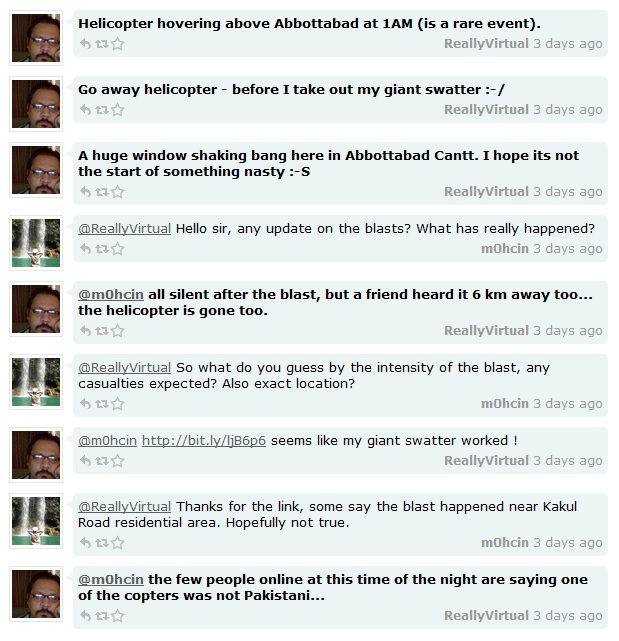
A little earlier a more “purely” digital version of the story – no less confused by the “fog” that inevitably surrounds the reporting of highly volatile situations – had emerged quite spontaneously via Twitter, when the delightfully-named ReallyVirtual (an IT specialist who had moved to Abbottabad for some peace and quiet) was kept awake by the noise of helicopters overhead and sounds of explosions, and tweeted a couple of late-night friends… and a stream of tweets began which quickly led to an almost thousandfold spike in Yahoo searches on bin Laden, and bin Laden related searches occupying all top twenty spots on Google trends

You might call that spontaneous, distributed story-telling – but it’s also the raw material for a collated and curated twitter narrative, using Chirpstory, a tool for curating and presenting stories from the twitter-stream:

chirpstory.jpg

We’re not done yet…

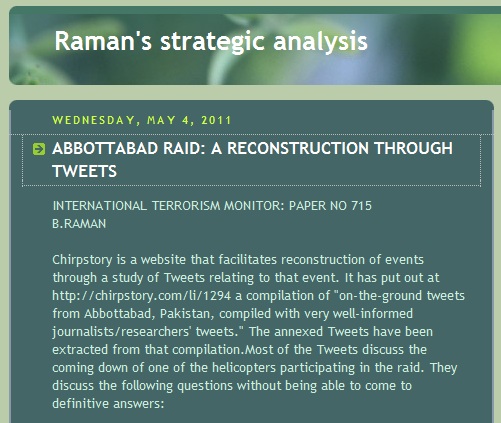
That in turn provides grist for the analytic mill of B Raman, a highly-regarded Indian analyst, blogger, and former chief of counter-terrorism with India’s R&AW intelligence agency – who winnowed out the chaff and added in his own commentary to create a denser, tighter analytic narrative of his own:

raman.jpg

To my way of thinking, the spontaneous twitter-stream version, the Chirpstory adaptation and B. Raman’s midrash on it are at least as interesting as the successive White House narratives…

.

3. Further reading:

Also relevant to our narrative here, and your own readings on the topic of our tale:

How the Bin Laden Announcement Leaked Out
Bin Laden Reading Guide: How to Cut Through the Coverage

Answering Ronfeldt’s Question About the Nature of Strategy

Wednesday, May 4th, 2011

RAND emeritus scholar and co-author of the classic Netwars and Networks, David Ronfeldt asked an astute question in reaction to my post proposing a grand strategy board:

I almost always see strategy defined as the art of relating ends and means.  It’s defined that way time after time, often but not always with a few extra criteria added here and there.  Usually something about plans or resources.  But I’ve long felt that I’d prefer to define strategy as the art of positioning.  That presumes a consideration of ends and means, but in my view, it’s not as abstract a definition, and gets to the core concern right away.  In looking around for who else may favor such a definition, the best and almost only leader I find is Michael Porter and his writings about corporate strategy.  He’s says explicitly that strategy is the art of positioning – apropos market positioning in particular.  maybe in some long-forgotten moment, that’s where I got the notion in the first place.  Meanwhile, i’ve been told that, of military strategists, Jomini emphasizes positioning the most.  This is not my area of expertise.  I’d like to know more:  is the “ends and means” view so accepted, so basic, so adaptable, that it’s not worth questioning?  What’s to be gained, and/or lost, by the “positioning” view?  Is there any strategy that isn’t about positioning? 

This is a great question, because it is a clarifying question about fundamentals.

I am not familiar with Micheal Porter’s work, but Chet Richards pointed out in his excellent Certain to Win that there are some significant differences in applying strategic thinking to business compared to using strategy in war. While war and the market both represent dynamic, competitive environments which require actors to adapt to survive, war is a destructive enterprise while business is ultimately transactional, cooperative and constructive, though you may have to overcome competition and conflict first. Conflict and competition on which the state and society place tight legal constraints to which buyers and sellers must conform.  Arguably, this explains the drift toward oligopolistic competition in regulated capiltalist economies: the constraints of rule of law which govern market actors would tend to give an even greater emphasis to “positioning” in peaceful economic competition than in warfare.

What about “positioning” and strategy generally?

Strategy is indeed defined by most experts as the alignment of Ends -Ways -Means. In my opinion, it is the most practical starting point for people of any level of strategic skill to consider what is to be done in the short or medium term within a known framework ( a theater, region, an alliance system, nation-state etc.). “Positioning” falls within this trinity under “ways” – for example, something as simple as seizing the high ground or as complicated as maneuver warfare theory is, in essence, an effort to acquire a comparative advantage over your opponent. Having comparative advantages are always good but they are usually transitory rather than being something that can be “locked in” permanently ( though man has tried – ex. the Great Wall of China, Constantinople on the Dardanelles, the age of fortresses in 16th-17th C. Europe, Mercantilist Policy, Massive Retaliation etc.). Normally, you have to keep moving, tactically adjusting your position in response to your opponent’s efforts to re-balance.

Positioning also exists outside the trinity of Ends-Ways-Means as the initial starting conditions that shape subsequent strategy. The phrase “Where you stand depends on where you sit” conveys the lesson that our perspectives, our premises, are deeply affected from where we begin. Geopolitical theory is rooted in this idea but positioning can be something other than physical location – politics and culture are positional because they are embeded with values and what we value to some extent determines what our Ends are going to be and how we perceive and define the problem for which we will employ a strategy to overcome.

The latter kind of positioning can be *very* problematic because ideological concerns inflame passions, distort our rational calculus of matching means to ends and generally introduce ever larger amounts of irrationality into strategic decision making at the expense of empirical observation. Boyd would call this a “mismatch” with reality from a corrupted OODA Loop and a textbook example would be the behavior of Imperial Japanese leaders in WWII. Launching an unwinnable war with the United States and prosecuting it almost to national annihilation was driven to a demonstrable extent by Japanese cultural norms related to honor, debt (on-giri), the “Imperial Will” and dysfunctional constitutional arrangements that made extricating Japan from a strategic cul-de-sac politically impossible. To a lesser extent, American prosecution of the war in Vietnam and the occupation of Iraq share similar irrationality derived from a priori ideological positioning.

A final observation:

When time horizons are very long and/or the problem is ill-defined and the framework boundaries vague or unknown or uncertainty high, the cognitive requirements for strategic thinking shift and it may not be possible to move beyond speculating as to Ends to the point where action should or even can be taken effectively. More information may be required. 0r greater means than exist. The problem may only be a hypothetical potentiality, rather than an actual problem. This point is one that is likely to be disputed as even being in the realm of strategy and could belong in that of theory or politics, depending on your perspective.

Many readers here are students of strategy or even professional strategists. In the interest of brevity, I’ve avoided getting into the specifics of schools of strategic thought or Clausewitz vs. Sun Tzu or Jomini, but I’d like to invite readers to weigh in on Dr. Ronfeldt’s question or my response as they wish.

The tightly woven web of Jarret Brachman

Wednesday, May 4th, 2011

[ by Charles Cameron — cross-posted with minor alteration from SmartMobs ]
*

Jarret Brachman is one of our brightest analysts of jihadist behavior on the internet. He was the first Director of Research with the Combating Terrorism Center at West Point, and is the author of Global Jihadism: Theory and Practice.

His blog today featured an extraordinary post titled My One Fan in Abottabad.

First he writes:

Out of sheer curiosity, I ran a google analytics search to see if I’ve ever had any hits from Abbottabad, Pakistan to the blog.

Then he shows us the map his research produced :

abbot

and then he comments:

Sure enough, I’ve got one fan there who has been checking the blog randomly over the past couple years.

*

As my Watchmen-hip son might say, … Quis custodiet ipsos custodes?

Towards a Pattern Language for CT?

Tuesday, May 3rd, 2011

[ by Charles Cameron ]

.

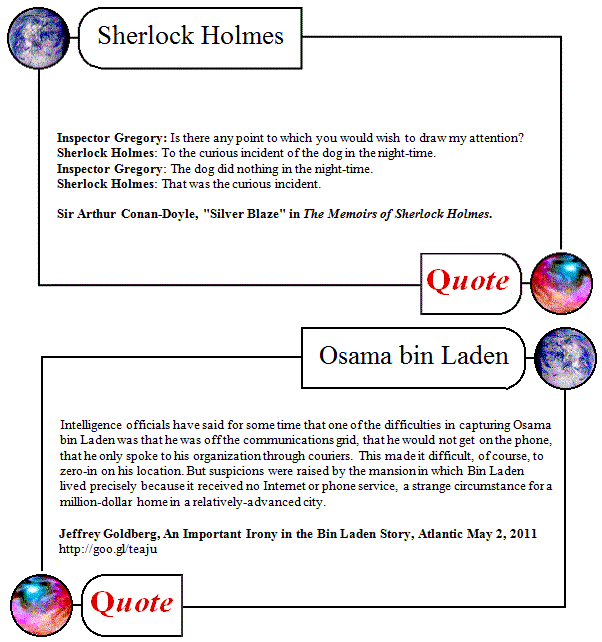
Okay, someone wasn’t reading his Sherlock Holmes

quo-obl-and-holmes.gif

Consider this a very minor contribution to the ongoing discussion of the benefits of a liberal arts education in connecting analytic dots (or avoiding those who connect them).

*

Refs:

Wikipedia, Pattern Language (background), and Christopher Alexander, A Pattern Language (one of the very great books).


Switch to our mobile site