zenpundit.com » metacognition

Archive for the ‘metacognition’ Category

Tree series, I: This is how nature thinks

Saturday, June 23rd, 2012

[ by Charles Cameron — this one’s a companion piece for One bead for a rosary and the first of three more or less contemplative / creative posts on trees. ]

.


.

This is how nature thinks: this is one of nature’s thoughts, and it’s the kind of thought that comes late, after much else has been worn away and only essence remains, the kind we find in our elders and call by the name wisdom.

We don’t think of trees as thoughts, but perhaps we should: our idea of mind might broaden.

*

And rivers.

We spend a great deal of our time thinking and speaking in straight lines. One of the straight lines I tent to think along and speak about is the idea that we might want to think differently, to braid our linear ideas perhaps, to listen to the voices of others and join ours to theirs, making somehow a thought that is many-voiced, a thought stream that reflects on itself, echoes itself, has eddies of questioning, rapids, calm stretches, still ponds… “pondering”, my friend Derek suggests.

There are certain people who, I trust you’ll agree, are deliciously frank and frankly strange: we call them by affectionate negative names – he or she’s “an ornery old cuss” we say, perhaps – I suppose I may be one myself, and my language old-fangled, but I trust again that you get my drift.

Gnarly.

Now there’s another word for them. It comes from the gnarls in wood, and the poet Hopkins applies it to the nails that tear the hands of Christ: With the gnarl of the nails in thee, niche of the lance…

A gnarly character has come to conclusions you probably don’t share, but you feel a grudging admiration for the forthrightness with which this character has pursued some intricate and personal logic to its unordinary conclusion.

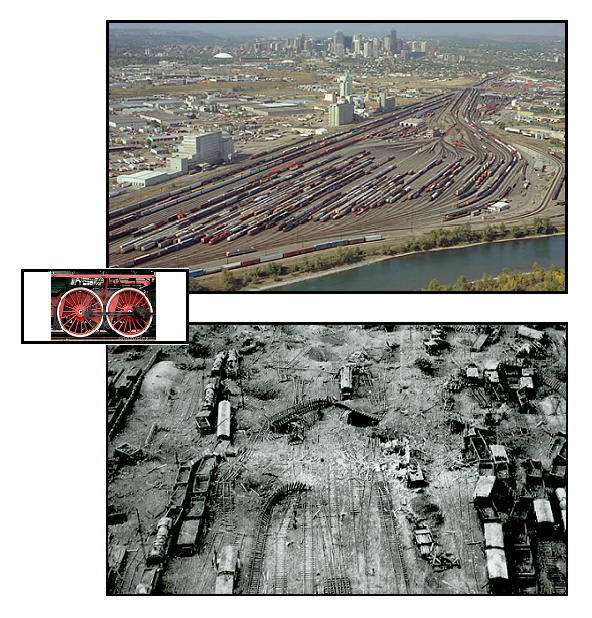
I have presented various images for a kind of thinking that is many-braided, communal yet irrepressibly individualistic, including a railway marshaling yards after a bombing raid and the multiple complex paths of the Mississippi.

*

Please consider the tree above – seen in a photo by Rick Goldwasser of a Bristlecone Pine from the White Mountains in California – as exemplifying the gnarly, intensely personal, complexly braided thought of a Beethoven in the late quartets and sonatas, the Hammerklavier and Grosse Fuge – or the unfinished late masterworks of a Michelangelo.

A tree, a way of thinking – and appreciation for that which is bone-weary yet resolute, difficult yet rewarding, which swirls like water yet is almost as still as stone.

* * *

The Grosse Fuge, performed by the Takács Quartet:

The Hammerklavier, performed by Mitsuko Uchida:

These, also, are among nature’s thoughts.

Another magnificent example of which is GM Hopkins’ poem, The Wreck of the Deutschland, from which that line about “the gnarl of the nails in thee” is drawn…

A footnote to a benchmark in boundless cyberspace

Saturday, June 23rd, 2012

[ by Charles Cameron — Taliban use of social media with side ramble on the cognition of similars, parallels and opposites ]
.


.

It’s not like it’s a big deal or anything, it’s just a footnote, a detail — but God is in the details, the devil is in the details. And it looks as though a certain Twitter account does belong to the Taliban after all.

Some back-story:

A while back, on my way to make other points, I posted this:

I wasn’t the first or last to make the connection between A Balkhi and the Taliban, nor to note the Twitter-exchanges between Balkhi and the ISAF press office — but I happened to have this habit of juxtaposing similars and opposites, and had developed the “Specs” format used here, with the little binoculars inset, to suggest the idea of seeing parallel or opposite things in parallel or opposition — a sort of mental equivalent of stereoscopic vision or stereophonic sound — in the hope that something about the comparison and contrast would add a depth dimension to understanding.

As a footnote to a footnote to a footnote, I think the Necker Cube can add an interesting aspect to this business of stereoscopic thinking:

When two things are so much the same and so utterly different that, as with a Necker Cube (or the positive and negative of a photo rapidly alternating) the mind flashes rapidly from one view to its exact and opposite other, a metacognitive insight arises about what I can only term the two in one in twoness experienced.

File that under number theory, koans.

But that’s about metacognition, let’s get back to the Taliban on Twitter.

Towards the end of last year, Alex Strick van Linschoten posted his doubts about A Balkhi:

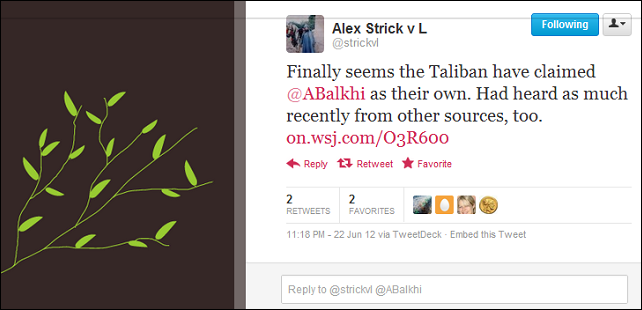
No. Just no. The account @abalkhi appears to have nothing to do with the Taliban (see below). I’d also be interested to see the evidence for the statement that ‘Taliban spokesmen also frequently spar with Nato press officers’. I have not seen a single instance of this. Every other story on these accounts repeats this claim. And it’s presumably quite an important distinction: an official spokesman (we might assume it is a man) engaged in verbal attacks on the official ISAF account is a different thing from some fanboy in his bedroom doing the same thing.

Today, Alex (I hope that’s the appropriate way to name him) reversed himself with the tweet featured at the top of this post.

The pool of people to whom it matters whether A Balkhi is an official Talibvan site or a fan site is probably quite small, and by now they will all surely have either read the Wall Street Journal, seen Alex’s tweet, or arrived at whatever conclusion in the matter their own intelligence sources have suggested to them.

In the enormity of cyberspace, then, this whole post of mine is just a footnote to a footnote.

Alex’s piece from which I quoted above, on the other hand, is a true footnote: it provides us with a decent summary of Twitter-feeds associated with the Taliban, helpfully annotated.

Let’s call it a benchmark — and while this business about A Balkhi may be just a detail, benchmarks are go-tos, and I hope Alex will update his.

One bead for a rosary

Friday, June 22nd, 2012

[ by Charles Cameron — one bead from NASA for the glass bead game as rosary ]
.


photo credit: Norman Kuring, NASA’s Goddard Space Flight Center
.

Consider her sacred, treat her with care.

Myst-like Universities, Oxford-like Games?

Saturday, June 16th, 2012

[ by Charles Cameron — games in education — written in 1996 for friends on the Magister-L mailing list — for background, see In response to Lewis Shepherd ]
.

I’ve been thinking about education, “edutainment” and games, with special reference to Myst-type games, Glass Bead Games and Universities not unlike my own alma mater, Oxford…

Here are some preliminary ideas…

I: Proposal

There is no reason why the books in a MYST-like game shouldn’t be real books.

Yeah? So?

There is no reason why studying the books in a MYST-like game to gain access to the information needed to “solve puzzles” within the game structure and gain access to more advanced levels of the game should be any different from studying the same books in an OXFORD-like university to gain access to the information needed to “pass exams” within the academic structure and gain access to more advanced levels of knowledge…

There is no reason why education and game should not merge. OXFORD is a walk-thru MYST, and the puzzles are exams. Education is Game, the supreme Game of life itself.

The only thing needed to make the future of computer game playing and the future of computer education one thing is a concept of gaming which extends as far as the concept of education — and Hermann Hesse’s Glass Bead Game does this.

A future Glass Bead Game with Myst-like properties could encompass the entirety of education, because (a) unlike chess it deals in the sum of human culture and knowledge while (b) its own skills involve a chess-like mastery: its game aspect stretches as high as its knowledge base.

We already know from such things as Sesame Street that learning about “fiveness” can take place at the intersection of education and entertainment, with a kangaroo bouncing five oranges on a trampoline and gleefully calling out “five, five”. We suspect that at this level, the entertainment element adds to the student’s interest in learning.

We also suspect that at higher levels of learning, entertainment quite naturally gives way to the “more important” educational element. No need to entertain, the subject itself fascinates…

But Feynmann — the Nobel Prize man, the drummer, the CalTech fellow — entertains while he educates, educates while he entertains: it’s an aspect of the nature of his genius…

The future of education lies in a Game involving mastery in the acquiring and manipulating of knowledges, both in depth within individual disciplines, and in breadth across them. This is the future of the Glass Bead Game…

It is stored on megacomputers. It is accessible through cable lines coming into your home. It is displayed on your new hi-res TV screen. Think of a terabyte holographic storage device which could transfer info in or out a gigabyte per second… Its architecture contains “rooms” at all levels of learning from K through post doctoral, in all subject areas. Any student of whatever age can access any “room” to which he has solved the “prerequisite” puzzles. The “rooms” contain a massive library of “books” and an equally impressive video library…

Imagine a world in which the very best classes taught at Harvard, Yale, MIT, CalTech, Stanford, Oxford, Cambridge, Heidelberg, the Sorbonne are accessible on the web in video form…

Imagine a world in which students can supplement their “live” classes with access to a virtual environment of this sort…

The arts — at the level of a Mozart, a Bach, a Yeats, a Shakespeare, a Leonardo, a Michelangelo — are games. Creative play with a very high order of skill…

Imagine the Great Game…

II: Background

That’s the main thrust of where I’m going, but it may help if I add in some background, in the form of the following notes:

I am wondering about a number of “threads” that seem to come together somewhere hereabouts:

(i) a recent effort in California to put together all the information in a “geography” curriculum from kindergarten through — I think — the second year of college on videodisks, in such a way that a student of any age could move as far and as fast through it as his/her ability to give “correct” answers to the quizzes along the way permitted…

(ii) the notion that large film archives such as those maintained by the studios may in the not too distant future be accessible on-line, with real time delivery along fiber optic “phone” cable for display on the “tv” screen…

(iii) the notion that all the classes in, say, Harvard, Yale, Stanford, MIT, CalTech, Oxford, Cambridge, Heidelberg… could be videotaped, also in the not too distant future, and be made available in a similar fashion…

(iv) efforts to put large libraries online in toto: I gather from an IBM commercial (!), for instance, that the Indiana musicological library is now available to the daughters of Italian vineyard owners over the net…

Putting these all together, I see the possibility of computers storing and delivering enough in the way of first class lectures and libraries to allow students of whatever age to move as far and as fast through self-education as their interest and capacity to pass quizzes permits…

III: Invitation

The “proposal” and “background” above, taken together, represent the thinking I’ve done so far, and the direction I hope to take — they’re my personal “state of the art” on all this. I suspect there are people already working on many of the ideas that go into this mix — but that the overall vision here is a “gourmet” version, and that we’ll get pretty thin soup if we leave it to people outside the GBG environment to do all the cooking.

There’s further background on the origins of Myst-like games in the classical Art of Memory in my piece The Mysts of Antiquity.

Please feel free to contact me if you are interested in discussing these ideas in more detail.

The crackling energy of a Sembl move

Sunday, June 10th, 2012

[ by Charles Cameron — cross-posted from Sembl ]
.

image credit The Movie Poster Art Gallery / http://www.rock-explosion.com/catpage2.html


.

1.

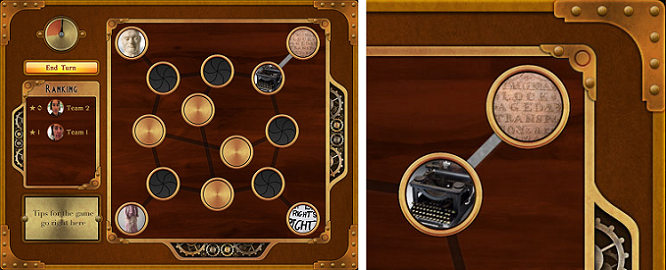
I’m always looking around for ways to describe the leap between two ideas (concepts, people, events, things) that occurs when you make a move in a Sembl game. On the game board, the ideas are shown as circles and the links as lines between them.

In the case of the museum version, the “ideas” are objects in the Museum’s collection – but the same principle applies whether we’re talking objects, concepts, events or people: entities of whatever type go in the circles, the lines between them signify the exploration of their resemblances and differences.
.

2.

Okay.

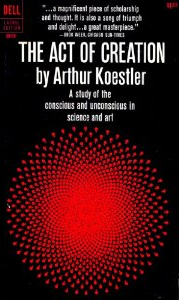
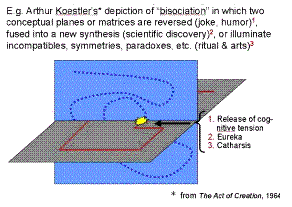
In more technical terms, Arthur Koestler in his classic book about the conceptual structure of creativity, The Act of Creation, diagrammed the intersection of two conceptual frames as representing the place where the joyous aha! of discovery, the gasped ah! of tragedy or the delightful ha! of laughter is generated, and this more recent version of his diagram gets the essence:


.

3.

But wait!

There’s a lot going on here, there’s a distinct leap – think: creative leap, even perhaps leap of faith.

It was the leap between two ideas – electricity and magnetism – that gave Faraday his dynamo, Maxwell his equations, and the modern world almost its whole existence. It was the leap between two ideas – modular forms and elliptic equations – that gave Taniyama his conjecture and Wiles his proof of Fermat‘s Last Theorem.

The leap that intuits similarities, particularly rich similarities between rich concepts in widely separated fields, is the most powerful tool of the thinking mind – and playing Sembl amounts to nothing more or less than a repeated, playful, delightful invitation to make leaps of exactly that kind.

So a Sembl leap of resemblance can be anything from training wheels for creativity to a prize-winning long-jump at the conceptual Olympics.
.

4.

Maria Popova at Brainpickings quotes Steve Jobs:

Creativity is just connecting things.

And she quotes James Webb Young, back in 1939:

Consequently the habit of mind which leads to a search for relationships between facts becomes of the highest importance in the production of ideas.

This isn’t some hidden secret, but it’s not exactly common knowledge either, it’s not something many schools teach — which is why the great anthropologist Gregory Bateson famously told his fellow Regents at the University of California:

Break the pattern which connects the items of learning and you necessarily destroy all quality.

Which is also why Eliot Eisner, Stanford professor and former President of the American Educational Research Association, said of Sembl’s precursor HipBone Games, “the cognitive processes you are interested in developing are critical to a decent education”.
.

5.

And just what does this have to do with Van der Graaf Generators, you might wonder?

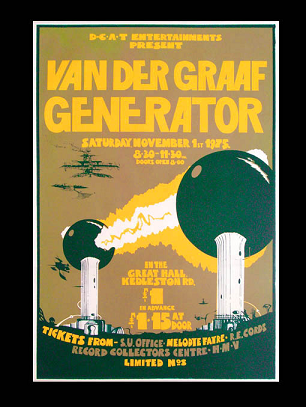
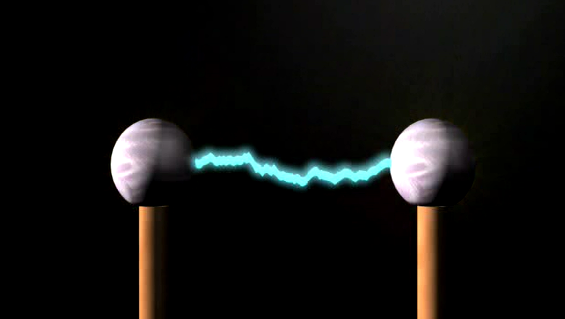
There’s a cracking sense of energy discharged when you connect two ideas in a Sembl game move – not unlike the discharge of energy between the spheres of two Van der Graaf Generators picture here:

Imagine the spheres as two ideas in place on a Sembl game board, and the electrical discharge as the excitement of seeing how they mesh together to create that ah!, aha! or ha!

Or watch the whole, ultra-short video from which that image was taken, courtesy of the folks at MIT:


Switch to our mobile site