zenpundit.com » metacognition

Archive for the ‘metacognition’ Category

Klimt under the microscope, then on to bigger things

Saturday, March 17th, 2012

[ by Charles Cameron – the “internal” complexity from which we relate to both the simplest and most complex issues and problems in the “external” world ]
.

The painting is by Gustav Klimt: your eye sees it, you know it’s a painting, reproduced here in pixels, you can read the text that accompanies it — a Nobel laureate wrote it — which describes just one chemical level of the complexity in you that responds to the painting, reproduction, pixels, blog post..

Viewing the painting, reading the accompanying text — they’re complex activities. You notice the woman’s head, “detached” for her body by that golden necklace, might see the beheaded head she’s holding almost out of the picture frame, lower right — might or might not know the story of Judith and Holofernes, which gives the painting a cultural intensity of particular interest to Israel under threat — Alexander Kafka sketched the background thus in the Chronicle article that brought all this to my attention today:

In 590 BC, to protect her besieged city of Bethulia, the alluring Jewish widow Judith drank with and seduced the attacking Assyrian general Holofernes. When he fell into a drunken, sated heap, she decapitated him with his own sword and displayed his head as trophy, rallying her fellow citizens to rout the Babylonians.

And if the writer hadn’t forewarned you, you might well have missed that echo effect of the beheaded Holophernes and the necklaced head of his beheader.

All of which touches on meaning, while Nobel laureate (and long-time Klimt collector) Eric Kandel‘s commentary deals in neurotransmitters: dopamine, oxytocin, vasopressin, norepinephrine, serotonin, acetylcholine

*

Gilles Fauconnier and Mark Turner have a fine book out called The Way We Think: Comceptual Blending and the Mind’s Hidden Complexities in which they lay out some fascinating aspects of how the brain builds for us the “blend” of different impulses, correspondences and perceptions that we consider to be “the world we live in”…

They quote Sir Charles Sherrington‘s celebrated description of the mind waking from sleep as an enchanted loom in his Man on his Nature:

The brain is waking and with it the mind is returning. It is as if the Milky Way entered upon some cosmic dance. Swiftly the head mass becomes an enchanted loom where millions of flashing shuttles weave a dissolving pattern, always a meaningful pattern though never an abiding one; a shifting harmony of subpatterns.

And it’s with that “shifting harmony of subpatterns” within us that we meet and attend to the shifting patterns of the world around us — a world that features its own “complex, n-dimensional and constantly shifting” problems, which we seek to understand and resolve via insights and solutions %i(that would also make good tight soundbites) for the TV.

*

Indeed — are those two weaves of complex shifting patterns, within us and around us, distinct — or one and the same?

Eh?

The speeds of thought, complexities of problems

Wednesday, February 1st, 2012

[ by Charles Cameron — instinct, rationality, creativity, complexity and intelligence ]
.

Guy Claxton, Hare Brain, Tortoise Mind
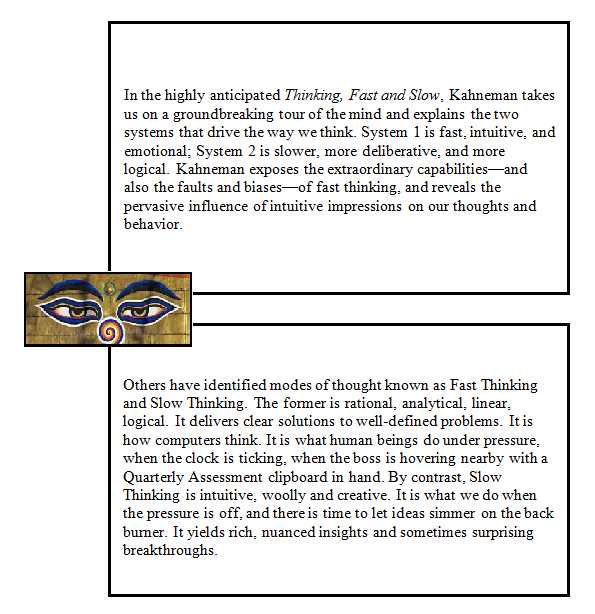
Daniel Kahneman, Thinking, Fast and Slow

You might think, taking a quick glance at their titles, that these two books would be in substantial agreement with one another about the speeds of thought. But consider these two comments, in one of which the deliberative, logical mind is “slower” than the intuitive and emotional — while in the other, it is the rational mind that is “faster” and the intuitive mind which is “slower”. Brought together, the two quotes are amazing — it would seem that either one or the other must be wrong:

\

Happily, I don’t believe either one is wrong — I think it’s more a matter of there being three speeds of thought, and the two books in question using different terminologies to emphasize different distinctions between them.

Here’s a more extended version of Guy Claxton’s position:

Roughly speaking, the mind possesses three different processing speeds. The first is faster than thought. Some situations demand an unselfconscious, instantaneous reaction. … Neither a concert pianist nor an Olympic fencer has time to figure out what to do next. There is a kind of ‘intelligence’ that works more rapidly than thinking. This mode of fast, physical intelligence could be called our ‘wits’. (The five senses were originally known as ‘the five wits’.)

Then there is thought itself — the sort of intelligence which does involve figuring matters out, weighing up the pros and cons, constructing arguments and solving problems. A mechanic working out why an engine will not fire, a family arguing over the brochures about where to go for next summer’s holiday, a scientist trying to interpret an intriguing experimental result, a student wrestling with an examination question: all are employing a way of knowing that relies on reason and logic, on deliberate conscious thinking. … Someone who is good at solving these sorts of problems we call ‘bright’ or ‘clever’.

But below this, there is another mental register that proceeds more slowly still. It is often less purposeful and clear-cut, more playful, leisurely or dreamy. In this mode we are ruminating or mulling things over, being contemplative or meditative. We may be pondering a problem, rather than earnestly trying to solve it, or just idly watching the world go by. What is going on in the mind may be quite fragmentary. What we are dunking may not make sense. We may even not be aware of much at all. As the English yokel is reported to have said: ‘sometimes I sits and thinks, but mostly I just sits’. […]

That third mode of thinking is the one Claxton identifies with “wisdom” — which is interesting enough. Just as interesting, though, is his identification of this slowest mode of thought with “wicked problems”:

Recent scientific evidence shows convincingly that the more patient, less deliberate modes of mind are particularly suited to making sense of situations that are intricate, shadowy or ill defined. Deliberate thinking, d-mode, works well when the problem it is facing is easily conceptualised. When we are trying to decide where to spend our holidays, it may well be perfectly obvious what the parameters are: how much we can afford, when we can get away, what kinds of things we enjoy doing, and so on. But when we are not sure what needs to be taken into account, or even which questions to pose — or when the issue is too subtle to be captured by the familiar categories of conscious thought — we need recourse to the tortoise mind.

I haven’t read either book, and I’d hope that Kahneman as well as Claxton actually addresses all three speeds of thought. But my immediate point is that the slowest of the three forms of thought is the one that’s best suited to understanding complex, wicked and emergent problems.

And that’s the one that can’t be hurried — the one where the Medici Effect takes effect — and the one which provides Claxton with one of his finest lines, with which he opens his book, a western koan if ever I saw one:

There is an old Polish saying, ‘Sleep faster; we need the pillows’, which reminds us that there are some activities which just will not be rushed. They take the time that they take.

More on that front shortly, insha’Allah and the creek don’t rise.

In Defense of Grand Strategy

Tuesday, January 31st, 2012

I have been involved, on and off, with another grand strategy discussion. Several discussions to be exact, one of which was prompted by Adam Elkus’s well-constructed volte-face on the concept of grand strategy. While I can find merit in many of Adam’s points regarding our dysfunctional policy-strategy process, the need to make definitive choices in order to have sound policy and our partisan epistemological crisis, I part company with him on his core argument:

America Needs Sound Policy, Not Grand Strategy

….The idea of grand strategy as both policy and strategy is by definition unachievable, and the source of much confusion.  By infusing normative policy elements into strategy, this fusion turns strategy into a manifestation of ideology rather than a technical device for getting things done.  Think, for example, of how debates about regional strategy and even the tactics and operations of COIN, drones, and counterterrorism have become proxies for domestic ideological political battles. This happens, in larger part, because the policy-strategy distinction in American national security circles is extremely weak, as strategy is taken to be politics and politics becomes strategy.

Adam has further endorsed a more emphatic follow-up post by our mutual blogfriend Joseph Fouche, where, much like his fictional countryman,  Captain Renault, JF in his forcefully argued post is shocked to discover that gambling is going on in here:

Terminology Proliferation is the Escape Hatch of Politics 

….One sure way to detect politics is signs of desperate efforts to call politics something other politics. Though politics is the most elemental of human endeavors, disgust with overt political machinations is one of the most elemental of human emotions:

Who likes a brown noser?

Who likes a squealer?

Who likes the kid who gathers up his toys and goes home when he doesn’t get his way?

Who likes the guy who obviously looks out for number one?

….Policy is portrayed as the objective, virtuous, and expert pursuit of ponies for everyone. Framed this way, policy is politics without the division of power. But politics without the division of power is impossible. “Policy” is a mythical beast. ”Policy making” is mere politicking, trading one favor for another to offset one interest with another, persuading through influence when possible and enforcing compliance with violence when impossible. But this reality reeks of knavery so it must be wrapped in the most virtuous lies imaginable. Hence we see a dramatic proliferation of “policy makers” and “making policy” where we’d normally expect to see politicians and politics. WIth so many policy makers making so much policy, you’d think the good and true would be breaking out all over. But, looking around, we see nobody down here but us dumb humans, horse trading with each other to get incrementally ahead.

“Grand strategy” and “operational art” represent further efforts to divorce politics from politics through politics, leaving behind a vacuum inhabited only by virtuous technocrats. In reality, they’re both attempts by one political group to escape the power of another political group, hopefully gaining more power for themselves in the process. The formulator of “grand strategy” is often an aspiring political actor who lacks the gifts necessary for political success. So they whine from the sidelines, falling back on a passive-aggressive strategy of victimhood where they denounce expertise in politics as squalid while advocating its replacement with their own (implicitly) more virtuous expertise. They attempt to reframe political questions as technical questions best handled by professional specialists. If a political question can be reframed as a technical question, resolving it is a merely an implementation detail. Such technical minutia should be beneath most politicians. Their attention should be devoted to truly important questions, leaving details to the poor peons.

….Policy, grand strategy, and operational art are merely the continuation of politics with the addition of other layers of obscurity.

Now, the insightful Mr. Fouche is not wrong in detecting politics in strategic clothing. In my judgement, he’s very much correct.  His objection, as I infer it, to grubby political decisions within a state being regularly deferred “downward” to be made in the guise of nominally apolitical (in American tradition) operational planning, or “upward” to be masked as “technocratic” grand strategy is reasonable because it is a sign of dysfunction in our political community. He’s right – America has a systemic problem in being unable to overtly make any hard political choices through it’s formal political process.

However, being politically dysfunctional doesn’t mean that grand strategy (or policy, or operational art or whatever) in general is purely fictive or that it is always simply a deceptive substitute for an honest political process. Or that raw politics can replace all these conceptual tools equally well or better. These conceptual tools were developed as a form of intellectual specialization because politics as a general and broad societal activity too often failed to meet the challenges of diplomacy and war. Or worse, politics worked irrationally against the survival of the political community in wartime while to the benefit of a faction within it.

Grand strategy, policy, strategy and even operational art are imbued with a political character, but one that is a step or several more removed from the general politics – the art of strategy is, after all, intended to serve a political community and “Ends” of “Ends-Ways-Means”  is always infused with value-laden assessments of worth and priority. Nor is politics their *only* character; all are, foremost, instrumental, while some may also be specifically cultural and technical.  The recession of politics (ideally as settled choices and not ongoing, sub rosa, competition) in strategy to the background permits greater focus on solving particular problems with diplomacy, coercion and force of arms. If made a substitute for domestic politics, these things are less likely to work for their intended purpose – to the risk of all.

Grand strategy can be useful, and while it is not always needed, at times having a sound grand strategy is vital for survival. As I have previously written on the subject:

….Grand strategy is not, in my view, simply just ”strategy” on a larger scale and with a longer time line. Strategy is an instrumental activity that unifies ends, ways and means. While grand strategy subsumes that aspect, it also provides ordinary strategy with a moral purpose, perhaps even in some instances, an identity.  Grand strategy explains not just “how” and “for what”, but ”why we fight” and imparts to a society the supreme confidence in itself to sustain the will to prevail, even in the face of horrific sacrifice. Grand strategy brings into harmony our complex military and political objectives with the cherished, mythic narrative of a ”good society” we conceive ourselves to be, reducing “friction”, “pumping up” our resolve and demoralizing our enemies. Grand strategy is constructive and energizing.

A simple but profound moral argument is a critical element of a grand strategy, to a great extent, it frames the subsequent political and military objectives for which war is waged.

and furthermore:

….First, to use an analogy from the biological sciences, grand strategy enunciated by a great power is a process of geopolitical co-evolution. There is an effort in grand strategy to impose over time one’s political will upon others to shape the “battlespace”, the sphere of influence, the hegemonic dominion to a state of affairs favorable to the state actor. Often, this is done by military force in times of crisis but over the long term, economic and diplomatic factors, all of DIME really, weigh heavily on the outcome. The process is never a one way street, even for actors who are considered to be largely triumphant. It is coevolutionary. If you gaze into the abyss, the abyss will gaze into you.

….Secondly, sustaining the national or group identity is a critical component of grand strategy that makes it a different, more expressly political/cultural  exercise than crafting strategy as Clausewitzians use the term as being driven by policy. Grand strategy should guide policy formulation because it is not just a set of concrete structural ends, or a laundry list of “vital interests” but a constructive, values-laden, attractive, motivating, civilizational narrative. An ideal or cultural identity for which men and societies are willing to go to war, to stand, fight and die. As Thomas P.M. Barnett once put it, for a “Future worth creating“. Grand strategy is a defiant clarion call of civilizational supremacy, marshalling those who will fight for that which is not, but could be.

Men do not stand, fight and die for mere instrumentalities. You can show a man how to do an unpleasant chore in the most efficient manner but he may remain unmotivated to do it, still less to make terrible sacrifices to do it. Conversely, the passion of faction is strong, but usually rejects the logic of strategy for it’s own self-destructive calculus. It divides the house against itself in the hour of maximum danger.

Not every nation needs or can execute a grand strategy. Having sound policy and competent strategy, as Adam Elkus suggested, is often more than sufficient ( nations frequently prevail despite incoherent policies and poor strategies) and is no small task to get right in itself. A grand strategy, if required, is something that crystallizes into consensus because it emanates from deep cultural roots as well as empirical dangers – without such an anchor to give it legitimacy, it is less likely to amount even to a sound policy than a trite political campaign.


Iconic: compare and contrast III

Saturday, December 24th, 2011

[ by Charles Cameron – Iraq war, beginning and ending, analytic power of similarity ]

.

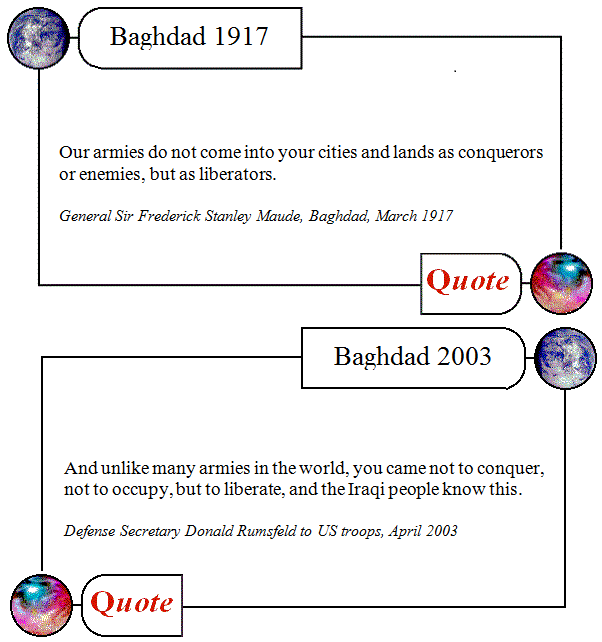
I’ve thanked Zen for his Iconic Compare and Contrast post already, but I’d like to run with his juxtaposition of images from the end of the Iraq war, and book-end it with an early DoubleQuote of mine from the beginning, thus:

That’s the beginning of the war, as I saw it “binocularly” — and here’s its ending, as Zen captured it:

Different though they are — one verbal, one visual — I think they go well together. I think they belong together.

But that’s essentially an aesthetic intuition.

*

And — apart from thanking Zen — that’s the thing I want to talk about.

The two quotes, eighty-six years apart, about an (anglophone) army in Baghdad coming there to liberate, not to conquer, are similar enough that they should give us pause for thought. They challenge us to think long and hard about the similarities between the two situations — and they challenge us to think no less hard and long about their differences.

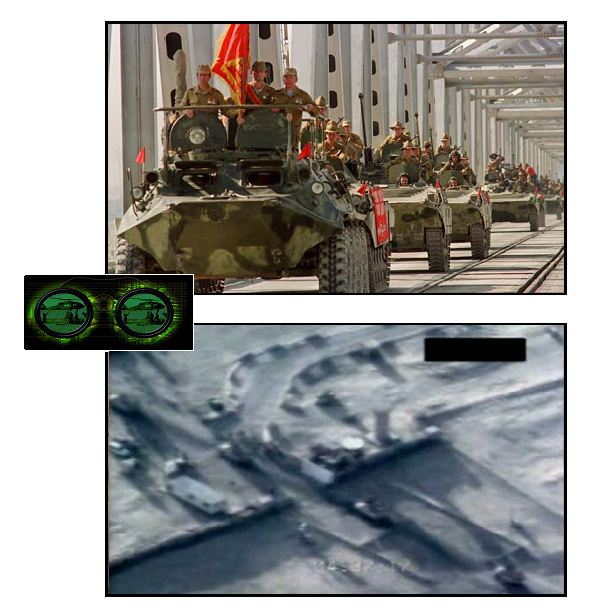
Likewise, it’s the similarities between the two images Zen chose — of the Soviet withdrawal from Afghanistan and the US exit from Iraq — that give that juxtaposition its power.  And Zen has chosen very carefully:

Not only are there two lines of vehicles stretching back from the foreground away into the distance in each image, but the angle from which the two columns are seen is about the same — and there are even two “tracks” in each photo reinforcing the vanishing point — two tracks to the right of the vehicles in the Afghan photo, the edge of the road and a what looks like the shadow of an overhead cable in the photo from Iraq.

*

But let’s take this a bit further. The following juxtaposition is every bit as much a juxtaposition of the Soviet and American withdrawals as the pair of images Zen picked, but this time we have an aerial view of the US convoy — so the visual “rhyme” between the two images is no longer there — and even though the aerial shot is an intriguing one, what a difference that makes!

There’s nothing in that juxtaposition to make you go, yes!

On the level of what’s being referred to, the troop withdrawals from Afghanistan and Iraq,  this pair of images has the same properties as the two images that Zen selected.  But it doesn’t capture our attention in nearly the same way.

And the same would have been true if I’d picked a different sentence from Rumsfeld‘s speech to juxtapose with General Maude‘s “not as conquerors or enemies but as liberators” — such as, “You’ve unleashed events that will unquestionably shape the course of this country, the fate of the people, and very likely affect the future of this entire region.” I’d still be comparing and contrasting two speeches from the beginnings of two occupations of Baghdad.  But there’d be no oomph to the comparison.

*

Because — and this is what I am trying to get at, the basic principle of HipBone analysis and what distinguishes it from otherwise similar modes of brainstorming and mind-mapping — the recognition of pattern, of salient sameness, of close parallelism or opposition is the criterion for success or failure in a HipBone-style juxtaposition.

Zen’s graphic example has that closeness — even down to those two parallel tracks beside and to the right of the vehicles.  My two quotes from Maude and Rumsfeld have that.  And it’s that closeness of match that makes a juxtaposition powerful.

Analogy works this way, rhyme works this way, fugue works this way, graphic match (in cinematography) works this way — it’s basic to the arts, basic to rhetoric, and basic to the way our analogically-disposed minds think.

It is not a method for arriving at conclusions, it’s a method for posing questions. And it sits right at the juncture where analysis admits it is not a science but an art.

Iconic: compare and contrast

Thursday, December 22nd, 2011

[ by Charles Cameron — iconic images, riot police, compare and contrast, repetition with variation ]
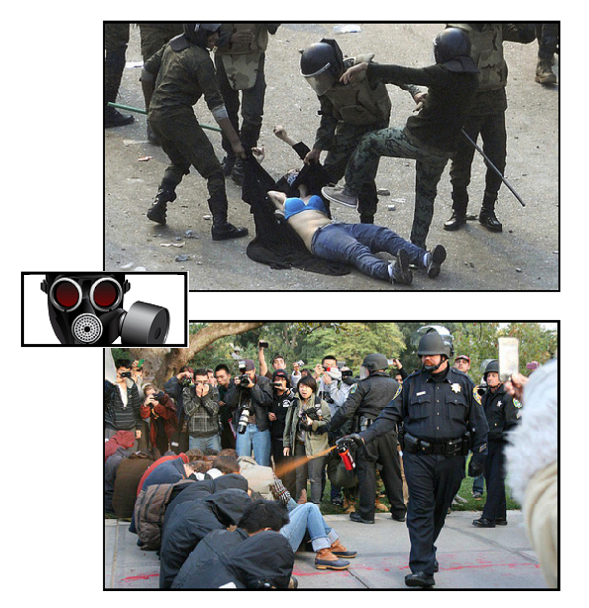
First, let’s be clear that both these images have been widely considered iconic.

Thus NPR reported of the first photo:

There have been countless accounts of violence recorded during the uprisings in Egypt but the image that perhaps has captured the most attention is the most recent. The image has been widely referred to as the “girl in the blue bra.”

While Real Clear Politics quotes Michael Moore on the second:

“The images have resonated around the world in the same way that the lone man standing in front of the tanks at Tiananmen Square resonated. It is an iconic movement in Occupy Wall Street history,” Michael Moore declared on MSNBC’s “Last Word” program.

Moore was referring to police pepper spraying students at an “Occupy” protest at UC Davis.

So we have two similarities between the two images: they both show police in riot gear taking action against demonstrators, and they have both caught the public eye as somehow being representations that can “stand in” for the events they seek to portray.

Beyond that, it’s all compare and contrast territory — or variations on a theme, perhaps — and different people will find different reasons to attack or defend the demonstrators or the police in one, the other, or both cases.

1.

These are, for many of us, “home” and “away” incidents, to borrow from sports terminology, and some of our reactions may reflect our opinions in general of what’s going on in Egypt, or in the United States.

We may or may not know the rules of engagement in effect in either case, on either side.

In a way, then, what the photos tell us about those two events, in Tahrir Square and on the UC Davis campus, may tell us much about ourselves and our inclinations, too.

2.

As I’ve indicated before, I am very interested in the process of comparison and contrast that the juxtaposition of two images — or two quotes — seems to generate. And I’ve quoted my friend Cath Styles, too:

A general principle can be distilled from this. Perhaps: In the very moment we identify a similarity between two objects, we recognise their difference. In other words, the process of drawing two things together creates an equal opposite force that draws attention to their natural distance. So the act of seeking resemblance – consistency, or patterns – simultaneously renders visible the inconsistencies, the structures and textures of our social world. And the greater the conceptual distance between the two likened objects, the more interesting the likening – and the greater the understanding to be found.

I’d like to examine these two particular photographs, then, not as images of behaviors we approve or disapprove of, but as examples of juxtaposition, of similarity and difference — and see what we might learn from reading them in a “neutral” light.

3.

What I am really trying to see is whether we can use analogy — a very powerful mental tool — with something of the same rigor we customarily apply to questions of causality and proof, and thus turn it into a method of insight that draws on our aha! pattern recognition and analogy-finding intuitions, rather than the application of inductive and deductive reason.

And that requires that we should know more about how the mind perceives likenesses — a topic that is often obscured by our strong emotional responses — you’re making a false moral equivalence there! or look, one’s as bad as the oither, and it’s sheer hypocrisy to suggest otherwise!

So among other things, we’re up against the phenomenon I call “sibling pea rivalry” — where two things, places, institutions, whatever, that are about as similar as two peas in a pod, have intense antagonism between them, real or playful — Oxford and Cambridge, say, and I’m thinking here of the Boat Race, or West Point and Annapolis in the US, and the Army-Navy game.

Oxford is far more “like” Cambridge than it is “like” a mechanic’s wrench, more like Cambridge than it is a Volkswagen or even a high school, more like it even than Harvard, Yale, Princeton or Stanford — more like it than any of the so-called “redbrick universities” in the UK — so like it, in fact, that the term “Oxbridge” has been coined to refer to the two of them together, in contrast to any other schools or colleges.

And yet on the day of the Boat Race, feelings run high — and the two places couldn’t seem more different. Or let me put that another way — an individual might be ill-advised to walk into a pub overflowing with partisans of the “dark blue” of Oxford wearing the “light blue” of Cambridge, or vice versa.  Not quite at the level of the Zetas and the Gulf Cartel, perhaps, but getting there…

4.

So one of the things I’ve thought a bunch about is the kind of analogy that says a : A :: b : B.

As in: Egyptian cop is to Egyptian protester as UC Davis cop is to UC Davis protester.

Which you may think is absolutely right — or cause for impeachment — or just plain old kufr!

And I’ve figured out that the reason people often have different “takes” on that kind of analogy — takes so different that they can get extremely steamed about it, and whistle like kettles and bubble over like pots — has to do with the perceptual phenomenon of parallax, whereby some distances get foreshortened in a way that others don’t.

5.

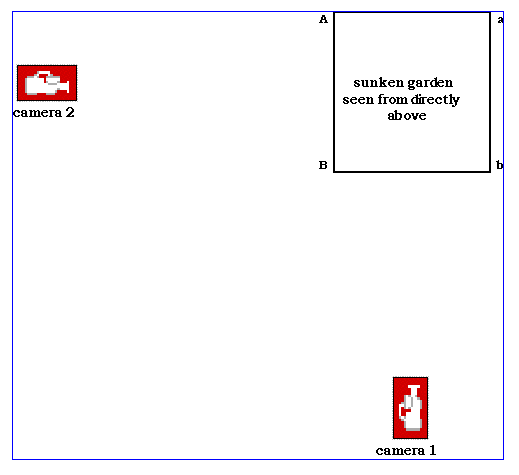
So my thought experiment sets up a sunken garden — always a pleasure, with two video cameras observing it, as in this diagram:
And from the two cameras, the respective views look like this:
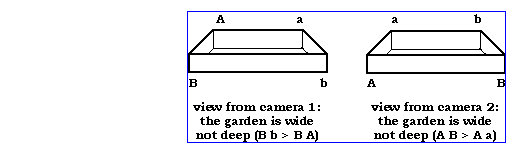
In this scheme of things, Aa (Oxford) seems very close to Bb (Cambridge) seen from the viewpoint of camera 1 — but from camera 2’s standpoint, Aa (Oxford) and Bb (Cambridge) are at opposite ends of the garden, and simply couldn’t be father apart.

6.

Now, my thinking here is either so obvious and simple as to be a platitude verging on tautology — or one of those subtle places where the closer examination of what looks tautological and obvious leads to the emergence of a new insight, a new “difference that makes a difference” in Bateson’s classic phrase.

And clearly, I hope that the latter will prove to be the case here.

7.

What can we learn from juxtapositions? What can we learn from our agreements about specific juxtapositions — and what can we learn from our specific disagreements?

Because it’s my sense that samenesses and differences both jump out at us, as Cath Styles suggested — and that both have a part to play in understanding a given juxtaposition or proposed likeness.

Each juxtaposition will, in my view, suggest both a “sameness” and a “difference” — in much the same way that an arithmetic division of integers, a = qd + r, gives both quotient and dividend.

And then we have two or more observers of the juxtaposition, who may bring their own parallax to the situation, and have their own differences.

8.

Tahrir is to Tienanmen as Qutb is to Mao?

Or is pepper spray just a food additive?

And how do icons become iconic anyway? Are they always juxtapositions, cops against college kids, girl vs napalm, man against line of tanks?  Even in the iconic photo of Kennedy from the Zapruder film, the sudden eruption of violence into the stateliness of a presidential parade is there — a morality play in miniature.

Any thoughts?


Switch to our mobile site