zenpundit.com » metacognition

Archive for the ‘metacognition’ Category

Request for Information from the Readership

Thursday, October 27th, 2011

Need some help with a project at work. 

Looking to assemble a fast-and-dirty reading list for laymen that deals with the following topics:

Social intelligence, Emotional self-regulation, Emotion and learning, De-escalation of conflict, Attention, Self-Efficacy

Interested in both academic (for reference) and middlebrow (for distribution) titles, particularly those that contain interpersonal strategies and organizational culture angles. Links to journal or magazine articles or whatever else you deem useful will also be appreciated.

Fire away, the more the better.

More on Boyd & Beyond II and Boydian Theory

Wednesday, October 19th, 2011

Two posts of note:

USNI Blog (Lucien Gauthier) – Training Sailors to be Autodidactic

….The conference spent a lot of time on the first half of the OODA-Loop, Observing and Orienting.  At some point I became convinced that the type of Sailor we need is one that is a “situational autodidact”.  Major Marcus Mainz, USMC, during his presentation made the brilliant comment that “training is for the known, education is for the unknown” in this sense, the spirit in which we must educate our Sailors must be towards making them capable of educating their self as needed when the unknown presents itself to them.

….For Sailors to take greater advantage of their experiences, they need to actively question their actions.  By this, I mean that a person analyses a question more than they do a statement.  But, it has been my experience that when someone recants an experience they had, it is a rare thing to hear someone say anything in terms of ‘why’ they did something.  Much more often someone only tells the ‘what’ of their actions.  Think of the Socratic Method, where Socrates would answer his students questions with another question.  A Sailor who has internalized such a ‘Socratic process’ would be in a position to provide more cogent feedback as well as learn from their mistakes more often than we do today.

What I am saying is not that the training we offer Sailors falls short of its objectives as they stand today.  But, that the spirit of the training is not where it needs to be-we focus our objectives too much on acting rather than orienting.  The training our Sailors receive are based on concrete and testable objectives that can be measured, quantified and turned into metrics, that fit well into powerpoint.  We do no help Sailors to become autodidactic-we are not training them to become students of their environment, but rather students of their school house.

We start to approach training Sailors to be autodidacts of their environment in the Operational Risk Management training we receive (One thing about ORM:  It is Boyd’s OODA-Loop operationalized.  The Navy has totally ripped off Boyd, and yet we never mention his name outside of the Warfare Universities-shame on us).  We need more and deeper training on ORM and how this method applies to everything we do, whether we consciously realize it or not.  In giving this deeper level or ORM, we should also find Sailors able to be more articulate of the process they’ve gone through.  Thereby becoming able to better train others of their experiences….

Naval affairs is not my bailwick, but my understanding of following online discussions by experts in the field like General Robert Scales, is that Professional Military Education across all the services is a) in need of significant reform and b) is facing a future of restricted budgets and possible deep cuts. My only firsthand knowledge of PME comes from a brief stint in June at The Army War College, courtesy of Dr. Steve Metz. The AWC curriculum was explained to me in detail by Col. Bill Lord, and while they were hitting the right notes in terms of trying to inculcate a strategic epistemology, the time frame allowed for doing so is extremely compressed.

Fast TransientsBoyd’s Conceptual Spiral – New Edition

This is from Dr. Chet Richards as well as Chuck Spinney….

Download Conceptual Spiral (152 KB PDF), Boyd’s take on the origin and importance of novelty:

Novelty is not only produced by the practice of science/engineering and the pursuit of technology, it is also produced by the forces of nature, by our own thinking and doing as well as by others. Furthermore, novelty is produced continuously, if somewhat erratically or haphazardly. Now, in order to thrive and grow in such a world, we must match our thinking and doing, hence our orientation, with that emerging novelty. (28)

Adds the original page numbers, which may seem a little odd because for readability this edition spreads several of Boyd’s originals over two or even three pages.  All of these will have the same number.

We are wired to crave and be attracted to novelty, it sets us thinking and generates insights and stimulates our creativity.

Tea Party and / or Occupy?

Sunday, October 9th, 2011

[ by Charles Cameron — parallels, opppositions, analysis, games, coincidentia oppositorum ]

.

labelling-bodies1.jpg

My friend Cath Styles, who has been developing an iPad playable version of my HipBone Games under the name Sembl for the National Museum of Australia, made a point I’ve been trying to make for a while now, with sweet lucidity, in a recent blog post:

A general principle can be distilled from this. Perhaps: In the very moment we identify a similarity between two objects, we recognise their difference. In other words, the process of drawing two things together creates an equal opposite force that draws attention to their natural distance. So the act of seeking resemblance – consistency, or patterns – simultaneously renders visible the inconsistencies, the structures and textures of our social world. And the greater the conceptual distance between the two likened objects, the more interesting the likening – and the greater the understanding to be found.

That’s absolutely right, and it gets to the heart of my games and analytic practice — to see and acknowledge both parallelisms and differences, oppositions…

Oxford is the polar opposite of Cambridge as anyone at the annual boat race between them will tell you — yet they’re so similar that the term Oxbridge exists to distinguish them as a dyad from all else the wide world round…

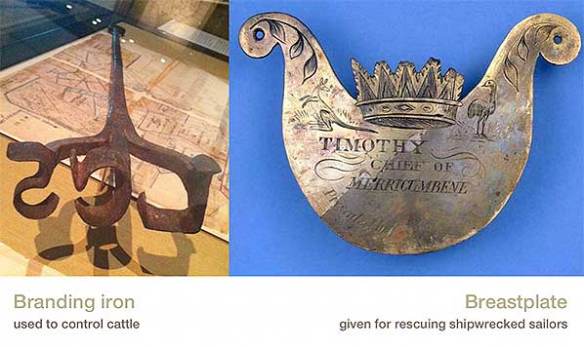
Similarly, in the example illustrated above, Cath shows two items from the Museum collection that were juxtaposed by players of an early version of her game, and writes:

the Sembl players who linked the above branding iron to the breastplate – because both are tools for labeling bodies – cast new light on the colonial practice of giving metal breastplates to Aboriginal people.

* *

Since the essence of my own analytic style (and that of HipBone and Sembl games) is the recognition of parallelisms and oppositions, I was particularly interested to see one group of early Tea Party folk reaching out to the emerging Occupy movement. Here, then, are two posts in which we can see the beginnings of recognition that there may be a kinship between the two…

Occupy Wall Street: Another View:

You know what the “Occupy Wall Street” movement is?
.
It is all the things that were in the original Tea Party, but were steadily ignored as the TP became a Republican booster club.

That comes from a post on FedUpUSA, a site with the Gadsden flag as its web-logo that was [as “Market
Ticker”], one of the founding orgs behind the TP. It’s from someone who identified as a Libertarian Party activist.

Here’s another post from FedUpUSA, not so identified:

An Open Letter From FedUpUSA To Occupy Wall Street Protestors All Over The Country:

This is a letter to OWS from FedUpUSA, one of the original Tea Parties:
.
We support you in exercising your First Amendment Right. We are outraged that any peaceful demonstrator would be assaulted or abused by any authorities.
.
If you are protesting because there are no jobs— We stand with you.
.
We are for a free economy and recognize that what we have now is NOT a free economy; it is not capitalism what we have is a fascist state or crony-capitalism. There is nothing free about doing business with Countries that manipulate their currencies to attract cheap labor. We agree that these jobs need to come back to America.
.
If you are protesting because no one has gone to jail— We stand with you.
.
Regardless of what is being said from the white house and media, we know that there are many in the financial district and the banks that have committed fraud and outright theft and we too want to see them prosecuted. We support the stop looting and start prosecuting.
.
If you are protesting because everything costs more— We stand with you.
.
We see prices rise in our food, gas, clothes yet our wages have stayed the same or have decreased. The Federal Reserve has bailed everyone out but us and not only are we going to have to pay for that, those bailouts make the price of everything else go up because it devalues our currency. We support monetary reform.
.
If you are protesting because you are tired of our bought and paid for government on both sides— We stand with you.
.
We are also against the banks and big corporations buying our politicians and writing laws that favor their special interests. We understand that our economy is broken BECAUSE of this and that all of our other issues will never be addressed as long as the financial elite control OUR government.
.
We understand that these issues cross party lines and ideologies and effect each and every one of us. We also understand that these issues will never get fixed as long as we continue to let the media, the elite, and members of the government separate us by our differing ideologies.
.
Only Together, can we Implement Change
.
It is time, We Americans, put our ideologies in our back pocket and not let them separate us so that we can work together for this ONE COMMON GOAL: to get the special interest money and elite out of OUR Government and return it to US — the people.
.
As long as the banks, largest corporations, and wealthy elite control our government, we will never have a representative republic and laws will continue to be passed that only benefit the few 1% at the expense of us 99
.
Demand that NOT ONE MORE LAW gets passed until they pass:
.
Lobby reform:
.
It is a Federal Offense punishable by a minimum 5 years in prison to:

.
Lobby any member of the US Congress outside of the district you live, work, or own a business.
Lobby a member of congress while they are physically outside the district they represent.
.
Campaign Reform:
.
It is a Federal Offense punishable by a minimum 5 years in prison to:
.
For any one person, corporation, enterprise, group, union or the like, to donate more than $2,000 to any one candidate during one campaign period.
For any member of the media to deny equal access to competing candidates.
.
These two laws will cut the control the Financial elite have on our government by leveling the playing field. You will have just as big as a voice with your representative as the big box retailer that resides in your town. Simply, it will end the Crony-Capitalism that is strangling our economy.
.
I encourage all my fellow Tea Partiers to join Occupy Wall Street protesters in their non-violent, peaceful protests and together demand that the Government be returned to the people. After all, this is precisely what the Tea Party was intended to be before it was taken over and marginalized by the establishment politicians.

.
FedUpUSA.org

* *

And we’re deep into John Robb territory…

What do you think? Do the parallelisms strike you, or the oppositions — or, perhaps, both?

FWIW, Cath’s Sembl version of my game looks like it is going to be a beautiful steampunk affair…

Alice’s Wonderland Battlespace

Tuesday, August 23rd, 2011

[ by Charles Cameron — terrain, IDF, inverse geometry, Necker cube, apocalyptic signs ]

.
wonderland-battlespace.jpg

I’ve just read one of those astounding paragraphs that leaves the mind reeling. Some of you will no doubt already be aware of the work of Israeli architect Eyal Weizman, but for me, his paper Lethal Territory is new ground:

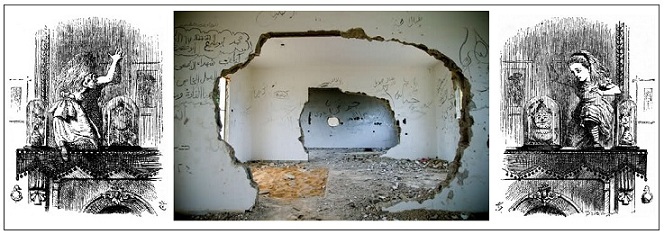
The maneuver conducted by units of the Israeli Defense Forces (IDF) in Nablus in April 2002 was described by its commander, Brigadier General Aviv Kokhavi, as inverse geometry, the reorganization of the urban syntax by means of a series of microtactical actions. During the battle, soldiers moved within the city across hundred-meter-long “overground-tunnels” carved through a dense and contiguous urban fabric. Although several thousand soldiers and several hundred Palestinian guerrilla fighters were maneuvering simultaneously in the city, they were so “saturated” within its fabric that very few would have been visible from an aerial perspective at any given moment. Furthermore, soldiers used none of the streets, roads, alleys, or courtyards that constitute the syntax of the city, and none of the external doors, internal stairwells, and windows that constitute the order of buildings, but rather moved horizontally through party walls, and vertically through holes blasted in ceilings and floors. This form of movement, described by the military as “infestation”, sought to redefine inside as outside, and domestic interiors as thoroughfares. Rather than submit to the authority of conventional spatial boundaries and logic, movement became constitutive of space. The three-dimensional progression through walls, ceilings, and floors across the urban balk reinterpreted, short-circuited, and recomposed both architectural and urban syntax. The IDF’s strategy of “walking through walls” involved a conception of the city as not just the site, but the very medium of warfare — a flexible, almost liquid medium that is forever contingent and in flux.

Where do I begin?

* * *

1. For sheer creativity, this reversal of our normal understanding of space is both audacious and brilliant.

2. In terms of the way the humans living in that space experience the tactic, it must have been – must be – extraordinary – shock and awe on the scale of the individual family and its dwelling. Weizman quotes a Palestinian woman’s response:

Imagine it – you’re sitting in your living room, which you know so well; this is the room where the family watches television together after the evening meal. .. And, suddenly, that wall disappears with a deafening roar, the room fills with dust and debris, and through the wall pours one soldier after the other, screaming orders. You have no idea if they’re after you, if they’ve come to take over your home, or if your house just lies on their route to somewhere else. The children are screaming, panicking. . Is it possible to even begin to imagine the horror experienced by a five-year-old child as four, six, eight, twelve soldiers, their faces painted black, submachine guns pointed everywhere, antennas protruding from their backpacks, making them look like giant alien bugs, blast their way through that wall?

3. It has a past, there’s nothing entirely new under the sun:

Similarly, the strategy of walking through walls, as Israeli architect Sharon Rotbard reminds us, is reinvented for every urban battle in response to local conditions. It was first described in Marshal Thomas Bugeaud’s 1849 draft of La Guerre des Rues et des Maisons, in the context of anti-insurgency tactics used in the class-based urban battles of 19th-century Paris. Instead of storming the barricades from the front, Bugeaud recommended entering the barricaded block at a different location and “mouse-holing” along “over-ground tunnels” that cut across party walls, then taking the barricade by surprise from the flank. On the other side of the barricades and a decade later, Louis-August Blanqui wrote this microtactical maneuver into his Instructions pour une prise d’armes.

* * *

4. Quite apart from the notion of “inverse geometry” there’s a thread here that concerns mapping and deserves investigation. First, there’s this quote in Weizman’s essay from Walter Benjamin:

I have long, indeed for years, played with the idea of setting out the sphere of life — bios — graphically on a map. First I envisaged an ordinary map, but now I would incline to a general staff’s map of a city center, if such a thing existed. Doubtless it does not, because of the ignorance of the theatre of future wars.

Then, in a paper on forming a “coherent mental map of the Israeli-Palestinian conflict”, Weizman writes

A new understanding of territory had to be developed to govern the West Bank. The Occupied Territories were no longer seen as a two-dimensional surface, but as a large three-dimensional volume, layered with strategic, religious and political strata.

Later in the same piece, we can find Weizman’s description of a “politics of verticality” along with its vivid quote from Benveniste:

New and intricate frontiers were invented, like the temporary borders later drawn up in the Oslo Interim Accord, under which the Palestinian Authority was given control over isolated territorial ‘islands’, but Israel retained control over the airspace above them and the sub-terrain beneath.

This process might be described as the ‘politics of verticality’. It began as a set of ideas, policies, projects and regulations proposed by Israeli state-technocrats, generals, archaeologists, planners and road engineers since the occupation of the West Bank, severing the territory into different, discontinuous layers.

The writer Meron Benvenisti described the process as crashing “three-dimensional space into six dimensions – three Jewish and three Arab”. Former US president Bill Clinton sincerely believed in a vertical solution to the problem of partitioning the Temple Mount. Settlement Masterplanners like Matityahu Drobless aimed to generate control from high points.

* * *

Upside down, inside out, and topsy-turvy? Apart from Alice, of course — what does this remind me of?

Why, religion, naturally.

Take the Gospel of Thomas, logion 22 (Barnstone & Meyer, p. 51):

Yeshua said to them,
When you make the two into one,
and when you make the inner like the outer
and the outer like the inner
and the upper like the lower,
and when you make male and female into a single one,
so that the male will not be male nor female be female,
when you make eyes in place of an eye,
a hand in place of a hand,
a foot in place of a foot,
an image in place of an image,
then you will enter the kingdom.

Similar sayings are found in the poetry of Kabir, the great Indian mystic-poet, and described thus by Linda Hess (The Bijak of Kabir, p.135):

A particularly intriguing category of Kabir’s poems is the type known as ulatbamsi, poems in “upside down language”. They intrigue because they are absurd, paradoxical, crazy, impenetrable, and yet they purport to be meaningful.

In Japan, they might be given the name of koan — Hess quotes (p. 145) an early Mahayana sutra describing the world as “like a desert mirage, a celestial city, a mirror-reflection, a stone made from water hardened by a whirlwind”.
.

Here is one of the signs of the end times quote in Islamic sources:

After the night of three nights, the following morning the sun will rise in the west. People’s repentance will not be accepted after this incident.

* * *

And so perhaps the saying with which Eihei Dogen described Master Dogo‘s friend in his Shinji Shobogenzo best encapsulates both the state of mind that a sudden reality-reversal accomplishes in those who are not prepared for it — and paradoxically, the state of mind in which it can be accepted as part of the natural order of things:

He does not have a roof above his head, nor any ground under him.
The OODA of Fouche

Wednesday, August 17th, 2011

Did not want this fine graphic of Joseph Fouche lost in the dread comment section:

The fog and friction is a nice touch.


Switch to our mobile site

