zenpundit.com » metacognition

Archive for the ‘metacognition’ Category

The Said Symphony: moves 6-9

Saturday, June 18th, 2011

[ by Charles Cameron – extended analytic game on Israeli-Palestinian conflict — continuing ]

Move 6: Glenn Gould
move-006.gif

Move content:

51pewuz2vyl__sl500_aa300_.jpg

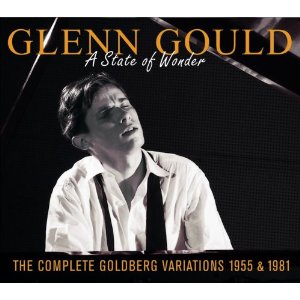
Glenn Gould was a great pianist whose two recordings of Bach‘s Goldeberg Variations alone would prove both the brilliance of his skill, which could draw forth the individual lines in Bach’s counterpoint in a way no earlier pianist had the technique to pull off, and the depth of his musical understanding.
glenn-gould-solitude-trilogy.jpg

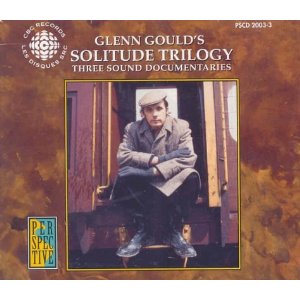
Late in life, Gould began “composing” radio works for the Canadian Broadcasting Corporation — he calls them “contrapuntal radio” — which revealed his interest in listening not just to Bach and other music but to life in general with an ear for counterpoint:

Gould set himself up to hear the world in a new way. In diners he ate his lunch alone, eaves dropping closely on the voices around him. He learned to hear conversation as music, the lilting lines, the rhythms everywhere up, down, and around, what Bach does to our sense of talk. There are two part inventions in words, themes and variations in the quarrels of couples and the tales told by friends. Gould met the world on his own terms, and he was fascinated by this way of listening to human voices as if they were a musical interplay, not participating in a conversation but taking it all in, as an audience.

It is that manner of listening which I am attempting in this game…

Links claimed:

To Bach, because Gould is Bach’s great interpreter, taking his interpretation of Bach’s counterpoint not just into the deep riches of Bach’s music for keyboards, but also out into the depth and riches of the world…

Comment:

I see this move as concluding the first, quiet introductory section of the game, setting forth the mode of understanding in which it is played, and honoring those those work has preceded, comforted and confirmed my own.

We shall return to this theme of counterpoint no doubt — the whole work falls under the aegis of Bach, as all of Bach’s work falls under his familiar motto: Soli Deo Gloria.
____________________________________________________________________________________________

Move 7: Daniel Barenboim

move-007.gif

Move content:

Daniel Barenboim is another celebrated musician, a brilliant Argentinian-Israeli pianist and conductor, in whose biography we read:

In the early 1990s, a chance meeting between Mr. Barenboim and the late Palestinian-born writer and Columbia University professor Edward Said in a London hotel lobby led to an intensive friendship that has had both political and musical repercussions. These two men, who should have been poles apart politically, discovered in that first meeting, which lasted for hours, that they had similar visions of Israeli/Palestinian possible future cooperation. They decided to continue their dialogue and to collaborate on musical events to further their shared vision of peaceful co-existence in the Middle East. This led to Mr. Barenboim’s first concert on the West Bank, a piano recital at the Palestinian Birzeit University in February 1999, and to a workshop for young musicians from the Middle East that took place in Weimar, Germany, in August 1999.

The West-Eastern Divan Workshop took two years to organize and involved talented young musicians between the ages of 14 and 25 from Egypt, Syria, Lebanon, Jordan, Tunisia and Israel. The idea was that they would come together to make music on neutral ground with the guidance of some of the world’s best musicians. … There were some tense moments among the young players at first but, coached by members of the Berlin Philharmonic, the Chicago Symphony and the Staatskapelle Berlin, and following master classes with the cellist Yo-Yo Ma and nightly cultural discussions with Mr. Said and Mr. Barenboim, the young musicians worked and played in increasing harmony.

From the orchestra’s current news page:

In 2005, the orchestra realized the impossible: a concert with Israelis, Palestinians, and other Arab musicians in the Palestinian territory of Ramallah.

Links claimed:

To Edward Said: because they were friends, because the West-Eastern Divan is a a human analog to Said’s view of a symphonic understanding of the Israeli-Palestinian conflict, and because he stands as an Israeli Jew in counterpoint to Said, the Palestinian.  Indeed, it is Barenboim, not Said, who is quoted here:

Drawing on the fundamentality of counterpoint in music, Barenboim describes how ‘in the act of challenging each other, the two voices fit together’ and that ‘music is always contrapuntal, in the philosophical sense of the word’ – indeed, ‘joy and sorrow can exist simultaneously in music’. He further argues that ‘acceptance of the freedom and individuality of the other is one of music’s most important lessons’. And this is the philosophy that underpins the phenomenon of the Divan orchestra: ‘You can’t make peace with an orchestra’, but one can ‘create the conditions for understanding’ and ‘awaken the curiosity of each individual to listen to the narrative of the other’.

To Bach, because as he writes:

I was reared on Bach. My father was virtually my only teacher, and he attached great importance to my growing up with Bach’s keyboard music. He considered it to be very important, not only for its musical and pianistic aspects, but also for everything else that is played on the piano. For him polyphonic music-making was simply one of the most important issues concerning everything relating to piano-playing. … The music can only be of interest if the different strands of the polyphonic texture are played so distinctly that they can all be heard and create a three-dimensional effect – just as in painting, where something is moved into the foreground and something else into the background, making one appear closer to the viewer than the other, although the painting is flat and one-dimensional.

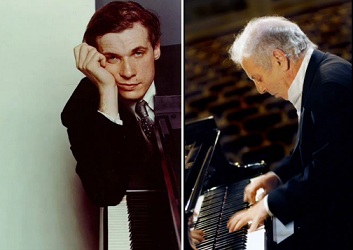
And to Glenn Gould because —
gould-barenboim.jpg

well, you may consider it a duel or a duet (a decision which shadows all differences, no?) but the two men are both celebrated for their renditions of the Bach Goldberg Variations, which are compared in excerpts back to back here on YouTube for our delight.

Comment:

I have only a couple of things to note here — the name West-Eastern Divan hearkens back to Goethe‘s poetry, and thus to the western world’s discovery of the sufic poetry of Hafez and Rumi — we find here a brief allusion to Yo-Yo Ma — and in the friendship of Said and Barenboim we see personified both the Israeli-Palestinian conflict and its transcending — in which a potential duel becomes a realized duet..

[ My thanks to Howard Rheingold for a pointer ]

____________________________________________________________________________________________

Move 8: Richard Wagner and antisemitism
move-008.gif

Move content:

barenboim-ring.jpg

With Richard Wagner, the ugly shadow of antisemitism falls across our play:

The idea of racial decline, and of German mentality being inherently superior, is integral to everything Wagner stood for. He saw himself as a redeemer, a notion his wife Cosima and her acolytes adopted as their creed. He gave the Aryan saviour-hero a dominant role in his operas. Siegfried is the incarnation of the sun-hero who would set Germany back on the true path – an idea that had existed in German mythology since the Middle Ages. Parsifal has characteristics of an Aryan Jesus.

European high culture had long had a disdain for the Jews, the merchants, the lenders — in Wagner’s writings, in his essay Judaism in Music and arguably in his operas too, he argues for the purity of the German race and the inability of the Jew, talented though he may be, to do more than ape that culture:

Our whole European art and civihisation, however, have remained to the Jew a foreign tongue; for, just as he has taken no part in the evolution of the one, so has he taken none in that of the other; but at most the homeless wight has been a cold, nay more, a hostile looker-on. In this Speech, this Art, the Jew can only afterspeak and after-patch — not truly make a poem of his words, an artwork of his doings.

It is a shadow that will touch, a virus that will infect Hitler — who will visit the Wagner family long after the Master’s death, attend and protect the Master’s playhouse in Bayreuth, cause the Master’s music to be played at the Nuremberg Rallies — and in so doing, teach European high culture itself that it is not immune to genocidal fantasies nor their execution in fact — enthrall and revolt and disgust and be deafeated — thus leading to the foundation in 1948 of the State of Israel, the Yom Ha’atzmaut of the Israelis, the Yawm an-Nakbah of the Palestinians…

Consider this press report, from which I have already quoted above:

Until the final scene, the Hamburg State Opera’s November 2002 production of Die Meistersinger von Nurnberg had proceeded without comment. Everyone was primed to applaud the hymn to “holy German art” that brings Richard Wagner’s four-hour pageant to a climax. Then came the bombshell. Midway through Hans Sachs’s monologue about honouring German masters over “foreign vanities”, the music came to an abrupt halt. Suddenly one of the mastersingers started speaking: “Have you actually thought about what you are singing?” he asked.

The virulence of antisemitism, and the shadow side of our common humanity, are not to be excluded from our game.

Links claimed:

To Daniel Barenboim, because he, a Jew and a musician, had the temerity to conduct the Berlin Staatskapelle orchestra in the Overture to Wagner’s Tristan und Isolde, in Jerusalem, in July 2001.

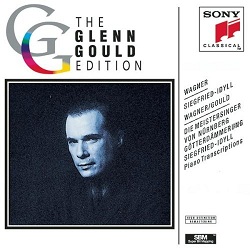
And to Glenn Gould, because…
gould-wagner.jpg

his piano transcription and performance of the Prelude to Die Meistersinger is a revelation: you might like to purchase it.

Comments:

I will confine myself to saying that Wagner’s concept of the gesamtkunstwerk or “work of total art” with its combination of poetry, drama, dance, song and even architecture is, in its own way, a precursor to many modern cross-disciplinary endeavors — the experimental works of Scriabin, whose “unrealized magnum opus Mysterium was to have been a grand week-long performance including music, scent, dance, and light in the foothills of the Himalayas” (Wikipedia), the Orphic poetry-in-film of Jean Cocteau, the crossover between poetry and the visual arts in Guillaume Apollinaire‘s Calligrammes — and not least, in Hermann Hesse‘s great Glasperlenspiel

____________________________________________________________________________________________

Move 9: Golgotha
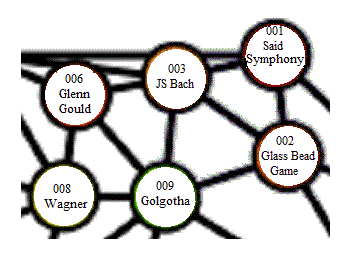
move-09.gif

Move content:

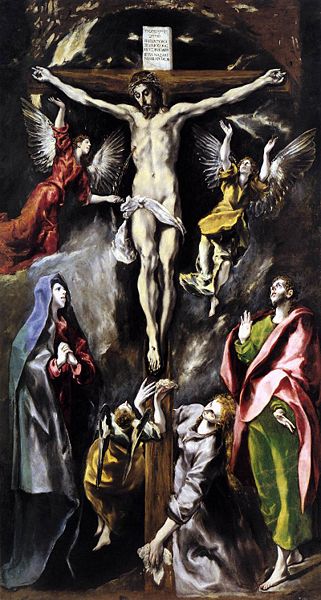
Specifically, Golgotha refers to the small hill outside the Jerusalem city walls where Christ was crucified — our word “Calvary” is derived from the name:

And when they were come unto a place called Golgotha, that is to say, a place of a skull, They gave him vinegar to drink mingled with gall: and when he had tasted thereof, he would not drink. And they crucified him, and parted his garments, casting lots: that it might be fulfilled which was spoken by the prophet, They parted my garments among them, and upon my vesture did they cast lots. And sitting down they watched him there…

Matthew 27: 33-36

321px-crucifixion_prado.jpg
El Greco, The Crucifixion, The Prado, Madrid
Figuratively, Golgotha is the nadir, the lowest point — as in this powerful observation by the soldier-poet Capt. Wilfred Owen, describing the carnage of trench warfare in World War I in a letter to Osbert Sitwell, dated 4 July 1918.

For 14 hours yesterday, I was at work-teaching Christ to lift his cross by the numbers, and how to adjust his crown; and not to imagine he thirst until after the last halt. I attended his Supper to see that there were no complaints; and inspected his feet that they should be worthy of the nails. I see to it that he is dumb, and stands mute before his accusers. With a piece of silver I buy him every day, and with maps I make him familiar with the topography of Golgotha.


Links claimed:

To Wagner, in a manner that continues the motif of his antisemitism: Rudolf Steiner, founder of the Waldorf schools and anthroposophist, gave a lecture on the mythic underpinnings of Wagner’s Parsifal in 1906, which he said:

How was it that Wagner was able to find the right mood for his Parsifal? It is most important for us to recognize that Wagner was able to do this because he knew that what happened on Golgotha had especially to do with the blood, he knew that we had to see there not only the death of the Saviour but we had to see what took place there with the blood, how the blood was purified on Golgotha and became something quite different from ordinary blood. Wagner has spoken of the connection of the Saviour’s blood with the whole of mankind. In his book “Paganism and Christianity” we read these words: “Having found that the capacity for conscious suffering is a capacity peculiar to the blood of the so-called white race, we must now go on to recognize in the blood of the Saviour the very epitome, as it were, of voluntary conscious suffering that pours itself out as divine compassion for the whole human race.”

To Glenn Gould — introducing a contemporary instance of the nadir of human consciousness — because Hannibal Lecter, the insane psychiatrist of Thomas Harris‘ novel The Silence of the Lambs, has a copy he made from memory (“Memory, Officer Starling, is what I have for a view”) of Duccio‘s painting Golgotha after the Deposition on the walls of his cell, and listens to the Bach Goldberg Variations on his tape recorder — Glenn Gould is specified as the performer.

To the Glass Bead Game, because Hermann Hesse in what can only be an autobiographical passage in Demian writes:

The teacher had spoken of Golgotha. The Biblical account of the suffering and death of the savior had made the deepest impression upon me from my earliest childhood. Often as a small boy I had, after my father had read the story of the passion on Good Friday, lived in this painfully beautiful, pale, ghostly and still powerfully living world of Gethsemane and on Golgotha. I had experienced it listening to Bach’s St. Matthew Passion, it had flooded me with the somber, powerful tones of this mysterious world, with its mystical drama. Even today I find in this music, and in Actus Tragicus the essence of all that is poetical and of all artistic expression.

and there is no less surely an echo of that in a comment made by Joseph Knecht — the Magister Ludi of Hesse’s novel —

Nowadays, for example, we do not think much of the theology and the ecclesiastical culture of the eighteenth century, or the philosophy of the Enlightenment; but we consider the cantatas, passions, and preludes of Bach the ultimate quintessence of Christian culture.

For Hesse at least, and Knecht himself by implication, the Golgotha of Bach’s St Matthew Passion is “the essence … of all artistic expression”.

And to Bach, finally, for those sections (58-9 in Part II of the Passion) which deal with Golgotha and the crucifixion:

58a. Rezitativ (Evangelist): “Und da sie an die Stätte kamen”
58b. Chor: “Der du den Tempel Gottes zerbrichst”
58c. Rezitativ (Evangelist): “Desgleichen auch die Hohenpriester”
58d. Chor: “Andern hat er geholfen”
58e. Rezitativ (Evangelist):”Desgleichen schmäheten ihn auch die Mörder”
59. Rezitativ: “Ach Golgatha”

all of which can be heard in John Eliot Gardiner‘s performance here on YouTube, although I’d highly recommend Gardiner’s Bach: Sacred Vocal Works: the Christmas Oratorio, St. Matthew Passion, St. John Passion and Mass in B Minor as a boxed set — a stunning treasure.

Comment:

Hesse recommends the practice of meditation between moves in the Glass Bead Game, and rather than comment on this move briefly here, I shall next write a more extended meditation on the game thus far, and on this move in particular.

Here we approach the very walls of Jerusalem.
____________________________________________________________________________________________
The Said Symphony: moves 1-5

Saturday, June 18th, 2011

[ by Charles Cameron – extended analytic game on Israeli-Palestinian conflict ]

.

In two previous posts (Intro, and Board and Gameplay), I have described my forthcoming attempt to “play” a 130-plus move game, in which I will use quotations, images and anecdotes to express something of the complex weave of thoughts and emotions that govern — in tense and tenuous fashion — the “Israeli-Palestinian problem”.

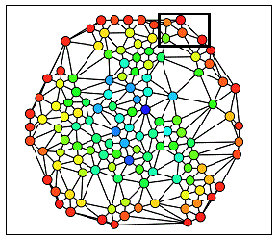
Here I will commence play, making my initial “moves” in this area of the board:

said-bd-zp-start.gif

____________________________________________________________________________________________
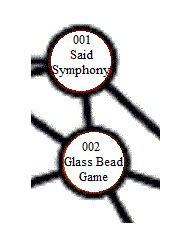
Move 1: The Said Symphony

move-001.gif

Move content:

When you think about it, when you think about Jew and Palestinian not separately, but as part of a symphony, there is something magnificently imposing about it. A very rich, also very tragic, also in many ways desperate history of extremes — opposites in the Hegelian sense — that is yet to receive its due. So what you are faced with is a kind of sublime grandeur of a series of tragedies, of losses, of sacrifices, of pain that would take the brain of a Bach to figure out. It would require the imagination of someone like Edmund Burke to fathom.

Edward W. Said, Power, Politics, and Culture, p. 447 — from the section titled “My Right of Return,” consisting of an interview with Ari Shavit from Ha’aretz Magazine, August 18, 2000.

Links claimed:

In his novel of the Glass Bead Game, Hermann Hesse writes:

Every transition from major to minor in a sonata, every transformation of a myth or a religious cult, every classical or artistic formulation was, I realized in that flashing moment, if seen with a truly meditative mind, nothing but a direct route into the interior of the cosmic mystery, where in the alternation between inhaling and exhaling, between heaven and earth, between Yin and Yang, holiness is forever being created.

It is in the links between moves, the creative leaps of the analogical mind, that the secret of the game can be found — so the “links claimed” sections of moves can be viewed as meditation points — architecturally, they are the “arches” of potential insight between the “pillars” of existing ideas. Here, no links are claimed, since this is the first move in the game.

Comment:

This is where it begins… with a vision of dissonant voices in counterpoint… ____________________________________________________________________________________________
Introductory moves

Before we get directly into the “meat” of the game, I want to explore its purpose via a few more moves that focus on what we might call the polyphony of ideas — thinking in terms of multiple voices.

Move 2: Hermann Hesse and the Glass Bead Game
Move 3: JS Bach and the Art of Fugue
Move 4: William Blake and Fourfold Vision
Move 5: Bob Dylan and One Too Many Mornings
Move 6: Glenn Gould

Then two moves nudging us in the direction of, then directly into — Israel:

Move 7: Daniel Barenboim
Move 8: Wagner

and specifically to the outskirts of Jerusalem / Al Quds:

Move 9: Golgotha

You might want to consider these nine moves a sort of overture.  Let’s see how that goes…

____________________________________________________________________________________________
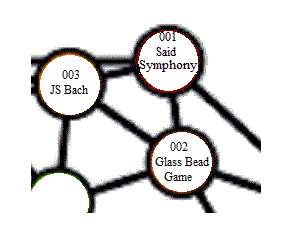
Move 2: Move 2: Hermann Hesse and the Glass Bead Game

move-002.gif

Move content:

Hermann Hesse’s novel Das Glasperlenspiel (English title The Glass Bead Game, also published as Magister Ludi) won him the Nobel for Literature.

gbg-cover.jpg

The centerpiece of the novel is the Game itself. Hesse doesn’t spell out in detail how it is to be played, but his hints are enough to let us know that in play, different ideas from across world culture are combined as if in a virtual music of ideas:

The Glass Bead Game is thus a mode of playing with the total contents and values of our culture; it plays with them as, say, in the great age of the arts a painter might have played with the colors on his palette. All the insights, noble thoughts, and works of art that the human race has produced in its creative eras, all that subsequent periods of scholarly study have reduced to concepts and converted into intellectual values the Glass Bead Game player plays like the organist on an organ. And this organ has attained an almost unimaginable perfection; its manuals and pedals range over the entire intellectual cosmos; its stops are almost beyond number.

It is in an attempt to bring Hesse’s idea of a musical synthesis of ideas into practical application in helping us understand — and perhaps even, god willing, help us to resolve — the Palestinian-Israeli conflict that I am playing this game.

The idea is not to come up with a solution, but a richer sense of the interplay of motives and memories as they build the situation we all now face.

Link claimed:

To Edward Said, in that Hesse immediately precedes Said in his intuition that melodies are not the only kinds of thought that can be juxtaposed in counterpoint and thus integrated in a complex, sometimes tragic, often profound, always human music.

Comment:

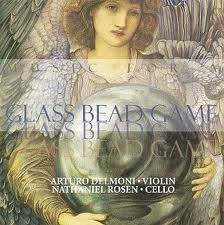
The graphic I have used is from the cover of a lovely CD, featuring Arturo Delmoni and Nathaniel Rosen, Music for a Glass Bead Game. ____________________________________________________________________________________________
Move 3: Move 3: JS Bach and the Art of Fugue

move-003.gif

Move content:

gould-art-of-fugue.jpg

Bach was my first great love in the arts, and when I applied to study at Christ Church, Oxford, it was essays on Hopkins, El Greco, and Bach — specifically the B Minor Mass — that got me in the door. Years later, when I lived in Warrenton and commuted to a think-tank job in Arlington, VA, I found myself muttering To hold the Mind of Bach over and over to myself like a mantram.

And that, I think, is the key to my games.

I want to think as Bach did, polyphonically — to see the world in terms of counterpoint, to read life musically. And my games, which involve holding related, sometimes harmonious and sometimes conflicting thoughts in the mind at the same time, invite and encourage me to do that. They also provide me with a method of notating (scoring, in the musical sense) such multi-thought patterns on the various HipBone boards.

It is Bach, therefore, who is grandfather to Said’s thought, as Hesse is its father — and Bach’s greates expressions of this approach are found in such great summary works as the B Minor Mass and the Art of Fugue.

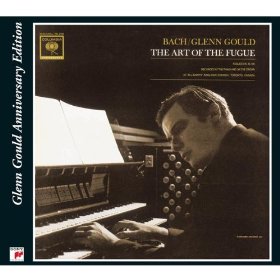
The taste I offer here is from Contrapunctus IX, which you can hear played by Glenn Gould on the organ here (and download it for 99 cents)…

Links claimed:

To Hesse and the Bead Game, because Bach’s presence, and that of counterpoint whose greatest exponent he was, is fundamental to Hesse’s great Game. Indeed, as he writes in the book:

The Game was at first nothing more than a witty method for developing memory and ingenuity among students and musicians. … One would call out, in the standardized abbreviations of their science, motifs or initial bars of classical compositions, whereupon the other had to respond with the continuation of the piece, or better still with a higher or lower voice, a contrasting theme, and so forth. It was an exercise in memory and improvisation quite similar to the sort of thing probably in vogue among ardent pupils of counterpoint in the days of Schütz, Pachelbel, and Bach — although it would then not have been done in theoretical formulas, but in practice on the cembalo, lute, or flute, or with the voice.

To Edward Said and his call for a symphonic reading of the Israeli-Palestinian situation: because he invokes the mind of Bach himself in the passage quoted in move 1, speaking of the

sublime grandeur of a series of tragedies, of losses, of sacrifices, of pain that would take the brain of a Bach to figure out.

Comment:

It is said that every artist teaches us to see, listen, hear, read, understand in a fresh way, so that the artist’s own work, at first well-nigh incomprehensible, may gradually find its way first into clarity, and then into ease of access, obviousness, popularity, and “classical” status — later stages of the same process will bring it first obscurity and finally oblivion.

We are not yet in a position to hold many thoughts simultaneously in the mind as Bach’s mind held many melodies, but we are opening to the possibility…

Multi-tasking… this will be an early attempt at a game of musical multi-thinking. Please think it through with me… ____________________________________________________________________________________________
Move 4: William Blake and Fourfold Vision

move-004.gif

Move content:

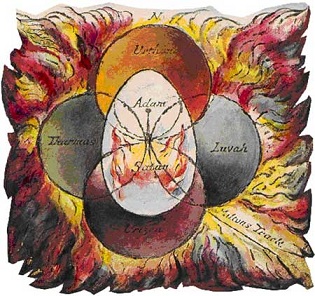
Here’s what William Blake saw:

ogormanblake.jpg

Here’s what William Blake said, in his Letter to Thomas Butts:

Now I a fourfold vision see

And a fourfold vision is given to me

Tis fourfold in my supreme delight

And three fold in soft Beulahs night

And twofold Always.

May God us keep\

From Single vision & Newtons sleep.

Here’s a commentary on Blake’s notion from a fascinating paper by Marcel O’Gorman:

Several Blake critics have attempted to unravel Blake’s use of term “fourfold vision.” Accoring to Jerome McGann, beings of single vision see the world in absolutes. Life is a prison term that ends in a final, discrete annihilation. Men of twofold vision see the world dialectically, according to contraries. Threefold vision enables one to recognize the contraries and see that they are not absolute, but that the boundaries of good and evil shift according to each individual. In Milton, Blake defines threefold vision as a peaceful state, and he associates it with Beulah:

There is a place where Contrarieties are equally True This place is called Beulah, It is a pleasant lovely Shadow Where no dispute can come. Because of those who Sleep.  (M 30:1-3)

Beulah and threefold vision are identified with sleep, restfulness. But fourfold vision involves activity, not sleep. Fourfold vision is generation and destruction, life and death, or even life in death. Evidently, Blake’s understanding of death is unconventional, to say the least. For Blake, death is considered as part of the creative process, a part of life.

Links claimed:

To the Glass Bead Game: because Hesse writes:

I suddenly realized that in the language, or at any rate in the spirit of the Glass Bead Game, everything actually was all-meaningful, that every symbol and combination of symbols led not hither and yon, not to single examples, experiments, and proofs, but into the center, the mystery and innermost heart of the world, into primal knowledge. Every transition from major to minor in a sonata, every transformation of a myth or a religious cult, every classical or artistic formulation was, I realized in that flashing moment, if seen with a truly meditative mind, nothing but a direct route into the interior of the cosmic mystery, where in the alternation between inhaling and exhaling, between heaven and earth, between Yin and Yang, holiness is forever being created.

Yin and yang are the opposites of the dialectic, but in the yin-yang symbol or tai-chih we see them alternating and interpentrating in the subtle and fluid play between them (Blake’s threefold vision) from which, in Hesse’s words, “holiness is forever being created” — Blake’s fourth.

To the Said Symphony, because precisely that kind of fluid flowing between one perspective and another is what allows empathy to triumph over opposition, and the “other” to become “brother” — the condition in which alone “the peaceable kingdom” / “peace on earth” can prevail…

Comment:

Blake was the mentor of my own poetic mentor, Kathleen Raine, and my own early published poems appeared in a Penguin volume edited by Michael Horovitz and titled Children of Albion in Blake’s honor.

I am happy to remember such friends in writing this game — and amazed to find in the Blake illustration above, which I only ran across today in O’Gorman’s article, yet another visual precursor to the boards on which my games are played. ____________________________________________________________________________________________
Move 5: Bob Dylan and One Too Many Mornings

move-005.gif

Move content:

dylan.jpg

The Bob Dylan song, One too many mornings.

You’re right from your side

I’m right from mine

We’re both just one too many mornings

An’ a thousand miles behind

Links claimed:

To Fourfold Vision and William Blake: Dylan captures the utterly wrong double-rightness of conflict that features in Blake’s vision — at an intensely personal level. And I’d argue, personally, that Dylan does in music and poetry what Blake was doing in poetry and visual art — at greater depth than his Blakean friend (and companion on parts of the Rolling Thunder tour) Allen Ginsberg.

Comment:

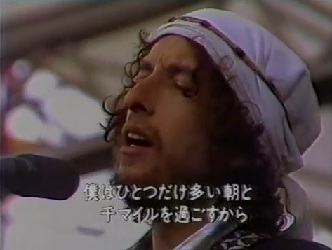
I believe I was at the Colorado Rolling Thunder Revue concert where Dylan sang the version which YouTube presents here from a Japanese bootleg video tape. You can purchase the Hard Rain album — or just the one track — here. ____________________________________________________________________________________________
four more moves coming up shortly in a follow-up post, and then I’ll take a break.

The US Army War College National Security Seminar 2011

Sunday, June 12th, 2011

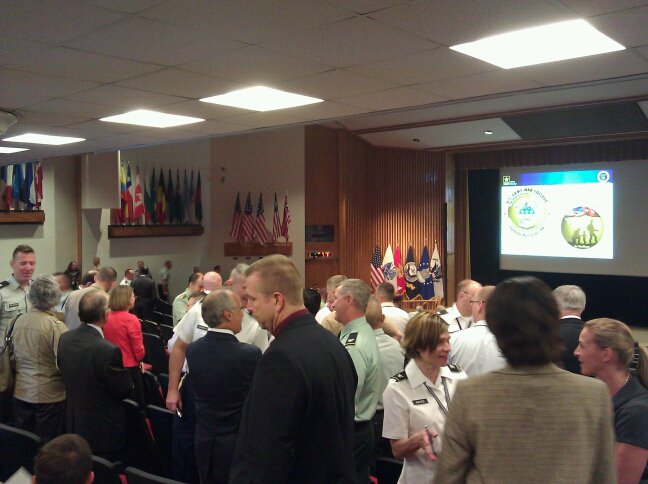
warcollege.jpg

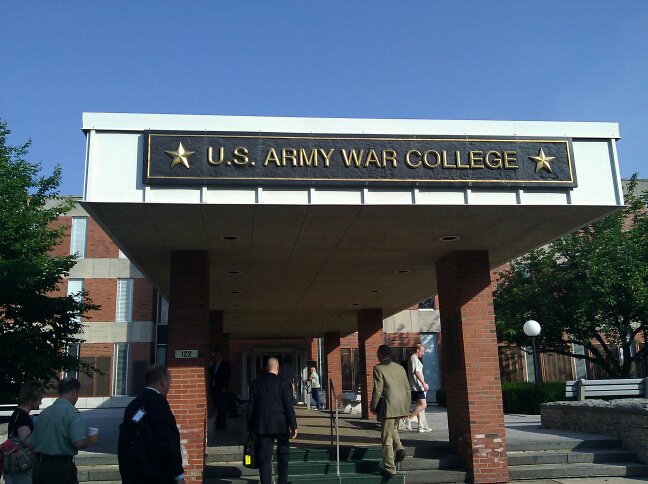
As noted previously, I was fortunate to attend the National Security Seminar at the the US Army War College this year and wanted to relay my impressions while they were still fresh.

First, in terms of reception and cordiality, I have rarely experienced such an extensive and personal outreach as was demonstrated by the War College staff, faculty, administration and students. Every new member had a “sponsor” – a student, usually a colonel or Navy captain, who acted as a liason and personal guide from the time their plane touched down until the moment they returned to the airport. My sponsor, the former commander of the WolfhoundsColonel Richard “Flip” Wilson, whom I consider a friend, really extended himself on my behalf, making me feel welcome and a full member of Seminar Group 20. Most of the students have multiple tours of duty in Iraq and Afghanistan under their belt and many can report the same for the first Gulf War, Panama, Bosnia or Kosovo.

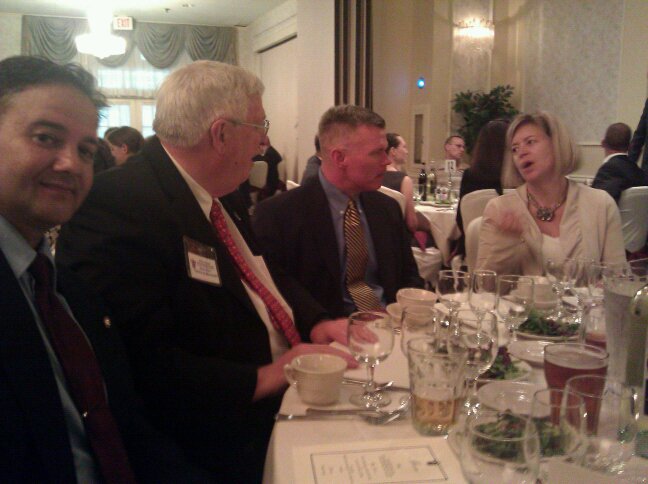
The War College, the Commandant and the Seminar Group all hosted receptions and dinners designed to get students and civilian new members to mix and further discuss issues raised in the seminar sessions or lectures. At these events I had the opportunity to meet and talk to the leadership of the Army War College including the Commandant Major General Gregg Martin, the Deputy Commandant for International Affairs, Ambassador Carol Van Voorst, the Executive Director of the Army Heritage Foundation, Mike Perry, the Director of SSI, Dr. Douglas Lovelace,  the Chief of Staff and numerous faculty and seminar members. The New Members such as myself were exceedingly well fed at these events as I suspect the Army was attempting to prove that it really does march on it’s stomach.


warparty.jpg

warparty2.jpg

The serious business of the National Security Seminar was divided into two segments, the talks given by distinguished speakers to the entire class of 2011 and the New Members and the Seminar Group sessions of approximately twenty students, New Members, academics and foreign visitors. We received a brief on the war in Afghanistan from the ISAF Chief of Staff, who was standing in last minute for General Petraeus who was called to meet with senior adminstration officials; and a very interesting concluding talk by Foreign Affairs Editor Gideon Rose, author of How Wars End, which covered issues of strategy, grand strategy and the disconnect with policy.

warseminar.jpg

  The National Security Seminar is run strictly on a non-attribution basis, in order to encourage candor and frank exchange of views, which handicaps my ability to discuss specifics here. I can say that my views on Pakistan ( which I compared to “North Vietnam” ) riled more than a few people – Pakistan is the only country in the world given 2 exchange student slots at the Army War College at the request of the most senior leadership of the US Army – and several students and faculty members took the time, outside of seminar sessions, to make certain I heard countervailing POV regarding Pakistan’s value as an ally. Other topics included, but were not limited to:

Defense budget cuts and force structure
Narco-cartels in Mexico: Insurgency or No?
Civil-Military Relations
Repeal of DADT
AfPak War
al Qaida and GWOT/US Strategy
COIN
Critical thinking and Leadership
Logistics
Libya and NATO
AWC Strategy Curriculum/Program
What the US public expects from their military
China as a peer competitor
Effects of ten years of war on officer corps/military
Illegal combatants and international law
PTSD
Battle of Gettysburg and Grand Strategy
Cyberwar
Differences in Armed Services strategy, command climate, discipline, leadership
The Arab Spring
US Global leadership and Economics
Interagency Operational jointness

Most of the discussion took place in the seminar groups, with Q&A periods in the mass sessions with featured speakers. I came away deeply impressed with the seriousness and insights as practitioners that AWC students brought to the table. The AWC strategic studies program seeks to broaden students who are assumed to arrive with tactical expertise and prepare them for higher command that carries operational, strategic and even policy responsibilities (at least in terms of interpreting and executing within policy guidelines). Many students were articulating ideas associated with Thomas P.M. Barnett, the “mission order” and “commander’s intent” style of leadership or Clausewitzian strategic premises during debates and discussion.

The National Security Seminar Week was for me, an enlightening and exceptionally enjoyable experience, one I would highly recommend to readers who may have such opportunities in future years.

With Greco: two views of Toledo

Monday, June 6th, 2011

[ by Charles Cameron — perception, painting, pre-modern, modern, post-modern, heaven, sky, simulation, John Donne, El Greco ]

.

It is Sunday.

I find it powerfully interesting that the sky as perceived by painters (our “seers” par excellence) used to be filled with supernatural beings and is currently filled with natural ones — a clear sign that our culture has effectively moved from what one might call a theological vision of the world to a meteorological one (with astronomical trimmings under a clear sky)…

And I see that transition captured very precisely in four words, when John Donne writes:

At the round earths imagin’d corners, blow
Your trumpets, Angells, and arise, arise
From death, you numberlesse infinities
Of soules, and to your scattred bodies goe…

The “round earth” is that of modern science, the “imagin’d corners” those of pre-modern maps – and angelology.

*

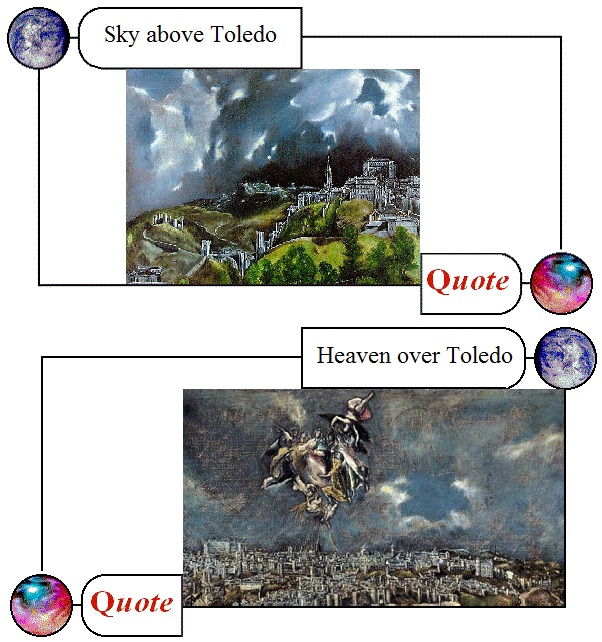
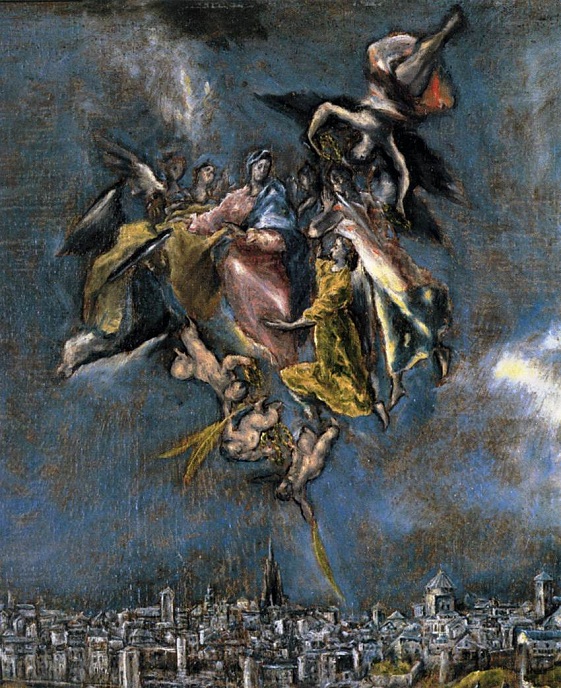
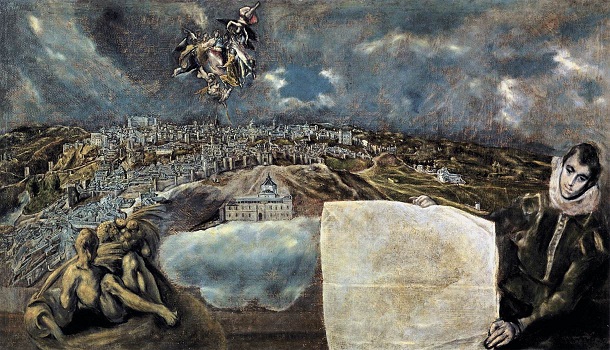
I have to admit, therefore, that I was surprised yesterday evening to come across an El Greco painting of Toledo that featured the blessed Virgin Mary over the city.

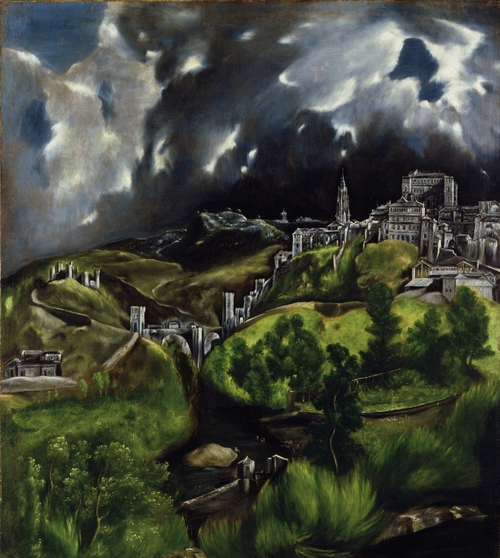
I have long been familiar with his better known View of Toledo, which is entirely naturalistic unless you want to consider storm-clouds as portents of a divine presence —

quo-sky-over-toledo.jpg

but the second of these images, from the View and Plan of Toledo, came as quite a surprise…

Here is a detail of the Virgin taken from it, to illustrate the point:

el-greco_view-and-plan-of-toledo_detalhe2_c1610.jpg

*

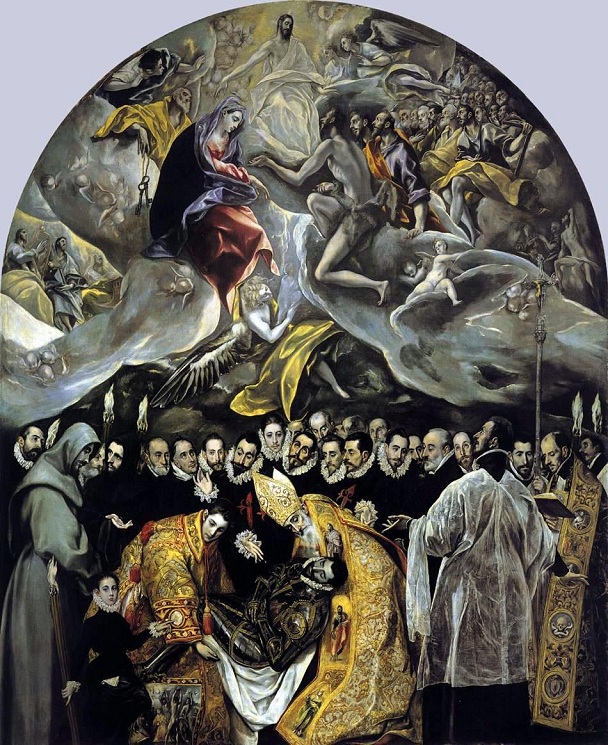
El Greco is famous for painting heaven-and-earth as a continuum – his great masterpiece, the Burial of Count Orgaz, catches the release of the soul from its bodily sheath as directly as Donne’s “to your scattred bodies goe” does to the return of those souls to corporeality at the General Resurrection:

entierro-del-conde-de-orgaz-sm.jpg

*

And yet El Greco, like Donne, sees both – Toledo under storm-clouds, Toledo under the shelter of the blessed Virgin…

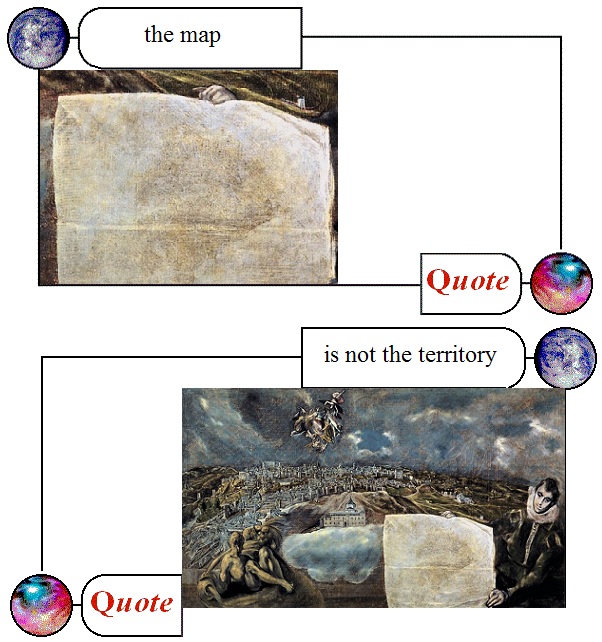
But there is more here, in this extraordinary painting. There is a map of the territory

quo-greco-toledo.jpg

*

If I could say in a nutshell what post-modern is, I would say it is recursive. It recognizes our perceived reality to be a simulation, and is thus always playing with maps and models, as Shakespeare was when he penned the words “All the world’s a stage” to be spoken in a theater whose sign and motto was “Totus mundus agit histrionem” – the whole world enacts a play.

Think of Hofstadter‘s Godel Escher Bach. Of Escher himself, and his image of himself holding his own small world in a glass sphere in his hand…

Think of Korzybski, and his dictum: the map is not the territory.

Think of Gregory Bateson, who wrote:

We say the map is different from the territory. But what is the territory? Operationally, somebody went out with a retina or a measuring stick and made representations which were then put on paper. What is on the paper map is a representation of what was in the retinal representation of the man who made the map; and as you push the question back, what you find is an infinite regress, an infinite series of maps. The territory never gets in at all. […] Always, the process of representation will filter it out so that the mental world is only maps of maps, ad infinitum.

Astoundingly, presciently – prophetically? – El Greco is already alluding to this, around 1610, in his View and Plan of Toledo.

11777-view-and-plan-of-toledo-el-greco-sm.jpg

*

El Greco’s Burial of Count Orgaz is in the Church of Santo Tomé in Toledo.

El Greco’s View and Plan of Toledo is in the Museo de El Greco, Toledo.

Here is the complete text of Donne’s sonnet:

At the round earths imagin’d corners, blow
Your trumpets, Angells, and arise, arise
From death, you numberlesse infinities
Of soules, and to your scattred bodies goe,
All whom the flood did, and fire shall o’erthrow,
All whom warre, dearth, age, agues, tyrannies,
Despaire, law, chance, hath slaine, and you whose eyes,
Shall behold God, and never tast deaths woe.
But let them sleepe, Lord, and mee mourne a space,
For, if above all these, my sinnes abound,
‘Tis late to aske abundance of thy grace,
When wee are there; here on this lowly ground,
Teach mee how to repent; for that’s as good
As if thou’hadst seal’d my pardon, with thy blood.

El Greco’s View of Toledo is in the Metropolitan Museum of Art in New York:

29_1006.jpg

Here we find no blessed Virgin, no angels with their final trumpets — and yet this painting can be viewed as analogous to his Vision of Saint John and the opening of the Fifth Seal — which owes its power to its “otherworldly stormy light” — and thus seen as yet another apocalyptic scene, one which “recalls St. John’s vision of the New Jerusalem in the Book of Revelations … a landscape of unearthly power and drama: a dialogue between heaven and earth conducted appropriately by the cathedral spire…”

Guest Post: Few’s The Serenity Prayer for Grand Strategy

Thursday, May 26th, 2011

[Cross-posted from SWJ Blog]

Major Mike Few, one of the SWJ Blog’s trusty editors opines on the nuts and bolts of “doing grand strategy”. Pay close attention to points #2 and #7. Hopefully, the first of many guest posts here by Major Few, if I can steal some of his time from Dave Dilegge 🙂 :

The Serenity Prayer for Grand Strategy: Nine-Step Recovery Method for Reframing Problem Solving

by Mike Few

Recently, our authors began to shift from problem definition to reframing problem solving. Over the last year, we published some remarkable works effectively describing Iraq, Afghanistan, Mexico, Libya, and others. Simultaneously, we published several series on design and wicked problems.

The challenge we are posing is can someone produce a concise document applying design to an existing problem? If we cannot find practical application or wisdom, then the process becomes a moot effort. Below is my white board attempt to provide an example and discussion for others to follow. This blog post is similar to many of the discussions our authors and readers have daily in the classroom and nightly at the pub or dinner with colleagues. Simply put, I am merely merging the sum of our published thought and discussions.

Three years ago, I was challenged to determine if my experiences in big wars and counterinsurgency could be applied to the macro level. On the tactical level, I found that I simply relearned the lessons of those that had come before me, the countless art of war and warfare. However, when I consider how my thinking had changed, I feel that perhaps there are some lessons that can be applied for us all.

In combat, I finally learned the limits of my own control. This understanding freed me to concentrate focusing on changing the things that I could control. I look at framing problem solving in international relations in a similar manner. It’s kind of like the Serenity Prayer for Grand Strategy. So, as a practical exercise, below is an example of how I would use Design, Wicked Problems, and Military Decision Making Process using the example of Mexico.

1. Define what we cannot control. We cannot “fix” Mexico. They are a sovereign nation-state, and they must choose to work on their internal issues. Moreover, our “solution” to their problems may not be a proper fit despite our best intentions. Our intervention efforts in Central and South America over the past sixty years (or more) have had mixed results.

2. Define the problem as it is not as we wish to see it. Are we really in a war on poverty, drugs, education, terrorism, and governance? Are we really at war? Labels are often limiting, but there needs to be some common framework to understanding. Typically, that can be driven by good communication and active listening. We must learn to transcend how “I” see the problem and work towards how the collective group sees the problem accounting for all stakeholders.

3. Define our relationship. How does the US and Mexico see each other? This perception requires a degree of self-introspection and humility. Are we a brother attempting to help our sibling overcome addiction or work through difficult financial times? Are we a parent disciplining a spoiled child? Are we a spouse in a broken marriage? How we see ourselves defines our national interest. If we see ourselves as the parent, then we’re self-imposing a conceptual block.

As Martin Luther King wrote while sitting in the Birmingham Jail,

“Moreover, I am cognizant of the interrelatedness of all communities and states. I cannot sit idly by in Atlanta and not be concerned about what happens in Birmingham. Injustice anywhere is a threat to justice everywhere. We are caught in an inescapable network of mutuality, tied in a single garment of destiny. Whatever affects one directly, affects all indirectly. Never again can we afford to live with the narrow, provincial “outside agitator” idea. Anyone who lives inside the United States can never be considered an outsider anywhere within its bounds…In any nonviolent campaign there are four basic steps: collection of the facts to determine whether injustices exist; negotiation; self-purification; and direct action.”

4. Describe what we are currently doing and how we can adjust these things.

– Impact of NAFTA
– Border Security
– FID efforts in Mexico
– Counter-Drug efforts in Mexico
– Counter-Drug efforts in the United States
– Anti-Gang efforts in the United States

5. Discuss the cost benefits of future intervention efforts and internal reforms

– Comprehensive immigration reform
– Dream Act
– Expanded Counter-Drug efforts
– Expanded FID efforts to better strengthen Mexico’s Army and Police internal security forces
– State Department “better” governance efforts (Plan Colombia)- to include judicial and economic issues
– Legalizing drugs in the continental United States (demand side interdiction)
– Comprehensive Prison Reform in the United States
– Treasury Department financial interdiction to narco banking
– Promoting and expanding free press in Mexico through Twitter, Facebook, and new media

6. Describe Area of Influence- Central and South America

– Illegal immigration from Guatemala
– Drug Trafficking from Colombia

7. Ask the hard questions

-What are the key factors driving the problem?
-What is the causality?
-And, if the analysis is from a U.S. perspective, to what degree and in what ways is the problem a problem for the United States?
-what ways do those in power benefit by the status quo?

8. Rethinking the Assumptions

-What are the desired outcomes?
-Is the policy driving the process or is the effort outcome based?
-Are our efforts helping or hurting?

9. Timing of Implementation

– Simultaneous, Sequential, or Cumulative
-Prepare to accept that some items are not decision points; Rather, they are processes that change and morph over time.

Special thanks to those that contributed to the proofreading of this post, and I would like to specifically highlight Dr. Nancy Robert’s methodology for teaching any class on problem solving,

A. Creativity
B. Problem Framing
C. Systems thinking
D. Entrepreneurship and Innovation
E. Collaboration in Networks

Now, let the discussion and writing continue…


Switch to our mobile site