zenpundit.com » metacognition

Archive for the ‘metacognition’ Category

New Books

Monday, March 11th, 2013


Out of our Minds: Learning to be Creative by Sir Ken Robinson 

Wild Bill Donovan by Douglas Waller  

I am about half finished with the first book by creativity in education guru Sir Ken Robinson, who also has a new book out called, The Element. Technically, I have been reading a large volume of books, articles and research regarding creativity and creative thinking lately for a project, but most of those are academic in nature while Robinson is writing for mainstream audiences. I may or may not review it here, but it is clearly argued and Robinson is an effective popularizer.

The biography of Wild Bill Donovan is timely. If the idiosyncratic and at times improvisational OSS, staffed by gifted amateurs, eccentric adventurers and white-shoe, unapologetically elite WASPS, was something that would be impossible to exist in today’s rancid political climate, there are elements in that legacy that are in short supply in today’s modern and highly technological IC.

Ironically, many of the pioneers in creativity research that developed that field within cognitve psychology in America were themselves disproportionately veterans of the OSS.

Boyd and Beyond Local DC Event

Tuesday, December 18th, 2012

[by J. Scott Shipman]

Jim Hasik’s White Board Outline


At the suggestion of Adam Elkus, we were privileged to host our first “local” Boyd and Beyond event on 15 December. We had 14 attend, and five speakers. Logistically, we turned our family room in to a fairly comfortable briefing area, using a wall with Smart Sheets as a temporary white board. In keeping with our October events, we took up a collection and had pizza delivered for lunch. Coffee, soft drinks light snacks were provided. Each speaker was allotted 50 minutes, but given the participation of the audience, most talks lasted about 90 minutes. I should emphasize to those planning one of these events, to keep a lean speaker’s list, as the Q&A and discussion can easily double the time of a presentation—-and I believe all who attended would agree the comments/discussion made already great presentations even better.

My sincere thanks go out to my wife and partner, Kristen, for making this event look easy! She was the one who made sure everything was moving along and that folks felt at home. I would encourage others around the country to schedule and hold events through the year. We’re looking to do another in March 2013.

Our speakers were:

Jim Hasik, Beyond Hagiography: Problems of Logic and Evidence in the Strategic Theories of John Boyd

Francis Park, The Path to Maneuver Warfare in the U.S. Marine Corps

Robert Cantrell,  Which Card Will You Play?

Terry Barnhart, Designing and Implementing Maneuver Strategy in Transforming Major Organizations

Marshall Wallace, Theories of Change and Models of Prediction

I led off with a few comments on the military professional and intellectual rigor. I recommended the best book I’ve read this year: Inventing Grand Strategy and Teaching Command, by Jon Tetsuro Sumida, and the challenges he suggests in the realm of intellectual rigor. He writes:

“It remains to be seen whether readers exist with the mind and will to accept his guidance on what necessarily is an arduous intellectual and moral voyage into the realm of war and politics.” (emphasis added)

I followed with the example from An Unknown Future and a Doubtful Present: Writing the Victory Plan of 1941, by Charles E. Kirkpatrick. Mr. Kirkpatrick’s little book provides an excellent primer to the formulation of the United States’ WWII strategy and a refreshing insight into the education of an master strategist, then Major Albert C. Wedemeyer, attached to the War Plans Division, the Army chief of staff’s strategic planners, who wrote the Army strategy for WWII in 90 days. (read the review here) I suggested that military professionals should start something akin to a book club, where they can discuss and debate strategic issues and concept.

Following my comments, Jim Hasik offered his critique of John Boyd’s work. Adam tweeted that we were a “tough crowd,” but Jim was able to discuss his misgivings with respect to Boyd’s work and a lively discussion got us started. For those unfamiliar, Jim is the author of a paper called, Beyond Hagiography, which generated controversy in the Boydian community following this year’s October event at Quantico. (reviewed here and at zenpundit.comHere is a link to the paper. (see Hasik’s white board outline above).

According to Hasik, Boyd erred when extrapolating from physical processes/science to social processes. He reviewed Boyd’s use of science in his essay, Destruction and Creation, and suggested no literal correlation between Clausius’ Second Law of Thermodynamics (entropy), Gödel’s Incompleteness Theorem, and Heisenberg’s Uncertainty Principle and human behavior (on this I concur with Hasik, as analogy or metaphor these scientific principles enlighten).  Hasik asked if OODA scales from air-to-air combat to large scale events, and whether OODA was original (compared to PDCA, for example). One point that generated quite a bit of discussion was whether one could “like” Clausewitz or Sun Tzu and Boyd. Hasik questioned whether Boyd’s work should be judged as social science, history, or war studies, and suggested that further work was needed to fill in the gaps in his work. In October, someone suggested Boyd needed a “Plato,” someone to address Boyd’s work with less emphasis on science (as in Osinga’s book), thereby making Boyd’s work more accessible. The Strassler model was suggested; Strassler is an “unaffiliated scholar” who has written exhaustively referenced versions of ThucydidesHerodotus, and Arrian. [personal note: I believe a Strassler-like book on Boyd’s ideas would be a great resource] A great thought-provoking conversation.

Francis Park’s White Board


Francis Park’s talk on on maneuver warfare, the evidence of history began with “I’m a historian and I have a problem.” The irony wasn’t lost on the audience, as Francis is an active duty Army officer, speaking on the history of the USMC’s adoption of maneuver warfare (MW). Park called the Marine Corps “the most Darwinian of the services.” The venue for for the Corps discussion between MW advocates, and the “attritionists” was the Marine Corps Gazette. This venue was “unofficial,” otherwise the debate may have never happened. The Gazette’s forward-thinking editor made space and encouraged the debate, which was a “long, bitter, and complex fight.”

Park listed and discussed the champions of MW Michael D. Wyly, G.I. Wilson, William Woods, William Lind, and Alfred M. Gray. Park recommended Fideleon Damian’s master’s thesis, THE ROAD TO FMFM 1: THE UNITED STATES MARINE CORPS AND MANEUVER WARFARE DOCTRINE, 1979-1989. (Adam Elkus recommended Eric Walters essay in the Small Wars Journal, titled Fraud or Fuzziness? Dissecting William Owen’s Critique of Maneuver Warfare.)

Park called the USMC adoption of MW a “confluence of fortune” that may have never happened without the vigorous efforts of proponents.

Robert Cantrell’s Which Card Will You Play? was an instructive and interactive example of Robert’s strategy cards. Cantrell has two decks of strategy playing cards, one devoted to strategy, the other to sales strategy. The user’s guide is at www.artofwarcards.com.

Robert provided examples of how the cards are used to spark strategic thought and ideas. Volunteers pulled first one, then two cards from the decks, and read aloud and commented on how the statement(s) on the cards could be used in practice. For example, “Muddy The Water To Hide the Nets” was drawn (the 8 of clubs, a bit more on card suits from Robert below). The “strategy” is to “confuse your adversary so he cannot perceive your intentions. The “Basis” is “Confused adversaries make mistakes they would not make if they grasped your intentions.”

Longtime friend of this blog, Fred Leland at Law Enforcement Security Consulting is using the cards with success. Fred’s goal is “to get cops thinking more strategically and tactically in their work. I have been pulling a card from the deck and writing my thoughts and sharing them with cops who have been passing them along to their officers.” He is using Robert’s cards for “in-service” training, and providing a low cost entry into strategic thinking.

I followed up with Robert and asked for an explanation of the card suits. Here is his response:

Hi Scott – although they are gray delineations, the Hearts are oriented on the shaping self, the Clubs on shaping the field of contest…the diamonds are isolation strategies, and the spades are elimination strategies. This is the wolf pattern on the hunt: wolf becomes all the wolf it can be, shapes the hunt, isolates a member from the heard, brings that member down. With aces high – and again also gray – the higher cards tend to be strategies used from a greater abundance of strength and the lower numbers from comparative weakness in strength. Of course from here we can talk about gaining relative advantage if we cannot have absolute advantage to gain strength for a critical moment…and so on

Terry Barnhart spoke on Boydian organizational applications in a talk called Designing and Implementing Maneuver Strategy in Transforming Major Organizations. Terry said any organizational change had to be accomplished on the realms of the moral, mental, and the physical. With that in mind, he advised mapping the social networks of the organization and speaking in “the language of the culture” and “asking for what you need” when attempting to transformation. The end goal is “aligned autonomy,” and Terry’s recommended method of choice is taken from Boyd’s Patterns of Conflict,Slide 80:

Patterns of Conflict, Slide 80


Search out the “surfaces and gaps”, as reference from Slide 86, POC. In Boyd’s language:

•Present many (fast breaking) simultaneous and sequential happenings to generate confusion and disorder—thereby stretch-out time for adversary to respond in a directed fashion.

•Multiply opportunities, to uncover, create, and penetrate gaps, exposed flanks, and vulnerable rears. [emphasis added]

Create and multiply opportunities to splinter organism and envelop disconnected remnants thereby dismember adversary thru the tactical, grand tactical, and strategic levels. [emphasis added]

In Terry’s words, “be everywhere at once” and establish relationships that result in buy-in, avoiding “no,” as Terry advised it can take a couple of years to overcome an objection. As aligned autonomy is reached, word will get around about the successes, and all of sudden what was a single agent of change becomes a movement. So Terry is recommending methods in maneuver warfare as a method in transforming organization culture.

During Terry’s talk, Dave recommended Orbiting the Giant Hairball, by Gordon MacKenzie as a guide in navigating the bureaucracy and obstacles often found in large organizations.

Marshall Wallace’s White Board


Marshall Wallace’s Theories of Change and Models of Prediction was our final presentation. Marshall has emerged as one of the leading thinkers among Boydeans. Wallace said, “people are lazy” as he led off his discussion of change models. [personal note: I’ve come to refer to this laziness as “neurological economy”] His thinking was influence by Daniel Kaneman’s Thinking, Fast and Slow and the Heath brother’s Switch: How to Change Things when Change is Hard. When change is desired, clarity is an absolute must have. Wallace offered the four models above as example of change. He said we must ask: “What is the change we want to see?” and ” What are the pre-conditions?”—instead of this model, most people begin with the idea, which more often than not, fails.

Wallace walked our group through the models and emphasized the importance of tempo and used his wife’s efforts to establish dog parks in their city. Everything in government has a process, and Wallace said in this case “going slower than the politicians” paid off. Also, for programs of change, it is best if there is 100% transparency of goals. Both Marshall and Terry recommended a book called The Progress Principle, by Teresa Amabile and Steven Kramer. The most powerful model for me was the one in the lower right corner—particular the use of “more people” and “key” people in any effort to affect change.

Post meeting, Wallace posted the following to our Facebook group wall, that rounds out and expands his thinking:

I was on the plane back to Boston yesterday morning, deeply engrossed in Terry’s book [Creating a Lean R&D System] when a phrase leapt into my head: “Target the whole organism”.

As the Michaels in our lives (Moore and Polanyi) remind us, “we know more than we can say”. I feel that quite clearly and I constantly struggle with language. I am never satisfied with any presentation I give because I know that, due to failures on my part to use the perfect word at the right moment, I left some understanding on the table.

Somehow the weekend, with spectacular conversation, a good night’s sleep, the enforced idleness of air travel, and Terry’s superb book, shook something loose.

Target the whole organism.

What flashed through my mind at that moment were pieces of the talks.

Jim prompted discussion of what the next set of books about/on/adding to Boyd should look like.

Francis drew a pie wedge with “firepower” on one edge of the pie and “maneuver” on the other. He was describing two schools of thought on conflict as represented by these extremes. Everybody seemed to agree that the balance lay somewhere in the middle and was definitely related to the context.

Robert’s exercises with his strategy decks shook countless examples of strategic action and insight loose in our minds. The combination of cards, taking one from each of the competition and collaboration decks, was especially exciting.

Terry laid out his plan to blitzkrieg his company, and invited us to make it better.

I ended with a 4-cell matrix demonstrating the four basic categories under which all Theories of Change operate (more on this later). Experience has shown that most people operate out of an implicit Theory that traps them in one quadrant, whereas social change only occurs if all four quadrants are affected.

Target the whole organism.

I got home and opened up “The Strategic Game of ? and ?”. Interaction and Isolation.

Firepower and maneuver – at the same time. Competition and collaboration at the same time.

Boyd side-by-side with his sources and several commentators. CEO, discouraged middle-managers, and the line at the same time. More People and Key People at both the individual level and the structural level all at the same time.

Target the whole organism.

A force that uses maneuver to confuse and firepower to destroy will dominate. A force that can swing rapidly between extremes and also find balance is even more slippery than one that acknowledges the “necessary” balance. The two practices can be in separate parts of the battlespace (context matters), but because both are occurring, the confusion generated may well be more intense. It looks as though the force is two distinct armies and communication among the enemy may be unintelligible because the threats being faced are so different.

Bringing collaborative concepts into competitive spaces or vice versa while not abandoning the underlying logic of the space opens up more options, challenges notions, and expands horizons. Can we interact and isolate at the same time? What does that snowmobile look like?

If we want to effect social change, we need to target the whole system. We can sequence our efforts in time, though we can’t forget to move as quickly as the circumstances allow. At the same time, every effort must be connected to the whole organism.

The target is not the target. I do not aim at the eye of the fish. I don’t wan’t to hit the bullseye.

I want to pick up the whole madding crowd of intense archers, cynical kings, and wildly cheering spectators and move them.

This was the first “local” event, and based on the response, we’ll be doing these a few times a year. Many thanks to all who participated, and Merry Christmas and a Happy New Year to  you all!

UPDATE: Dave shared these with our group. Francis said, “We live and die by bumper stickers.” Here is a good example:


Here is Dave’s interpretation of the Sufi elephant:


Cross-posted at To Be or To Do.

Of children, cultural differences, and computers

Saturday, December 15th, 2012

[ by Charles Cameron — kids, computers, creativity and games ]
.

Motorola Xoom tablet

.

It’s quite a triumphant story, with African kids in the foreground and Nicholas Negroponte and MIT playing the role of proud parents pushing them forward from behind…

With 100 million first-grade-aged children worldwide having no access to schooling, the One Laptop Per Child organization is trying something new in two remote Ethiopian villages—simply dropping off tablet computers with preloaded programs and seeing what happens. The goal: to see if illiterate kids with no previous exposure to written words can learn how to read all by themselves, by experimenting with the tablet and its preloaded alphabet-training games, e-books, movies, cartoons, paintings, and other programs. Early observations are encouraging, said Nicholas Negroponte, OLPC’s founder, at MIT Technology Review’s EmTech conference last week.

[ … ]

Earlier this year, OLPC workers dropped off closed boxes containing the tablets, taped shut, with no instruction. “I thought the kids would play with the boxes. Within four minutes, one kid not only opened the box, found the on-off switch … powered it up. Within five days, they were using 47 apps per child, per day. Within two weeks, they were singing ABC songs in the village, and within five months, they had hacked Android,” Negroponte said. “Some idiot in our organization or in the Media Lab had disabled the camera, and they figured out the camera, and had hacked Android.”

That’s a striking story, and it has caught many people’s attention since David Talbot wrote about it in a piece in MIT’s Technology Review in late October, titled Given Tablets but No Teachers, Ethiopian Children Teach Themselves.

**

I’d like to let that sink in — because I don’t want to deny it, in fact I want to share the excitement — but I do, too, want to juxtapose it with something else I read recently, where we’ll see some other African children, and where a different set of questions about their intelligence are in the air.

This quote is from Malcolm Gladwell, in a New Yorker piece titled None of the Above: what IQ can’t tell you about race:

The psychologist Michael Cole and some colleagues once gave members of the Kpelle tribe, in Liberia, a version of the WISC similarities test: they took a basket of food, tools, containers, and clothing and asked the tribesmen to sort them into appropriate categories. To the frustration of the researchers, the Kpelle chose functional pairings. They put a potato and a knife together because a knife is used to cut a potato. “A wise man could only do such-and-such,” they explained. Finally, the researchers asked, “How would a fool do it?” The tribesmen immediately re-sorted the items into the “right” categories. It can be argued that taxonomical categories are a developmental improvement— — that is, that the Kpelle would be more likely to advance, technologically and scientifically, if they started to see the world that way. But to label them less intelligent than Westerners, on the basis of their performance on that test, is merely to state that they have different cognitive preferences and habits. And if I.Q. varies with habits of mind, which can be adopted or discarded in a generation, what, exactly, is all the fuss about?

That one, of course, concerns me deeply — in fact they both do.

**

Look, my work with Cath Styles on the Sembl Game is predicated on the importance of resemblances — so the more cognitive preferences we can marshal by inviting people to make rich and varied links between things — Kpelle-style, western-style, art-style, science-style, you think of it, you name it — the better. But clearly we should also be aware in using and propagating the game that different styles of association exist, and should be explored.

And the first quote? That’s important too, because it shows the eagerness to learn that’s there, innate, before our culturally-acquired habits and assumptions and behaviors inhibit the childlike excitement of discovery, recognition, eureka! and aha!

**

Howard Rheingold once said of community-building digital media such as this blog, “Like all technologies, this medium has its shadow side, and there are ways to abuse it.”

When feeling the thrill of “up” stories like Negroponte’s, it may we wise to ask also what the “down” side might be. And IMO, there’s always room for optimism — but let’s keep it cautious, eh?

Form is insight: a musical experiment

Monday, October 22nd, 2012

[ by Charles Cameron — here’s a musical experiment from the book / project i seem to be writing, which offers a grand slam intro to contemplative and artistic approaches to creative thinking, and hence a fresh angle on intelligence ]
.

It looks very much as though I’ve been beginning to write parts of let’s call it “a book” for a while here on Zenpundit. I laid out the overall topic and approach as I see it in my previous post, but here I would like to launch into it mid-stream, with a musical experiment to explore the mind’s capabilities. I’ll explain why, later.

**


.

**

Okay, here’s the experiment.

I invite you to listen to a short piece by JS Bach on YouTube. This will take roughly three and a half minutes of your time, the piece of music itself is one of the glories of the classical tradition, I’ve chosen the video because of the terrific graphics that accompany and illuminate the music, there will be some rock and ragtime to follow for those whose tastes go those ways — and I must ask you to pay very special attention while watching and listening to the video.

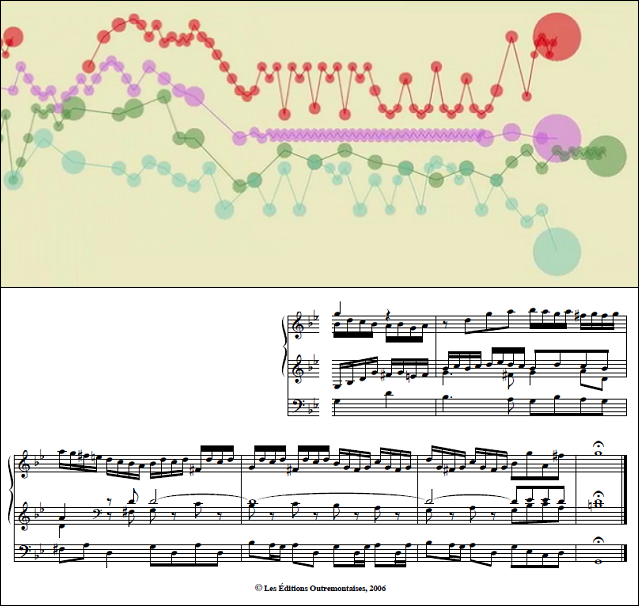
Before you do that, however, I’d like you to take a look at the image at the top of this post, which shows you the ending of the piece both as the video graphics present it, and in the musical notation or “score” an organist would read. The graphics are terrific because they allow the untrained eye to follow the threads of the different melodies or “voices” as Bach braids them together. The work is his “Little Fugue” in G minor, which you can find indexed in his collected works as “BWV 578”.

Here’s how I’d like you to pay attention during the piece:

As you listen to the performance on video, I’d like you to follow the colored lines of the melodies as they move along in the video graphic, and listen carefully to hear how many of the lines of sound you can actually follow distinctly in your mind. At the beginning there’s only one “voice” – only one line of melody – so your task is easy. If you are used to listening to music of one sort or another, you’ll almost certainly be able to track, more or less, some kind of thumping bass line and some kind of melody rising above it – two voices.

Can you manage three? four or more?

If you’re a musician you may still find the graphics — and the exercise – illuminating, but you might prefer to make the same experiment with a version of the piece played by Robert Köbler on a Silbemann organ, accompanied on video by the score..

Here’s the video — see how many voices you can hear and track:

**

How did you do? How many voices could you follow at one time?

And why am I bothering to as you to do this, and then talking so much about it? After all, you may already know everything I’m saying and more, or you may simply not care that much about such things.

Here’s why: the project is about creativity and intelligence.

It’s about how to apply forms of creativity that are generally found in the arts and humanities — and in the world’s contemplative traditions — to the questions that arise for every bright human as we face the exhilarating challenging and terrifyingly complex world around us.

It’s about understanding complexity, in the way the Intelligence Community needs to understand complexity, and business leadership, and our scientists and technicians, and the congregants at our synagogues, churches, mosques and temples, and, well, all the bright people everywhere — disillusioned, or fresh and rarin’ to go.

**

Complex problems often require some sort of recognition and resolution of several or many distinct and sometimes conflicting voices, points of view, concerns or vectors.. which may shift in intensity and direction as the situation evolves.

In musical terminology, any music that includes two or more distinct melodic lines or “voices” playing together simultaneously is polyphonic — from the Greek for “many voices”. Counterpoint — from the Latin for a point that counters another point — is the artful way in which composers can “work” two or more melodic lines together, so they clash at times, resolve, and harmonize.

The fugue — the particular contrapuntal form Bach uses in the piece you just heard — imposes even tighter constraints on the composer, and can elicit even greater creative inspiration as a result — as many of Bach’s, Mozart‘s, Beethoven‘s and others’ greatest works testify..

**

I imagine you can see that the many voices of polyphony — voices in counterpoint, that at times clash and are in need of resolution and harmony — have their equivalents in the complex multi-stakeholder problems, clashing points of view and need for constructive resolutions that creative artists, intelligence analysts, strategy, policy and decision makers, and anyone who wants to keep aware of the shifting currents of our strange and complicated times all need to take into account.

So polyphonic, and specifically contrapuntal, thinking, can be extended way beyond the realm of music — as Hermann Hesse suggested in his greatest novel, Glenn Gould tried to demonstrate in his “contrapuntal radio” pieces, and Edward Said understood when he characterized the Israeli-Palestinian issue in these words:

When you think about it, when you think about Jew and Palestinian not separately, but as part of a symphony, there is something magnificently imposing about it. A very rich, also very tragic, also in many ways desperate history of extremes — opposites in the Hegelian sense — that is yet to receive its due. So what you are faced with is a kind of sublime grandeur of a series of tragedies, of losses, of sacrifices, of pain that would take the brain of a Bach to figure out.

The “book” may turn out to be a DVD, or a workshop, at this point who knows? Whatever format it winds up it takes, it will teach contrapuntal thinking — using examples drawn from world culture and contemporary geopolitics — as a radical alternative methodology, complementary to but very different from our current analytic methods. It will be a text in the cross-disciplinary, associative, lateral or horizontal equivalent of the kind of disciplinary, siloed, linear or vertical thinking that our increasingly specialized culture has trained us in —

and which we need to supplement, if we are to have the mental flexibility to see and make the creative leaps our times require of us.

For more on this, see also my Feb 2011 post (at least I’m reasonably consistent over time) A HipBone approach to analysis VI: from Cairo to Bach.

**

God only knows how many voices there are in Bob Dylan‘s song Sad Eyed Lady of the Lowlands, or Eric Clapton‘s Have you ever loved a woman from the 2004 Crossroads Guitar Festival – the principle’s the same, but we don’t (yet) have the graphics to allow your eye to follow what the musicians are doing — and there are solos, and sidemen.

Each musician has at least one voice, its melodies and its silences, to present – and sometimes several, as we saw with the Bach organ piece. And together the individual musicians add up to an ensemble, each with an awareness of the others’ voices and a concentration on their own.

And for an insight into the varieties of organ mastery, compare Billy Preston‘s amazing solo starting at 9’33” on the Clapton piece, Al Kooper‘s organ work on Dylan’s Sad Eyed Lady, and Ton Koopman‘s rendering of the same Little Fugue BWV 578 we started with – where at times you can watch Koopman’s fingers on the keys or feet on the pedals, for yet another way of visualizing the intricate interweavings of this glorious music.

**

Glenn Gould had an amazing mind: for your enjoyment, here’s a version of his own fugue, aptly entitled So You Want To Write a Fugue? — with a similar graphical display to help you follow along with the interweaving lines of melody…

It’s serious, and it’s hilarious too! Or maybe you’d prefer Scott Joplin? Either way, enjoy:

Glenn Gould:

Scott Joplin, Euphonic Sounds, a Syncopated Novelty:

A triptych for Jane McGonigal

Thursday, October 18th, 2012

[ by Charles Cameron — on play, games, vertigo and koan — technically this is a ludibrium, a jeu, a jest — a dervish whirl for the mind ]
.


.

I’m joining the conversation Jane McGonigal is leading over on Big Questions Online — our topic is How Might Video Games Be Good for Us? — and she came up with a gem of a quote from Huizinga‘s Homo Ludens which pointed me to two other quotes that are part of the collection I keep in mind, one from Wittgenstein, the other from Roger Caillois.

**

I’ve strung them together here because the way the mind hops and skips from one idea to the next in this series enchants me:


.

There’s more to those three quotes taken together, along with the leaps between them, than there is in keeping them apart. They have, what was it Wittgenstein said? — a family resemblance. They belong together. You could start with the third quote, in fact, and then hop to the first and second, and the effect would be much the same, you could make a ring of them.

**

They spiral so closely in on one another, indeed, as to induce ilynx, vertigo. Let’s keep on spinning.

To my mind, the master of vertigo in our times is Jorge Luis Borges, who uses the word “vertiginous” at least four times in his fictions — my favorite arriving in his story The Circular Ruins, where he writes:

He understood that modeling the incoherent and vertiginous matter of which dreams are composed was the most difficult task that a man could undertake, even though he should penetrate all the enigmas of a superior and inferior order; much more difficult than weaving a rope out of sand or coining the faceless wind.

Blam! — is there anything more vertiginous than paradox, enigma, koan, mystery?

**

In perspective, there’s the vanishing point. In service to others, there’s forgetfulness of self.

**

While we’re on the subject of play, I have a confession to make. Several times on this blog and elsewhere, I have cited the art historian Edgar Wind as saying that Ficino’s motto was “studiossime ludere” and that he translated it “play most assiduously” — Marsilio Ficino being the intellectual hub of Renaissance Florence under the Medici. When I was putting together my initial post to Jane McGonigal for her Big Questions discussion, I wanted to use that quote, but couldn’t quite find it in the source I thought it came from. Well, I’ve been doing some checking since then, and Wind does quote something very similar in his Pagan Mysteries in the Renaissance — but the phrase is “studiosissime ludere”, and what he writes is this —

Serio ludere was a Socratic maxim of Cusanus, Ficino, Pico, Calcagnini — not to mention Bocchi, who introduced the very phrase into the title of his Symbolicae quaestiones: ‘quas serio ludebat’.[1]

which he then footnotes thus (translation coming up shortly):

[1.] cf. Ficino, In parmeniden (Prooemium), Opera, p. 1137: ‘Pythagorae, Socratisque et Platonis mos erat, ubique divina mysteria figuris involucrisque obtegere, … iocari serio, et studiosissime ludere.’

Then there’s Ioan Couliano, another great scholar of Renaisssance thought — and a victim of Ceausescu‘s secret police — in Eros and Magic in the Renaissance, translates for us (pp. 37-38):

Pseudo-Egyptian hieroglyphics, emblems and impresae were wonderfully suited to the playful spirit of Florentine Platonism, to the mysterious and “mystifying” quality Ficino believed it had. “Pythagoras, Socrates, and Plato had the habit of hiding all divine mysteries behind the veil of figurative language to protect their wisdom modestly from the Sophist’s boastfulness, of joking seriously and playing assiduously, iocari serio et studiosissime ludere.” [34] That famous turn of phrase of Ficino’s — translation of a remark by Xenophon concerning the Socratic method — depicts, at bottom, the quintessence of every phantasmic process, whether it be Eros, the Art of Memory, magic, or alchemy — the ludus puerorum, preeminently a game for children. What, indeed, are we doing in any of the above if not playing with phantasms, trying to keep up with their game, which the benevolent unconscious sets up for us? Now, it is not easy to play a game whose rules are not known ahead of time. We must apply ourselves seriously, assiduously, to try and understand and learn them so that the disclosures made to us may not remain unanswered by us.

Couliano footnotes the quote thus:

[34.] Proem. in Platonis Parmenidem (Opera, II, p. 1137). This is simply the Latin translation of an expression Xenophon had used to designate the Socratic method (paizein spoude). On the custom of the “serious games” of Ficino and his contemporaries, see Edgar Wind, Pagan Mysteries in the Renaissance 3d ed. (Oxford, 1980), pp. 236-38.

**

Okay, I was trying to check a Latin tag that I’d obviously been quoting from memory, and things just kept on spinning — and weaving — together.

So where are we now? We’re talking of “playing with phantasms, trying to keep up with their game” (Couliano) — and thus back at that Borges quote, too, with its “incoherent and vertiginous matter of which dreams are composed”…

Which is us.

I mean, “We are such stuff as dreams are made on, and our little life is rounded with a sleep.”

**

Okay. Practical matters. To go along with Witty Wittgenstein and the others on my recommended reading list, here’s an image of McGonigal’s dissertation and book:

The dissertation is available here as a .pdf: the book is available here on Amazon.


Switch to our mobile site