zenpundit.com » cultural intelligence

Archive for the ‘cultural intelligence’ Category

Which world is more vivid? This, or the next?

Monday, March 19th, 2012

[ by Charles Cameron — bin Laden, Abu Bakr, Bernard of Clairvaux, Qur’an burning, Tora Bora, David Ignatius, Emptywheel, and impassioned belief ]
.


image: Paulo Uccello (1443) depicts the Resurrection
life after the grave, seen through a glass, darkly
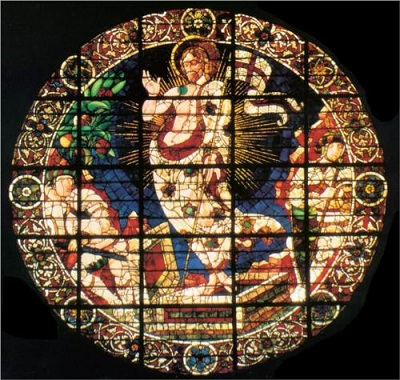
We keep on stumbling over this one.

To the western mind, mostly, this world is axiomatically more vivid than the next. But there are those for whom the next life is axiomatically the more vivid – even if their day to day practices are geared to success and continuity in this life.

And this has consequences for our own lives, in the world around us — and for security.

1.

Some who are of this mind – bin Laden in this video among them — may quote or paraphrase Abu Bakr‘s message to Khosru:

I have come to you with an army of men that love death, as you love life.

That particular quote is from the rich tapestry of Islam – but Jewish history speaks also of Kiddush ha-Shem, martyrdom for the glory of God, which became in the time of the crusades “the exemplary answer of Jews threatened in their life and faith” when offered the options of conversion to Christianity or death.

And in Christendom, there is St Bernard of Clairvaux, who is quoted as writing in his letter to the Templars at the time of the Second Crusade:

The Christian who slays the unbeliever in the Holy War is sure of his reward, the more sure if he himself is slain.

and for good measure in his sermon promoting the Crusade:

Christian warriors, He who gave His life for you, to-day demands yours in return. These are combats worthy of you, combats in which it is glorious to conquer and advantageous to die.

2.

It is with this difference in axiomatic understanding in mind, that we should approach such issues as the relative importance – in our own minds, and in those of many Afghans – of the loss of human life in a night raid, as compared with the burning of copies of the Qur’an [In Reactions to Two Incidents, a U.S.-Afghan Disconnect]:

The mullah was astounded and a little angered to be asked why the accidental burning of Korans last month could provoke violence nationwide, while an intentional mass murder that included nine children last Sunday did not.

“How can you compare the dishonoring of the Holy Koran with the martyrdom of innocent civilians?” said an incredulous Mullah Khaliq Dad, a member of the council of religious leaders who investigated the Koran burnings. “The whole goal of our life is religion.”

And a quick note here — this is an issue I’ve raised before, eg in Burning scriptures and human lives, in Of Quantity and Quality I: weighing man against book, and more recently in On fire: issues in theology and politics – ii.

3.

The same understanding also explains bin Laden’s retreat to the Tora Bora caves. As I said in an early guest post here on ZP, with a hat-tip to Lawrence Wright and his book The Looming Tower:

When bin Laden, at the lowest point of his jihadist efforts, leaves the Yemen for Afghanistan and betakes himself to the Tora Bora caves, he will inevitably remind some Muslims of the Prophet himself, who at the lowest point of his prophetic vocation left Mecca for Medina and sought sanctuary in a cave — where by the grace of his God, a spider’s web covered the entrance in such a way that his enemies could not see him.

Our natural tendency in the west is to see Tora Bora in terms of military topography, as a highly defensible, almost impregnable warren of caves deep within some of the world’s most difficult mountain territory. What we miss may be precisely what Muslim piety will in some cases see — that bin Laden’s retreat there is symbolically aligned with the “sunna” or life of the Prophet, and thus with the life of Islam itself — in much the same way that Christians, in the words of Thomas a Kempis, may practice “the Imitation of Christ”.

4.

It was in fact Emptywheel‘s piece about bin Laden’s comment re killing President Obama (and thus promoting Joe Biden) that caught my attention today and prompted this post.

Emptywheel quoted the same passage from David Ignatius that had triggered my own post On the “head of infidelity” and the tale of Abdul-Rahman ibn Awf late yesterday —

“The reason for concentrating on them,” the al-Qaeda leader explained to his top lieutenant, “is that Obama is the head of infidelity and killing him automatically will make [Vice President] Biden take over the presidency… “

— and commented:

OBL was going to kill Obama not for the sake of killing the US President, but because Biden, who served in the Senate for 36 years, almost 12 of which he served as one or another powerful committee Chair, “is totally unprepared for that post, which will lead the U.S. into a crisis.”

I just don’t think that’s right. I think it’s wrong, in fact, but [and here’s the important part] subtly wrong.

I believe that OBL lived at the confluence of worlds — one that we might call mythic or spiritual, and one that’s the one we call the “real” world. I believe that it was his myth, archetype, spirit based reality that was the more vivid to him, the one to which he was entrained, and that he found means in the practical world of strategies and tactics to adhere to the demands of that other world.

A world that was both invisible to us, and to him axiomatically victorious – at least as much so in death as in life.

The Facebook pages of public diplomacy & the Billboards of unbelief

Monday, March 19th, 2012

[ by Charles Cameron — Facebook diplomacy between Israeli and Iranian individuals, atheist proselytizing in the US, popular media uses in a “monitory” world ]
.

I have long been intrigued by some of the unofficial ways in which we communicate with one another — some of you may recall an earlier post of mine on a spate of religious arguments carried out on “duelling buses“, while another more recent post noted some of the stencilled graffiti and at times quite sophisticated artwork featured on the walls around Tahrir Square during the demonstrations there…

1.

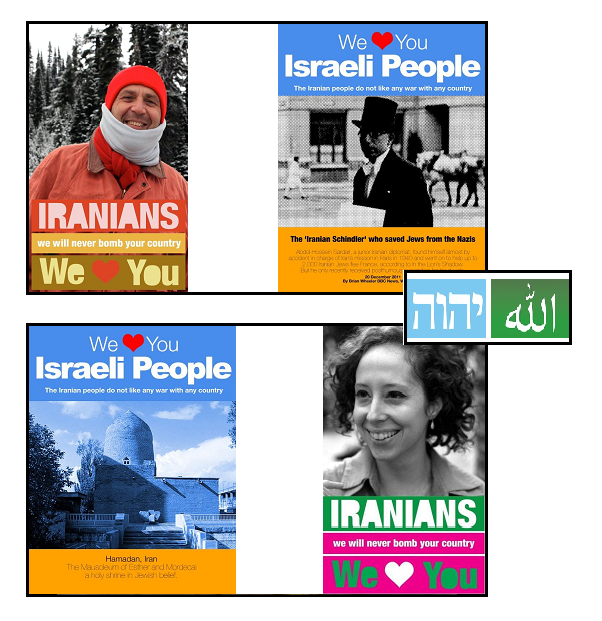
In much the same spirit, I’d like to offer here for your consideration four thumbnails of images recently posted on Facebook by individual citizens in Israel and Iran, in response to a posting (above) by two Israeli graphic artists, Ronnie Edri and Michal Tamir, which seems to have triggered quite a response in both countries.

The two Israeli posters appear to have posted images of individuals, perhaps themselves. The Iranian posters, interestingly, used images of Abdol-Hossein Sardari, the “Iranian Schindler” (upper image), with a caption that reads in part:

Abdol Hossain Sardari, a junior Iranian diplomat, found himself almost by accident in charge of Iran’s mission in Paris in 1940 and went on to help up to 2,000 Iranian Jews flee France…

and an image of the tomb of Esther and Mordecai — the tomb in Hamadan, Iran, of the same Jewish heroine recently celebrated at Purim, and pointedly referenced by Netanyahu in his gift of a Megillah to Obama — and a popular site of pilgrimage for Iran’s present day Jewish population.

Apparently there has been quite an exchange of these graphics, although some have been on the more caustic side, expressing what I can only call .. strangelove

2.

My other graphic examples are of a pair of billboards recently put up by American Atheists:

As we might expect, these were to be displayed (respectively) in or near Jewish (above) and Muslim (below) communities — the Jewish-oriented billboard in the Williamsburg area of Brooklyn, New York, and the Islamic-oriented billboard in Paterson, New Jersey.

According to the MSNBC report where I first ran across these billboards a couple of weeks ago, a Williamsburg rabbi said the sign in his district was “a disgrace. .. The name of God is very holy to us and to the whole world” — while the American Atheists’ president David Silverman reported he had not received “any blowback” from the Muslim Community in Patterson.

One imagines that some in each community would have had hurt feelings, while some in each community clearly had the good sense to show tolerance.

3.

These images tie in, I believe, with John Keane‘s notion of “monitory democracy” [link is to .pdf] that our blog-friend David Ronfeldt discussed in his post today… with our discussions here [1, 2] of the wicked complexity of many of the problems that face us… and also perhaps of the Slaughter doctrine [1, 2, 3]of the responsibility to protect

Of diversity in Islam

Wednesday, March 7th, 2012

[ by Charles Cameron — against either / or thinking — a graphic reminder? ]
.

Islam is “a mosaic, not a monolith”.

Vartan Gregorian, president of the Carnegie Corporation, offered us a 177-page exposition of that theme in a book of that title published by the Brookings Institution (2003), expanding on an earlier and shorter essay of the same title. Of the book-length version, he writes:

Presenting such a wide-angle view in a relatively small space requires the free use of generalizations, summaries, and categorizations that must leave out many nuances of history.

1.

There’s no doubt that some currents within Islam preach a continuing war against “Crusaders and Zionists” — and make no mistake about it, this is a religious movement, claiming its sanction in scripture and its path as submission to the will of God, as indicated by David Martin Jones and MLR Smith in Whose Hearts and Whose Minds? The Curious Case of Global Counter-Insurgency [see Zen’s comments here]:

The process of radicalisation is obviously a complex one. Certainly, the passage to the act of terrorism cannot be reduced solely to religion. Nevertheless, it is somewhat naive, if not perverse, to dismiss it completely. The bombings of the Madrid and London transport systems in March 2004 and July 2005 respectively, and even the 9/11 assaults, are, whatever else, Islamist acts in a Western setting. The view that religion is at best a secondary motive defies the evidence. All the groups that have undertaken high-profile terrorist acts dating from 9/11 and stretching from Bali to Madrid, London and Mumbai have acted in the name of a militant understanding of Islam. Such a pattern of worldwide attacks, exhibiting a profound devotion to a politically religious cause intimates, if nothing else, a religious dimension to jihadism. In fact, to reduce jihadism to individual social pathology attempts to explain away political religion as a social fact. Rather worryingly, it assumes that when a highly motivated jihadist claims to undertake an operation to advance a doctrine, he does not really mean it.

This might seem so obvious as to require no comment — yet Jones and Smith follow this paragraph with a question:

we need to resolve this paradox: why do counterinsurgency theorists exhibit this reluctance to confront the ideological or politically religious dimension of modern insurgency?

— and there are no doubt other segments of the media, intelligence and policy communities of which the same question might be asked.

One aspect of the answer, I believe, lies in the general tendency of post-enlightenment thinkers to “push religion into the background of their story” (Richard Landes‘ words, which I quoted here in a different context a week ago).

2.

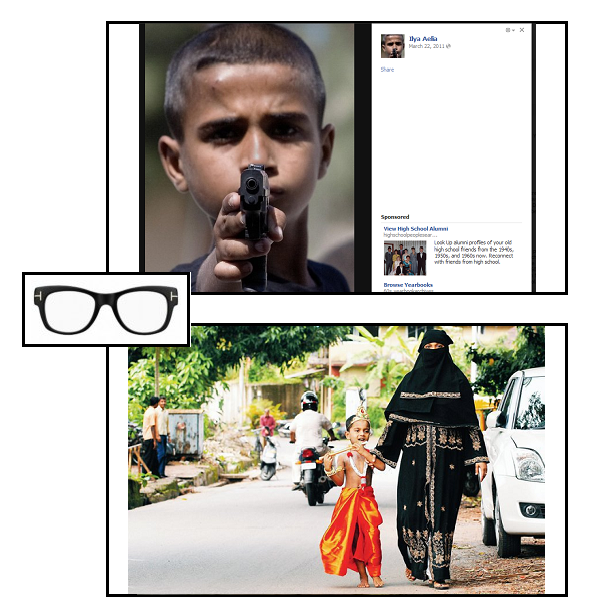
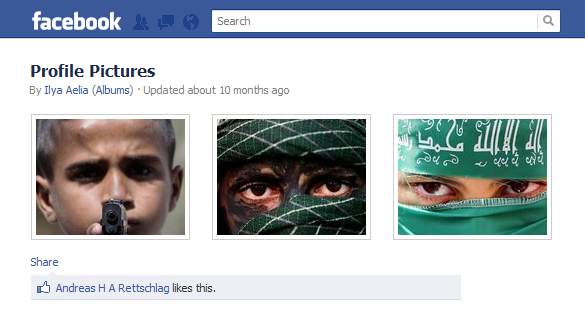
The young man pointing a gun at the viewer on a Facebook page (h/t Internet Hagganah) is the avatar of a net-salafi in Germany whose sequence of avatars looks like this:

Quintan Wiktorowicz defines a salafi thus:

The term “salafi” is used to denote those who follow the example of the companions (salaf) of the Prophet Mohammed. Salafis believe that because the companions learned about Islam directly from the Prophet, they commanded a pure understanding of the faith.

As he notes in another article:

The Salafi movement (often referred to as the Wahhabis)1 represents a diverse community. All Salafis share a puritanical approach to the religion intended to eschew religious innovation by strictly replicating the model of the Prophet Muhammad. Yet the community is broad enough to include such diverse figures as Osama bin Laden and the Mufti of Saudi Arabia. Individuals and groups within the community reflect varied positions on such important topics as jihad, apostasy, and the priorities of activism. In many cases, scholars claiming the Salafi mantel formulate antipodal juristic positions, leading one to question whether they can even be considered part of the same religious tradition.

The avatar-salafi depicted above sums up his own existence and “aim in life” by pointing a gun at you.

3.

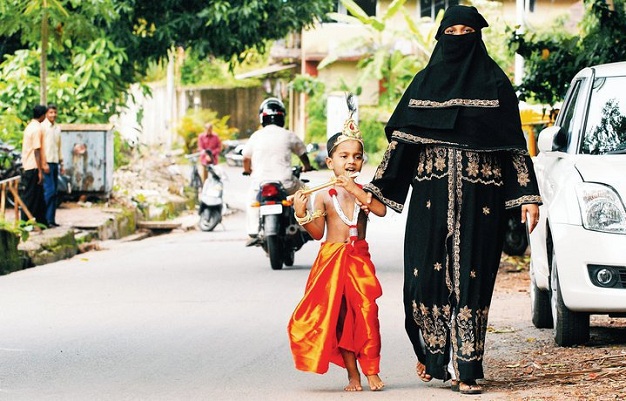
Not so the lady leading a child by the hand in the lower of the two images, from a photo taken in India.

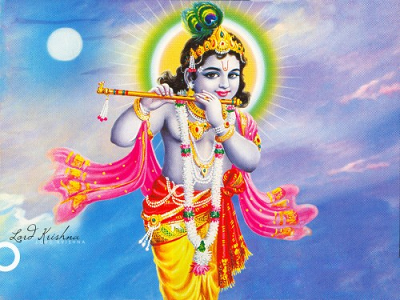
She offers us, in fact, a vividly contrasting picture of Islam to that of the salafi. She, a woman who is clearly observant of the demure dress code given in Qur’an 33.59 and wearing a niqab, is leading by the hand a joyful child arrayed in the finery of Krishna — beloved flute-playing avatar of Vishnu (avatar in its original sense) among her Hindu neighbors.

You might consider the pair of them together as monotheism hand-in-hand with polytheism. But then again, you might see them as peace and delight together, walking hand-in-hand.

You might see them as expressive of the Quranic proclamation (49.13 ):

O people, We have created you from a male and a female and made you into races and tribes so that you may know each other. Surely the most honored of you in the sight of God is the one who is the most righteous of you.

4.

To bring this back to contemporary politics, we may have our views about Islamist politics, and in the context of the changing scene across the Arab world it is worth pondering this recent quote from Rachid Ghannouchi, founder of the Ennahda Party in Tunisia, indicating another significant aspect of the contemporary evolution of Islamist thought:

Freedom is a fundamental principle in Islam, religion can not be forced on believers … Religion is not meant to give us guidance in all areas of industrial management, agricultural innovation, and governance, those subjects require human reason. Religion, however, gives us a code of values and principles.

Islam is not merely diverse, it is self-renewing.

5.

In light of all this, we need a far richer awareness of the mosaic that is Islam that our tendency towards black and white, war or peace, either / or thinking easily allows.

Consider these Quranic verses (35.27-28):

See you not that Allah sends down rain from the sky? With it We then bring out produce of various colors. And in the mountains are tracts white and red, of various shades of color, and black intense in hue. And so amongst men and crawling creatures and cattle, are they of various colors.

Again, the delight in diversity!

Now take another, closer look at those two folks from India:

Beautiful.

A note about nodes

Monday, March 5th, 2012

[ by Charles Cameron – places, people, neurons, ideas, with Kabul and Khost providing illustrations ]
.


[ illus: Starlight, from PNL ]

I was just reading Matthieu Aikins‘ GQ account of The Siege of September 13 in Kabul, when a couple of sentences caught my eye, not because of the attack itself, but because they reminded me of a point I want to make about the way we think these days about networks, nodes and linkages:

Salangi’s SUV was passing down the main road north of the embassy when the sound of gunshots and his police radio simultaneously erupted. He told his driver to turn around and head toward the sounds.

At Massoud Circle, the next roundabout down from Abdul Haq, they encountered a bottleneck of police vehicles, and so Salangi continued on foot, ducking as he heard the crack and whine of bullets passing close by…

What specifically caught and rerouted my attention was that phrase, “Massoud Circle, the next roundabout down from Abdul Haq” — Abdul Haq Circle, I’d read earlier in the article, “is a wide traffic roundabout named for a deceased mujahideen commander”, as presumably is the circle named for Massoud.

So we have two roundabouts connected by a road… and two deceased mujahideen commanders.

Or to put that another way, we have two nodes and a connection between them, twice over — in once case the nodes are places, and in the other the nodes are people.

*

Further into the article, I found a graphic showing the two places and the road connecting them — and an image of two people in Kabul that day, one extending an arm of care to the other. These two men weren’t Abdul Haq and Massoud, of course, but two people nonetheless. So in each graphic, we have two nodes and a connection:

A great deal of time and treasure goes into the analysis of networks of communication — cellphone to cellphone, person to person — or travel — place to place — (a) because the patterns can be revealing, and (b) because the data (what number called what number, e.g., how often Nidal Hassan emailed al-Awlaki, or what route bought Abu Dujanah from Amman to Khost) is unambiguous when obtained.

*

We’re also fond of neural nets, eh? — whether the “artificial” nets of AI or the “biological” nets of the brain — and again, these are unambiguous, scientists and technicians love them, and software developed with Congress-friendly budgeting implications is required to process them.

But what about ideas?

What about minds, what about the subjective side of persons and travels and communications and contacts and brains — what about thoughts, what about admiration?

That’s the node-link-node mapping that I find most interesting: it utilizes the most complex software (human intelligence), and demands the least complex support system (cappucino, napkin and pencil) — and some of its nodes and their linkages (beliefs, e.g., leading to actions) are among the richest features of the human behavioral landscape.

*

The idea that jihad is an individual obligation, for instance, is a staple of AQ-style theology. It is my contention, indeed, that acceptance of that idea is the religious foundation on which acts of jihadist suicide are based.

And by the same token, these suicide acts are then viewed in terms of martyrdom, since they were enacted in the cause of Allah, giving rise to such eulogies as this one, offered by AQ to Abu Dujanah after the Khost event:

May Allah have mercy on you, our dear Abu Dujanah, and may He raise your ranks in register of the inhabitants of Paradise. By the Lord of the Ka’bah, indeed you have succeeded, our dear Abu Lailah, Allah willing. You were truthful, and you became known. You set an example, and you were truthful in word and deed. You followed the speakers and writers before you. May Allah be pleased with you . Your patience, Jihad, and tolerance of hardships were in Allah’s Cause. Your prayers and insistency was for Allah, and was your solitude and secret conversation. Thus, your reward is with Allah. Allah is your Lord and Protector, and Allah willing, our next meeting will be in Al-Firdaws Al-A’la, our dear beloved brother.

Such logic, such rhetoric, and such devotion are of the essence of what we confront in the jihad…

*

And richest of all for us to come to terms with: the person to person transmission of such ideas…

On fire: issues in theology and politics – ii

Tuesday, February 28th, 2012

[ by Charles Cameron — burning and blasphemy ]
.

The question here is a simple one: which is the more blasphemous? burning holy scripture — or burning oneself, a human being?

Now I imagine you think the answer to that’s quite obvious, and I do too. But there are people with the opposite opinion to mine — and when we burn their scriptures, even by mistake, even making apologies afterwards, they get enraged, and kill people. There may be many other factors that contribute to their rage, but this is the trigger, the religious sanction, the thing that pushes them over the top.

Someone tweeted the other day:

Souls are being burned alive in Homs & others riot over ink & paper. Where’s the logic?!

It is not my purpose to attack or defend anyone’s beliefs or opinions here — what I would like to do instead is to see through the rage and glimpse that logic: I would like us to avoid needlessly triggering it.

I want to bring what may at first seem utterly incomprehensible to us, a little closer to our comprehension.

1.

In the Quran 5.32, we read:

We ordained for the Children of Israel that if any one slew a person – unless it be for murder or for spreading mischief in the land – it would be as if he slew the whole people: and if any one saved a life, it would be as if he saved the life of the whole people.

On the one hand, that sets an extremely high value on human life — the Jewish equivalent is found in the Talmud, Tractate Sanhedrin 37a — and on the other hand, it can be claimed that that high value is set not by humans but by their Creator in his revealed Word, the Qur’an.

2.

What metaphor or analogy would allow me to understand that logic in terms of my own culture? Not the rage itself, not the killings — but the logic that potentiates them?

3.

If you think, as the melancholy Jaques has it in As You Like It, that all the world’s a stage, and all the men and women merely players – and as Hamlet might think, pondering what more things might be in heaven and earth than are dreamt of in philosophy – why then —

How does one weigh the value of the life of a Jaques, or Hamlet, of one of us, one single human being – of whom Shakespeare, again through his Hamlet, said:

how noble in reason! how infinite in faculty! in form and moving how express and admirable! in action how like an angel! in apprehension how like a god! the beauty of the world! the paragon of animals! ..

against the value of a single copy of the Works of one William Shakespeare – who then continued on, through that same Hamlet’s voice, to ask:

And yet, to me, what is this quintessence of dust?

4.

Shakespeare, the First Folio, Hamlet?
God, the Scripture, you or me?

5.

It is said the imperishable Quran is writ in heaven before time was, and there is a hadith of Tirmidhi that describes Allah reciting Suras 20 and 36, Taha and Ya Sin, upon hearing which the angels responded “Happy are the people to whom this comes down, happy are the minds which carry this, and happy are the tongues which utter this”.

I am not a literalist, I am a poet — so that makes poetic sense to me, the way Shakespeare’s “all the world’s a stage” makes sense.

In reading these words, I see for a moment the beauty, the devotion that is possible towards this book, the fervent dedication.

I am not about to kill people in the name of Shakespeare or the Gospels — yet I can understand a reverence for that which is greater than I, for that which is more than we dream of, and for that which “comes down” from thence.

6.

Suppose the body is a perishable scaffolding, and the book an eternal transcript written in the immortal soul…

And now recall what that eternal transcript says:

We ordained for the Children of Israel that if any one slew a person – unless it be for murder or for spreading mischief in the land – it would be as if he slew the whole people: and if any one saved a life, it would be as if he saved the life of the whole people.

The paradox here, surely, is that we are each of us the quintessence of dust – each of us more than is dreamt of in philosophy.

7.

May the soul of Mohamed Bouazizi rest at last.


Switch to our mobile site