zenpundit.com » propaganda

Archive for the ‘propaganda’ Category

Should I whisper, should I scream? – Abu Musab al-Suri redux, Pt 2

Thursday, March 1st, 2012

[ by Charles Cameron — typology of intelligence failures, analytic blind spot, millennial movements, prophecy as strategy, abu Musab’s end times chronology ]
.

To tie in with the first part of this double-post, let me quote Aaron Zelin again:

I’ll back that up with Jean-Pierre Filiu‘s observation that in Abu-Musab al-Suri’s reading of jihadist history, “events lead on from one another toward the appearance of the Mahdi” — and that in Abu-Musab’s own words, “We shall be alive, then, when Allah’s order comes.”

I’ll give a brief account of the chronology below. Let’s get on with this.

1.

I don’t believe that Richard Landes, my mentor at the Center for Millennial Studies, mentions Abu Musab al-Suri in his Heaven on Earth: The Varieties of the Millennial Experiences (again as with Furnish, I could be wrong) — but if there’s a single book that will convince you of the enormity of our blind spot when it comes to taking millennial movements seriously, it’s this masterwork — simply stunning.

The thrust of his book is that millennial movements have been quite deliberately overlooked twice by the grand narratives of western civilization — first by religious writers who were embarrassed by the repeated cycle of enthusiasm followed by failure of end times prophecies and retroactively marginalized the topic, and more recently by…

secular historians, determined to push religion into the background of their story, [who] were hardly interested in highlighting religious phenomena that even the ecclesiastical historians considered ridiculous.

It is to undo the damage that this two-fold blindedness has caused us that Landes writes his remarkable book, covering in extraordinarily wide-ranging scholarly detail and with insight and wit, that current in human fear and hope he terms “the most protean belief in human history: millennialism.”

2.

In other words, the “the most protean belief in human history” has been consistently disregarded for way too long by academics, pundits and experts.

Put that in the context of this trenchant paragraph from Richards Heuer‘s Psychology of Intelligence Analysis, just recently quoted and indeed highlighted by Clint Watts and John E. Brennan in their paper Capturing the Potential of Outlier Ideas in the Intelligence Community:

Major intelligence failures are usually caused by failures of analysis, not failures of collection. Relevant information is discounted, misinterpreted, ignored, rejected, or overlooked because it fails to fit a prevailing mental model or mind-set.

3.

Rejected and overlooked?

Even the Psalmist (118.22) knows the importance of what’s rejected:

The stone which the builders rejected has become the chief cornerstone.

And just in passing, I’d argue that two of the seven “outlandish, unthinkable, and wholly anomalous” outliers that Watts & Brennan offer as bulleted examples in their paper — the Khomeini and bin Laden events — would have shown up rather more prominently had a subset of analysts been tasked to keep an eye on millenialist and / or specifically mahdist movements.

4.

Very quickly, then, here are some of the recent reports regarding al-Suri from well-informed analysts which seem to pay little mind to the Mahdist strand in his strategic thinking:

  • Raff Pantucci‘s January 26, 2012 post Whither al Suri? focuses on the implications of al-Suri’s release and quotes Brynjar Lia — insightful, but no mention of Mahdism.
  • Aaron Zelin‘s February 3 Foreign Policy post on al-Suri’s release comes closest to mentioning an apocalyptic angle when he writes:

    Additionally, his lore will grow in light of an alleged vision he had this past August, which was relayed by online jihadist Jundi Dawlat al-Islam (“Soldier of the Islamic State”), a member of the important Shamukh al-Islam Arabic Forum. “I have been informed that the Shaykh [Suri] saw in the past days a vision that he will have an important role in Bilad al-Sham (Syria), we ask Allah that it becomes true,” the jihadist wrote. Suri’s release will be seen as a vindication of that vision by his supporters, and no doubt boost his influence.

    The significant role of Shams — “the apocalyptic theater par excellence” — in al-Suri’s narrative is something J-P Filiu emphasized (p. 189).

  • Bill Roggio‘s February 5 piece for Long War Journal is an excellent backgrounder as befits LWJ — but no mention of eschatological strategy there, either.
  • Jarret Brachman‘s February 6 Abu Musab al-Suri Still Matters Online at Chronus Global is a brief note, just a tip-off that al-Suri is still influential…
  • MEMRI‘s February 8, 2012 The Release of Top Al-Qaeda Military Strategist/Ideologue Abu Mus’ab Al-Suri from Syrian Prison – A Looming Threat makes no mention of al-Suri’s eschatological thinking, and neither does their more extensive report on al-Suri, Al-Qaeda Military Strategist Abu Mus’ab Al-Suri’s Teachings on Fourth-Generation Warfare (4GW), Individual Jihad and the Future of Al-Qaeda, to which their February 2012 post links.
  • And the Jamestown Foundation‘s Feb 10 piece by Murad Batal al-Shishani, Syria’s Surprising Release of Jihadi Strategist Abu Mus’ab al-Suri, in their Terrorism Monitor v 10 # 3 doesn’t mention the apocalyptic angle — and Jamestown is where I heard Ali A Allawi speak on Millenarianism, Mahdism and Terrorism: The Case of Iraq back in 2007!

    Curious…

  • Ah well, there’s always Zenpundit [vbg].

    5.

    Okay, it looks to me as though we’re still so focused on the “nizam la tanzim / system not organization” and “lone wolf / leaderless resistance” aspects of al-Suri’s work, significant as they are, that it’s easy to overlook that damned ridiculous “end times” stuff the fellow also considers important, strategically speaking.

    So for the record, here’s the chronology of future events as J-P Filiu recounts it:

    Events will unfold in the following manner: “The Arabian Peninsula will be preserved [from harm] until the destruction of Armenia, Egypt will be preserved until the destruction of the [Arabian] peninsula, Kufa will be preserved until the destruction of Egypt, the city of impiety [mad?nat al-kufr] will be conquered only after the great wars, and the Antichrist will appear only after this conquest.” The concentrically expanding path of apocalyptic devastation will then close in upon Palestine, the sanctuary of Judeo- Crusader “impiety,” where the ultimate confrontation with the Byzantines will take place in and around the city of Acre.

    Well, that’s part of it, but you should read Filiu’s pp 186-191 for a fuller account — and somebody, please send me a reliable translation of those last 100 pages of abu Musab’s Call if you have one!

    Sadly, I don’t read or speak Arabic.

    6.

    Okay, that’s it, I’ve shouted, or whispered or whatever.

    The books at the top of this post are:

    David Cook, Contemporary Muslim Apocalyptic Literature
    Timothy Furnish, Holiest Wars: Islamic Mahdis, Their Jihads, and Osama bin Laden
    Jean-Pierre Filiu, Apocalypse in Islam
    Richard Landes, Heaven on Earth: The Varieties of the Millennial Experience

    All four are worthy of your consideration.

    4GW and Legitimacy at SWJ

    Thursday, February 23rd, 2012

    Fourth Generation Warfare and William Lind was the topic of a critical essay by Major Lincoln Farish at Small Wars Journal. The article was interesting, despite my disagreement with the author on most points, because he was wrestling with important questions related to insurgency and COIN at a time when FM 3-24 is undergoing revision and the role of COIN itself in US Army operational culture is being questioned. Tight defense budgets= Musical chairs at the Pentagon. 🙂

    Unfortunately, the article contained, in my view, significant problems in terms of understanding 4GW or strategy in general.Here is the article. It isn’t overly long. I am going to be commenting on passages that caught my attention and I invite readers to do the same and check out those made by Ken White and Slapout in the comments section at SWJ:

    The Quest for Legitimacy 

    According to The U.S. Army Marine Corps Counterinsurgency Field Manual an insurgency is “an organized movement aimed at the overthrow of a constituted government.” FM 3-24 continues with, “political power is the central issue in insurgencies and counterinsurgencies: each side aims to get the people to accept its governance or authority as legitimate.” Fourth Generation Warfare (4GW) advocates propose fighting insurgents with small cadres of highly-trained infantry, avoiding the large footprint of earlier generations of war created by command and control echelons above the company. Even if the 4GW proponents are correct on the tactical level, their proposed methods will not be successful in defeating an insurgency strategically as 4GW does not offer a legitimate alternative to the insurgents at the strategic or national level.

    Premises here are incorrect.

    First, while I do not speak for Mr. Lind, any fair reading of his many columns, articles and posts of the past decade (!) would demonstrate that he was, as Ken White and Slapout indicated, strongly opposed to expeditionary COIN adventures unless they were absolutely unavoidable.  His 4GW grand strategy was for the US to scrupulously avoid “centers of disorder” and view all states, even ideologically hateful misfits, as potential allies against 4GW forces. Where required, the US would instead rely on “punitive raiding” against such 4GW entities but not hunker down in the mud with them on a permanent basis.

    William S. Lind, the architect of the 4GW concept, argues for units to become “true light infantry.”  He writes, “virtually all Fourth Generation forces are free of the First Generation culture of order; they focus outward, they prize initiative and, because they are highly decentralized, they rely on self-discipline.” Discipline is a key issue here; a company commander only has the authority to punish soldiers up to the (U. S. Army) rank of Sergeant (E-5). This is to protect not only the soldiers, but to give the commander the ability to maintain order and discipline commensurate with his position and abilities. A company is usually composed of only three to four officers, and they have little ability to conduct an investigation without disrupting combat operations….

    …. Clear, codified, equitable discipline is one of the features that separate a military from a street gang or an insurgent movement…..

    ….It [4GW forces] should be trained and equipped to use cash to draw on the local infrastructure for most of its needs.”  Lind expects a company to handle most of its logistical needs with a minimum of support from a higher echelon, in other words, Lind is advocating an autonomous company.

    One of the assertions of 4GW theory is that a large military with a  2GW culture organization based on hierarchy, micromanagement. limited or no autonomy of subordinates will go down to defeat ( or at least protracted stalemate) with a smaller, but more agile, adaptive 4GW force. Secondly, that counter-4GW units should be retooled to “mirror” these advantages in initiative and flexibility because the disciplined firepower of conventional military trumps those of irregulars (who of course, lack tanks, attack helicopters, cruise missiles, FOBs with food courts that include Pizza Hut and other hyperexpensive brontosaurian logistical tails). This combat advantage of light infantry over guerrillas is the reason for Lind’s advocacy of “Jaegers“.

    H. John Poole, another disciple of 4GW, goes even further. Poole advocates using fire teams (a 3-4 man team) to perform deep interdiction to deny an enemy maneuver room, destroy minor camps, supply areas, and staying in place for up to three months at a time. In this scenario, how is it possible that the team effects the capture of prisoners? Would the team have to allow surrendering personnel to escape? How would enemy causalities be treated? Would the team leave enemy wounded, and how would that be portrayed to the media and world-wide? Whatever flaws there may be with 4GW, the biggest one is with legitimacy.

    Poole is a tactical expert, which I certainly am not, even in terms of historical study. As I am not qualified to debate the utility of fire-teams vs. platoons or companies, I will simply note that in a different strategic context, both the Soviets and NATO contemplated and prepared for very deep, behind the lines, operations, by small, pre-positioned, sleeper cells. We also have scouts and a variety of special forces units and CIA clandestine operatives running around AfPak and the Horn of Africa – how do they currently handle these problems? Does SEAL Team 6 usually return home from a raid with 50+ prisoners?

    A Western democratic government is considered legitimate if its rule is primarily derived from the consent of the populace. An illegitimate government would be one that ruled by coercion. Legitimate governments are inherently stable. They engender the popular support required to manage internal problems, change, and conflict. A lack of legitimacy in a constituted government results in a lack of popular support, and an end to the government’s actions.

    Well, while I understand the point of contrast the author is making, and I’m deeply in sympathy with the inherent Lockeanism, the idea that liberal governments who have the consent of the governed do not regularly exercise coercion is fundamentally and empirically incorrect. This is easily demonstrated by refusing to pay one’s taxes, or attempting to sell unpasteurized milk, engage in sedition, build a house at variance with local zoning or in a myriad of ways. States enforce law where they do not have voluntary compliance and that enforcement, or threat thereof, constitutes coercion in a very real sense. If a state cannot make use of coercion in time of need, then it has failed as a state.

    What states with consent of the governed have is a comparative advantage. Their greater legitimacy permits their actions of coercion- unlike that of a a hated, mad, tyrant – to take place less frequently and then with with less friction when they do. Enjoying greater voluntary compliance, more legitimate states have moral leeway and the political benefit of the doubt of the populace, when confronting lawbreakers and applying coercion to other challengers to the state’s authority. It is this very moral authority possessed by the state that 4GW forces seek to erode.

     Conrad Crane proposes six possible indicators of legitimacy:

    – The ability to provide security for the populace.

    – Selection of leaders at a frequency and in a manner considered just and fair by a substantial majority of the populace.

    – A high level of popular participation in or support for political processes.

    – A culturally acceptable level of corruption.

    – A culturally acceptable level and rate of political, economic, and social development.

    – A high level of regime acceptance by major social institutions.

    While this is a good guide from a western view of what constitutes a “legitimate” government, not every group in the world would agree, and legitimacy is in the eyes of the beholder. What was legitimate in earlier times may now be unacceptable, what is legitimate in one area of the world is not in another.

    Crane’s indicators are usefully pragmatic in a heuristic sense, but probably not sufficient in themselves – “legitimacy” is a huge subject and has many aspects or facets in terms of internal politics, external diplomacy, cultural identity and both positive and international law.  While “legitimacy” is difficult to define to the mutual satisfaction of military leaders, lawyers, statesmen or academics, populations seem to “know it when they see it” (and more importantly, when they don’t). The rub with pop-centric COIN theory, from a 4GW perspective, is that it is extremely difficult (though not always impossible) for armed outsiders to bestow or shore up legitimacy of a state.

    I suspect that gambit works most effectively with new or emergent states also seeking acceptance or peace with neighboring states and aid from the international community and less well in cases of purely civil strife.

    Insurgencies that are trying to develop legitimacy have integrated themselves locally into the social and political fabric of societies worldwide. They establish a “shadow government,” first addressing the needs of the local populace. Insurgents establish themselves as organizations capable of addressing the everyday problems of the local population. Insurgent groups have set up schools, medical clinics, sports clubs, and programs for free meals. Hamas and Hezbollah have also become powerful political parties within their respective governments. The key difference is that to be seen as legitimate, the insurgent only needs to appear legitimate in the area they are operating in and in accordance with the mores of the local populace.

    Much of this passage is actually in concordance with classic 4GW thinking. I would hedge in that many 4GW entities, for example, criminal-insurgencies or loyalist paramilitaries (4GW entities acting in support of the state) have no interest in becoming a “shadow government”. Some, like Hezbollah and HAMAS do, but an across the board assumption is an effort to intellectually shoehorn all insurgencies everywhere into the Maoist model – that they seek to replace regime as the state’s new rulers- and that is one of the major flaws of pop-centric COIN assumptions.

    Atrocities committed by insurgents, even if they were reported could be easily ignored.  International opinion matters little to an insurgent organization that is local, and is not subject to, or concerned with, international laws.

    No.

    Atrocities by irregulars may or may not be ignored. Largely that is the fault of policy, our elite’s decided lack of will in consistently pursuing their publicity, condemnation and where possible, exemplary punishment. That said, whether atrocities by irregulars are ignored or not and whether leaders of non-state forces hold international opinion in contempt, as parties to an armed conflict they are indeed subject to the laws of war and international law. Breaking laws does not mean that therefore, you are somehow above them.

    The national government, on the other hand, has to appear legitimate at the international level, the national level, and at the local level. At each level there may be different beliefs as to what does or does not constitute “legitimate” governance. The counter insurgent has an even more difficult time, as they must be seen as “legitimate” in their home country, the host country, internationally, and at the local level. There is a difference in what actions and processes are seen as legitimate by these successive levels and the counter insurgent must not only be cognizant of these expectations and restrictions, but abide by them as well.

    Generally correct, but all levels of legitimacy are not equally important all of the time.

    The context of situations matter a great deal – first of all, the shooting part of war does count even in 4GW or COIN. It does not help to be scrupulously legitimate in all OF your actions if you lose the war to insurgents and are captured, tortured lavishly and displayed in a cage before being executed on live television.  Appealing to the sense of legitimacy of generally adversarial and distantly located foreign elites may or may not matter vs. appealing to the primary loyalty of villagers in guerrilla country. Or it might.

    It is important to remember that in terms of legitimacy, the counterinsurgent  has an audience of overlapping political communities, but communities of unequal importance to the outcome. All actions in counterinsurgency warfare have political trade-offs. The bias is to ruthlessly accept those trade-offs that methodically and irrevocably advance the COIN side to victory and eschew ones where the costs greatly exceed any potential gain. To quote John Boyd, when considering conflict and threatswe should only undertake operations and policies that:

    • Support our national goal, which at the highest level involves improving our fitness, as an organic whole, to shape and cope with an ever-changing environment
    • Pump-up our resolve, drain-away our adversary’s resolve, and attract the uncommitted
    • End the conflict on favorable terms
    • Ensure that the conflict and peace terms do not provide seeds for (unfavorable) future conflict.

    To continue:

    The 4GW method of COIN does not properly account for legitimacy. Following the 4GW method, insurgent groups will be able to use the need for legitimacy by the counter insurgents to disrupt operations. If a charge is made that the 4GW forces have committed an atrocity, there will be a lot of interest in that story by outside groups. The media will want information, and human rights groups will bring political pressure for a full and complete investigation to be conducted, something a company commander will not have the resources to do.

    I find this passage to simply be strange, given the emphasis that various writers of the 4GW school placed upon the mental and moral levels of war. Whether you agree with 4GW and William Lind or think that both = horseshit, it remains a fact that concern with legitimacy is one of 4GW’s central tenets as a theory or school of strategic thought. See, there’s this guy, an Israeli military historian, named Martin van Creveld and……

    The problem, I suspect, is with how the author approaches legitimacy and the division of responsibility for questions of tactics, operations, strategy and policy. Bill Lind’s advocacy of of jaegers never seemed to me to imply that a master sergeant or captain out in the backcountry would be running an international level IO on his own. In his area of responsibility, with locals, sure – just not when Lara Logan or Dr. Jakob Kellenberger of the Red Cross shows up.

    If the alleged atrocity is not investigated properly, regardless of the veracity, legitimacy for the operation and popular support at all levels will be at risk. The insurgents will be able to use the incident as a rallying cry against the counter insurgent forces. The lack of a full and complete investigation will give credence to their claims, and there will be allegations of “cover ups” and “obfuscation,” by those sympathetic to the insurgent cause. Outside neutral groups, like NGOs and the media, will not be able to quickly and easily refute these allegations, further reinforcing the insurgent’s claims. These claims harm the legitimacy of the counter insurgent operations and degrade popular support. Without popular support the U.S. Army would be forced to leave, allowing the insurgents to reoccupy the area. Tactically the insurgents may have been beaten at every turn, but strategically they have won. Given the proposed structure of 4GW forces, small 3-4 man teams, out of direct contact with higher headquarters for extended periods of time, with a minimum of command oversight- how would an investigation occur? How would media requests be handled, or investigations by human rights NGOs? How would the team or the company even be able to demonstrate that they were not responsible for the alleged crime? Do 4GW adherents believe that the US Army would be given the benefit of the doubt by the international press?

    Wow.

    First of all, all of what the passage describes occurs now, under the present system, beloved by Big Army, of top down micromanagement of company and platoon leaders by senior field grade or, remarkably, general officers. Any incarnation of 4GW COIN operations have not failed in the way Farish described but every major media failure that has happened in the war can be attributed in part, to the current institutional culture, climate and structure that produced such slick American IO moments as Abu Ghraib and “the Runaway General“.

    Admittedly, as it is untried, a 4GW style COIN operation might not do any better than this, but really, it could hardly do worse.

    The current mass of command and control, while cumbersome and at times inefficient, exists to protect the soldier and to allow him to conduct his mission with minimal disruption. To try and strip that away to a “lean fighting force” is to invite tactical success, but strategic failure. 

    Top-heavy, slow moving, risk-averse, military bureaucracies ensure strategic victory?  Administrative process defines or formulates strategy? WTF?

    With the loss of a robust command structure and the protection it brings from outside agencies, it will be easy for the insurgents to portray soldiers as cold-blooded killers, rampaging throughout the land with no oversight and no regard for international law, the UCMJ, or legitimacy. Without the appearance of legitimacy popular support will erode, without popular support counter- insurgent forces will be forced to cede the battlefield to the insurgents.

    Move….out…of….your….comfort zone.

    In general, military history and strategic thinking need to be taught earlier in the career arc of professional officers than the War College level as a counter to the habits of mind inculcated by organizational culture. The relationship between tactics, strategy and policy is always holistic, not distributed between “tactical leaders”, “operational planners” and civilian “policy wonks”. Strategy does not live way up at HQ or in the White House but should be a ladder or chain of implications that reach down to guide tactical decisions and upwards to a national or grand strategy.

    Quick note — tweet and riposte

    Tuesday, December 13th, 2011

    [by Charles Cameron — on warfare and social media ]

    .

    Al-Shabaab‘s media wing now has a twitter interlocutor from the Kenyan Army

    as the Islamic Emirate (Afghan Taliban) does from the ISAF Press Office:

    Is this just “silliness”, as @Rory_Medcalf tweeted — or is there something fresh and with potential going on?  I’m thinking of richer social media initiatives, like Leah Farrall‘s conversations with Abu Walid, here, too…

    Twitter combat, al-Shabaab, black banners, Tahrir and more

    Thursday, December 8th, 2011

    [ by Charles Cameron — first Twitter as combat zone, then black banners again, Somalia, Mahdism, Babism, AQ, Iraq, Libya, Egypt  ]


    Just for the record.

    You probably already knew ISAF has been tweeting back at the Islamic Emirate, and you can follow both at @ABalkhi and @ISAFmedia…

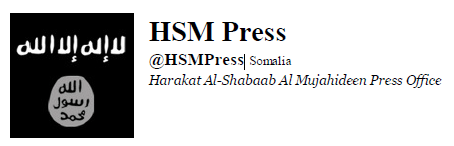
    Well, @HSMPress just joined the fray — that’s al-Shabaab:

    Notice the flag?

    It’s that black banner again.

    *

    There has been some controversy over whether or not there was an element of support for AQ in Libya, and at the recent Tahrir Square demonstrations, and black banners have featured heavily in the discussions.

    Let’s get our black banners straight. First, Libya.

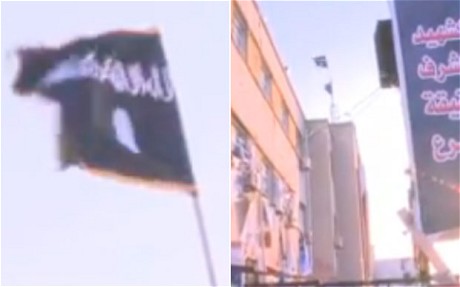
    This was the black flag allegedly flown in Libya after the ouster of Col. Gadhafi.  It was published as illustrated here by the Daily Telegraph, under the headline “Libya: Al Qaeda flag flown above Benghazi courthouse” and with the commentary ” The black flag of Al Qaeda has been spotted flying over a public building in Libya, raising concerns that the country could lurch towards Muslim extremism.”

    Note the resemblance to the logo al-Shabaab is using.

    *

    Juan Cole pooh-poohed the idea that this was an AQ flag, calling it a “silly urban legend going around” and quoting a Libyan scholar-friend on the point:

    I looked up the mentioned flag, it appears to be a black flag with the shahada [Muslim profession of faith] in it. A black flag goes back all the way to the prophet, and the addition of the shahada makes it a Jihadist flag. There have been Jihadists in Libya from day one, and they fought against Qaddafi. But is Al-Qaeda, as in the global network taking over? No.

    Cole’s friend’s comments are worth reading in full: they provide context on the various factions and their relative strengths, and Cole sums it all up in terms of the specific issue of AQ and Benghazi thus:

    What this informed observer is saying is that a miniscule group of jihadists put up that flag, in the chaos of the post-revolutionary period, but that they are highly unrepresentative of politics in Benghazi.

    Fair enough. But that wasn’t just a black flag with the Shahada, was it?

    When Cole’s friend rites “A black flag goes back all the way to the prophet, and the addition of the shahada makes it a Jihadist flag,” Cole comments “Moreover, the black flag as a symbol is not a monopoly of al-Qaeda. Revolutionaries raised a black flag in the medieval Abbasid Revolution of 750 AD.”

    Indeed. They may also have produced the ahadith about the army with black banners from Khorasan, which give such flags a distinctively Mahdist application – ahadith which Ali Soufan tells us have been used extensively in AQ recruitment.

    So there are black banners and black banners. There was “Khalifa Abdullah’s great black banner, black-lettered with text from the Koran and the Mahdi’s sayings” mentioned in Burleigh‘s account of the Battle of Omdurman – and a little earlier, the Bab had instructed his followers to “gather under the black standard which was being raised in Khurasan” according to Munirih Khanum‘s Memoirs and Letters.

    *

    Aaron Zelin has a post at The Wasat which allows for a quick comparison between various black flags and banners. Here’s the flag that Aaron identifies as that of the Islamic State of Iraq:

    That’s an AQ-related flag, and it distinctly features what is believed to be the seal of Muhammad:

    So I wouldn’t be so sure that “No, that wasn’t an al-Qaeda Flag over Benghazi” Dr. Cole.

    *

    What about Egypt?

    In another piece — this one entitled “Did the Muslim Brotherhood Threaten to Kill “All Jews”?” — Dr. Cole wrote:

    The Muslim Brotherhood and other religious parties in Egypt (including the Salafis and the Gama’a al-Islamiya) held a rally at al-Husayn Square in Cairo last Friday to which a few thousand people came. The big rally was at Tahrir Square in downtown Cairo and was dominated by secular forces.

    Cole is entirely right in rebutting a YNet correspondent’s claim that “a Koran quote vowing that ‘one day we shall kill all the Jews’ was uttered” at the al-Husayn site:

    Beck, who clearly does not know what he is talking about, said that the crowd repeatedly quoted a verse in the Qur’an that spoke of killing all Jews. There is no such verse in the Islamic holy book. The Jewish revelation from God to Abraham and Moses is retold in the Qur’an, which has positive stories of the Children of Israel. The castigation of the Children of Israel in the Qur’an is of the same sort you see in the Hebrew Bible, and often put in the mouth of Moses or another Jewish prophet.

    Indeed, a commenter on the YNet article from Quebec went further:

    Eldad Beck wrote: “Time and again, a Koran quote vowing that ‘one day we shall kill all the Jews’ was uttered at the site”.

    There is NO such verse in the Qur’an. In fact, the Qur’an says this:

    “Those who believe in the Qur’an, those who follow the Torah and the Sabians and Christians–anyone who believes in G-d and the Last Day and who does righteous deeds need not be in fear and will not grieve.” (5:69)

    There were indeed hotheads in the crowd who yelled that they would “fight the Jews (i.e., Israelis)”. If Mr. Beck spoke Arabic fluently, he would not have mistaken the shouted word “mutaqalah” (to fight, combat, overcome) with the word “qatala” (to kill). In addition, he would know that in Palestinian colloquial Arabic “al-yahud” (the Jews) usuallhy has the limited meaning of “the Israelis”.

    Sadly the errors (or willful misrepresentations) of Beck have been repeated in dozens if not hundreds of paper and electronic media.

    If he made an innocent error, he should apologize and set the record straight.

    If not, let him stand before the Mercy Seat of Ha-Shem and explain why he violated the commandment given to Moses: “You shall not bear false witness against your neighbour.”

    *

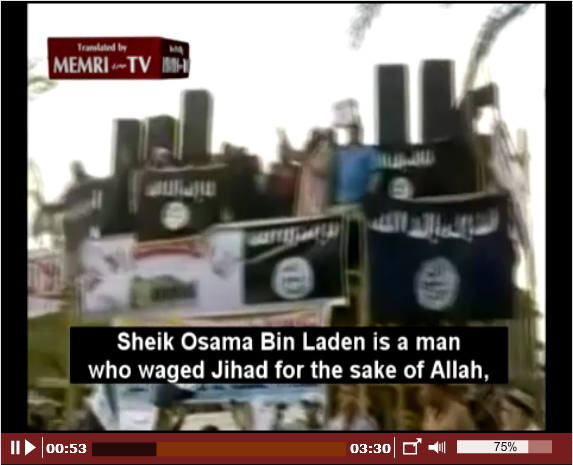
    The thing is — getting back to our black banners with Shahada and distinctive seal of Muhammad — there were in fact demonstrations in Tahrir Square just a week earlier, at which those pesky black flags were in evidence:

    MEMRI brought us the video of which that is a screen-capture, and provided a transcript of Sheikh Tawfiq al-Afni‘s address to the crowd, of which this is an excerpt:

    Tawfiq Al-Afni (On stage): ”Sheikh Osama bin Laden is a man who waged Jihad for the sake of Allah, and we pray that Allah will unite us with him and the martyrs in Paradise. My brothers, in Islam, we say with great pride that we adhere to the Jihad for the sake of Allah…”

    Crowd: “Allah Akbar.”

    Tawfiq Al-Afni: “We are not waging Jihad for worldly benefits or for positions. By Allah, we have only come to pledge our allegiance to Islam. We wage Jihad for the sake of Allah and the Koran. […]

    “We respond to Your call. Please turn our skulls into a ladder for your glory.”

    Crowd:
    “We respond to Your call. Please turn our skulls into a ladder for your glory.”

    Black banner, Shahada, seal of Muhammad, Tahrir Square.

    *

    So it’s important that we should know these things (oh, and much more besides):

    • The black banners are in Tahrir and Somalia, as they have been in Mahdist movements stretching back to the Abbasids.
    • Black banners featuring the seal of Muhammad appear to have a connection with AQ, often indicative of sympathetic support, if not active participation.
    • That such voices exist in Egypt should not make us think that they represent a majority, nor indeed that they are the voice of the Muslim Brotherhood, but rather that they are among the voices raised in a tumultous situation.
    • There are many secular voices raised in Tahrir, and also Islamist voices with a willingness to take the path of politics and compromise.
    • We should remember that there are voices in Tahrir of both terror and reconciliation. We should not forget the voices of those Muslims who protected Coptic churches, nor of the Copts who protected Muslims while they bowed their heads in prayer
    • And no-one, no-one left or right should forget that the Egyptian army, too, has a voice, and a megaphone, and much more besides.

    One hadith, one plan, one video, and two warnings

    Friday, November 11th, 2011

    [ by Charles Cameron – Ghazwah-e-Hind, the other prong of Khorasan jihad, YouTube propaganda, Zaid Hamid, his warnings to the West (leave well alone!) and to the Hindus (convert!) ]

    .

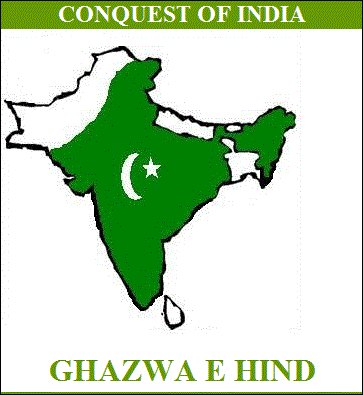
    ghazwa.gif

    1.

    The Hadith:

    The major sweep of the victorious army with black banners will be from Khorasan to Jerusalem, as described in various earlier posts here — but  there are ahadith that deal with the conquest of India (and China, but that’s another story, see David CookStudies in Muslim Apocalyptic, pp 170 ff) that are currently enjoying a vogue in Pakistan…

    Here is one version of the hadith, as quoted  by the Shaikh of the Naqshbandi Owaisiah Sufis, Muhammad Akram Awan, to whom I shall return in a future post, in a speech he gave in Pakistan in November 2008:

    From Abu Hurairah (rau), he said: (saws)

    The Messenger (saws) of Allah promised us Ghazwah-tal Hind. Now, if I encounter it, I shall invest my wealth and life in it. Then, if I am killed I will be among the most chosen Shuhada (martyrs) and if I live, I would be Abu Hurairah ‘the freed’ (from Hell Fire).

    2.

    The plan:

    So how does that translate into contemporary geopolitics?

    Syed Saleem Shahzad (Inside Al-Qaeda and the Taliban: Beyond Bin Laden and 9/11, pp 206-215) offers a brief overview of the Indian Jihad / Ghazwa-e-Hind in its current incarnation, with the involvement of the Pakistani ISI and AQ’s (presumed late) Ilyas Kashmiri, bringing us fast forward to the present day:

    This was the ISI plan drawn up 30 years ago with Harkat-ul-Jihad-iIslami, Jamaat-e-Islami, Muslim Brotherhood connections, Islamic seminaries, and Sufi networks of constructing a theater of war from Central Asia to Bangladesh to defeat the Soviet Union in Afghanistan, and simultaneously to acquire the right of self-determination for Kashmiris in India. Thirty years later, Al-Qaeda simply refurbished the plan after sketching out its ideological boundaries, to prepare the greater theaters of war of Khurasan and Ghazwa-e-Hind for victory, before its armies, holding the black flag aloft, entered in the Middle East for the final battle against the Western world.

    From my POV, the ghazwa is one of the topics Stephen Tankel might profitably have addressed as theological matter relevant to the LeT and the Mumbai attack…

    Here’s the close of Shahzad’s book, to make the apocalyptic thrust in all this quite clear:

    However, the saga of Al-Qaeda’s One Thousand and One Nights tales continues with new strategies and new characters. For Al-Qaeda these are just measures to keep the West running from pillar to post until it exhausts itself and Al-Qaeda can announce victory in Afghanistan. Al-Qaeda next aims to occupy the promised land of ancient Khurasan, with its boundaries stretching all the way from Central Asia to Khyber Paktoonwa through Afghanistan, and then expand the theater of war to India.

    The promised messiah, the Mahdi, will then rise in the Middle East and Al-Qaeda will mobilize its forces from Ancient Khurasan for the liberation of Palestine, where a final victory will guarantee the revival of a Global Muslim Caliphate.

    3.

    The video: 

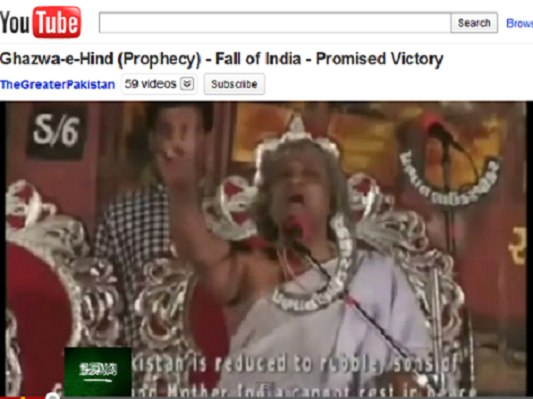
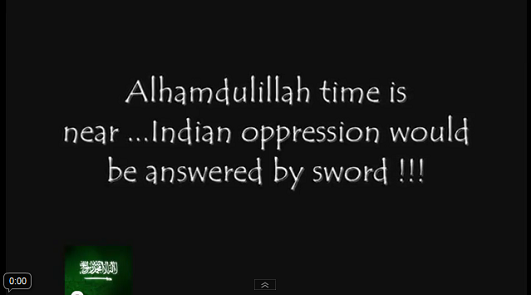
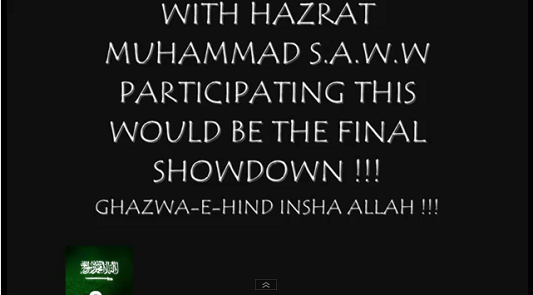
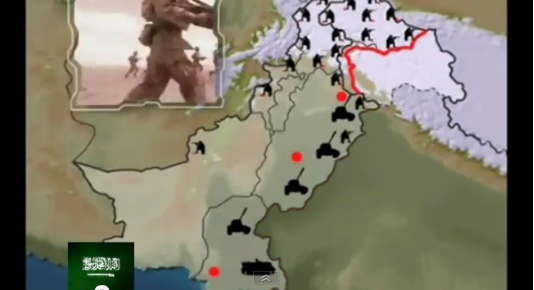
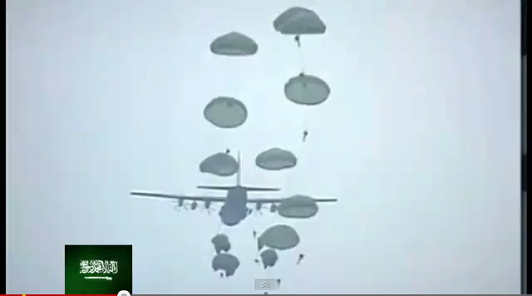
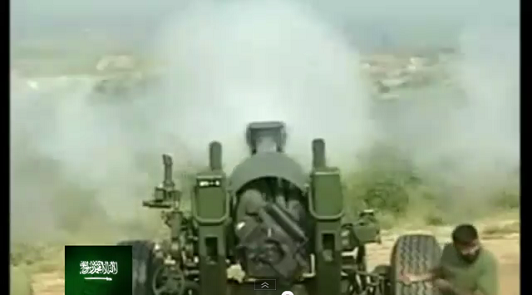
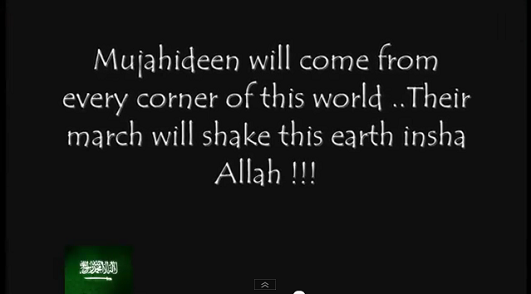
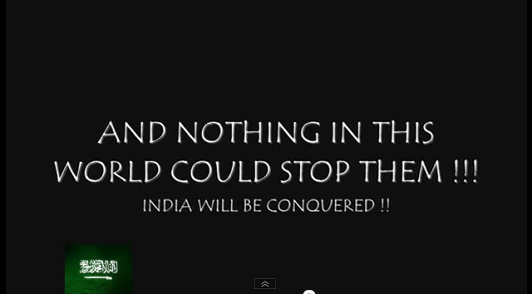
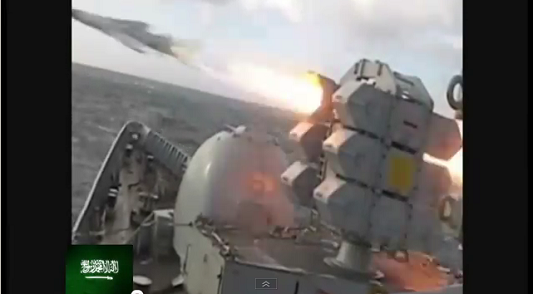
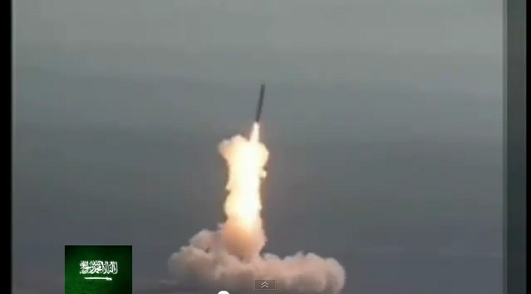
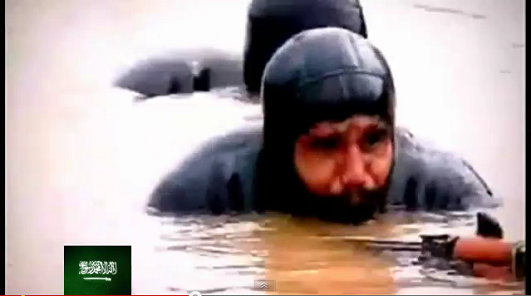
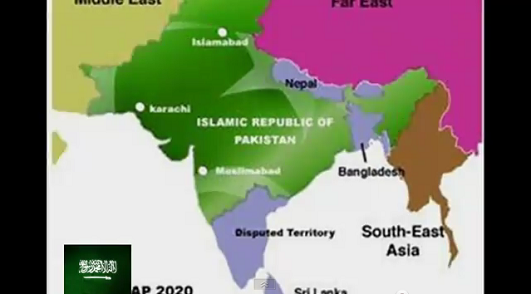
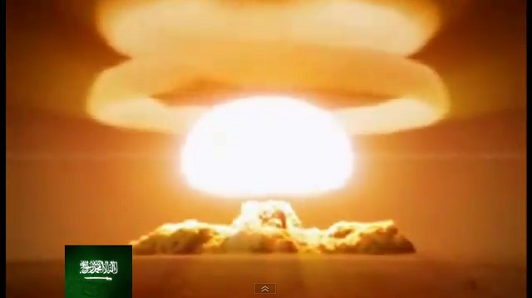
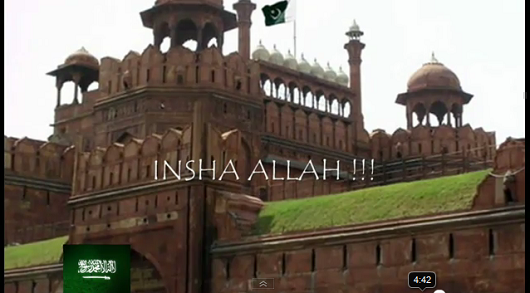
    With that as background, I’d like to illustrate the emotional drive of the ghazwa idea, with screen shots from a video posted to YouTube in February of this year, titled Ghazwa-e-Hind (Prophecy) – Fall of India – Promised Victory. This section will take up quite a bit of screen space, but you can pretty much scroll on down and get the general idea, pausing where something seems a tad different or more interesting:

    The video features stirring music throughout, presumably taken from Molossus (From “Batman Begins”) [2005] by Hans Zimmer & James Newton Howard — which we are invited to purchase on iTunes or AmazonMP3…

    It opens with a rally, at which an Indian speaker is castigating Pakistan —

    minus-1.png

    next up: two frames that give a textual expression of the hope involved —

    ghazwa-00.png

    ghazwa-00a.png

    then, what we might call a “starting” map —

    startmap.png

    various evidences of military might —

    ghazwa-00b.png

    ghazwa-00c.png

    ghazwa-00d.png

    ghazwa-00e.png

    another couple of text frames —

    ghazwa-00f.png 

    ghazwa-00g.png

    some arguably more intense weaponry —

    bb.png

    cb-rocket-1.png

    and no less intense special forces —

    cb-rocket-2.png

    then the hoped-for “close of play” map, book-ending the “opening” map above —

    ghazwa-01.png

    the ultimate threat —

    ghazwa-02.png

    and the flag of Pakistan flying over the Red Fort in Delhi —

    ghazwa-03.png

    4.

    The warning: 

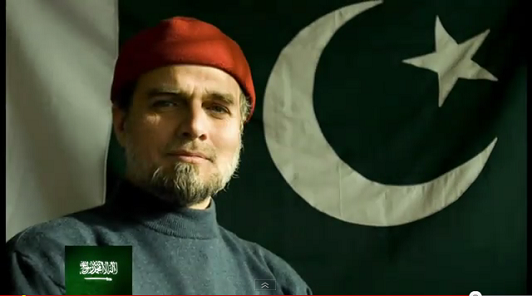
    I have one final screen shot in the series, and it features Syed Zaid Hamid

    ghazwa-04.png

    the man who has been most actively stirring up public sentiment in Pakistan for the Ghazwa-e-Hind.

    I will close with two of Hamid’s speeches, posted on YouTube, each of them containing a warning.  The first is in English, geopolitical in tone, and contains a warning to the US, Israel and India, that they should not attack Pakistan.

    The second is addressed to the Hindus:

    Such an invitation to convert is mandatory “when you meet your enemies’ before waging jihad, as stated in the hadith in Sahih Muslim, Book 19, 4294:

    Invite them to (accept) Islam; if they respond to you, accept it from them and desist from fighting against them.

    — and parallels bin Laden‘s Letter to America, in which UBL wrote:

    The first thing that we are calling you to is Islam.

    (a) The religion of the Unification of God; of freedom from associating partners with Him, and rejection of this; of complete love of Him, the Exalted; of complete submission to His Laws; and of the discarding of all the opinions, orders, theories and religions which contradict with the religion He sent down to His Prophet Muhammad (peace be upon him). Islam is the religion of all the prophets, and makes no distinction between them – peace be upon them all.

    5.

    The outline:

    That’s the basic outline.

    I hope to dig in deeper and provide more subtlety in future posts, but this topic is still pretty new to me — I first ran across it, somewhat tangentially, in the United States of Islam video which I began to discuss in October 2010, and which I may return to shortly.

    I also wish to invite comment from others who have been looking into the Ghazwa for longer than I have.


    Switch to our mobile site