zenpundit.com » music

Archive for the ‘music’ Category

The Said Symphony: moves 1-5

Saturday, June 18th, 2011

[ by Charles Cameron – extended analytic game on Israeli-Palestinian conflict ]

.

In two previous posts (Intro, and Board and Gameplay), I have described my forthcoming attempt to “play” a 130-plus move game, in which I will use quotations, images and anecdotes to express something of the complex weave of thoughts and emotions that govern — in tense and tenuous fashion — the “Israeli-Palestinian problem”.

Here I will commence play, making my initial “moves” in this area of the board:
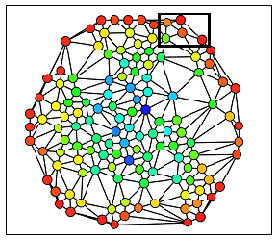
said-bd-zp-start.gif

____________________________________________________________________________________________

Move 1: The Said Symphony
move-001.gif

Move content:

When you think about it, when you think about Jew and Palestinian not separately, but as part of a symphony, there is something magnificently imposing about it. A very rich, also very tragic, also in many ways desperate history of extremes — opposites in the Hegelian sense — that is yet to receive its due. So what you are faced with is a kind of sublime grandeur of a series of tragedies, of losses, of sacrifices, of pain that would take the brain of a Bach to figure out. It would require the imagination of someone like Edmund Burke to fathom.

Edward W. Said, Power, Politics, and Culture, p. 447 — from the section titled “My Right of Return,” consisting of an interview with Ari Shavit from Ha’aretz Magazine, August 18, 2000.

Links claimed:

In his novel of the Glass Bead Game, Hermann Hesse writes:

Every transition from major to minor in a sonata, every transformation of a myth or a religious cult, every classical or artistic formulation was, I realized in that flashing moment, if seen with a truly meditative mind, nothing but a direct route into the interior of the cosmic mystery, where in the alternation between inhaling and exhaling, between heaven and earth, between Yin and Yang, holiness is forever being created.

It is in the links between moves, the creative leaps of the analogical mind, that the secret of the game can be found — so the “links claimed” sections of moves can be viewed as meditation points — architecturally, they are the “arches” of potential insight between the “pillars” of existing ideas. Here, no links are claimed, since this is the first move in the game.

Comment:

This is where it begins… with a vision of dissonant voices in counterpoint… ____________________________________________________________________________________________

Introductory moves

Before we get directly into the “meat” of the game, I want to explore its purpose via a few more moves that focus on what we might call the polyphony of ideas — thinking in terms of multiple voices.

Move 2: Hermann Hesse and the Glass Bead Game
Move 3: JS Bach and the Art of Fugue
Move 4: William Blake and Fourfold Vision
Move 5: Bob Dylan and One Too Many Mornings
Move 6: Glenn Gould

Then two moves nudging us in the direction of, then directly into — Israel:

Move 7: Daniel Barenboim
Move 8: Wagner

and specifically to the outskirts of Jerusalem / Al Quds:

Move 9: Golgotha

You might want to consider these nine moves a sort of overture.  Let’s see how that goes…

____________________________________________________________________________________________

Move 2: Move 2: Hermann Hesse and the Glass Bead Game
move-002.gif

Move content:

Hermann Hesse’s novel Das Glasperlenspiel (English title The Glass Bead Game, also published as Magister Ludi) won him the Nobel for Literature.
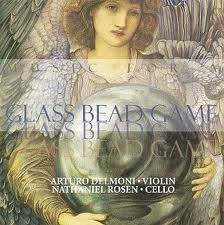
gbg-cover.jpg

The centerpiece of the novel is the Game itself. Hesse doesn’t spell out in detail how it is to be played, but his hints are enough to let us know that in play, different ideas from across world culture are combined as if in a virtual music of ideas:

The Glass Bead Game is thus a mode of playing with the total contents and values of our culture; it plays with them as, say, in the great age of the arts a painter might have played with the colors on his palette. All the insights, noble thoughts, and works of art that the human race has produced in its creative eras, all that subsequent periods of scholarly study have reduced to concepts and converted into intellectual values the Glass Bead Game player plays like the organist on an organ. And this organ has attained an almost unimaginable perfection; its manuals and pedals range over the entire intellectual cosmos; its stops are almost beyond number.

It is in an attempt to bring Hesse’s idea of a musical synthesis of ideas into practical application in helping us understand — and perhaps even, god willing, help us to resolve — the Palestinian-Israeli conflict that I am playing this game.

The idea is not to come up with a solution, but a richer sense of the interplay of motives and memories as they build the situation we all now face.

Link claimed:

To Edward Said, in that Hesse immediately precedes Said in his intuition that melodies are not the only kinds of thought that can be juxtaposed in counterpoint and thus integrated in a complex, sometimes tragic, often profound, always human music.

Comment:

The graphic I have used is from the cover of a lovely CD, featuring Arturo Delmoni and Nathaniel Rosen, Music for a Glass Bead Game. ____________________________________________________________________________________________

Move 3: Move 3: JS Bach and the Art of Fugue
move-003.gif

Move content:

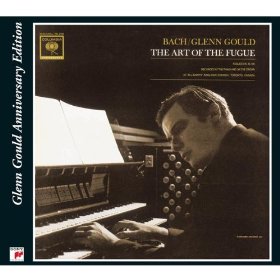
gould-art-of-fugue.jpg

Bach was my first great love in the arts, and when I applied to study at Christ Church, Oxford, it was essays on Hopkins, El Greco, and Bach — specifically the B Minor Mass — that got me in the door. Years later, when I lived in Warrenton and commuted to a think-tank job in Arlington, VA, I found myself muttering To hold the Mind of Bach over and over to myself like a mantram.

And that, I think, is the key to my games.

I want to think as Bach did, polyphonically — to see the world in terms of counterpoint, to read life musically. And my games, which involve holding related, sometimes harmonious and sometimes conflicting thoughts in the mind at the same time, invite and encourage me to do that. They also provide me with a method of notating (scoring, in the musical sense) such multi-thought patterns on the various HipBone boards.

It is Bach, therefore, who is grandfather to Said’s thought, as Hesse is its father — and Bach’s greates expressions of this approach are found in such great summary works as the B Minor Mass and the Art of Fugue.

The taste I offer here is from Contrapunctus IX, which you can hear played by Glenn Gould on the organ here (and download it for 99 cents)…

Links claimed:

To Hesse and the Bead Game, because Bach’s presence, and that of counterpoint whose greatest exponent he was, is fundamental to Hesse’s great Game. Indeed, as he writes in the book:

The Game was at first nothing more than a witty method for developing memory and ingenuity among students and musicians. … One would call out, in the standardized abbreviations of their science, motifs or initial bars of classical compositions, whereupon the other had to respond with the continuation of the piece, or better still with a higher or lower voice, a contrasting theme, and so forth. It was an exercise in memory and improvisation quite similar to the sort of thing probably in vogue among ardent pupils of counterpoint in the days of Schütz, Pachelbel, and Bach — although it would then not have been done in theoretical formulas, but in practice on the cembalo, lute, or flute, or with the voice.

To Edward Said and his call for a symphonic reading of the Israeli-Palestinian situation: because he invokes the mind of Bach himself in the passage quoted in move 1, speaking of the

sublime grandeur of a series of tragedies, of losses, of sacrifices, of pain that would take the brain of a Bach to figure out.

Comment:

It is said that every artist teaches us to see, listen, hear, read, understand in a fresh way, so that the artist’s own work, at first well-nigh incomprehensible, may gradually find its way first into clarity, and then into ease of access, obviousness, popularity, and “classical” status — later stages of the same process will bring it first obscurity and finally oblivion.

We are not yet in a position to hold many thoughts simultaneously in the mind as Bach’s mind held many melodies, but we are opening to the possibility…

Multi-tasking… this will be an early attempt at a game of musical multi-thinking. Please think it through with me… ____________________________________________________________________________________________

Move 4: William Blake and Fourfold Vision
move-004.gif

Move content:

Here’s what William Blake saw:
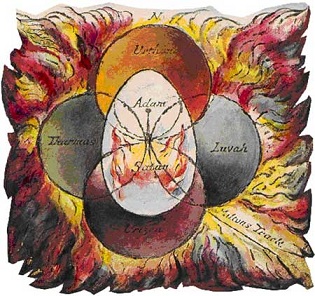
ogormanblake.jpg

Here’s what William Blake said, in his Letter to Thomas Butts:

Now I a fourfold vision see

And a fourfold vision is given to me

Tis fourfold in my supreme delight

And three fold in soft Beulahs night

And twofold Always.

May God us keep\

From Single vision & Newtons sleep.

Here’s a commentary on Blake’s notion from a fascinating paper by Marcel O’Gorman:

Several Blake critics have attempted to unravel Blake’s use of term “fourfold vision.” Accoring to Jerome McGann, beings of single vision see the world in absolutes. Life is a prison term that ends in a final, discrete annihilation. Men of twofold vision see the world dialectically, according to contraries. Threefold vision enables one to recognize the contraries and see that they are not absolute, but that the boundaries of good and evil shift according to each individual. In Milton, Blake defines threefold vision as a peaceful state, and he associates it with Beulah:

There is a place where Contrarieties are equally True This place is called Beulah, It is a pleasant lovely Shadow Where no dispute can come. Because of those who Sleep.  (M 30:1-3)

Beulah and threefold vision are identified with sleep, restfulness. But fourfold vision involves activity, not sleep. Fourfold vision is generation and destruction, life and death, or even life in death. Evidently, Blake’s understanding of death is unconventional, to say the least. For Blake, death is considered as part of the creative process, a part of life.

Links claimed:

To the Glass Bead Game: because Hesse writes:

I suddenly realized that in the language, or at any rate in the spirit of the Glass Bead Game, everything actually was all-meaningful, that every symbol and combination of symbols led not hither and yon, not to single examples, experiments, and proofs, but into the center, the mystery and innermost heart of the world, into primal knowledge. Every transition from major to minor in a sonata, every transformation of a myth or a religious cult, every classical or artistic formulation was, I realized in that flashing moment, if seen with a truly meditative mind, nothing but a direct route into the interior of the cosmic mystery, where in the alternation between inhaling and exhaling, between heaven and earth, between Yin and Yang, holiness is forever being created.

Yin and yang are the opposites of the dialectic, but in the yin-yang symbol or tai-chih we see them alternating and interpentrating in the subtle and fluid play between them (Blake’s threefold vision) from which, in Hesse’s words, “holiness is forever being created” — Blake’s fourth.

To the Said Symphony, because precisely that kind of fluid flowing between one perspective and another is what allows empathy to triumph over opposition, and the “other” to become “brother” — the condition in which alone “the peaceable kingdom” / “peace on earth” can prevail…

Comment:

Blake was the mentor of my own poetic mentor, Kathleen Raine, and my own early published poems appeared in a Penguin volume edited by Michael Horovitz and titled Children of Albion in Blake’s honor.

I am happy to remember such friends in writing this game — and amazed to find in the Blake illustration above, which I only ran across today in O’Gorman’s article, yet another visual precursor to the boards on which my games are played. ____________________________________________________________________________________________

Move 5: Bob Dylan and One Too Many Mornings
move-005.gif

Move content:

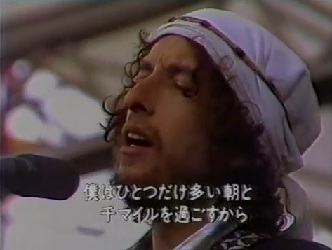
dylan.jpg

The Bob Dylan song, One too many mornings.

You’re right from your side

I’m right from mine

We’re both just one too many mornings

An’ a thousand miles behind

Links claimed:

To Fourfold Vision and William Blake: Dylan captures the utterly wrong double-rightness of conflict that features in Blake’s vision — at an intensely personal level. And I’d argue, personally, that Dylan does in music and poetry what Blake was doing in poetry and visual art — at greater depth than his Blakean friend (and companion on parts of the Rolling Thunder tour) Allen Ginsberg.

Comment:

I believe I was at the Colorado Rolling Thunder Revue concert where Dylan sang the version which YouTube presents here from a Japanese bootleg video tape. You can purchase the Hard Rain album — or just the one track — here. ____________________________________________________________________________________________

four more moves coming up shortly in a follow-up post, and then I’ll take a break.
A HipBone approach to analysis VI: from Cairo to Bach

Monday, February 28th, 2011

[ by Charles Cameron ]

*

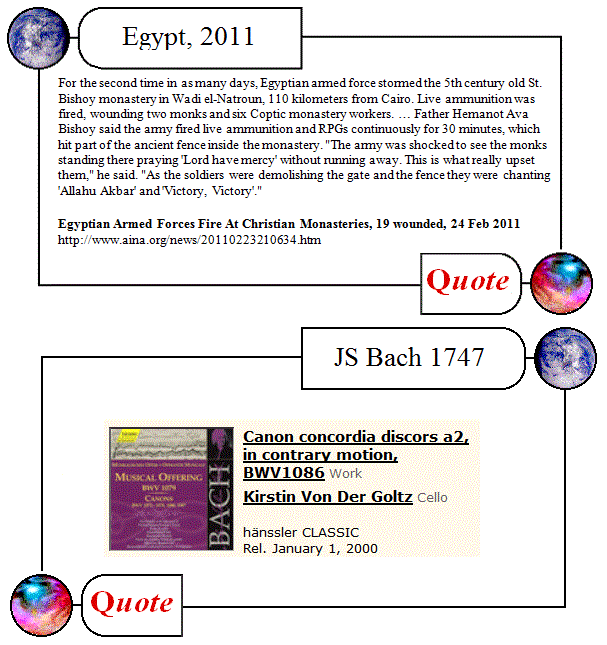
The description of Egyptian troops attacking a Christian monastery that forms the first quote in this DoubleQuote is horrifying in many ways.

quoprayer-counter-prayer.gif

Recent events in Egypt had featured mutual support between Muslims and their Coptic Christian neighbors, each group in turn acting as human shields to protect the other while they were praying. Here, by contrast, the army – which is effectively now “ruling” Egypt in the interregnum between the fall of Mubarak and the election of a new President and government – is attacking the humans it is supposed to protect.

But what does that have to do with Bach?

*

Part I: a monastery attacked in Egypt

This is vile.

Those who are being attacked happen to be Christians and monks, no less human on either account, and just as subject to bleeding as others – so they might ask, with Shakespeare‘s Shylock speaking for the Jews:

If you prick us do we not bleed? If you tickle us do we not laugh? If you poison us do we not die? And if you wrong us, shall we not revenge?

That last question of Shylock’s is an interesting one, and gets to the heart of what I want to discuss here, as we shall see.

Specifically, these human beings were monks. Muhammad had a higher opinion of monks than of many others. In the Qur’an, we find:

The nearest to the faithful are those who say “We are Christians.” That is because there are priests and monks among them and because they are free of pride.

*

Sigh.

These “followers” of Muhammad were attacking Christian monks with live ammunition and RPGs continuously for 30 minutes, wounding 19.

They felt superior to their compatriots the monks, they cried “God is Great” and “Victory, Victory” as they did it.

In this they resemble GEN Boykin, who famously responded to a Somali warlord claiming that God would protect him, “Well, you know what? I knew that my God was bigger than his. I knew that my God was a real God and his was an idol.”

I could easily have made that my second quote here, pairing it with the description of the Egyptian army attack on the monastery, for between the two of them they raise the question of whether weaponry is stronger than belief – and while some Christians might agree with General Boykin, some Muslims might agree no less strongly with the members of the Egyptian military shouting “Allahu Akbar”.

*

I believe that taking sides here misses the point.

Which I am happy to say, Abraham Lincoln made with considerable eloquence in his Second Inaugural Address in 1865, almost a century and a half ago:

The prayers of both could not be answered. That of neither has been answered fully. The Almighty has His own purposes.

That point is one which HaShem made to his angels, according to rabbinic teaching:

The Talmud teaches us that on the night that the Egyptian army drowned in the Red Sea, the first true moment of freedom for the Jews fleeing Egypt, God refused to hear the angels sing their prayers, and said “my creations are drowning in the sea, and you will sing songs?”

So, no — revenge is not the way to go…

*

But please note that the point I am making is not one of moral equivalence.

That God which created “both sides” in any human conflict and loves each and every one of his own creations, might indeed find one creed superior to another, as he might find one scientific law more accurately describing the workings of, say, gravitational attraction than another – or the night sky at Saint-Rémy portrayed by Van Gogh more or less moving than the thunderous sky over Toledo of El Greco.

In the view I am proposing, the “God who takes neither side” in fact takes both, but with this distinction: he sides with the wounded more than with those who inflict wounds – not because one side has a better creed than the other, but because he made us to learn not to unmercifully maim and destroy one another…

…one of whose names is The Merciful, in whose scriptures it is written:

If thou dost stretch thy hand against me, to slay me, it is not for me to stretch my hand against thee to slay thee: for I do fear Allah, the cherisher of the worlds.

…one of whose names is The Lord is Peace, in whose scriptures it is written:

Love your enemies and pray for those who persecute you.

*

Part II: Bach and contrapuntal analysis

All of which brings me to the second “quote” in my DoubleQuote above: JS Bach‘s “concordia discors” canon in two voices, BWV 1086 – which you can hear or purchase here.

Bach’s mastery was in counterpoint, the play of one musical idea against another, and in this particular work, the two ideas are exact opposite: in musical terms, the melody is played here against its inversion. And the point of counterpoint, if I may put it that way, is not to provide “harmony” but to show how discord can become harmonious and concordant — or to put that in the geopolitical terms that interest me, how conflict and opposition can be resolved…

Not, you understand, that this state of affairs then leads necessarily to the singing of Kumbaya or the kind of ending in which “they all lived happily ever after”.

Concordia discors: the resolution of the present conflict, in a continuing overall “music” of great power and beauty, in which further conflicts will inevitably arise and find resolution.

*

Here’s the essence: Bach takes contrasting and at times conflicting melodic ideas and makes music.

He teaches us to hear distinct and differing voices, to allow ourselves to hear and feel both the discomfort that their disagreements raise in us, and the satisfaction that comes as those disagreements are worked out. He does this by teaching us to hear them as voices within a choir, ribbons in a complex braid, making together a greater music that any of them alone could give rise to. And in this process, their differences are neither denied nor lost, but resolved and transcended.

Edward Said, whose politics my readers may dislike or like or even perhaps be unaware of, was for years the music critic for The Nation, wrote three books (and an opus posthumous) on music, and with his friend the pianist and conductor Daniel Barenboim co-founded the West-Eastern Divan Orchestra, named for the West-östlicher Diwan, Goethe’s collection of lyric poems.

Barenboim (the Israeli) wrote of Said (the Palestinian):

In addition to being well versed in music, literature, philosophy, and the understanding of politics, he was one of those rare people who sought and recognized the connections between different and seemingly disparate disciplines. His unusual understanding of the human spirit and of the human being was perhaps a consequence of his revelatory construct that parallels between ideas, topics, and cultures can be of a paradoxical nature, not contradicting but enriching one another.

And there we have it again: Bach’s insight, this time transposed by an accomplished musician into the key of thoughts and ideas…

*

Said talks quite a bit about counterpoint, both musically:

Musically, I’m very interested in contrapuntal writing, and contrapuntal forms. The kind of complexity that is available, aesthetically, to the whole range from consonant to dissonant, the tying together of multiple voices in a kind of disciplined whole, is something that I find tremendously appealing.

.

[Said, Power, Politics and Culture, p. 99.]

and politically:

When you think about it, when you think about Jew and Palestinian not separately, but as part of a symphony, there is something magnificently imposing about it. A very rich, also very tragic, also in many ways desperate history of extremes — opposites in the Hegelian sense — that is yet to receive its due. So what you are faced with is a kind of sublime grandeur of a series of tragedies, of losses, of sacrifices, of pain that would take the brain of a Bach to figure out. It would require the imagination of someone like Edmund Burke to fathom.

.

[Said, Power, Politics and Culture, p. 447.]

*

As I commented in an earlier post that ties in with this one, the great pianist Glenn Gould was also preoccupied with counterpoint, both in Bach’s music and in conversations overheard at a truck-stop cafe or on long train journeys — he too was “working” the parallel between melodic and verbal forms of counterpoint.

And JRR Tolkien made the reconciliation of discordant musics in a greater concord the central to his creation myth in The Silmarillion, “The Music of the Ainur”, which can now be read online at the Random House site.

*

Part III: invitation

May I strongly commend to your attention the movie, Of Gods and Men, which just opened in limited release, having won the grand jury prize at Cannes…

Gaddafi House Party: Zenga Zenga Song

Sunday, February 27th, 2011

If one of the homeless on lower Wacker Drive could become dictator….. 

I’m not sure what is being said here but as Gaddafi speaks mostly in violent, insane, drivel anyway, the remix satire remains spot on:

An Iridology of the Sciences?

Tuesday, January 4th, 2011

[ by Charles Cameron ]

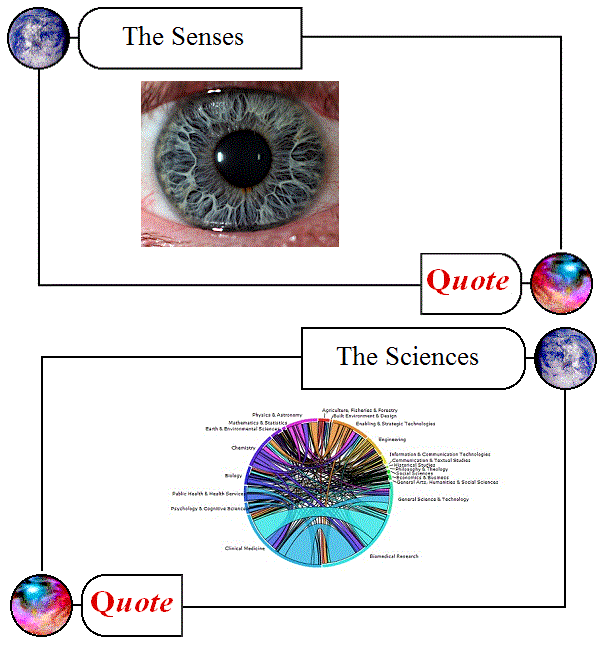
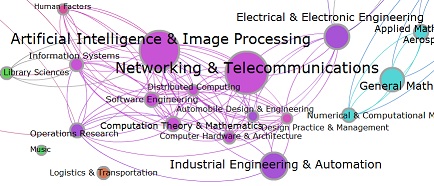
I for one am delighted to know that we can now play around with the iridology of the sciences, using the software available on the Science-Metrix Ontology Explorer site to view which fields have journals which cross-link to journals in other fields…

Seriously — that lower image is of the Field Citation Wheel that you can find, suitably enlarged for easy viewing, on that site.

*

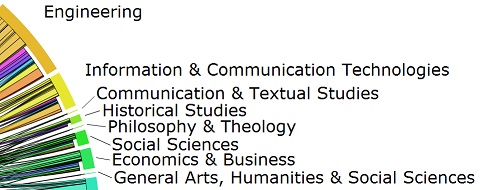
And it’s heartening for me to know, for instance — taking a closer look at the segment of that image that’s roughly east north-east — that scientific journals do have some links on their pages to works of theology or philosophy:


Engineering
, you’ll notice, has more links than history, philosophy, theology, the social sciences (even counting them twice), economics, business, the arts and humanities combined.

My own field, theology, has to share its thin segment with philosophy, and you can guess how small the number of links to articles on Islamic apocalyptic probably are…

Which is, in part, why I wonder whether a project like the ETH’s Living Earth Simulator will really manage to map such things as, well, a possible outbreak of global jihadist Mahdism and its consequences.

*

But then I look at another gorgeous graphic from the same source, focusing in on a part of the network of knowledge that interests me, and I can just faintly make out, lower left, entirely isolated, the field of music

What splendid isolation! That’s all of Bach, mind you – and all the Beatles, too.

*

Seriously, though:

  • It’s fascinating to be able to see how the various branches of knowledge cross-reference each other.
  • Visual data representation is a gorgeous, fantastic, field.
  • Mapping the all-of-everything is an irresistable lure for keen minds
  • I’m betting the humanities will prove to be at least as good at it as the sciences.
  • And I recall, not without a pang of regret, the time when my beloved Theology was Queen of the Sciences, and one might converse with Abelard on the streets of Paris…

A Baghdad DoubleTake and other matters

Friday, December 31st, 2010

[ by Charles Cameron ]

Zen recently posted a video of a terrific hour-plus-long speech by Doug Hofstadter – one of the best videos I’ve ever taken the time to watch – in which Hofstadter, the guy who brought us Godel Escher Bach and much more, talked about analogy and suggested that it’s at the very core of human cognition.

I posted a poem and some comments in response — they got a bit mangled in terms of formatting, which may be fixed by the time you read this – and Zen then posed a question:

Charles – there’s a large portion of visual imagery in the passage you cite: do you think the incorporation of imagery (thus activating a powerful region of the brain) enhances or distorts the underlying conceptual connection in an analogical construction?

That’s what set me off this time…

*

I think of a poem as a braiding of three strands: a strand of sound or music, a strand of image, and a strand of meaning. For convenience, I’ll usually include a fourth – wit – but it’s actually more like a pearl that can be threaded on the strand of meaning.

From my POV, the poem is thus essentially a screenplay for the mind’s eye – and if a poem begins with strong music, at the very least I’d like it to end with strong music, if it starts with wit or wordplay, I’d like it to end with that too, and if it has imagery, I’d like the images to unspool in a way not unlike the images in a movie…

When I’m reading poems by others, and particularly if I’m teaching a poetry class, I’ll sometimes notice a sudden disjunction in one of the three strands. If it’s clearly for effect, all’s well and good – but if it’s unconscious, unintended, it will always reveal an aspect of the poem that hasn’t been worked through yet, and applying conscious attention to it will result in the emergence of new material from the unconscious store that enriches the final product. Sometimes, that kind of attention reaches something that was psychologically difficult, a disjunction in soul if you like – and the result of moving through it to the finished poem can be very much like a breakthrough insight in therapy.

But “poetry is not a hospital” – if Apollinaire didn’t say that, and I used to think he did, I shall.

*

From my POV, therefore, there are analogies of sound, analogies of meaning, and analogies of image. There’s an analogy of sound between tomb and womb – we call it rhyme. There’s certainly an analogy of meaning – whence we come at birth, whither we go at death. And if you like, there’s an analogy of image – when I think of the “twinning” of those two words, I see life itself as running across a brief stretch of grass between two caves…

When as here, the analogy runs across all three braids, you have a very powerful “conceit” or poetic device.

The graphic match, together with sonic rhyme, between the visuals of a hotel room fan and the rotors of a helicopter at the beginning of Apocalypse Now parallels the sense of explosive heat and frustrated inaction of Captain Willard trapped in Saigon with the sense of freedom and clarity he feels when sent on mission up-river – again, an analogy in three strands.

*

But analogy can also cut across the senses in a different way. Here’s Hermann Hesse‘s view of the Glass Bead Game:

Throughout its history the Game was closely allied with music, and usually proceeded according to musical or mathematical rules. One theme, two themes, or three themes were stated, elaborated, varied, and underwent a development quite similar to that of the theme in a Bach fugue or a concerto movement . A Game, for example, might start from a given astronomical configuration, or from the actual theme of a Bach fugue, or from a sentence out of Leibniz or the Upanishads, and from this theme, depending on the intentions and talents of the player, it could either further explore and elaborate the initial motif or else enrich its expressiveness by allusions to kindred concepts.

Beginners learned how to establish parallels, by means of the Game’s symbols, between a piece of classical music and the formula for some law of nature. Experts and Masters of the Game freely wove the initial theme into unlimited combination.

That’s analogy cutting across disciplines, and across sensory modalities too.

There was a period of about a dozen years when I almost completely stopped writing poetry, and concentrated on devising a variant on Hesse’s game that would be playable on a napkin in a café – conceiving of it as an art that would combine tight form (think: sonnet, sonata) with the entire spectrum or palette of human thought, visual, verbal, numerical, aural.

Hesse again:

The Glass Bead Game is thus a mode of playing with the total contents and values of our culture; it plays with them as, say, in the great age of the arts a painter might have played with the colors on his palette. All the insights, noble thoughts, and works of art that the human race has produced in its creative eras, all that subsequent periods of scholarly study have reduced to concepts and converted into intellectual values the Glass Bead Game player plays like the organist on an organ. And this organ has attained an almost unimaginable perfection; its manuals and pedals range over the entire intellectual cosmos; its stops are almost beyond number. Theoretically this instrument is capable of reproducing in the Game the entire intellectual content of the universe.

And that was written before the world wide web allowed us to mingle visual, verbal, numerical and aural elements so directly in a single presentation.

You can imagine how delighted I was, therefore, to stumble upon Sven Birkerts‘ writing:

There are tremendous opportunities, and we are probably on the brink of the birth of whole new genres of art which will work through electronic systems. These genres will likely be multi-media in ways we can’t imagine. Digitalization, the idea that the same string of digits can bring image, music, or text, is a huge revolution in and of itself. When artists begin to grasp the creative possibilities of works that are neither literary, visual, or musical, but exist using all three forms in a synthetic collage fashion, an enormous artistic boom will occur.

That’s what the HipBone Games were all about…

*

That’s what I was reaching for, back in the days before I even called my games the HipBone Games — when they were still TenStones Games played on a board whose geometry I borrowed from the Sephirotic Tree – when I played TS Eliot‘s poem, The dove descending, in juxtaposition to Vaughan Williams‘ piece for violin and orchestra, The lark ascending

…matching music with poem, descent with ascent, dove with lark, and the natural world of the English countryside with the “wrought” world of Eliot’s London in the pentecostal Blitz.

I don’t think Stephen or I had web browsers at the time – we played that game using AOL’s early texting function, so the music was entirely in the mind…

And I still think of that game as one of the loveliest expressions of the “hipbone” art.

Hesse’s game really is, for me, the continuation of poetry by other means…

*

But then it turns out that analogy is an incredibly powerful aspect of human thought – and one that, IMO, we haven’t explored very deeply, perhaps precisely because it jumps silos and disciplinary boundaries, and creates fresh insight

…which is pretty much as Doug Hofstadter was suggesting in that video Zen posted.

And so this fundamentally analogical frame of mind — which I had developed in a poetic and aesthetic context and applied to the symbolism so dear to the poets, cultural anthropologists, analytical psychologists, and comparative theologians and the like — turned out to be highly applicable and seen as highly creative when applied to real world issues, when I got a job for a couple of years at a small think-tank just outside DC.

Because if linear causality is the warp of the weave of the world, acausal patterning is its woof (or weft) – and frankly, our current techno-civilization is hopelessly warped in the direction of warp, and has very little understanding of woof, of weft, of pattern — of what can only be learned from analogy.

*

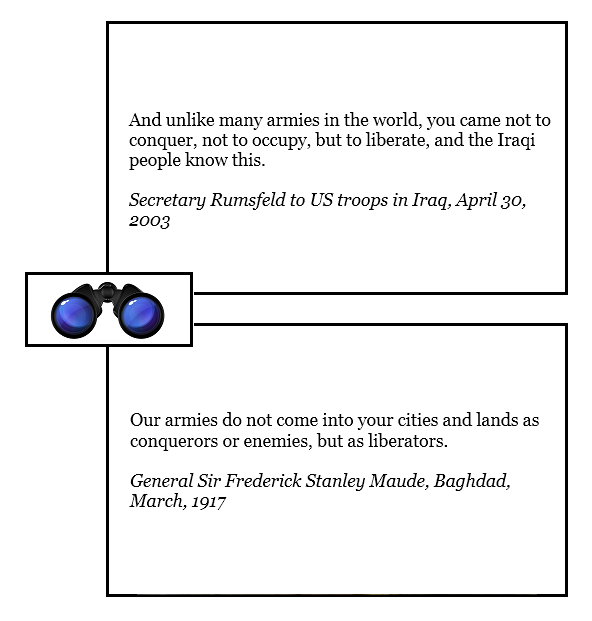
Not that there doesn’t have to be enormous care taken to avoid over-reading parallels. But consider the immediacy of the impact of this DoubleQuote, which I composed in 2003:

Eh, Zen?

Santayana echoes Marx refracts Hegel:

Hegel remarks somewhere that all great world-historic facts and personages appear, so to speak, twice. He forgot to add: the first time as tragedy, the second time as farce.

Those who cannot remember the past are condemned to repeat it

Seen from another angle: history has rhymes to match its reasons


Switch to our mobile site