zenpundit.com » strategist

Archive for the ‘strategist’ Category

Hoffman on the New Strategic Guidance

Tuesday, January 31st, 2012

Strategist and military analyst Frank Hoffman, now Director of National Defense University Press, takes a warm view of the new strategic guidance from DoD as a risk balancer in line with a dire fiscal and political reality. A “Pivot and Partner” strategy:

DefenseNews – Pentagon’s New Guidance: Sound Strategy Intricately Linked to Policies 

….Despite the fact that the Pentagon’s guidance represents the essence of “good strategy,” it was immediately panned by numerous pundits and several serious commentators who should know better.

What my critical colleagues have a problem with is not this document’s long-overdue need to reconcile our interests, priorities and resources. No, the real problem is that this guidance reflects a policy decision to sacrifice nearly $500 billion of planned increases to the defense budget over the next decade. Rather than resolve the strategic solvency gap between America’s goals and funding, the guidance’s critics want to continue to borrow money to maintain an unsustainable agenda.

The most common criticism is that the guidance is risky. There is little doubt that reductions in defense spending of the size now contemplated will increase risk. Such risks would be even more severe if sequestration is triggered by political gridlock.

However, the critics have no concern for the risk of fiscal collapse or the risks borne by the lack of renewal in the foundation of America’s power. Nor can they find fault with the increased risk borne by the $2 trillion already spent to prosecute two wars and build up America’s military budget to its current high of $550 billion, which exceeds Cold War-era spending levels. That’s the sort of thinking that partially got us into our economic crunch in the first place.

There Will Be Blood…..

Thursday, January 19th, 2012

All In: The Education of General David Petraeus by Paula Broadwell, with Vernon Loeb

The official biography of CIA Director General David Petraeus, by Harvard researcher Paula Broadwell, has long been anticipated in the .mil/COIN/NatSec/Foreign Policy communities and blogosphere.  I can hear pencils scrawling furiously away in the margins even as I type this post. 🙂

Broadwell,  herself a reserve Army officer, West Pointer, Harvard grad, doctoral student at King’s College War Studies Department , and by all accounts, an impressive up and coming individual,  had very extensive access to her subject – allegedly, far more than the official Army historian assigned to General Petraeus’ last command. Given the subject is General Petraeus, the precarious state of American policy in Afghanistan and 2012 as a circus of political excess, All In will be one of the few “must read” books this year.

And, I must commend Miss Mrs. Broadwell highly here, she will be donating 20 % of her net proceeds to help wounded veterans.

That said, in terms of reaction to this book, there will be blood.

Reviews of All In will afford the opportunity to tear the scabs off of the well-worn COINdinista/COINtra debate and rub salt in the exposed wounds – I for one am especially looking forward to reading future back to back reviews by Carl Prine and Thomas Ricks and Abu Muqawama vs. Colonel Gian Gentile. In the mainstream press, the opportunity for newspaper columnists to get in gratuitous potshots against figures like Presidents Bush and Obama, Dick Cheney, Don Rumsfeld, Robert Gates, Joe Biden, Hillary Clinton, Stan McChrystal and numerous others or grind partisan axes will be too tempting to resist, regardless of how relevant these remarks are to Broadwell’s biography of Petraeus. The looming specter of draconian cuts to defense budgets will also add to the rancor of the discussion of the book within the defense community.

Somewhere in that debate will be the book Broadwell actually wrote and within the book, perhaps, we will come to see David Petraeus. Or not.

Get your popcorn ready!

Right now, I am deep into reading the superb George Kennan biography by eminent diplomatic historian John Lewis Gaddis but All In is definitely next on my list.

And it will be reviewed.

On “Knowing How or Needing the Chance”

Sunday, January 8th, 2012

Trying to catch up from the point when work swamped me last week.

My longtime amigo Dave Schuler at The Glittering Eye voiced a disagreement with my post Ruminating on Strategic Thinking II. : Social Conditions which he set forth there, as well as in the comments section. Here’s Dave:

Knowing How or Needing the Chance? 

My blog friend Mark Safranski’s recent musings on the nature and sources of strategic thinking brought to mind an old politically incorrect joke whose punchline is “Know how; need chance.” He opens the post with a substantial list of strategic thinkers and then tries to find commonalities among them. I found his list of commonalities uncompelling. I don’t think these commonalities illuminate what strategic thinking is comprised of but rather what circumstances provide the greatest opportunity for strategic thinking.

For all we know the greatest strategic thinker of all time is sticking components onto a circuit board in Chengdu. We’ll never have the opportunity to see the results of her strategic thinking because she’s just struggling to make money to send to her parents back on the farm.

What “strategic thinking is composed of” – that is to say, the cognitive level behaviors – I speculated upon in part I – Ruminating on Strategic Thinking. I do not expect that I was successful in being comprehensive there, but I think that post is much closer to what Dave was alluding to above.

Part II was subtitled “Social Conditions”, which dealt with an informal case study of men “who had the chance”, the US leadership of WWII and the Cold War. Dave is correct that the human population of Earth or of a nation is statistically likely to yield a talent pool more able at strategic thinking than a subset of a  narrow elite groomed or self-selected for that purpose. However, the hypothetical potential of humanity at large does not provide me with case studies to examine they way that historical elites do, strategy often being intertwined with the holding and exercise of political power.

Part III, assuming I can get to it in a reasonable time frame, will look at activities that build an individual’s capacity for strategic thought


Ruminating on Strategic Thinking II. : Social Conditions

Tuesday, January 3rd, 2012

A follow up to Part I.

How does a society, as opposed to individuals, develop a capacity for “strategic thinking” ?

While war is an obvious answer, it is not an advisable first resort. First of all, although war teaches hard lessons about strategy, the costs of losing a war are high. Secondly, the costs of winning a war can be high. Thirdly, few people, relatively speaking to the number involved, have any direct input into genuinely strategic decisions during wartime; most will either gain tactical experience or be relegated to support functions. At best, wars seem to create a cohort of excellent tactical leaders with the potential to, someday, mature into strategic leaders or strategists. At worst, from a war, the wrong lessons may be drawn and institutionalized to create a future disaster.

What conditions produce strategic thinkers for a state? A brief example from American history:

Here are some of the US leadership of WWII, the postwar “Wise Men” and their Cold War successors, collaborators, thinkers and military chiefs:

Franklin Roosevelt, Henry Stimson, Joseph Grew, Dean Acheson, Douglas MacArthur, Charles E. Bohlen, George F. Kennan, Paul Nitze, George C. Marshall , Harry S. Truman, Robert A. Lovett, Dwight D. Eisenhower  , John J. McCloy , W. Averell Harriman, William Donovan, James F. ByrnesChester Nimitz,  John Foster Dulles,  James Forrestal, Vannevar Bush,  Allen Dulles, Ernest King, Albert Wohlstetter, Dean Rusk, Hyman RickoverHerman Kahn, Robert McNamara,  Bernard Brodie, Fritz G. A. KraemerMcGeorge BundyRichard Nixon, Thomas Schelling, Henry Kissinger

Some commonalities that these individuals shared, sometimes in pluralities and others in large majorities:

Above average to very high IQ
Middle class to high socioeconomic status
Eastern Establishment
Fraternal organizations
Male
Protestant
Episcopalian
Ivy League education
Law 
Politics
Military service
Diplomacy
Wall St.
Harvard
Yale
Princeton
Columbia
Harvard Law
Military Academy
University of Chicago
Berkeley
Skull & Bones
Scroll & Key
WWI
WWII
RAND
Executive Branch
Nuclear weapons/arms control/power

This list could be expanded or reduced on a number of grounds. For example, the list is composed of men primarily because almost no women, with very few exceptions, even from elite backgrounds, had an opportunity during the first 2/3 of the 20th century to contribute to strategic decisions or policy making. We could also include other characteristics, but what we have is sufficient for some broad generalizations.

  • First, these men generally engaged in careers that featured complex activities that stressed and rewarded incisive analysis of factual scenarios, assessment of risk and potential benefits, intuitive judgment and organizational abilities – law, politics, the stock market, diplomacy and corporate leadership. A minority of the list had formal training in advanced mathematics.

  • Secondly, the men all had the social wherewithal and ambition to gain entry into educational and social institutions that were by definition, highly exclusive on more than a strictly meritocratic basis. For many from higher SES families, this presented no significant barrier but for the “outsiders” like Kennan, Nixon or Rickover, it was a formidable obstacle to overcome. In either case, there were social mores or even commonly held prejudices to which they had to adapt in order to “fit in”. Despite this demonstration of social intelligence, most members of our list were not  professional politicians (but those that were made an impact on American history much greater than that of an “average” president).

  • Thirdly, the presence of such overlapping experiential commonalities, while not creating a formal “strategic community” was probably sufficient to impart a strategic mentalité as to how the world really worked, red in tooth in claw, as well as implicit ideological assumptions as how the world ought to work, if perfected. This meant that strategic debates about American national security could take place within the framework of commonly held assumptions and reference points. While certain individuals might be disliked (MacArthur, Truman, Nixon) or regarded warily, with little trust (Nixon, FDR, Kahn) their strategic arguments were nevertheless widely understood within the elite and could be assessed on their merits – an excellent environment for building an elite consensus and continuity on matters of policy and strategy. This condition may be a political prerequisite for a democratic state’s formulation and adoption of a successful grand strategy.

If we wonder why the United States has been so ineffective at strategy in recent years, maybe we should look at how our current (and most importantly, future) elite’s formative experiences have sharply diverged from their strategically gifted WWII-Cold War predecessors.

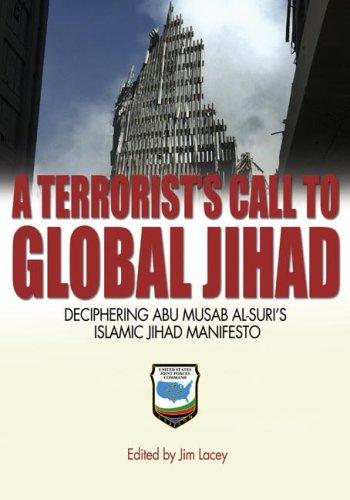
Book Review: A Terrorist’s Call to Global Jihad

Thursday, December 29th, 2011

A Terrorist’s Call to Global Jihad: Deciphering Abu Musab al-Suri’s Islamic Jihad Manifesto by Jim Lacey (Ed.)

Previously, I read and reviewed Brynjar Lia’s Architect of Global Jihad, about Islamist terrorist and strategist Abu Musab al-Suri. A sometime collaborator with Osama bin Laden and the AQ inner circle, a trainer of terrorists in military tactics in Afghanistan and an advocate of jihadi IO, al-Suri was one of the few minds produced by the radical Islamist movement who thought and wrote about conflict with the West on a strategic level. Before falling into the hands of Pakistani security and eventually, Syria, where al-Suri was wanted by the Assad regime, al-Suri produced a massive 1600 page tome on conducting a terror insurgency,  The Global Islamic Resistance Call, which al-Suri released on to the jihadi darknet.

Jim Lacey has produced an English digest version of al-Suri’s influential magnum opus comprising approximately 10 % of the original  Arabic version, by focusing on the tactical and strategic subjects and excising the rhetorical/ritualistic redundancies common to Islamist discourse and the interminable theological disputation. There are advantages and disadvantages to this approach.

First, Lacey has produced a concise and readable book from a large mass of sometimes convoluted and repetitive theorizing that al-Suri strung together piecemeal, sometimes on the run or in hiding. For those interested in getting to the heart of al-Suri’s nizam la tanzim strategic philosophy, A Terrorist’s Call to Global Jihad is an invaluable resource for strategists, counter-terrorism specialists, tactical operators,  law enforcement and laymen. Secondly, it is also a useful reference for policy people to see through al-Suri’s eyes the internal political and philosophical divisions within the radical jihadi community. al-Suri himself writes very ambivalently about 9/11 as a great blow against America and yet a complete calamity in it’s effects for the “jihadi current” that destroyed everything the Islamist revolutionaries had so painstakingly built, including the Taliban Emirate. Thus a climate was created by the American counter-attack where old methods of struggle were no longer useful and jihadis must adopt radically decentralized operations ( what John Robb terms Open-Source Warfare; indeed it is clear to an informed reader that al-Suri, a wide-ranging intellectual rather than a narrow religious ideologue, was influenced by Western literature on asymmetric warfare, 4GW, Three Block War  and COIN).

The drawback to this approach is more for scholars looking at the deeper psychological and ideological drivers of jihadi policies, strategy and movement politics. The religious questions and obscure Quranic justifications cited by Islamist extremists that are so tedious and repetitive to the Western mind are to the jihadis themselves, of paramount importance in establishing both the credentials of the person making an argument but also the moral certainty of the course of action proposed. al-Suri himself had some exasperation with the degree to which primarily armchair ideologues, by virtue of clever religious rhetoric, could have more influence over the operational decisions of fighting jihadis than men with field experience like himself. By removing these citations, an important piece of the puzzle is missing.

The Musab al-Suri whose voice appears in A Terrorist’s Call to Global Jihad is consistent with the one seen in Lia’s book, dry, sardonic, coldly hateful toward the West and highly critical of the jihadis own mistakes, laden with overtones of pessimism and gloom. al-Suri did not envision a quick victory over the West and wrote his manifesto as a legacy for future generations of Islamist radicals because the current one was nearly spent after the American onslaught and poorly educated in comparison with predecessors like the generation of Sayid Qutb.

Strongly recommended.


Switch to our mobile site