zenpundit.com » strategist

Archive for the ‘strategist’ Category

“Optimizing the Potential of Special Forces”

Sunday, July 14th, 2013

[ by Mark Safranski – a.k.a “zen”]

A remarkably blunt article on SF/SOF (“special forces” is being used as an umbrella term for both) in the context of policy and strategy, from the perspective of an emerging great power by LTG Prakosh Katoch of the Indian Army. The American example of SOCOM in Afghanistan/Iraq/GWOT has obviously had an impact here, as has the negative example of Pakistani use of terrorists as proxy forces and ISI covert operatives for direct action in Indian territory and elsewhere. Quite aside from global conflicts and the bilateral rivalry with Pakistan, India also faces more than a dozen long term irregular conflicts with their own dynamics, such as the NaxaliteMaoist insurgency , which Katoch places in the context of Chinese strategic ambitions against India.

A must read.

Optimizing the Potential of Special Forces

….In India, the lack of strategic culture, more on account of keeping the military out from strategic military decision making, has led the hierarchy to believe that conventional forces coupled with nuclear clout can deter us from irregular threats. Nothing can be farther from the truth. Pakistan, though conventionally inferior, has been successfully playing her ‘thousand cuts policy’ knowing full well that India has failed to develop the required deterrent. It is our inability to find a cure to this Achilles’ heel, that has led China, which was hitherto using Pakistan as proxy to wage irregular war on India, now directly aids and supports insurgent and terrorist outfits inside India.

….Why the US has managed to secure its mainland post 9/11 is not only because of an efficient Homeland Security organisation but because the US Special Forces (USSF) are operating in 200 countries including India. Significantly, USSF have undeclared tasks such as conducting proactive, sustained ‘man-hunts’ and disrupt operations globally; building partner capacity in relevant ground, air and maritime capabilities in scores of countries on a steady – state basis; helping generate persistent ground, air and maritime surveillance and strike coverage over ‘under-governed’ areas and littoral zones and employing unconventional warfare against state-sponsored terrorism and trans-national terrorist groups globally. Before 26/11, Al-Qaeda had planned similar operations against New York but could not because the USSF had infiltrated Al-Qaeda. One cannot guard the house by simply barricading it. You must patrol the streets and the area outside.

Growing inter-dependence and interlinking of terrorist groups regionally and internationally should be a matter of serious concern. It is not the US alone that has deployed its Special Forces abroad. This is the case with most advanced countries including UK, Russia, Israel, China and even Pakistan. Pakistan’s SSG was operating with the Taliban in Afghanistan and has been active in Jammu and Kashmir, Nepal and Bangladesh, primarily training anti-India forces. There is a strong possibility of their presence in the Maldives and Sri Lanka as well, aside from presence within India. The Chinese have been smarter. For all the development projects throughout the globe, including in Myanmar, Nepal, Pakistan-POK, Sri Lanka, Bangladesh and Seychelles, contracts underway by PLA-owned/affiliated companies employ serving and veteran PLA soldiers and disguised Special Forces with assigned tasks, including evacuation of Chinese citizens from that country in case of emergencies. 

Read the rest here.

Book Review at Pragati: The Strategy Bridge by Colin Gray

Friday, July 5th, 2013

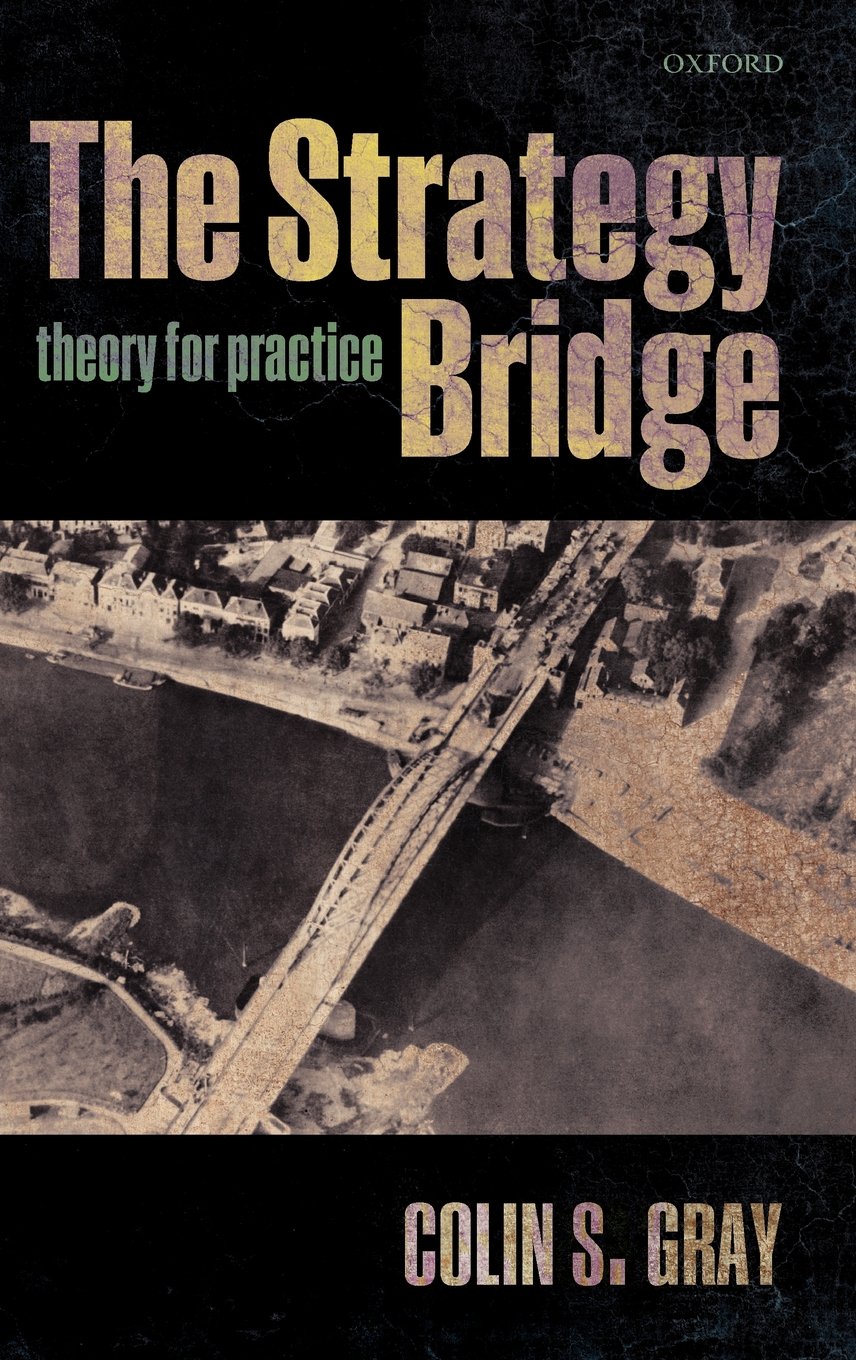
I have a new book review up at Pragati Magazine this morning, The Strategy Bridge:Theory for Practice by Colin S. Gray which is a must read book for any serious student of strategy.

Pragati, which is a national interest and policy magazine for India is starting to turn greater attention towards the subject of strategy and is also running another article in the same issue on strategy and the Maoist insurgency and recently on Indian grand strategy.

A Bridge over Troubled Waters

The title of The Strategy Bridge is also Gray’s operative metaphor, both for the purpose of strategy and the role of the strategist himself that represents the dialectical dynamic of war and strategy-making, the latter being a shared enterprise, save for some extreme historical outliers where strategy was vested in one man, like the regimes of Napoleon and Adolf Hitler. Strategy is the ‘bridge’ that must be built between policy determined by a national leadership and the operational and tactical behaviors of the military and other arms of national power. The strategist “mans the bridge”, orchestrating all of the elements within a master strategic concept and managing the iterative relationship.

Gray writes “The function of the military strategist, his unique raison d’etre, is to ensure that policy and the military instrument are purposefully connected… The strategist must understand the whole nature of a conflict, including war and warfare if antagonism has escalated thus far, because subject to political control, he has the duty of care over the entire competitive performance of the security community… The mission of the military strategist is to decide how the enemy is to be defeated. It is his task to invent a theory of military victory. That theory has to be expressed in and revealed in plans, which are contingent predictions of an extended kind, and must be commanded by generals to whom the strategist delegates some restricted command authority. Whether or not the strategist wishes or is able to function as a general also, must vary with historical circumstances”

….The Strategy Bridge is subtitled “Theory for Practice” because it is intended as a serious work of theory, a framework for understanding enduring principles of strategy so that a practitioner can thoughtfully apply them in making strategies for the specific context in which they find themselves to provide correct guidance for the operational planners and tacticians who will execute it. Consequently, Gray has not written an introductory text for a novice student but an insightful book for the strategic practitioner of journeyman experience – field grade officers, senior intelligence and foreign policy analysts, academic strategists, think tank researchers and national security advisers to senior government officials – who have a store of knowledge of their own. Hence the repeated invocation of “the bridge” metaphor by Gray; his primary audience are the people “doing strategy” and their success or failure “manning the bridge” will help determine the degree to which government purpose remains connected to action or whether the whole business will go off the rails into a quagmire, as it too often does. 

Read the rest here.

Clausewitz and Center of Gravity

Wednesday, July 3rd, 2013

At Small Wars Journal a provocative essay by Col. Dale C. Eikmeier:

Give Carl von Clausewitz and the Center of Gravity a Divorce

….Because we love Carl von Clausewitz and the center of gravity concept, we need to grant them a divorce- for our sake.  We tried for years to make it work, but it’s time to face reality, together they are just too abstract and confusing for us to embrace.

 The center of gravity concept, a mainstay of the US military “operational art” since 1986[1], has never fully satisfied doctrine’s intent.   According to Dr. Alex Ryan, a former School of Advanced Military Studies instructor, the concept is, “so abstract to be meaningless”[2]  Now if a ‘mainstay’ is so ‘abstract’ that subject matter experts declare it ‘meaningless’ we have a doctrinal problem.  The genesis of this problem is a doctrinal foundation built on dubious authorship and editing, underdeveloped theory, imprecise metaphors, and flawed translations. [3]  This Clausewitzian foundation, which was never very solid, is now collapsing under the weight of 21st century warfare.  For this reason it’s time to end our reliance on Clausewitz’s On War as the authority on the center of gravity concept.

….Crack Four.  Another problem is flawed translations.  Clausewitz never used the term “center of gravity”, or in German, “Gravitationspunkt”, he used the word schwerpunkt, which means weight of focus or point of effort which is different from center of gravity, hubs or sources of power. [9]   But it is easy to understand how an English translator when picturing this point of effort could think of a center of gravity which further illustrates the danger of metaphors.  Milan Vigo in Joint Operational Warfare Theory and Practice provides a detailed analysis of the evolution of schwerpunkt from focus of effort to center of gravity which is summarized below:[10]

  1. Schwerpunkt – main weight or focus or one’s efforts.
  2. Mid 19th century, schwerpunkt is associated with an enemy’s capital as the point of focus. Germans and Austrians used the word schwerpunktlinie to mean a line of main weight or effort that links one’s base of operations to the enemy’s capital. This is where the schwerpunkt as ‘the target’ understanding comes from.
  3. Late 19th century it comes to mean a section of the front where the bulk of one’s forces are employed to reach a decision. Schwerpunkt is now the ‘arrow’ not the target.  This is a subtle shift from the point of focus on a target, to the arrow or what is focused.  Count Alfred von Schlieffen and German military practice used the ‘arrow’ understanding up to WW II.
  4. Colonel J.J. Graham’s 1874 English language translation of On War  mistranslated Schwerpunkt as “center of gravity”[11]
  5. Post World War I German military progressively adds a new meaning using schwerpunkt to mean the focus of planning efforts.  This is a natural evolution of the late 19th century hybrid of ‘the arrow’ and the ‘target’ understandings.
  6. The Bundeswehr (German Army) now uses the English term “center of gravity” while the Austrian Army uses the German term “Gravitationspunkt” which translates to “center of gravity”. 

Hence, English translators took Clausewitz’s “schwerpunkt”, ‘the target or point of focus’ meaning mistranslated it into center of gravity which morphed into the source of power or ‘the arrow’ meaning. 

I’m not understanding Eikmeier’s hostility to the employment of metaphor as a device for learning as it is a conceptual bridge for understanding without which human society would not have made much progress.  Yes, metaphors can be misunderstood or abused but so can just about everything else. Most important ideas were either understood by or are most easily explained by metaphor and analogy.

“Center of gravity” in Clausewitzian theory is often misunderstood by non-experts or incorrectly identified in the enemy in practice in the midst of a war, but the same can be said of many other valuable concepts. Ask people to explain “gravity” itself and see how precisely scientific an explanation you receive, but that hardly means we should abandon the concept.

Regarding translation from On War, Eikmeier may have a more valid point but I am not qualified to assess it. I have a fair grasp of the political-historical context but not the linguistic and cultural nuances of early 19th century German language expression. Maybe Seydlitz89 will care to weigh in here?

New Book and New Monograph

Wednesday, April 10th, 2013

The Strategy Bridge by Colin S. Gray

I have been eager to read this book by the eminent Anglo-American strategist Colin Gray ever since Adam Elkus sang it’s praises and now I have a hardcover copy thanks entirely to an enterprising amigo. A description from Oxford Scholarship:

The Strategy Bridge: Theory for Practice is an original contribution to the general theory of strategy. While heavily indebted to the writings of Carl von Clausewitz, Sun Tzu, and the very few other classic authors, this book presents the theory, rather than merely comments on the theory, as developed by others. Bridge explains that the purpose of strategy is to connect purposefully politics and policy with the instruments they must use. The primary focus of attention is on military strategy, but this subject is well nested in discussion of grand strategy, for which military strategy is only one strand. Bridge presents the general theory of strategy comprehensively and explains the utility of this general theory for the particular strategies that strategists need to develop in order to meet their historically unique challenges. The book argues that strategy’s general theory provides essential education for practicing strategists at all times and in all circumstances. As general theory, Bridge is as relevant to understanding strategic behaviour in the Peloponnesian War as it is for the conflicts of the twenty?first century. The book proceeds from exposition of general strategic theory to address three basic issue areas that are not at all well explained in the extant literature, let alone understood, with a view to advancing better practice. Specifically, Bridge tackles the problems that harass and imperil strategic performance; it probes deeply into the hugely under?examined subject of just what it is that the strategist produces—strategic effect; and it ‘joins up the dots’ from theory through practice to consequences, by means of a close examination of command performance. Bridge takes a holistic view of strategy, and it is rigorously attentive to the significance of the contexts within which and for which strategies are developed and applied. The book regards the strategist as a hero, charged with the feasible, but awesomely difficult, task of converting the threat and use of force (for military strategy) into desired political consequences. He seeks some control over the rival or enemy via strategic effect, the product of his instrumental labours. In order to maximize his prospects for success, the practicing strategist requires all the educational assistance that strategic theory can provide.

I am unfortunately in the midst of a large project for work, but The Strategy Bridge is now at the very top of my bookpile and I will review it when I am finished.

And as long as we are on the subject of Professor Gray, he ventured into the murky domain of cyber war recently, publishing a monograph on the subject for The Strategic Studies Institute:

Making Strategic Sense of Cyber Power: Why the Sky is not Falling

Obviously, Dr. Gray is not in the “Cyber Pearl Harbor” camp:

The revolution in military affairs (RMA) theory of the 1990s (and the transformation theory that succeeded it) was always strategy- and politics-light. It is not exactly surprising thatthe next major intellectual challenge, that of cyber, similarly should attract analysis and assessment almost entirely naked of political and strategic meaning. Presumably, many people believed that “doing it” was more important than thinking about why one should be doing it. Anyone who seeks to think strategically is obliged to ask, “So what?” of his or her subject of current concern. But the cyber revolution did not arrive with three bangs, in a manner closely analogous to the atomic fact of the summer of 1945; instead it ambled, then galloped forward over a 25-year period, with most of us adapting to it in detail. When historians in the future seek to identify a classic book or two on cyber power written in the 1990s and 2000s, they will be hard pressed to locate even the shortest of short-listable items. There are three or four books that appear to have unusual merit, but they are not conceptually impressive. Certainly they are nowhere near deserving (oxymoronic) instant classic status. It is important that cyber should be understood as just another RMA, because it is possible to make helpful sense of it in that context. Above all else, perhaps, RMA identification enables us to place cyber where it belongs, in the grand narrative of strategic history….

Read the rest here.

Boyd and Beyond Local DC Event

Tuesday, December 18th, 2012

[by J. Scott Shipman]

Jim Hasik’s White Board Outline


At the suggestion of Adam Elkus, we were privileged to host our first “local” Boyd and Beyond event on 15 December. We had 14 attend, and five speakers. Logistically, we turned our family room in to a fairly comfortable briefing area, using a wall with Smart Sheets as a temporary white board. In keeping with our October events, we took up a collection and had pizza delivered for lunch. Coffee, soft drinks light snacks were provided. Each speaker was allotted 50 minutes, but given the participation of the audience, most talks lasted about 90 minutes. I should emphasize to those planning one of these events, to keep a lean speaker’s list, as the Q&A and discussion can easily double the time of a presentation—-and I believe all who attended would agree the comments/discussion made already great presentations even better.

My sincere thanks go out to my wife and partner, Kristen, for making this event look easy! She was the one who made sure everything was moving along and that folks felt at home. I would encourage others around the country to schedule and hold events through the year. We’re looking to do another in March 2013.

Our speakers were:

Jim Hasik, Beyond Hagiography: Problems of Logic and Evidence in the Strategic Theories of John Boyd

Francis Park, The Path to Maneuver Warfare in the U.S. Marine Corps

Robert Cantrell,  Which Card Will You Play?

Terry Barnhart, Designing and Implementing Maneuver Strategy in Transforming Major Organizations

Marshall Wallace, Theories of Change and Models of Prediction

I led off with a few comments on the military professional and intellectual rigor. I recommended the best book I’ve read this year: Inventing Grand Strategy and Teaching Command, by Jon Tetsuro Sumida, and the challenges he suggests in the realm of intellectual rigor. He writes:

“It remains to be seen whether readers exist with the mind and will to accept his guidance on what necessarily is an arduous intellectual and moral voyage into the realm of war and politics.” (emphasis added)

I followed with the example from An Unknown Future and a Doubtful Present: Writing the Victory Plan of 1941, by Charles E. Kirkpatrick. Mr. Kirkpatrick’s little book provides an excellent primer to the formulation of the United States’ WWII strategy and a refreshing insight into the education of an master strategist, then Major Albert C. Wedemeyer, attached to the War Plans Division, the Army chief of staff’s strategic planners, who wrote the Army strategy for WWII in 90 days. (read the review here) I suggested that military professionals should start something akin to a book club, where they can discuss and debate strategic issues and concept.

Following my comments, Jim Hasik offered his critique of John Boyd’s work. Adam tweeted that we were a “tough crowd,” but Jim was able to discuss his misgivings with respect to Boyd’s work and a lively discussion got us started. For those unfamiliar, Jim is the author of a paper called, Beyond Hagiography, which generated controversy in the Boydian community following this year’s October event at Quantico. (reviewed here and at zenpundit.comHere is a link to the paper. (see Hasik’s white board outline above).

According to Hasik, Boyd erred when extrapolating from physical processes/science to social processes. He reviewed Boyd’s use of science in his essay, Destruction and Creation, and suggested no literal correlation between Clausius’ Second Law of Thermodynamics (entropy), Gödel’s Incompleteness Theorem, and Heisenberg’s Uncertainty Principle and human behavior (on this I concur with Hasik, as analogy or metaphor these scientific principles enlighten).  Hasik asked if OODA scales from air-to-air combat to large scale events, and whether OODA was original (compared to PDCA, for example). One point that generated quite a bit of discussion was whether one could “like” Clausewitz or Sun Tzu and Boyd. Hasik questioned whether Boyd’s work should be judged as social science, history, or war studies, and suggested that further work was needed to fill in the gaps in his work. In October, someone suggested Boyd needed a “Plato,” someone to address Boyd’s work with less emphasis on science (as in Osinga’s book), thereby making Boyd’s work more accessible. The Strassler model was suggested; Strassler is an “unaffiliated scholar” who has written exhaustively referenced versions of ThucydidesHerodotus, and Arrian. [personal note: I believe a Strassler-like book on Boyd’s ideas would be a great resource] A great thought-provoking conversation.

Francis Park’s White Board


Francis Park’s talk on on maneuver warfare, the evidence of history began with “I’m a historian and I have a problem.” The irony wasn’t lost on the audience, as Francis is an active duty Army officer, speaking on the history of the USMC’s adoption of maneuver warfare (MW). Park called the Marine Corps “the most Darwinian of the services.” The venue for for the Corps discussion between MW advocates, and the “attritionists” was the Marine Corps Gazette. This venue was “unofficial,” otherwise the debate may have never happened. The Gazette’s forward-thinking editor made space and encouraged the debate, which was a “long, bitter, and complex fight.”

Park listed and discussed the champions of MW Michael D. Wyly, G.I. Wilson, William Woods, William Lind, and Alfred M. Gray. Park recommended Fideleon Damian’s master’s thesis, THE ROAD TO FMFM 1: THE UNITED STATES MARINE CORPS AND MANEUVER WARFARE DOCTRINE, 1979-1989. (Adam Elkus recommended Eric Walters essay in the Small Wars Journal, titled Fraud or Fuzziness? Dissecting William Owen’s Critique of Maneuver Warfare.)

Park called the USMC adoption of MW a “confluence of fortune” that may have never happened without the vigorous efforts of proponents.

Robert Cantrell’s Which Card Will You Play? was an instructive and interactive example of Robert’s strategy cards. Cantrell has two decks of strategy playing cards, one devoted to strategy, the other to sales strategy. The user’s guide is at www.artofwarcards.com.

Robert provided examples of how the cards are used to spark strategic thought and ideas. Volunteers pulled first one, then two cards from the decks, and read aloud and commented on how the statement(s) on the cards could be used in practice. For example, “Muddy The Water To Hide the Nets” was drawn (the 8 of clubs, a bit more on card suits from Robert below). The “strategy” is to “confuse your adversary so he cannot perceive your intentions. The “Basis” is “Confused adversaries make mistakes they would not make if they grasped your intentions.”

Longtime friend of this blog, Fred Leland at Law Enforcement Security Consulting is using the cards with success. Fred’s goal is “to get cops thinking more strategically and tactically in their work. I have been pulling a card from the deck and writing my thoughts and sharing them with cops who have been passing them along to their officers.” He is using Robert’s cards for “in-service” training, and providing a low cost entry into strategic thinking.

I followed up with Robert and asked for an explanation of the card suits. Here is his response:

Hi Scott – although they are gray delineations, the Hearts are oriented on the shaping self, the Clubs on shaping the field of contest…the diamonds are isolation strategies, and the spades are elimination strategies. This is the wolf pattern on the hunt: wolf becomes all the wolf it can be, shapes the hunt, isolates a member from the heard, brings that member down. With aces high – and again also gray – the higher cards tend to be strategies used from a greater abundance of strength and the lower numbers from comparative weakness in strength. Of course from here we can talk about gaining relative advantage if we cannot have absolute advantage to gain strength for a critical moment…and so on

Terry Barnhart spoke on Boydian organizational applications in a talk called Designing and Implementing Maneuver Strategy in Transforming Major Organizations. Terry said any organizational change had to be accomplished on the realms of the moral, mental, and the physical. With that in mind, he advised mapping the social networks of the organization and speaking in “the language of the culture” and “asking for what you need” when attempting to transformation. The end goal is “aligned autonomy,” and Terry’s recommended method of choice is taken from Boyd’s Patterns of Conflict,Slide 80:

Patterns of Conflict, Slide 80


Search out the “surfaces and gaps”, as reference from Slide 86, POC. In Boyd’s language:

•Present many (fast breaking) simultaneous and sequential happenings to generate confusion and disorder—thereby stretch-out time for adversary to respond in a directed fashion.

•Multiply opportunities, to uncover, create, and penetrate gaps, exposed flanks, and vulnerable rears. [emphasis added]

Create and multiply opportunities to splinter organism and envelop disconnected remnants thereby dismember adversary thru the tactical, grand tactical, and strategic levels. [emphasis added]

In Terry’s words, “be everywhere at once” and establish relationships that result in buy-in, avoiding “no,” as Terry advised it can take a couple of years to overcome an objection. As aligned autonomy is reached, word will get around about the successes, and all of sudden what was a single agent of change becomes a movement. So Terry is recommending methods in maneuver warfare as a method in transforming organization culture.

During Terry’s talk, Dave recommended Orbiting the Giant Hairball, by Gordon MacKenzie as a guide in navigating the bureaucracy and obstacles often found in large organizations.

Marshall Wallace’s White Board


Marshall Wallace’s Theories of Change and Models of Prediction was our final presentation. Marshall has emerged as one of the leading thinkers among Boydeans. Wallace said, “people are lazy” as he led off his discussion of change models. [personal note: I’ve come to refer to this laziness as “neurological economy”] His thinking was influence by Daniel Kaneman’s Thinking, Fast and Slow and the Heath brother’s Switch: How to Change Things when Change is Hard. When change is desired, clarity is an absolute must have. Wallace offered the four models above as example of change. He said we must ask: “What is the change we want to see?” and ” What are the pre-conditions?”—instead of this model, most people begin with the idea, which more often than not, fails.

Wallace walked our group through the models and emphasized the importance of tempo and used his wife’s efforts to establish dog parks in their city. Everything in government has a process, and Wallace said in this case “going slower than the politicians” paid off. Also, for programs of change, it is best if there is 100% transparency of goals. Both Marshall and Terry recommended a book called The Progress Principle, by Teresa Amabile and Steven Kramer. The most powerful model for me was the one in the lower right corner—particular the use of “more people” and “key” people in any effort to affect change.

Post meeting, Wallace posted the following to our Facebook group wall, that rounds out and expands his thinking:

I was on the plane back to Boston yesterday morning, deeply engrossed in Terry’s book [Creating a Lean R&D System] when a phrase leapt into my head: “Target the whole organism”.

As the Michaels in our lives (Moore and Polanyi) remind us, “we know more than we can say”. I feel that quite clearly and I constantly struggle with language. I am never satisfied with any presentation I give because I know that, due to failures on my part to use the perfect word at the right moment, I left some understanding on the table.

Somehow the weekend, with spectacular conversation, a good night’s sleep, the enforced idleness of air travel, and Terry’s superb book, shook something loose.

Target the whole organism.

What flashed through my mind at that moment were pieces of the talks.

Jim prompted discussion of what the next set of books about/on/adding to Boyd should look like.

Francis drew a pie wedge with “firepower” on one edge of the pie and “maneuver” on the other. He was describing two schools of thought on conflict as represented by these extremes. Everybody seemed to agree that the balance lay somewhere in the middle and was definitely related to the context.

Robert’s exercises with his strategy decks shook countless examples of strategic action and insight loose in our minds. The combination of cards, taking one from each of the competition and collaboration decks, was especially exciting.

Terry laid out his plan to blitzkrieg his company, and invited us to make it better.

I ended with a 4-cell matrix demonstrating the four basic categories under which all Theories of Change operate (more on this later). Experience has shown that most people operate out of an implicit Theory that traps them in one quadrant, whereas social change only occurs if all four quadrants are affected.

Target the whole organism.

I got home and opened up “The Strategic Game of ? and ?”. Interaction and Isolation.

Firepower and maneuver – at the same time. Competition and collaboration at the same time.

Boyd side-by-side with his sources and several commentators. CEO, discouraged middle-managers, and the line at the same time. More People and Key People at both the individual level and the structural level all at the same time.

Target the whole organism.

A force that uses maneuver to confuse and firepower to destroy will dominate. A force that can swing rapidly between extremes and also find balance is even more slippery than one that acknowledges the “necessary” balance. The two practices can be in separate parts of the battlespace (context matters), but because both are occurring, the confusion generated may well be more intense. It looks as though the force is two distinct armies and communication among the enemy may be unintelligible because the threats being faced are so different.

Bringing collaborative concepts into competitive spaces or vice versa while not abandoning the underlying logic of the space opens up more options, challenges notions, and expands horizons. Can we interact and isolate at the same time? What does that snowmobile look like?

If we want to effect social change, we need to target the whole system. We can sequence our efforts in time, though we can’t forget to move as quickly as the circumstances allow. At the same time, every effort must be connected to the whole organism.

The target is not the target. I do not aim at the eye of the fish. I don’t wan’t to hit the bullseye.

I want to pick up the whole madding crowd of intense archers, cynical kings, and wildly cheering spectators and move them.

This was the first “local” event, and based on the response, we’ll be doing these a few times a year. Many thanks to all who participated, and Merry Christmas and a Happy New Year to  you all!

UPDATE: Dave shared these with our group. Francis said, “We live and die by bumper stickers.” Here is a good example:


Here is Dave’s interpretation of the Sufi elephant:


Cross-posted at To Be or To Do.


Switch to our mobile site