zenpundit.com » pakistan

Archive for the ‘pakistan’ Category

Lion of the Punjab

Tuesday, January 4th, 2011

[ by Charles Cameron, cross-posted from SmartMobs ]

I found this story strangely moving. The governor of the province of the Punjab in Pakistan, Salmaan Taseer, was killed by one of his own guards — according to this NY Times Lede blog story, because he was speaking out in favor of amending Pakistan’s blasphemy laws.

So here’s my DoubleQuote twitter-requiem for a courageous man:
.
quo-salman-taseer2

Guest Post: The United States of Islam

Tuesday, October 26th, 2010

 Charles Cameron is the regular guest-blogger at Zenpundit, and has also posted at Small Wars Journal, All Things Counterterrorism, for the Chicago Boyz Afghanistan 2050 roundtable and elsewhere.  Charles read Theology at Christ Church, Oxford, under AE Harvey, and was at one time a Principal Researcher with Boston University’s Center for Millennial Studies and the Senior Analyst with the Arlington Institute:

The United States of Islam Video

by Charles Cameron

[ the first in a series, cross-posted from Chicago Boyz ]

Let’s take a closer look at the United States of Islam video which I mentioned in my post Of Weaponry and Flags.

 USI Films

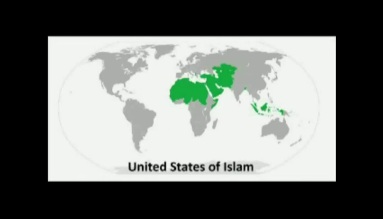
The video announces itself as “an USI Films production”. It then opens with the words “since 911 the world has changed” in white type against black, followed immediately by news clips of the WTC attacks and of President Bush describing them as “evil acts” and declaring “I have directed the full resources of our intelligence and law enforcement communities to find those responsible, and to bring them to justice.” What we shall be seeing, then, is a time-oriented video, presenting a historical context for the present moment with implications for the near future. From here we cut by way of another white on black typed message — “they started this war in afghanistan” – via clips of war footage to another – “but their agenda is much bigger and brutal than that” – and then to another clip of Pres. Bush: “Our war on terror begins with al-Qaida but it does not end there. It will not end until every terrorist group of global reach has been found, stopped, and defeated.” By this point, the background music, which is taken (for reasons both political and musical?) from Vangelis’ 1492 – Conquest of Paradise soundtrack, is swelling. A global map appears, showing much of north Africa, the middle east, Indonesia and Malaysia in green, with Pres. Bush in voice over speaking of the establishment of “a violent political utopia across the middle east which they call a Caliphate where all will be ruled according to their hateful ideology.”

USI world map

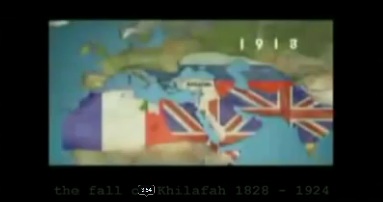
The map is titled United States of Islam. The words “they have done this before” are then followed by a series of film clips showing “the fall of the Khilafa 1828 -1924” and maps showing the slow spread of the British and French flags across north Africa and the middle east, with glimpses of Lawrence of Arabia, the Balfour declaration, and General Allenby, accompanied by the voice-over of someone I’d tentatively identify as Sheikh Imran Nazar Hosein, declaring: The Khilafa was destroyed. Who destroyed it? Why did they destroy it? How did they destroy it? When did they destroy it? What did they replace it with? With what was it replaced? And what is its destiny?

These are awesomely important questions which very few can answer today.

Caliphate divided

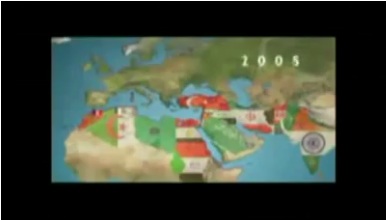
The text then states that (the west) “divided us into 54 states” and the map begins to show the various flags of the Islamic states intowhich the region was more recently divided…

Carved up

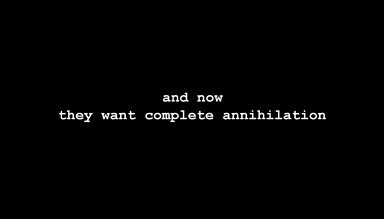
ending up in 2006. And what do we want now? You might be forgiven if you haven’t already guessed:

Total Annihilation

Clips then show the toppling of Saddam’s statue in Baghdad, the Israeli army in Gaza with casualties, the October 2009 Pishin attack on the Revolutionary Guard in Iran (which was claimed by Jundullah), and a first mention of the Christmas bomber, Al Qaida and Yemen… a quick mention of Nigeria and Somalia… and “Pakistan from which they fear the most”. A newscaster from, presumably, Pakistan intones “this is called the fourth generation warfare.” That essentially brings us up to the present moment. * We have arrived at the half way point in the 10 minute video and seen the global historical context, laid out in maps and flags. We have focused in on the present from a two-hundred year sweep, and on Pakistan from the distributed ummah. What follows will expound and expand on this present moment, bringing Afghanistan into the picture alongside Pakistan, emphasizing the spiritual significance of Khorasan, and taking the battle variously to India and Jerusalem…

[ to be continued ]

Exum in Foreign Policy

Sunday, October 24th, 2010

Andrew Exum on negotiation in AfPakland in Foreign Policy:

Smoke and Mirrors in Kabul

….But Afghans are perfectly comfortable talking while still fighting. So too, at least in practice, are the United States and its allies: In insurgencies from Vietnam to Northern Ireland, we have negotiated with insurgents while combat operations were ongoing. In the American public’s mind, however, wars take place sequentially: First, you fight; second, you negotiate a settlement. The word “negotiations” conjures up hopes for an end to the conflict in the minds of Americans and other Westerners — when all that really might be occurring is another round of jockeying for position between Afghanistan’s warring political forces.

….All that, to make matters worse, assumes the insurgent groups are independent actors. The reality, though, is that negotiations between the insurgent groups and the government in Kabul will only go so far as the Pakistani security services allow. Some Western analysts took heart in Pakistan’s decision in February to arrest Taliban leader Mullah Abdul Ghani Baradar. At the time, however, the arrest of Mullah Baradar, who was in negotiations with the government in Kabul, was interpreted by the Taliban rank and file to be a stark warning to those who would negotiate without the permission of the Pakistani government, under whose patronage and protection the Taliban has operated east of the Durand Line since 2005. Today it is widely accepted that this was indeed the case and that Pakistan deliberately thwarted negotiations between the Quetta Shura Taliban and the government in Kabul to serve its own parochial interests. Since that event, there is no sign that Pakistan’s powerful military has taken a softer line on negotiations between the Taliban and the government in Kabul.

Exum wrote a good op-ed. Go read it.

That said, the above paragraph makes me want to ask Andrew why the United States is not negotiating directly with Pakistan/ISI instead of wasting valuable time kabuki-ing around with plausibly deniable and expendable members of proxy groups over which Pakistan holds a demonstrated veto?
 
What is particularly curious in this situation is that  Secretary of Defense Robert Gates, in his memoir From the Shadows, made laudatory remarks about George Schultz (with whom Gates bumped heads) as “the toughest secretary of State I knew” who was willing to negotiate with the Soviets in one part of the world while bleeding them in another ( paraphrasing here). A lesson from history that bears revisiting.

Pakistan is our real adversary in Afghanistan and the party with the power to actually make agreements that stick. Negotiations 101: bargaining should not take place with powerless intermediaries.

Guest Post: The Diplomacy of Caring

Tuesday, October 19th, 2010

Charles Cameron is the regular guest-blogger at Zenpundit, and has also posted at Small Wars Journal, All Things Counterterrorism, for the Chicago Boyz Afghanistan 2050 roundtable and elsewhere.  Charles read Theology at Christ Church, Oxford, under AE Harvey, and was at one time a Principal Researcher with Boston University’s Center for Millennial Studies and the Senior Analyst with the Arlington Institute:

The Diplomacy of Caring

by Charles Cameron

It’s such a simple thing, a blog post with space for comments. And yet it is also a remarkable opportunity.

The blog post I’m thinking of today was made about three weeks ago by an American helicopter pilot, CWO John Bockmann, who has been flying relief missions in Pakistan as part of the US response to the terrible floods there.

A retired Pakistani officer, Brig. FB Ali, read it on Pakistan’s Express Tribune blog, and quoted from it in a guest post on Col. Pat Lang’s blog, Sic Semper Tyrannis, today. Both are worth reading – but what’s most wonderful, as Brig Ali notes, is the outpouring of love and appreciation in the Comments section, both from individual Pakistanis and from Bockmann’s own family.

Bockmann writes:

I have learned in my time here that Pakistani people are truly gracious. Strangers have invited me for chai and conversation. Almost anyone will shake my hand and ask my name, inquire about my health and how I am getting along. Instead of a handshake at our first meeting, I have sometimes been embraced. “Strangers shake hands,” my new friend Mahmood explained, “but brothers hug each other.” This warms my heart. My mission, our mission, is straightforward, noble, and good. I am deeply grateful to those who support us here, for we need all the help we can get in order to help those in need. I am honored to do this work. I feel at home here beyond anything I could have expected.

and

When I do return home, I will bring with me hundreds of pictures, dozens of journal entries, six duffel bags, and several recipes for local dishes that I have enjoyed, but I will also bring innumerable memories that I will treasure for life — memories of Pakistan and its people. They have surprised me with friendship. I hope that through our work of compassion we may surprise them with friendship as well.

I will let the comments of Abdullah and Mustafa stand for the many that were posted by Pakistanis in response:

God bless you and may you return home safe and sound . There is a lot in common and a lot to share between common people not only living in U.S and Pakistan but also between people living all over the world. — Abdullah

and:

John, I’d like to personally thank you for your efforts and for giving your time for this cause. May Allah reward you and bless your family. — Mustafa

Others wrote longer and more effusive comments, but in their simplicity those two capture the spirit of the whole.

And then John’s mother, deeply moved by the love shown her son by these people from a far-off country, wrote her own comment — which strikes closer to the heart than the best of diplomats easily can:

Thus shall it be between Christians and Muslims, your country and mine: despite the heartbreaking fractures, we shall become strong in all the weak places, and no government policies, no misguided violent people shall prevent it, because God wills it, whether we call him Allah or Jehovah, and we will it, with all our hearts. We shall support each other while respecting our differences.

I’m with FB Ali on this, and Pat Lang, and John Bockmann and his family, and all the many Pakistanis who responded. More recently, John Bockmann wrote this comment on the whole exchange:

Amazing. I know the hearts of many Pakistanis now, but I am still surprised by their outpouring of warmth — especially in such hard times. I read all of the comments — the stories, the blessings, the frustrations — and I am increasingly convinced that international relations are effected more by common people like you and me than by politicians who may never get a chance to have tea and real conversation with “the other side”. I am so privileged to be so well loved while I am so far from home. God’s blessings on Pakistan and her people.

If you want to see Bockmann, Cpl. Jenie Fisher interviewed him earlier in the mission, and you can find those videos here. I hope she does a follow-up. I hope the press picks up on this. This is what’s best in our common humanity — hearts and minds – they’re not won, they open. And this is what’s best about the internet — this possibility. I’ll close with the words of Engineer Syed, who writes:

Ten people like the pilot who is in the picture in worlds each decision making cabinet-agency-organization etc can change the total scenario of the world


Other Voices on AfPak….

Wednesday, August 18th, 2010

In addition to the futurist  Afghanistan 2050 Roundtable going on at Chicago Boyz, I’d like to point out some bloggers and academics dealing with the region’s present:

Chris Albon – US Military And Pakistan Flood Relief

Since July, monsoon rains have caused heavy flooding in many areas of Pakistan. The United Nations estimates more than 20 million people are affected. In response the disaster, the United States has launched a civilian and military relief effort in the country. As part of that effort, US military fixed and rotary wing aircraft are ferrying people and supplies to and from the flood zone. Below are thirteen photos from that military response.

Please consider donating to the NGO flood relief effort here or elsewhere

Spencer Ackerman – Petraeus: Here’s My Afghan Redeployment Strategy

…. Some units pulled out of stable districts might find themselves heading for more volatile ones. “You maybe take one company and send it somewhere else. Maybe send it home,” Petraeus explains. “We want to reinvest some of the transition.” It won’t necessarily be the case that a unit that “thins out” from a district heads directly home. “Some will, certainly,” Petraeus qualifies. “And this is all premature.”In keeping with Petraeus’ admitted addiction to PowerPoint, the general passes on a briefing slide, titled “Transition,” to explain his thinking. The assessment for drawing down will be built around “Districts, Provinces, Functions [and] Institutions,” looking for what can be handed to Afghans with minimal disruptions in security. In our interview, he elaborates that “institutions” means U.S. functions like training the Afghan security forces – jobs that don’t have to remain American duties indefinitely. According to the slide, it’s a process that will draw on what security gains the U.S. command in charge of training Afghan security forces believes the Afghans can maintain; and the Afghan government itself.

Pundita – On the matter of indicting Oxfam and International Red Cross for war crimes, and a grim warning for U.S. military, Former PM Nawaz Sharif says Pakistan doesn’t need Western flood aid, and other tales of flood aid to Pakistan and Taliban blitzkrieg in North Afghanistan. NATO blindsided. I do not want to hear they didn’t get help from Pakistan military

….Same basic message to United Nations, IMF, World Bank, and the rest of the so-called international community. Stop helping Pakistan’s regime rape their country’s poor. Every time they get away with stealing from you, you’re just reinforcing the idea that they do nothing wrong — else why do you keep giving to them? Just stop it, you goddamn fools. Just stop.The Taliban said they would donate USD 20 million to flood relief effort if the regime wouldn’t take money from Western governments. Hold to them their offer. Then shake the country’s rich until they collectively cough up a billion USD for flood relief. That’s how it’s done. That’s how civilized humans act when extorted by fiends.

Walter Russell Mead  –The Roots of Pakistan’s Rage and Pakistan’s Crisis: It’s More Than The Militants

Things were tough enough during my stay.  On my way in from the airport in Karachi, traffic was unusually light.  Roving gangs of armed thugs were roaming through the city, pillaging gas stations.  The police force was laughably overwhelmed; the only gas stations that stayed open had battalions of private security.  Meanwhile, up to 100 people died there in violence between the organized gangs of criminals known in that unhappy city as political parties, schools and businesses are closed in fear, and tens of thousands of families already living at the margins of existence are losing their daily wages until peace returns. One night during my visit a vicious goon threw a hand grenade into a group of worshipers performing their evening prayers in a Karachi mosque; nothing in this city is sacred anymore.

In Khyber-Pakhtunkhwa, formerly known as the Northwest Frontier Province, and currently on the front line of the COFKATGWOT (the currently nameless Conflict Formerly Known As The Global War On Terror) assassins  killed the son of a prominent official and Safwat Ghayyur, the Commandant of the Frontier Constabulary.  Three million people became homeless in the early stages of the flood; since then monsoon rains continue to inundate the highlands, and successive flood crests is move inexorably down river, spreading devastation through the Punjab and overspreading the country’s most valuable and productive agricultural land across both Punjab and Sindh.

 Hat tip to Eddie!


Switch to our mobile site