zenpundit.com » history

Archive for the ‘history’ Category

Is Mammon having a “secularism” crisis?

Friday, October 21st, 2011

[ by Charles Cameron — Robb’s analysis, capitalism as religion metaphor, irony, warning ]
.

church-for-sale-sm.jpg

image source — btw, contact jonesharris [at] btinternet.com if interested

.
Okay. The Church of England‘s own website, whose banner reads A Christian presence in every community, now hosts a list of, well,

closed-churches.jpg

which seems a rather unfortunate way to phrase things — but the point is, something called “secularism” is gnawing away at belief and church attendance, and I’m wondering if it may not be gnawing away at belief and bank attendance, too…

And since Mammon is the theological term for riches or material wealth personified, I’m asking, metaphorically speaking, whether Mammon is now facing its own “secularism” crisis…

Well, to be honest, I’m not the one doing the wondering, really — I’m borrowing the whole idea from the imperturbable John Robb, fighter pilot, entrepreneur and author of Brave New War, and spicing it up a bit with nice pictures of a church conversion to drive the irony of the whole thing home.

From two of Robb’s recent posts on his Global Guerrillas blog:

1.

Oct 5 JOURNAL: The Pope of the Church of Capitalism

The Chairman of the Federal Reserve is part:

Religious figure. The Pope of the Church of Capitalism. The leader of the Church. Final arbiter on the meaning of scripture (arcane economic indicators and economic papers). Is trained in ancient mysteries (economics). Has a council of Cardinals (the Fed board). He also issues indulgences (bailouts and free loans) to banks that he likes.

2.

Oct 7 OCCUPY (Insert Your City Here): Protesting Capitalism’s Crisis

What Occupy is Really About The real reason we are seeing this movement right now is because

Capitalism, the last great ideological system, is in crisis.

This isn’t merely a crisis of outcomes (economic depression, financial panic, etc.), it’s a crisis of BELIEF. While people generally believe in the idea of capitalism, a critical mass of people now think that the global capitalist system we currently have is so badly run, so corrupt, so terrible at delivering results that it needs either a) a complete overhaul or b) we need to build something new.

In short, in its tiny way, this protest may be the start of a reformation of the church of capitalism.

A splintering that may change everything…. For better or worse depending on how well you did in the old, corrupt system.

3.

So, anyway — is it time for capitalism to rid itself of the sale of indulgences?

The religious metaphor is, of course, what fascinates me.

But there’s a warning here, too, about the dangers of radically polarized populations and mobs and their heated passions, as Robb quietly implies with his “for better or worse” — are we ready to go through another (networked, and no doubt accelerated) Thirty Years War?

That is something I devoutly hope we can avoid.

A Multi-Disciplinary Approach?: Coerr’s The Eagle and the Bear Outline

Thursday, October 20th, 2011

Here is something for the learned readership to chew on.

As you are probably all aware, in the hard sciences it is common for research papers to be the product of large, multidiciplinary, teams with, for example, biochemists working with physicists, geneticists, bioinformatics experts, mathematicians and so on. In the social sciences and humanities, not so much. Traditional disciplinary boundaries and methodological conservatism often prevail or are even frequently the subject of heated disputes when someone begins to test the limits of academic culture

I’m not sure why this has to be so for any of us not punching the clock in an ivory tower.

The organizer of the Boyd & Beyond II Conference, Stan Coerr, a GS-15 Marine Corps, Colonel Marine Corps Reserve and Iraq combat veteran, several years ago, developed a very intriguing analytical outline of thirty years of Afghan War, which I recommend that you take a look at:

The Eagle and the Bear: First World Armies in Fourth World Insurgencies by Stan Coerr

the-eagle-and-the-bear-11.pdf

There are many potential verges for collaboration in this outline – by my count, useful insights can be drawn by from the following fields:

Military History
Strategic Studies
Security Studies
COIN Theory
Operational Design
Diplomatic History
Soviet Studies
Intelligence History
International Relations
Anthropology
Ethnography
Area Studies
Islamic Studies
Economics
Geopolitics
Military Geography
Network Theory

I’m sure that I have missed a few.

It would be interesting to crowdsource this doc a little and get a discussion started. Before I go off on a riff about our unlamented Soviet friends, take a look and opine on any section or the whole in the comments section.

Quoting Joseph Smith on “the Al-Koran or the sword”

Tuesday, October 18th, 2011

[ by Charles Cameron — Christopher Hitchens, Muhammad, Jack Chick, and Joseph Smith ]

.

I get so tired of people not doing their homework, left and right.

Or perhaps that should read, Left and Right.

1.

I don’t know quite how you’d classify Christopher Hitchens, but in a Slate article today titled Romney’s Mormon Problem: Mitt Romney and the weird and sinister beliefs of Mormonism, he asserts:

On his later forays into the chartless wilderness, there to play the role of Moses to his followers (who were permitted and even encouraged in plural marriage, so as to go forth and mass-produce little Mormons), Smith also announced that he wanted to be known as the Prophet Muhammad of North America, with the fearsome slogan: “Either al-Koran or the Sword.”

Juicy, eh?

Luckily, Hitchens has linked the phrase “Either al-Koran or the Sword” – so we can source the quote in, let’s see, Christopher Hitchens, in his book God is Not Great, as excerpted in Slate again:

The Church of Jesus Christ of Latter-day Saints-hereafter known as the Mormons-was founded by a gifted opportunist who, despite couching his text in openly plagiarized Christian terms, announced that “I shall be to this generation a new Muhammad” and adopted as his fighting slogan the words, which he thought he had learned from Islam, “Either the Al-Koran or the sword.”

Sadly, there’s no link this time, no further sourcing of the quote.

2.

Hugh Nibley is my go-to man for Mormon scholarship (orthodox), and it doesn’t surprise me that there’s an essay of his on the web comparing Islam and Mormonism [.pdf].

Nibley accepts that “in fact, early Mormon leaders saw no reason why Mohammed should not be considered a true prophet, for there have been many prophets, great and small, in the past whose words are not in the Bible.” But that impression didn’t long survive a second observation:

[T]he striking resemblance turns almost at once into an equally striking contrast when the Moslems announce that Mohammed is the last of the prophets and that there can be no prophet after him. “When a doctrine is sealed,” writes an eminent Moslem scholar, “it is complete, and there can be no further addition. The holy Prophet Mohammed closed the long line of Apostles. … there has been and will be no prophet after Mohammed.”

Nibley’s six-page essay has no quotation in which Joseph Smith speaks of “Al-Koran or the sword”.

Neither, in fact, does Todd Harris in his 162-page 2007 BYU Master’s thesis A Comparison of Muhammad and Joseph Smith in the Prophetic Pattern [.pdf].

3.

Jack Chick to the rescue.

As you may know, Jack Chick publishes some appallingly poorly illustrated Christian booklets that are almost as small as large postage stamps, and almost as much fun to collect.

Chick’s larger-than-usual publication The Enchanter, whose cover graces the top of this post, includes the following garishly interesting graphic:

But – poor taste in art aside – Chick is more thoroughgoing than Hitchens, and is kind enough to supply us with references for the statements he makes. In a commentary on his own pamphlet, he writes:

On October 14, 1838, Joseph Smith called himself a “second Muhammad” as he was concluding a speech in the public square at Far West, Missouri. Those words have been verified by affidavits from Thomas B. Marsh, Orson Hyde (from Joseph’s Quorum of the Twelve), George M. Hinkle, John Corrill, W.W. Phelps (a major leader in the Mormon church), Samson Avard (founder of the Danites), and Reed Peck.

To Marsh’s statement, he footnotes thus:

For the full affidavit of Thomas B. Marsh, see The Rocky Mountain Saints by T. B. H. Stenhouse (New York: D. Appleton and Company, 1873), pp. 89-90.

and points out that we can read the relevant pages ourselves on Google Books.

4.

There’s an article titled From the Archives: Joseph Smith or the Sword!? at the Juvenile Instructor blog, commenting on the Jack Chick publication, which handily quotes the various 1838 testimonies in which associates and one-time associates attest that Smith compared himself with the Prophet of Islam – that of Thomas Marsh being the only one of which actually offers us the phrase that Hitchens — remember Hitchens? – was (almost) quoting.

Marsh’s statement reads:

I have heard the prophet say that he should yet tread down his enemies, and walk over their dead bodies; that if he was not let alone he would be a second Mahomet to this generation, and that he would make it one gore of blood from the Rocky Mountains to the Atlantic Ocean; that like Mahomet, whose motto, in treating for peace, was “the Alcoran or the Sword,” so should it be eventually with us, “Joseph Smith or the Sword.”

And so — with the exceptions that the original has “Mohammed” where the Juvenile Instructor has “Mahomet” and that the original has single quotes where the Juvenile Instructor has double — Marsh’s testimony as published in Stenhouse’s book does indeed read.

5.

So that’s the closest thing we have to a source for Joseph Smith having made the statement that Hitchens says Smith “adopted as his fighting slogan” – when even that one source has Smith uttering it with the conditional “if he was not left alone” and the future-oriented “so should it be eventually with us”…

For what it may be worth — no more and no less, and I shall not be the judge of that — the third volume of BH RobertsHistory of the Church of Jesus Christ of Latter-day Saints contains the following, which I take to be placed in the mouth of Smith himself, but drawn from his diaries and other contemporary papers:

Thomas B. Marsh, formerly president of the Twelve, having apostatized, repaired to Richmond and made affidavit before Henry Jacobs, justice of the peace, to all the vilest slanders, aspersions, lies and calumnies towards myself and the Church, that his wicked heart could invent. He had been lifted up in pride by his exaltation to office and the revelations of heaven concerning him, until he was ready to be overthrown by the first adverse wind that should cross his track, and now he has fallen, lied and sworn falsely, and is ready to take the lives of his best friends. Let all men take warning by him, and learn that he who exalteth himself, God will abase.

This at least gives us a sense of the tension between the two men…

And consider this:

The disaffected and the apostate are in particular informants whose evidence has to be used with circumspection. The apostate is generally in need of self-justification. He seeks to reconstruct his own past, to excuse his former affiliations, and to blame those who were formerly his closest associates. Not uncommonly the apostate learns to rehearse an ‘atrocity story’ to explain how, by manipulation, trickery, coercion, or deceit, he was induced to join or to remain within an organization that he now forswears and condemns.

That’s from Bryan Wilson, Fellow of All Souls College, Oxford, and author of The Social Dimensions of Sectarianism: Sects and New Religious Movements in Contemporary Society.

6.

Homework, Hitchens, homework!

I shouldn’t say stuff like that – I’m sure I’ve missed a few points myself.

7.

At least Hitchens is wittier than Limbaugh.

In honor of Ada, Countess of Lovelace

Friday, October 7th, 2011

[ by Charles Cameron — childhood memories, computer history, creative thinking, analogy, bead game ]

.

hors508.jpg

This menacing old pile, Horsley Towers — John Julius Norwich said of it in his Architecture of southern England, “The over-riding idiom seems to be vaguely Italianate Gothic, but in reality East Horsley is like nothing but itself, a grotesque Victorian Disneyland which has to be seen to be believed – and may not be even then” — was home to Ada, Countess of Lovelace, daughter of the poet Lord Byron.

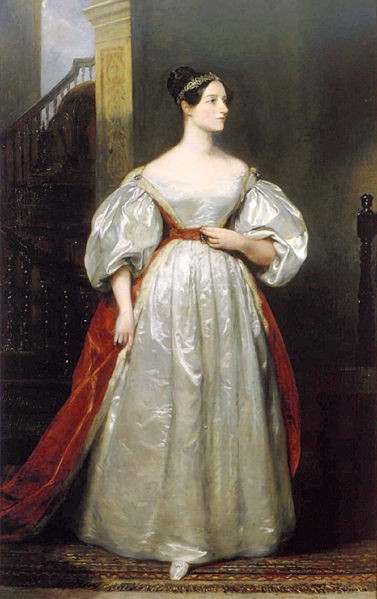
Today is Ada Lovelace Day, and I have special reasons to honor her.

horsley-gateway.jpg

For one thing, I grew up inside these gate-towers, in the last little house before the Lovelace estate proper began, and certain features of the first fields on the way to the big pile were my childhood haunts, the old oak with its dark and mysterious hollow wound, the clovered grass and cow pats, the small mound for boyish climbing, the bramble bushes with their delicious blackberries…

*

But it is as a devotee of Hermann Hesse‘s great Bead Game that I want to celebrate Ada Lovelace today —

ada3.jpg

for she illustrates to perfection the importance of cross-disciplinary analogies in creativity.

*

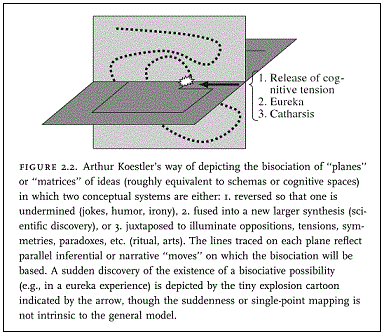
Consider this diagram from Mark Turner‘s The artful mind: cognitive science and the riddle of human creativity, based on those in Arthur Koestler‘s The Act of Creation (eg those on pp 35 and 37):

koestler-model.gif

Hesse proposes — in his Nobel-winning novel, the Glass Bead Game (aka Magister Ludi) the building of an architecture of ideas in which the great works of human culture are linked — bound together — by analogies between them.

Beginning players of his Game,  he writes, learn “how to establish parallels, by means of the Game’s symbols, between a piece of classical music and the formula for some law of nature.” As I wrote elsewhere, on a more complex level, Hesse speaks of scholars proposing materials for inclusion in the Game Archives, and specifically mentions someone who had been studying “the rhythmic structure of Julius Caesar’s Latin and discovered the most striking congruences with the results of well-known studies of the intervals in Byzantine hymns”…  Hesse couldn’t possibly have known about it when writing that particular sentence, of course, but there is actually a book by Jane-Marie Luecke, OSB, entitled Measuring Old English Rhythm: an Application of the Principles of Gregorian Chant Rhythm to the Meter of Beowulf, (Literary Monographs, vol 9, U. Wisconsin Press, 1978).

Hunh?  So?

*

Consider what Ada, Countess of Lovelace hath wrought.

She perceived just such an analogy — comparing Charles Babbage‘s Analytical Engine with Jacquard‘s mechanical loom, and writing:

The Analytical Engine … weaves algebraic patterns, just as the Jacquard-loom weaves flowers and leaves.

That analogy between weaving and algebra was the great creative leap: from there to the adoption and adaptation of Jacquard’s punched card system in computation was the lesser step from insight to application.

And think about it: her mind moved unerringly between “art” and “science” — or more exactly, craft and mathematics — in 1843, to deliver a technological insight on which the mainframes of the 1970s still relied…

That, my friends, was a superb move in the spirit of the Glass Bead Game — and impossible without a well-furnished and agile mind.

Fouche on Potential and Probable Uses of Power

Friday, October 7th, 2011

My sometime Chicago Boyz colleague, Joseph Fouche, had an interesting if somewhat meandering post on how power is used, not used and possibly abused.

The Chains of the Improbable vs. The Chains of the Impossible

An old Vulcan proverb advises us that only Sulla could march on Rome. This proverb may contradict another ancient proverb that claims that all roads lead to Rome. This seeming contradiction is resolved when you include little used roads, off the beaten track, the roads not taken. Sherlock Holmes once chided John A. Watson, M.D., saying, “How often have I said to you that when you have eliminated the impossible, whatever remains, however improbable, must be the truth?” Some roads to Rome are impossible, leading to the insurmountable. Lucius Cornelius Sulla Felix took a road that, while thought impossible, proved to be merely improbable.

Sulla, consul of Rome for the year 88 B.C., was in camp preparing to take his army east to fight King Mithridates VI of Pontus. Two envoys arrived to tell him that his command had been taken away by the vote of one of the people’s assemblies in Rome. These envoys of the Roman people expected that Sulla would do the only thing possible: lie down there, obedient to their commands, as every Roman army commander before him had done. Unfortunately, what they thought was impossible was only improbable.

Sulla gathered his men, announced what the will of the Roman people was, and asked them what the will of the army was. Sulla’s soldiers answered by stoning the envoys of the Roman people to death, much to the surprise of the envoys of the people. Sulla’s soldiers then petitioned Sulla to take an impossible road, a road never taken, and lead them to Rome to reclaim his Mithridatic command. Sulla, much to the surprise of his own officers, who thought such a course impossible, decided to heed his men and march on Rome. His officers resigned en masse except a happy few. But the poor bloody legionaries of Sulla’s army eagerly began the march on Rome.

Envoys from Rome streamed towards Sulla’s army as it marched north.These envoys were shocked and grew increasingly shocked as they protested to Sulla that surely, surely it was impossible that he wanted to march a Roman army through the city limits and into Rome itself. The law forbade it. The unwritten constitution forbade it. The Republic forbade it. The gods forbade it.

Sulla responded to the effect of, “Go tell the Romans that I don’t lie here obedient to their commands. I’m coming to Rome and hell’s coming with me.” The tone of these envoys’ entreaties and the mood of the people of Rome grew increasingly hysterical as the improbable dawned on them: not only could a Roman army commander march an army on Rome, it was increasingly probable that Sulla would march armed Roman legionaries right into the heart of Rome itself to deal with his political enemies. Indeed, Sulla led his men across the sacred pomerium that divided the “public thing” (res publica) of sacred Roma herself from land that was merely the property of Rome. Sulla’s veteran legionaries easily dispatched the hastily gathered mob of gladiators and other ruffians that his political opponents had thrown together at the last moment in a futile attempt to stop them.

Sulla had revealed that the impossible was merely the improbable.

Sulla spent the rest of his life trying to disguise this state of improbability as a mere state of impossibility.

He failed.

That was merely Fouche’s introduction. The post is well worth reading in full.

The post caught my eye because of Sulla, a Roman who did a monstrous thing but who was himself no monster. Much like a surgeon whose patient’s body is riddled with cancer, Sulla attempted to buy the old Roman Republic time and restore a semblance of political health by ruthlessly cutting out a tumorous faction and ratcheting back a host of constitutional gimmickery that had been welded onto Roman government over the years by ambitious politicians. Older, original rules of the game, or new ones in their spirit, were restored after blood shed in the proscriptions was scrubbed from the forum. Sulla even formally stepped down from the supreme power he held, like Cincinnatus, to further drive home the point to his fellow Romans regarding the sanctity of their traditions – though reportedly Sulla remained, even in a debaucherous retirement, a terrifying figure and stringpuller.

Fouche is correct that Sulla’s extreme measures failed. The underlying structural problems of the Republic were rooted in an increasing concentration of wealth, primarily in land ownership by Patricians and politically favored trading opportunities in “the East”, held mostly by the elite of Rome’s Italian “allied” city states, that left many Roman citizens too impoverished to perform military service or to be active in politics, except as dependent members of a clientela. The Republic’s legions and it’s political virtue had been based on an economically independent smallholding class who were being despoiled by politically powerful Patricians. Sulla’s reforms may have tempred political conflict within the ruling class for a time, but they also aggravated the social grievances that provided the Populares with political support from ordinary Romans and tilted the delicate political balance in the Republic toward extreme oligarchy.

In his retirement, observing the young Julius Caesar, whom Sulla had reluctantly spared, his toga fashionably loosely belted, long sleeved and wearing boots, like the ancient kings of Alba Longa, Sulla remarked “ He contains many Mariuses“. Caesar did. And unlike Marius but like Sulla, Julius Caesar was successful, Sulla having shown him the way to cross a Rubicon.

Power is power but power coupled with legitimacy endures. Sulla to Caesar to Augustus is the continuum.


Switch to our mobile site