zenpundit.com » Geography

Archive for the ‘Geography’ Category

Even Mountain Dew has its Mellow Yellow

Saturday, February 22nd, 2014

[summoned from the far regions of the deep bench by Lynn C. Rees]

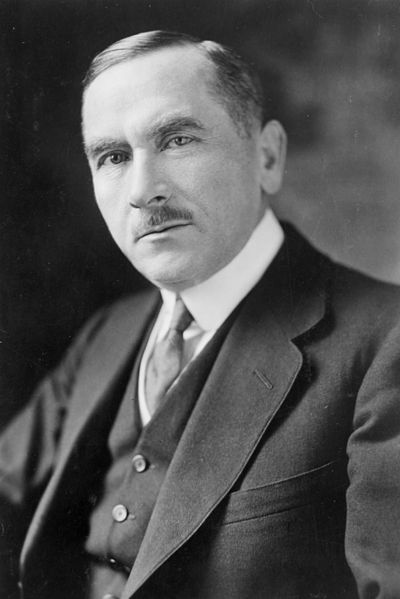
Jozef Pilsudski was a minor Polish noble born in the Lithuanian countryside in Poland’s historic periphery. Roman Dmowski was an impoverished commoner born in the city of Warsaw, deep in Poland’s historic core.

Pilsudski was a revolutionary, dedicated to a policy of violent confrontation. Dmowski was a politician, dedicated to creating change from within the system.

Pilsudski became a soldier. Dmowski became a diplomat.

They both wanted an independent Poland. Their strategies for achieving that independence and their vision of what an independent Poland would be were wildly divergent.
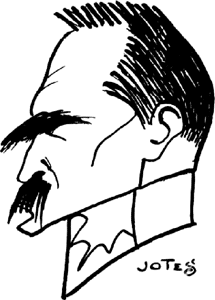
Josef Pilsudski

Josef Pilsudski

Pilsudski saw Russia as the true enemy of Polish independence. He was subjected to “Russification” as a student, leading him to observe later that, “With the Germans, we lose our land. With the Russians, we lose our soul”. In this spirit, Pilsudski soon involved himself in pro-independence agitation. This bought him the usual one-way ticket to a Siberian prison.

After his release, Pilsudski became a revolutionary. He became notorious for leading the only Polish party willing to use violence to win independence. To pursue his policy of violent resistance, from the safety of Austrian Poland, with a few nods and winks from Austro-Hungarian officials, Pilsudski created a Polish army complete with professional officer, NCO, and military training under the cover of setting up a network of Polish “sporting” and rifleman clubs.

Dmowski saw Germany as the true enemy of Polish independence. Russian backwardness was repellent to civilized Poles, he argued. They’d naturally resist Russification. Germany’s advanced culture was more dangerous: it could seduce wavering Poles into voluntarily Germanizing so they could hitch a ride on Germany’s meteoric ascent. Dmowski’s fear of Germanization led him to turn to Russia as a counterweight against German influence. Working with Russia, he believed,  offered the best path to eventual Polish autonomy.

Roman Dmowski

Roman Dmowski

Pilsudski was a romantic. He harked back to the glory days of the Polish-Lithuanian Commonwealth. The Old Republic ruled over diverse ethnic minorities while tolerating may different religions. Pilsudski wanted to create a similar ethnically and culturally diverse citizenry, unified by a stronger republic within the Old Republic’s ancient borders.

While Polish culture in its heartlands would be protected from foreign suppression, it wouldn’t be imposed on Poland’s minorities. They could become “Polish” just by being loyal to the Polish state.

Pilsudski’s policy was described as “state-assimilation”.

Dmowski was anything but romantic. A prominent biologist, he  was cold and rational. Dmowski looked back on four Polish uprisings against Russian rule in the nineteenth century and saw nothing but romantic foolishness. All they’d accomplished was bringing down Russian wrath on Poland. Like his slightly older contemporary Booker T. Washington, Dmowski argued that Poland should concentrate on peaceful modernization. Instead of romantic and doomed rebels, Poles should become scientists and businessmen.

Dmowski extended this refusal to romanticize to the Old Republic. Dmowski hated the Old Republic: he thought it was too tolerant and diverse. In the place of Pilsudski’s revived and wildly diverse Old Republic, Dmowski favored a homogenized Poland. Minorities ruled by the Old Republic would be excised from a more compact independent Poland. Dmowski saw the world through Social Darwinism. He saw nation fighting nation in a forever struggle for existence where strong trampled weak and only the fittest of nations survived.

Dmowksi’s Polishness was based on language and religion. Polish ancestry was helpful but not required: but, if Poland had to incorporate minorities, the few among a compact Poland’s many had to be strongly encouraged to speak the Polish language and practice the Roman Catholic religion.

Dmowski’s policy was described as “national-assimilation”.

The Romantic

The Romantic

These stark differences led to Pilsudski’s and Dmowski’s first  clash. When the Russo-Japanese War broke out, Pilsudski went to Tokyo to ask the Japanese government to support a Polish uprising. Dmowski traveled to Tokyo with a different purpose: to talk the Japanese out of supporting Pilsudski’s rebellion. Dmowski largely succeeded: the Japanese gave Pilsudski enough money and arms to distract the Russians but not enough to do anything that would make the Russian’s unreasonable.

When Pilsudski finally launched his uprising from Austrian Poland, Dmowski helped the Russians keep control of Russian Poland. He sent his party militia to fight Pilsudski’s party militia. The uprising failed. When the Russian Empire held elections for Russia’s parliament, Pilsudski’s party boycotted the elections. Dmowski’s party participated and won most of the open seats. Dmowski himself became a member of parliament and a political insider. Pilsudski retreated back to Austrian Poland and continued building up his forces for the general European war he presciently foresaw.

World War I began with Dmowski supporting Russia and Pilsudski leading Polish troops under Austrian command. Later, after he failed to get firm Russian commitments for more Polish self-rule, Dmowski went lobbying among Russia’s allies. He formed what the Allies recognized as Poland’s legitimate government (Thomas Woodrow Wilson (may his bones be crushed) was not impressed, “I saw Mr. Dmowski and Mr. Paderewski in Washington, and I asked them to define Poland for me, as they understood it, and they presented me with a map in which they claimed a large part of the earth.”). Pilsudski’s opposition later in the war to using Polish soldiers as what he described as “German colonial troops” led to his imprisonment by the Germans.
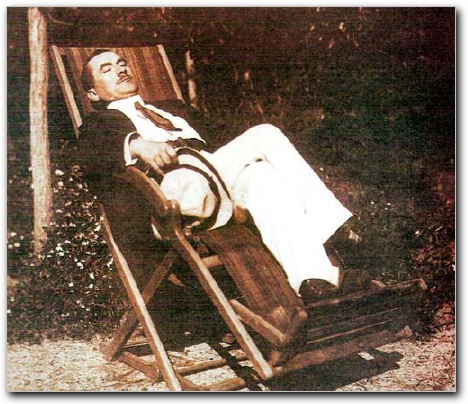
The Vulcan

The Vulcan

After Germany surrendered, Pilsudski had enough troops on the ground to win control of Poland. But Dmowski had the backing of the Allies and, soon enough, had his own army. In order to head off a civil war between their supporters, the two signed an agreement where Dmowski became the Polish representative to the Paris Peace Conference while Pilsudski became provisional president of Poland. At Versailles, Dmowksi followed his vision of the future Polish nation and concentrated on obtaining territory with Polish majorities while territory that lacked Polish majorities. Pilsudski, in pursuit of his vision of the future Polish state, focused on creating facts on the ground by military conquest of “unredeemed” parts of the Old Republic.

While Pilsudski succeeded in winning large territories with non-Polish majorities for Poland, Dmowski controlled the Polish government in the early 1920s. As promised, he actively “polonized” those minorities. Pilsudski pulled a 1/2 DeGaulle, coming from self-imposed exile at his rural estate to lead a coup in 1926 that reversed Dmowski’s policy. After seizing power, Pilsudski was free to implement his own vision of a trans-ethnic New Old Republic. Ironically, after Pilsudski’s death in 1935, Pilsudki’s own followers implemented Dmowski’s policy. Dmowski himself died early in 1939, right before Nazi Germany and Communist Russia partitioned Poland for a fourth time that fall.
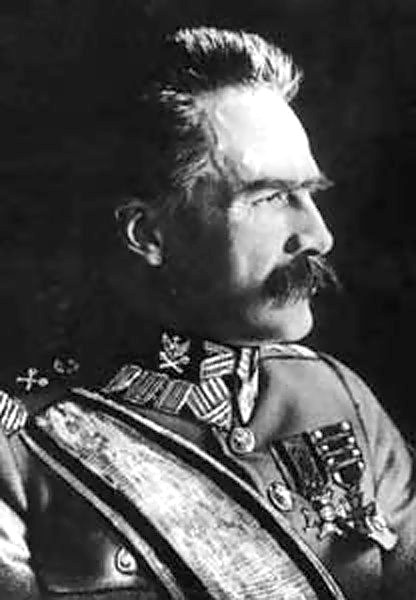
Military Conquest

Military Conquest

Ironically, Dmowski’s vision of Poland  triumphed over Pilsudski’s, though it  came about in a sinister and twisted way. Hitler liquidated Poland’s large Jewish community. Joseph Stalin took away the territories Pilsudski had conquered at the end of World War I. Polish minorities in those territories were expelled into Poland and the minorities of eastern Poland, primarily Ukrainians, were expelled into the Soviet Ukraine. In the west, 10 million Germans were expelled from the sections of eastern Germany transferred to Poland that Dmowski had earlier coveted. As a result, post-1950 Poland became homogeneous in culture, religion, language, and ethnicity. Very Dmowski. But modern Poland reveres Pilsudski, the romantic hero, over Dmowski, the logical realist.

Pilsudski was the proponent of the State and Dmowski was the proponent of the Nation. In David Ronfeldt’s TIMN (Tribe-Institution-Market-Network) framework, Pilsudski stood for the Institution and Dmowski stood for the Tribe. Pilsudski sought to bind people together through loyalty to a new Institution, the state. The Institution would largely replace  the Tribe in the hearts of the Polish people. If the Polish nation, as a Tribe, exercised any power over the other Tribes, it would be through the “soft power” of  Polish culture. Dmowski, in contrast, sought to bind people together through loyalty to an existing Tribe, the nation. Poland had an existing linguistic, territorial, and religious  heritage (Dmowski wasn’t big on traditional Polish culture). That was a surer foundation for a political community, enabling it to survive in the international jungle. Minorities should  be excluded  or strongly encouraged  to adopt the distinctive Tribal trappings. If not, they would be a source of weakness.
Political Conquest

Political Conquest

Nations and states have existed since the dawn of history. Sometimes they overlap into a nation-state, sometimes they don’t. Many of the earliest political communities known to us were states. The first Mesopotamian empires were unified Institutionally. However, they also contained a multitude of Tribes. Egypt, on the other hand, had many features of a nation-state, having been unified politically and culturally at the literal dawn of history. While Egypt had its moments of disunity, it kept a strong sense of self well into Roman times.

In the early twentieth century, nation-states seemed to be the hip-happening thing: France and Britain had become powerful and acquired great empires after becoming nation-states in late medieval times. This inspired nation-state-building exercises all over Europe, with Germany and Italy being the most prominent. It inspired Dmowski. He preferred the Anglican and Lutheran faiths as examples of national religions, since they were based in the nation itself. He viewed Rome with suspicion since the Catholic Church was headed by a foreign potentate. However, he later came to accept that the bond between Catholicism and Polish identity was so strong that Catholicism was the de facto Polish national church.

The rise of nation-states elsewhere in Europe contrasted with the fate of Poland in the late eighteenth century. Dmowski’s analysis of the Old Republic was that it had become so diverse and diffuse that it easily spun itself apart. Foreigners were able to champion different factions and minorities within Poland, using the peculiar institutions of Polish republicanism to weaken what had once been the major power in Eastern Europe. The future had not belonged to this multinational federal republic but to its highly centralized, autocratic neighbors Russia, Austria, and Prussia. Dmowski sought to banish this wild frenzy of ethnic, cultural, and religious diversity in favor of a consolidated Polish nation focused on modernization.

Pilsudski’s vision of a multi-ethnic, multi-cultural, and multi-denominational federated republic is more appealing to modern tastes. Pilsudski’s vision of a polity based on loyalty to a state apparatus and a set of abstract values is widely shared in contemporary elite circles, particular those overlapping with the EU, UN, and other supra-national institutions. Diversity and tolerance are now held up as core principles to build a modern political community upon. Pilsudski treated Poland’s minorities with respect during his dictatorship, only insisting that they swear loyalty to the Polish state.

His ambitions even stretched beyond Poland: Pilsudski sought to create a federation (Intermarum) that would unite Central and Eastern Europe from the Baltic Sea across the European Peninsula to the Black Sea. This was yet another echo of the Old Republic, which at its height also stretched from the Baltic to Black. This plan made little headway when Pilsudski proposed it. The new pygmies of Eastern Europe only grudgingly clumped together into a less ambitious yet equally untenable two-front proto-Iron Curtain against revisionist/Marxist Russia and revisionist/revanchist Germany.

Pilsudski and Dmowski correlate with veteran American publicist Howard Bloom’s proposed “diversity generators” and “conformity enforcers”. Pilsudski’s federation and Institution represent diversity generation. Dmowski’s nation and Tribe represent conformity enforcement. One rapidly mutates to provide multiple ways to adapt. One imposes commonality so adaptions can be shared and applied. Both are needed in any healthy system. The right and proper balance struck between them is a constantly shifting dilemma.

Pilgrim visas, the Hajj, and MERS-CoV

Tuesday, June 11th, 2013

[ by Charles Cameron — it’s all a matter of concentric circles and the integration of the vertical — ibn Arabi ]
.


.

The concentric circles around the Kaaba ripple out across our world. This means we should be watchful at the intersection of three overlapping regions in a Venn diagram: pilgrim visas, MERS-CoV epidemiology, and pilgrim dispersal.

John Burgess of Crossroads Arabia is the only one I know focusing on the conjunction, see his Saudis Restrict Pilgrim Visas.

The point I’d like to be hinting at here is that whereas MERS-CoV epidemiology is a scientific monitoring and interpretive matter using Science Rules, and visa issues are mostly matters of bureaucracy, the Hajj itself is a matter of the most passionate devotional concern, and a “purely rational” understanding will hardly scratch its surface.

**

Those with a mixture of poetry and scholarship in their souls may wish to read Love Letters to the Ka’ba: a presentation of Ibn ‘Arabi’s Tâj al-Rasâ’il to glimpse the Kaaba as seen by the al-Sheikh al-Akbar, Muhyiddin ibn Arabi:

Charles-Andre Gilis has pointed out that in the Islamic tradition the Ka’ba symbolises the centre of every state of Being, as is demonstrated by the tradition recorded by Ibn ‘Abbas according to which there exists a Ka’ba, similar to the one belonging to our world, in each of the seven heavens and seven earths (cf. La Doctrine Initiatique du Pélerinage, Paris, 1982, pp. 45-6). In the introduction to the Tâj, Ibn ‘Arabi refers to the Visited House (al-bayt al-ma’mûr), situated in the seventh heaven, the celestial prototype of the Ka’ba (p. 557).

As Gilis also observes, the Ka’ba is perceived by Ibn ‘Arabi as a manifestation of the divine Essence (Tâjallî dhâtî). However, he situates it, due to its mineral nature, in the lowest level of Being. But it is precisely the inferior character of its external aspect that allows it to sustain the ladder of beings and to identify itself on each level. It is thus described as “celestial constitution, angelic reality, young girl with formed breasts, level of the perceptible realm, and Meccan dignity (at the same time this constitutes an excellent example of the assonances of his rhymed prose: nash’a falakiyya wa haqîqa malakiyya wa jâriya falkiyya wa martaba mulkiyya wa rutba makkiyya) (p. 555).” Ibn ‘Arabi himself is astonished at the number of contradictory aspects that this being is able to bring together: “Oh marvel: divine constitution, simil (mithliyya), angelic, human, superior and inferior in which we find validity and deficiency, multiplicity and scarcity.” (p. 556)

The devotional aspect of the Hajj is orthogonal to the realism of bureaucracies and epidemiology — but not on that account any the less powerful!

Water and people

Thursday, May 9th, 2013

[ by Charles Cameron — and then of course there are animals and plants, too, and wildfires, and the Grand Canyon ]
.

Just a couple of things to think about:

Sources:

  • More than half of the world’s population lives inside this circle

    Even more mindblowing: said circle is mostly water.

  • All of the World’s Water

    Spheres showing:
    (1) All water (sphere over western U.S., 860 miles in diameter)
    (2) Fresh liquid water in the ground, lakes, swamps, and rivers (sphere over Kentucky, 169.5 miles in diameter), and
    (3) Fresh-water lakes and rivers (sphere over Georgia, 34.9 miles in diameter).

  • In the lower panel, the “all water” sphere is obvious, the “fresh liquid” sphere is visible, but the “freshwater lakes and rivers” — did you even notice it?

    **

    Some paras I wrote for John Petersen while at The Arlington Institute around the turn of the millennium:

    Water is our most precious resource. Our bodies are largely made of it; we thirst for it, and die when it is withheld more rapidly than we die for lack of food; and our food itself — whether animal or plant — also relies on it for nourishment and survival. Not surprisingly, water features in religious scripture and poetic mythology as among the highest symbols of purity and blessing: the Psalmist declares “There is a river, the streams whereof shall make glad the city of God” (Psalms 46: 4), Jesus in the New Testament speaks of his own teachings as “a well of water springing up into everlasting life” (John 4:14), while Allah declares in the Koran, “We made from water every living thing” (Al-Anbiyáa 30). For Lao-tzu in the Tao te ching, it is the analog of wisdom: “In the world there is nothing more submissive and weak than water,” he writes, “yet for attacking that which is hard and strong nothing can surpass it.”

    We consume water in ever increasing amounts, while polluting it as though its very purity was a reproach to us – and simultaneously beginning to recognize that this most precious of resources is just that – a limited, physical resource that we are squandering. Such significant indicators of hydrologic activity as , salinity, sea levels, snowmelt, glacial melt, and rainfall are not merely changing but accelerating their rates of change. We are fast running our of fresh water to drink and to irrigate our crops. And when World Bank vice president Ismail Serageldin declared in 1995 that “The wars of the next century will be over water”, he was giving advanced notice of a looming problem which we overlook at our peril.

    Of hot spots and feedback loops

    Friday, October 26th, 2012

    [ by Charles Cameron — with a pinch of humility which, if you ask me, burns hotter than any pepper ]
    .


    .

    Micah Zenko at the Council on Foreign Relations‘ Politics, Power, and Preventive Action blog raised a question yesterday that I found irresistible:

    Well…

    To be more exact, and exercise just a little humility, the question I found so exciting was really the one Crispin Burke posed, in a tweet pointing to Zenko’s piece:

    **

    So I read Zenko’s post with Burke’s term “hot spot” in the back of my head, and when I responded to Zenko, did so in terms of hot spots. Which because they’re like the celebrated “dots” we’re often told we’ve failed to connect, triggered some thoughts that I think are worth repeating, even if the phrasing is a little off from Zenko’s own.

    And the only real benefit I can see from my carrying Burke’s “hot spots” over into Zenko’s post is that it raised the issue of peppers, which adds a little spice to my response, and gave me a great graphic to go at the top of this post.

    Okay, here’s the key sentence that frames Zenko’s post:

    If you ask ten forecasters to predict the next conflict, you’ll likely get ten very different answers. But, they will agree on one thing: it is impossible to know for sure where and when the next conflict will emerge.

    Zenko may not mention hot spots as such, but already two things stand out for me: he uses the words “where and when” and “the next” — so he’s thinking in geographic terms and short timelines. In his title, he asks about 2013, which is almost in the greetings card section of my local Safeway by now. And he sees trouble in terms of places, not systems.

    **

    Here’s the response I posted at his CFR blog:

    A given hot spot may only be hot when coupled with another spot in a feedback loop – and the two spots may be widely separated geographically.

    To my way of thinking, an assessment of incipient troubles needs to look for feedback loops, blowback systems, echo chambers – all of them patterned phenomena that are likely to feature both sides of a potential or ongoing conflict from a systems analytic point of view. A microphone isn’t a hot spot, a loudspeaker isn’t a hot spot, but put the two of them in the same acoustic system and you can generate an ear-shattering howl…

    I’d look at “strong” versions of Islamophobic rhetoric and “strong” versions of Islamist rhetoric as a single system transglobally, for example, and I’d want to figure out what would cause dampening effects on both sides.

    Another tack I’d take is to ask questions like “what’s in our blind spots” and “what’s under the radar” – I vividly recall hearing Ali Allawi tell a session at the Jamestown Foundation that within Iraq, “most of the dissident Shi’a movements not within the ambit of the political process have very strong Madhist tendencies” and that they were “flying under our radar” — despite the fact that US forces had been involved in a major battle with one such group outside Najaf.

    I’ll post a more extended response on Zenpundit – but for now, I’d just like to throw in one additional question: is there a Scoville Scale for the “hotness of spots” as there is for peppers? It’s hard to know how to think through potential vulnerabilities without some sense of both intensity and probability of risk…

    **

    Forget Scoville and his habaneros — let’s get to the meat and potatoes.

    I’ll be straightforward about this. I suspect we’re doing our intelligence analysis and decision-making with only one cerebral hemisphere fully functioning — ie with only half a brain — like halfwits one might almost say, but in a strictly metaphorical manner — without benefit of corpus callosum.

    We don’t have the leaf > twig > branch > limb > tree > forest > watershed > continent > world zoom down yet.

    We don’t think in systems, we think in data points.

    Blecch, or d’oh! — your choice.

    **

    So my questions — and I don’t claim by any means to have an exhaustive list, that’s why we have many and varied bright people instead of just one or two — would be along the lines of:

  • how many kinds of metaphorical dry kindling are there in the world, which could turn into metaphorical wildfires?
  • and what sorts of metaphorical sparks could trigger them?
  • where are the rumblings?
  • what are the undercurrents of strong emotion running in different sociological slices of the world, that can be discerned from open sources such as the comments sections of online news media, conspiracy sites, religious group and subgroup (sect/cult) teachings, eccentric political movements, strands of pop culture — fanfic, comics, graffiti — single issue blocs?
  • where are the feedback loops, the parallelisms and oppositions, the halls of mirrors, the paradoxes, the koans, the antitheses, the conceptual antipodes?
  • where does energy drain from the system, and where does it collect, pool, and stagnate?
  • and perhaps most of all, what do we do, ourselves, wittingly or unwittingly, that tends to irritate others enough that they do unto us?
  • and do we consciously want to keep doing those things, and the blowback be damned?
  • **

    Where do we go from here. I think Zen (the Zen of Zenpundit, not the Zen of Zenko in this case) is right: we need to cross-weave our “vertical thinking” tendencies with “horizontal thinking” — see Zen’s posts on understanding cognition 1 and 2, which I take to be foundational for this blog.

    It’s the horizontal part that I’m trying to develop here, in my series of posts under the rubric of “form is insight” — because I think we have the other half of the equation, or the other cerebral hemisphere if you prefer, fairly well in hand.

    As always, it’s our vulnerabilities, dependencies, deficits and blind-spots we should be paying most attention to.

    At the round earths imagin’d corners

    Friday, July 20th, 2012

    [ by Charles Cameron — mapping, holding two worldviews in mind at one time, a conductor’s score, complexity thinking ]
    .


    .

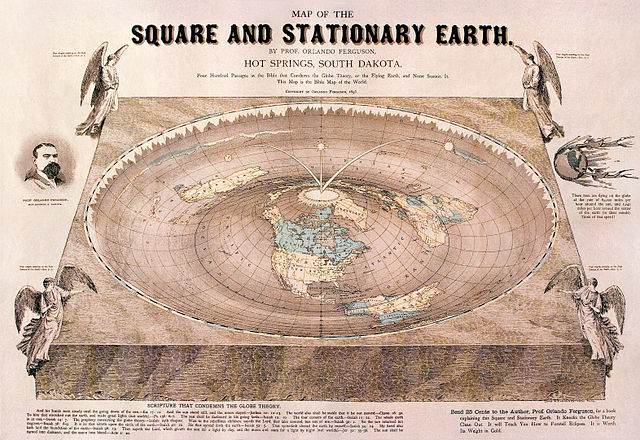
    About a year ago, the Atlantic reported that the Library of Congress had been given a map of the flat earth, designed according to Biblical principles — yet showing knowledge of the border between the United States and Canada…

    Thanks to a post from Jason Wells, I saw it today.

    The view that the earth is flat is one worldview, of course, and no longer the prevailing one. As Nicholas Jackson noted at the Atlantic:

    The interesting thing about the map is that it was created about 120 years ago by Orlando Ferguson, then a practicing physician in Hot Springs [South Dakota]. This is more than 500 years after most educated people gave up on the idea of the Earth as flat and accepted the spherical viewpoint first expressed by the Ancient Greeks.

    **

    It is, however, possible to hold two worldviews in mind at the same time. John Donne manages it in the first line of his extraordinary poem, written at a time when the two views were clashing:

    At the round earths imagin’d corners, blow

    AT the round earths imagin’d corners, blow
    Your trumpets, Angells, and arise, arise
    From death, you numberlesse infinities
    Of soules, and to your scattred bodies goe,
    All whom the flood did, and fire shall o’erthrow,
    All whom warre, dearth, age, agues, tyrannies,
    Despaire, law, chance, hath slaine, and you whose eyes,
    Shall behold God, and never tast deaths woe.
    But let them sleepe, Lord, and mee mourne a space,
    For, if above all these, my sinnes abound,
    ‘Tis late to aske abundance of thy grace,
    When wee are there; here on this lowly ground,
    Teach mee how to repent; for that’s as good
    As if thou’hadst seal’d my pardon, with thy blood.

    Donne accomplishes the task of holding two worldviews in mind at one time with four simple words: “round earths imagin’d corners”.

    **

    I don’t know how many melodic “lines of thought” the mind can hold in counterpoint at once. I do know it’s an important cognitive skill for us to cultivate. A classical conductor must surely be able to hold as many lines as there are in this page of Olivier Messaien‘s Oiseaux:

    As I pointed out in a recent comment here, “somewhere above three and before eleven there’s a point — Miller’s ‘magical number seven, plus or minus two‘ where the human mind can’t hold any more detail, so that’s a cut-off of sorts.”

    Well, Messaien clearly imagines the conductor’s mind can follow more than eleven paths…

    **

    And then there’s Bob Milne.

    I’ll let the Philosophy Compass take it from here:

    Bob is predominantly known for his piano concerts of Ragtime and Bogie-Woogie music – and was given the moniker of ‘National Treasure’ by the United States Library of Congress. It was at one of these concerts that drew the attention of Penn State neuroscientist Kerstin Bettermann. At his concerts, Bob often carries on conversations, telling stories and jokes, while simultaneously modulating key signatures over the polyrhythmic Ragtime music. In their broadcast, Radiolab discusses with Dr. Bettermann why this is so surprising.

    Language use and musical competency often use the same neural resources: the prototypical language areas in the left hemisphere of the brain, and the working memory circuit that keeps information available and rapidly accessible for a short-period of time. Our ability to use language and engage with music should, on most models of the brain, be competing for these neural resources and interfere with one another. Not so with Bob – he appears to be able to tackle both tasks with ease. Further, while most people can approach this kind of competency in multi-tasking, it usually involves many learning trials, a process of sedimenting the learning into what psychologists call procedural memory, which may have its roots in a different brain region, the cerebellum. But Bob can hear a tune just once, and play it back with commentary.

    But that’s not all Bob can do.

    In their interview, Dr. Bettermann heard Bob claim something extraordinary. He claims not only to be able to hear a symphony in his head, but that he normally does this with two symphonies simultaneously. Where most individuals would only hear a cacophonous mess – Bob claimed he could dial the relative volume of either symphony up or down, and could zoom in or out of individual instrumentations. To return to the considerations above, Bob further states on the Radiolab website that he does this while driving – another procedural memory task and presumable source of interference. But when Dr. Bettermann challenged him, Bob reluctantly claimed that he could probably do the same (not while driving, mind you) with four simultaneous symphonies.

    The claim is something like this: Bob states that he can hold and listen to four symphonies with different keys, instrumentation, tempo and style in his working memory at the same time. And what is stunning is that when they put Bob into an fMRI machine, they verified his claim. Bob could be stopped at any time during his imaginative trip through the four simultaneous symphonies, and hum out the exact phrase that the original recording would be on. Remarkable.

    **

    This in turn takes us back to that point Edward Said made, which gave me the basic concept for my Said Sympohony (must get back to that soon):

    When you think about it, when you think about Jew and Palestinian not separately, but as part of a symphony, there is something magnificently imposing about it. A very rich, also very tragic, also in many ways desperate history of extremes — opposites in the Hegelian sense — that is yet to receive its due. So what you are faced with is a kind of sublime grandeur of a series of tragedies, of losses, of sacrifices, of pain that would take the brain of a Bach to figure out. It would require the imagination of someone like Edmund Burke to fathom.

    Edward W. Said, Power, Politics, and Culture, p. 447 — from the section titled “My Right of Return,” consisting of an interview with Ari Shavit from Ha’aretz Magazine, August 18, 2000.

    I asked in a post yesterday how good we now are at modeling or simulating ideas in the “war of ideas” — just for a moment, suppose we could think through all complex geopolitical issues in this polyphonic, contrapuntal way…

    **

    Okay, you deserve a reward for faithful reading if you’ve come this far with me. Here’s the incomparable Richard Burton reading Donne’s poem — the text is up above, if you want to follow along:


    Switch to our mobile site