zenpundit.com » britain

Archive for the ‘britain’ Category

Nancy Fouts and the heart of the matter

Thursday, March 22nd, 2012

[ by Charles Cameron — Nancy Fouts, sculpture, juxtaposition, essence of creativity, pocket universes, Arthur Koestler, Mark Turner ]
.

Nancy Fouts is an American artist based in London. I ran across her work a while ago thanks to Michael Weaver on Google+, and was immediately struck by the intensity of her images, each one of which seemed like a landmark from a larger geography, more precisely focused and dense with meaning than our own world usually appears to be.

First impression:

.
The first image I saw was of a snail on the straight edge of a razor blade (above, left) — an image out of the script of Apocalypse Now to be sure, but presented by Fouts in sharp detail and unadorned by any other context, visually, direct from eye to mind and heart.

This may be the image many people first see of her work — very, very striking, exquisite, terrifying if you allow it to be so, and yet as clear and simple, almost, as a single drop of water on a leaf.

Singer and song:

.
But it was this next image that conquered me:

The juxtaposition is impeccable: sewing machine, record on turntable – and the overlap between the two, the link, the vesica piscis between them, is the needle.

The music of Bach, Handel, and Vivaldi — particularly on harpsichord — has been disparagingly called “sewing-machine music”. If that phrase gave rise to this marvelous image, perhaps the slight can be forgiven.

The sewing-machine? It’s a Singer. And in what must surely be an ironic, gender-influenced choice coming to us from an artist so assured and exacting — the music that the needle draws from the groove of the record is, as you can tell from the record label, the music of His Master’s Voice.

Philosophical aside:

.
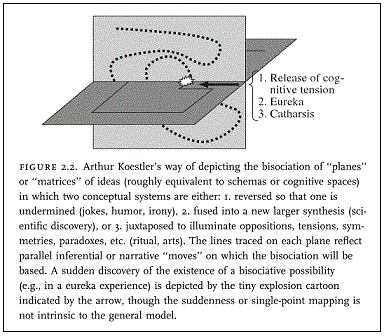
I have pointed before to this diagram from Mark Turner‘s The artful mind: cognitive science and the riddle of human creativity, based on those in Arthur Koestler‘s The Act of Creation (eg those on pp 35 and 37):
koestler-model.gif

It shows the essence of the creative act — the “release of cognitive tension” that occurs when some form of analogy, similitude, overlap allows the mind to join conceptual clusters from two fields in a “creative leap”.

Nancy Fouts’ work doesn’t merely make use of such twinned field overlaps, it makes twinned fields with overlap the defining quality of her works.

She is aiming right at the heart of the creative process. And it shows.

Moving further afield:

.
In that earlier post of mine, I talked about Ada, Countess of Lovelace, and noted that her analogy between Charles Babbage‘s Analytical Engine and Jacquard‘s mechanical loom, famously expressed by her thus:

The Analytical Engine … weaves algebraic patterns, just as the Jacquard-loom weaves flowers and leaves.

was precisely the creative leap that led to the us of punched card systems in computation from Babbage to Watson…

I could give other examples. The Taniyama-Shimura conjecture which formed the basis of Andrew Wiles‘ proof of Fermat‘s Last Theorem, bridges two previously distinct branches of mathematics precisely by showing that for every elliptic curve, there is a related modular form

And no, I don’t understand the mathematics. But I understand the concept of twinned fields, and the power of their overlap.

Some favorite tropes:

.
Back, then, to Nancy Fouts:

One thing that interests me about her work is that she has a few simple “essences” that she returns to time and again: in this case, bees, forms that resemble honeycombs, and by implication, honey.

In my own work, making similar connections between what we might paradoxically call “kindred ideas in unrelated fields” — I might set Nancy’s honeybees across from the verse from the Upanishads [Brihadaranyaka, fifth Brahmana, 14] which says:

This Self is the honey of all beings, and all beings are the honey of this Self.

Another of Nancy’s tropes connects nature and music…

The piercing:

.
And thimbles, those miniature emblems of armor and protection, are another recurring theme:

Let’s take a look at that last image, of the thimble transpierced by a needle.

I believe it has a history — again, accessible via an associative leap. Here are three images of the “wounded healer” motif, two of them specifically images of the Inuit shaman who has harpooned himself — a motif which the anthropologist and zen roshi Joan Halifax writes “captures the essence of the shaman’s submission to a higher order of knowing”:

Armor, the defenses we have in place to protect our selves, and vulnerability, the ability to to allow our selves to be wounded, so that the “self” which is “the honey of all beings” may shine through us. The paradox of Selflessness and Self.

Koan and sacrament:

.
Among wounded healers, we might count the crucified Christ, his side pierced by the spear of a Roman soldier — and here I might suggest that Fouts contrasts (image below, left) the self-sacrifice at the heart of Christianity with the pugilistic approaches of some proponents of his message:

And the image of Christ (right) balancing on a high wire?

Again I’m reminded of the language of shamanism. The anthropologist Barbara Myerhoff studied the religious beliefs and practices of the Huichol or Wixaritari of the Mexican Sierra Madre Occidental, with Ramon Medina Silva, a mara’akame or shaman of the tribe.

In her book, Peyote Hunt: The Sacred Journey of the Huichol Indians, she describes a feat of balance that Ramon performed, which appeared to serve a “sacramental” function for his people – providing them with what Cranmer‘s Book of Common Prayer calls “an outward and visible sign of an inward and spiritual grace”:

One afternoon Ramon led us to a steep barranca, cut by a rapid waterfall cascading perhaps a thousand feet over jagged, slippery rocks. At the edge of the fall Ramon removed his sandals and told us that this was a special place for shamans. We watched in astonishment as he proceeded to leap across the waterfall, from rock to rock, pausing frequently, his body bent forward, his arms spread out, his head thrown back, entirely birdlike, poised motionlessly on one foot. He disappeared, reemerged, leaped about, and finally achieved the other side. We outsiders were terrified and puzzled but none of the Huichols seemed at all worried. The wife of one of the older Huichol men indicated that her husband had started to become a mara’akame but had failed because he lacked balance.

It’s easy to read the description — but by no means as easy to keep one’s balance — something that Fouts’ image perhaps suggests more vividly than words easily can.

Richard de Mille describes the mara’akame‘s function in Huichol society as to “cross the great chasm separating the ordinary world from the otherworld beyond,” and suggests that Medina Silva’s feat of acrobatics on the barranca that day is to be understood as offering “a concrete demonstration in this world standing for spiritual balance in that world.”

Myerhoff herself was never entirely sure whether Medina Silva was “rehearsing his equilibrium,” or giving it “public ceremonial expression” that afternoon: it is clear, however, that for the Huichols, such feats of balance possess a resonance and meaning that extends beyond the “merely” physical.

Bringing the viewer into the picture

.
I may of course be projecting some of my own ideas onto Nancy Fouts’ work — and indeed, perhaps that’s the point.

She has some pretty fierce observations to make concerning matters religious — Christian, Buddhist and other — and I’ll leave those who are interested to make their own discoveries on her website. I don’t doubt there are places where her sympathies and my own overlap, and others where we differ.

Fouts speaks a direct and visceral language of images — and her juxtapositions, carefully chosen and choreographed as they are, provoke us to feel and think.

Thank you, Nancy.

No need to reach for the gun, fellas — but that’s art.

_________________________________________________________________________________________

credits for images of Harpooned Shaman: Charlie Ugyuk (left); David Ruben (right).
Iconic: compare and contrast

Thursday, December 22nd, 2011

[ by Charles Cameron — iconic images, riot police, compare and contrast, repetition with variation ]

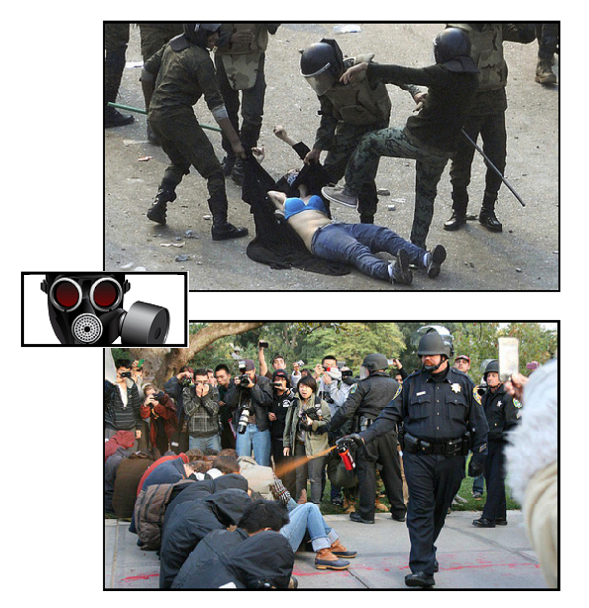
First, let’s be clear that both these images have been widely considered iconic.

Thus NPR reported of the first photo:

There have been countless accounts of violence recorded during the uprisings in Egypt but the image that perhaps has captured the most attention is the most recent. The image has been widely referred to as the “girl in the blue bra.”

While Real Clear Politics quotes Michael Moore on the second:

“The images have resonated around the world in the same way that the lone man standing in front of the tanks at Tiananmen Square resonated. It is an iconic movement in Occupy Wall Street history,” Michael Moore declared on MSNBC’s “Last Word” program.

Moore was referring to police pepper spraying students at an “Occupy” protest at UC Davis.

So we have two similarities between the two images: they both show police in riot gear taking action against demonstrators, and they have both caught the public eye as somehow being representations that can “stand in” for the events they seek to portray.

Beyond that, it’s all compare and contrast territory — or variations on a theme, perhaps — and different people will find different reasons to attack or defend the demonstrators or the police in one, the other, or both cases.

1.

These are, for many of us, “home” and “away” incidents, to borrow from sports terminology, and some of our reactions may reflect our opinions in general of what’s going on in Egypt, or in the United States.

We may or may not know the rules of engagement in effect in either case, on either side.

In a way, then, what the photos tell us about those two events, in Tahrir Square and on the UC Davis campus, may tell us much about ourselves and our inclinations, too.

2.

As I’ve indicated before, I am very interested in the process of comparison and contrast that the juxtaposition of two images — or two quotes — seems to generate. And I’ve quoted my friend Cath Styles, too:

A general principle can be distilled from this. Perhaps: In the very moment we identify a similarity between two objects, we recognise their difference. In other words, the process of drawing two things together creates an equal opposite force that draws attention to their natural distance. So the act of seeking resemblance – consistency, or patterns – simultaneously renders visible the inconsistencies, the structures and textures of our social world. And the greater the conceptual distance between the two likened objects, the more interesting the likening – and the greater the understanding to be found.

I’d like to examine these two particular photographs, then, not as images of behaviors we approve or disapprove of, but as examples of juxtaposition, of similarity and difference — and see what we might learn from reading them in a “neutral” light.

3.

What I am really trying to see is whether we can use analogy — a very powerful mental tool — with something of the same rigor we customarily apply to questions of causality and proof, and thus turn it into a method of insight that draws on our aha! pattern recognition and analogy-finding intuitions, rather than the application of inductive and deductive reason.

And that requires that we should know more about how the mind perceives likenesses — a topic that is often obscured by our strong emotional responses — you’re making a false moral equivalence there! or look, one’s as bad as the oither, and it’s sheer hypocrisy to suggest otherwise!

So among other things, we’re up against the phenomenon I call “sibling pea rivalry” — where two things, places, institutions, whatever, that are about as similar as two peas in a pod, have intense antagonism between them, real or playful — Oxford and Cambridge, say, and I’m thinking here of the Boat Race, or West Point and Annapolis in the US, and the Army-Navy game.

Oxford is far more “like” Cambridge than it is “like” a mechanic’s wrench, more like Cambridge than it is a Volkswagen or even a high school, more like it even than Harvard, Yale, Princeton or Stanford — more like it than any of the so-called “redbrick universities” in the UK — so like it, in fact, that the term “Oxbridge” has been coined to refer to the two of them together, in contrast to any other schools or colleges.

And yet on the day of the Boat Race, feelings run high — and the two places couldn’t seem more different. Or let me put that another way — an individual might be ill-advised to walk into a pub overflowing with partisans of the “dark blue” of Oxford wearing the “light blue” of Cambridge, or vice versa.  Not quite at the level of the Zetas and the Gulf Cartel, perhaps, but getting there…

4.

So one of the things I’ve thought a bunch about is the kind of analogy that says a : A :: b : B.

As in: Egyptian cop is to Egyptian protester as UC Davis cop is to UC Davis protester.

Which you may think is absolutely right — or cause for impeachment — or just plain old kufr!

And I’ve figured out that the reason people often have different “takes” on that kind of analogy — takes so different that they can get extremely steamed about it, and whistle like kettles and bubble over like pots — has to do with the perceptual phenomenon of parallax, whereby some distances get foreshortened in a way that others don’t.

5.

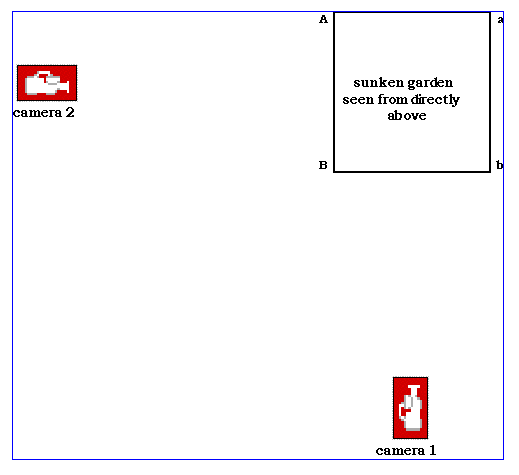
So my thought experiment sets up a sunken garden — always a pleasure, with two video cameras observing it, as in this diagram:

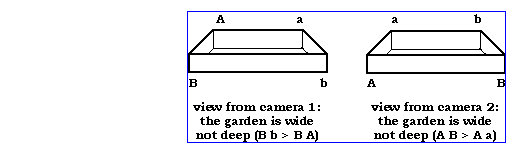
And from the two cameras, the respective views look like this:

In this scheme of things, Aa (Oxford) seems very close to Bb (Cambridge) seen from the viewpoint of camera 1 — but from camera 2’s standpoint, Aa (Oxford) and Bb (Cambridge) are at opposite ends of the garden, and simply couldn’t be father apart.

6.

Now, my thinking here is either so obvious and simple as to be a platitude verging on tautology — or one of those subtle places where the closer examination of what looks tautological and obvious leads to the emergence of a new insight, a new “difference that makes a difference” in Bateson’s classic phrase.

And clearly, I hope that the latter will prove to be the case here.

7.

What can we learn from juxtapositions? What can we learn from our agreements about specific juxtapositions — and what can we learn from our specific disagreements?

Because it’s my sense that samenesses and differences both jump out at us, as Cath Styles suggested — and that both have a part to play in understanding a given juxtaposition or proposed likeness.

Each juxtaposition will, in my view, suggest both a “sameness” and a “difference” — in much the same way that an arithmetic division of integers, a = qd + r, gives both quotient and dividend.

And then we have two or more observers of the juxtaposition, who may bring their own parallax to the situation, and have their own differences.

8.

Tahrir is to Tienanmen as Qutb is to Mao?

Or is pepper spray just a food additive?

And how do icons become iconic anyway? Are they always juxtapositions, cops against college kids, girl vs napalm, man against line of tanks?  Even in the iconic photo of Kennedy from the Zapruder film, the sudden eruption of violence into the stateliness of a presidential parade is there — a morality play in miniature.

Any thoughts?

Gunpowder, treason and plot

Saturday, November 5th, 2011

[ by Charles Cameron — instance of religious terrorism, UK, Catholicism, Protestantism, Vendetta-the-movie, Anonymous, OWS, Pharaoh ]

.

men.jpg

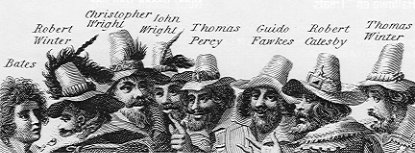
I am seven hours “behind” the land of my birth, but today would be the day on which to remember one Guy — named Guido in the image above — Fawkes, a terrorist whose religious and political sympathies were closely interwoven.

*

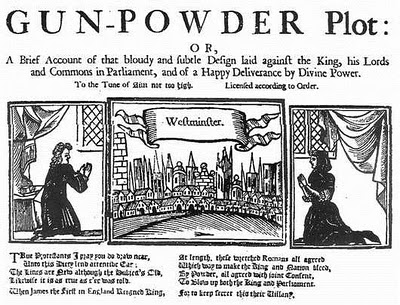
Archbishop Cranmer‘s [dare I say, Laudable?] blog today has a poetic description of the event, a fine illustration:

gunpowderplot.jpg

and some fascinating comments portraying both the event itself and religious terror more generally…

We have had four hundred years to “remember, remember” — should we remember, or should we forgive and forget?

*

The mask worn in the movie V for Vendetta is a Guy Fawkes mask, now also associated with both the Anonymous group and the Occupy movement… and it shows up in all sorts of strange places…

images1.jpg

Pharaoh? Guy Fawkes?

Clear proof that if you connect too many dots, you may go what we Brits call “dotty”…

The Myth of British Counterinsurgency?

Sunday, October 30th, 2011

This SSI monograph by Dr. Andrew Mumford should stir some robust debate in the COIN community:

Puncturing the Counterinsurgency Myth: Britain and Irregular Warfare in the Past, Present, and Future

Most of Mumford’s points are valid criticisms but I need to quibble with Myth # 1 The British Military is an Effective Learning Institution:

MYTH #1: THE BRITISH MILITARY IS AN EFFECTIVE LEARNING INSTITUTION

According to John Nagl, the British succeeded in Malaya-in contrast to the American failure in Vietnam-because the British army had an organizational culture akin to a so-called “learning institution,” whereby the army quickly adapted to COIN conditions and changed tactics accordingly.2 The array of operational activity, ranging from limited to total war, that the British army has experienced has arguably led to a greater degree of pragmatism in its military outlook. A dogmatic adherence to rigid military doctrine has been absent, which, when compared to the generation-long postmortem on the failure of U.S. strategy in Vietnam, perhaps explains more than most other factors why an almost mythic reputation has descended upon the British. However, this does not explain, nor should it obscure, the languid application of appropriate irregular warfare tactics and the absence of swift strategic design. When it comes to COIN, the British are slow learners.

The early phases of nearly every campaign in the classical era were marred by stagnancy, mismanagement, and confusion. The military was 2 years into the Malayan Emergency before it conceived of a cohesive civil-military strategy in the form of the Briggs Plan. The crucial early years of the troubles in Northern Ireland were marked by displays of indiscriminate force and an inability to modulate the response.3

The Director of the United Kingdom (UK) Defence Academy also concedes that, in relation to Northern Ireland, “[I]t is easy in the light of the later success . . . to forget the early mistakes and the time it took to rectify them.”4 As Lieutenant General Sir John Kiszely rightly observes, the Malayan Emergency was, “a much lauded counterinsurgency campaign, but often overlooked is the fact that in the early years . . . the British Army achieved very little success.” In COIN terms, therefore, the British have been consistently slow to implement an effective strategy and achieve operational success. Moreover, the vast body of campaign experience has not translated into a cogent COIN lesson-learning process within the British military. The very need to re-learn COIN in the post-September 11, 2001 (9/11) conflict environment has undermined assertions as to the British military’s being an effective learning institution. Such amnesia has created an imperative for the armed forces now to hone their lesson-learning abilities while simultaneously adapting to the intricate challenges of sub-state and transnational post-Maoist insurgent violence in the third millennium.

What sort of time frame is reasonable for “organizational learning” – that is, transforming a large, hierarchical, bureaucratic entity’s conceptualization and understanding of a situation and reforming and adapting it’s practices in light of experience? How fast can this really happen? An org is not an individual, two years while under fire does not seem slow to me. Am I missing something in Mumford’s argument?

Furthermore, I infer from the third paragraph that Mumford expects evidence of learning were for the Brits to have arrived in Basra good-to-go on COIN doctrine. Learning, whether in a person or org, is not represented by doctrine (lessons frozen in time) but rather a capacity to adapt to new circumstances. Mumford is on firmer ground criticizing British general officers for their blind assumption that they had all the answers on counterinsurgency  while the ragtag Mahdi Army bullied and ran circles around British units.

A monograph worth reading.

Hat tip to Lexington Green and SWJ Blog)

Guest Post: Pundita: Missing Something?

Sunday, August 28th, 2011

We’re delighted here at Zenpundit to present a cross-post from our blog-friend Pundita — of whom it has been said that “What Julia Child did for French cooking, Pundita is doing for foreign policy discussion. She’s opened a haute pursuit to ordinary people.”

Pundita quotes Mark in this post, and also raises some interesting issues with regard to America and monarchism — and as I have been prepping a series of posts on “the impact of ritual and ceremonial in church, military and state,” we all agreed it would be good to bring this post across to ZP in the hope of stirring some discussion — and see how things develop from there.

Pundita’s epigraph for this post is as follows:

Alan Rickman‘s Sheriff of Nottingham to a scribe: “Wait a minute. Robin Hood steals money from my pocket, forcing me to hurt the public, and they love him for it? That’s it then. Cancel the kitchen scraps for lepers and orphans, no more merciful beheadings, and call off Christmas.”

We bid her welcome.

— Charles Cameron

___________________________________________________________________________________________

Pundita writes:

The title of this post refers to the punch line in a series of TV commercials in the USA for Sears Optical eyeglasses. The ads feature amusing skits of people in serious need of a pair of glasses, such as the woman who mistakes a police patrol car for a taxicab. But helped along by bravura performances from Tara L. Clark as a blind-as-a-bat cat owner and Squirty as a wild racoon who can’t believe his luck, one of the skits is so funny it’s gone viral on the internet:

 Oh look it’s a democracy! Come snuggle with the United States!

There is nothing funny, however, about American officials who are so blind to what the United States stands for they snuggle with governments that march to a very different drumbeat than their own. Yet the officials are supported in their blindness by an equally blind populace. So in this post I’m going to break a taboo and wrestle with topics that are only whispered about in this country: monarchism and America’s involvement with it. To set the stage I’ll start with quotes from two recent news reports:

From the Globe and Mail (Canada), August 19, 2011:

Stephen Harper is working to recast the Canadian identity, undoing 40 years of a Liberal narrative and instead creating a new patriotism viewed through a conservative lens.Restoring the “royal” prefix to the navy and air force this week is just part of the Prime Minister’s attempt at “creating a new frame” for Canada and Canadians. …

From the New York Times, August 17:

A photograph taken last Friday of Gary F. Locke, the new United States ambassador to China, buying coffee with his 6-year-old daughter and carrying a black backpack at a Starbucks in the Seattle airport, has gone viral on the Chinese Internet. The seemingly banal scene has bewildered and disarmed Chinese because they are used to seeing their own officials indulge in privileged lives often propped up by graft and bribery and lavish expense accounts.

[…]

The first impression from the Starbucks episode has been bolstered by another photograph that shows Mr. Locke, his wife, Mona, and their three children carrying their own luggage after landing at Beijing Capital International Airport.Chinese who saw them then spread the word that the family had gotten into an anonymous minivan because a formal sedan that had been sent to pick them up was too small.

“To most Chinese people, the scene was so unusual it almost defied belief,” Chen Weihua, an editor at China Daily, an official English-language newspaper, wrote in an article Wednesday.

Cheng Li, a scholar at the Brookings Institution who studies Chinese elite politics, said in an e-mail: “Ambassador Locke’s photo contrasts sharply with the image of the Chinese officials who often live in a secret, insulated, very privileged fashion.

Often I’ve heard it asked why Britain’s political Right doesn’t seem much less socialist than the country’s Left. I’d say the answer is that the United Kingdom’s welfare state has as much to do with Marxism as bread and circus did under the Roman emperors. I’d also say the same answer would apply to the welfare state in the Kingdom of Norway and the Kingdom of Sweden and a number of other countries that are constitutional monarchies.

Yet my fellow Americans have such difficulty seeing monarchism that they confuse it with something else. The same blindness can afflict Americans who insist that China is not much different from the United States. In his 2008 article for the May/June issue of Good magazine (Ten Reasons Why China Matters To You), Thomas P.M. Barnett, an American security analyst, wrote that “China’s transformation echoes much of America’s past. … right now, China is somewhere in the historical vicinity of ‘rising America’ circa 1880.”

In my retort (The National Petition Bureau will see you now, Dr Barnett), I pointed out that Chinese make the pilgrimage to a bureau that’s a CCP placemarker for an emperor’s go-fers. I added in exasperation, “Ah yes, I remember as if just yesterday the tens of millions of American peasants in the 1880s who pilgrimaged to the nation’s capital every year to seek redress from the emperor.”

Dr Barnett turned out to have a sense of humor or at least a fair-minded attitude about receiving criticism because he linked my post at his blog. Yet that did little to allay my concern that Washington’s foreign policy establishment was blind as a bat to the fact that modern China is an imperial society with a frownie face of Communist Party dictatorship painted on it, and that modern Britain and a good number of other NATO-member countries are basically monarchist societies with a smiley face of democracy plastered on them.

One could even make an argument that modern Mexico’s most entrenched problems are rooted not in the rule of the Spanish but in indigenous imperial civilizations that predated Spain by thousands of years.

In fact, the more one starts looking around the world for societies that are not holdovers from the days of kings the more one appreciates that the United States of America has very few natural allies; i.e., countries that represent a real break with monarchism and the class systems that uphold it.

Norwegians might bristle at their society being described as monarchist. They would point out that their noble class has no political power anymore and that Norway today is an egalitarian society. However, it is an egalitarianism so rigidly enforced that the Norwegian mass murderer Anders Behring Breivik believed after he set off a bomb in Oslo that he would be caught and killed by the police before he reached Utoya island.

His faith in the omniscience of Norway’s government was dashed but the point is that the country’s egalitarian “open society” is maintained by the second largest deployment of public-space CCTV cameras outside the United Kingdom. And Norway’s generous public welfare system means that from cradle to grave Norwegians are easily monitored by the state, which helps the government make sure Norway stays an open, egalitarian society.

Yet Americans insist on describing such states as Leftist! Karl Marx would roll in his grave if he saw what passes today for many Leftist governments.

These same Americans decry their government’s close alliance with absolute monarchies such as the Kingdom of Saudi Arabia. They do so without realizing that there is a long history of the United States being closely allied with monarchies; that many of these are no longer “absolute” but “constitutional” with parliamentary forms of government and voting rights makes them no less monarchist.

Americans were also miffed at what they considered snobbishness when they heard the Swedish Chairman of BP, Carl-Henric Svanberg, expressing concern for the victims of the Gulf oil spill by referring to them as “the small people.”

Translation malfunction, explained his apologists. There was no malfunction; English is Svanberg’s second language. And he wasn’t being snobbish, he was being Swedish. Noblesse oblige and all that; one must always look after the basic needs of the small people so they don’t revolt.

None of the above is meant as a criticism of the countries I’ve mentioned or their people, and one would be hard-pressed to find nicer peoples than the majority of Swedes or Norwegians — and Canadians for that matter, who also live under a constitutional monarchy. I see no harm in people upholding traditions that provide them with a sense of order and give them continuity with their past, which is why I cheered on the royal pomp associated with the marriage of William and Kate. If it helped Britons get clearer on their values I was all for that.

The harm comes when Americans are so unclear on their own values, their own past and traditions, they can’t engage closely with the rest of the world without becoming terribly confused. One consequence is that the more the U.S. government has tried to mesh with the “international community,” the lower America’s standing in the world has fallen.

Americans can’t turn the situation around without first acknowledging that the international community is in large measure of bunch of royalists. Arriving at this realization doesn’t mean Americans should eschew friendly relations with people in such societies or that official Washington should spurn engaging with the governments on issues of mutual interest. It does mean that Americans are asking for ever greater trouble by lumping “democratic” monarchies” with American democracy.

Over at ZenPundit, Mark Safranski has again expressed concern about what he calls an emerging American oligarchy, an elite that’s manipulating the rest of the American populace to accept its rule. Meanwhile, Fareed Zakaria is seriously proposing that America replace its president with a prime minister and Congress with a parliament — with an upper house, I suppose, to be stuffed with Mark’s oligarchs, duly elected of course, so that Americans will stop the troublesome habit of vehemently disagreeing with one another.

Now just see how one thing leads to another. First you’re snuggling with liberal monarchies, then authoritarian ones, then one day you’re asking, ‘Why is there no USA anymore? Why is there only the international community?’

Missing something?


Switch to our mobile site