Archive for the ‘Strategy and War’ Category
Thursday, November 3rd, 2011
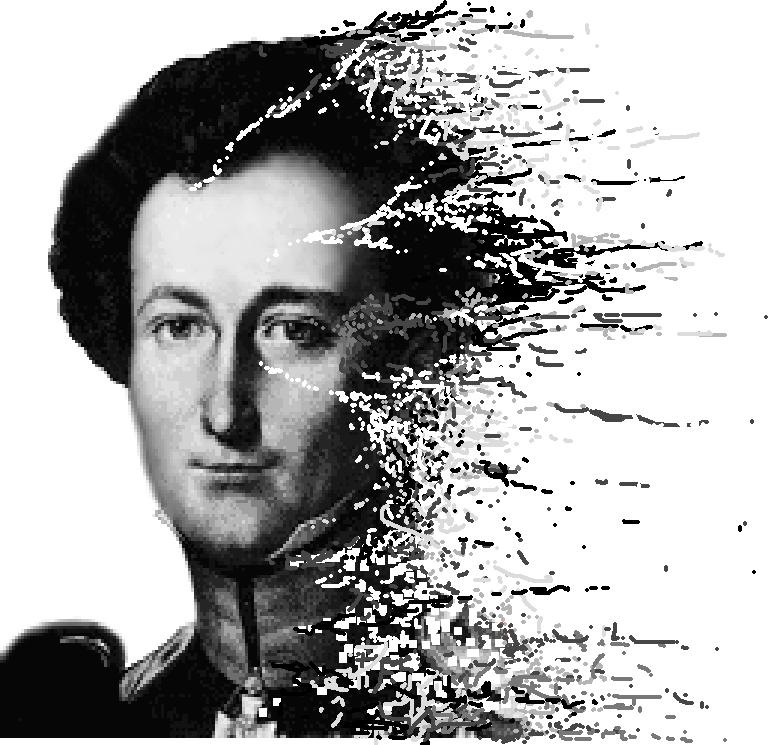
On War by Carl von Clausewitz has been the most influential book on strategy and war of all time.
We can say this because On War is the standard by which all other works of strategy are measured and only a few compared – notably Sun Tzu’s Art of War and The Peloponnesian War by Thucydides. The odd thing is that we can say this despite the fact that On War is more frequently shelved, cited or understood secondhand rather than read, even by military professionals. And furthermore, within the narrow demographic that reads Clausewitz seriously and critically, there can be heated dispute over what he meant, due to the difficulty of the text. Then there are the secondary effects, historical and military, of Clausewitz having been misunderstood, forgotten, ignored or at times, his strategic philosphy consciously rejected.
The shadow cast by On War is all the more remarkable given it’s circumstances of publication. Clausewitz died in 1831, at fifty-one, of 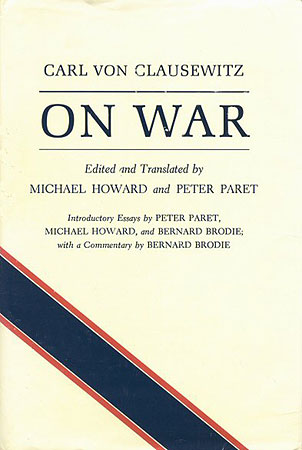 cholera, having finally risen to a military post his talents merited. He had been writing On War since 1816 and it was far from completed or refined to his satisfaction and it is highly unlikely, in my view, that Clausewitz would have consented to it’s publication in the condition in which he left it. His determined and intellectually formidible widow, Marie von Clausewitz, further shaped the manuscript of On War, guided by her intimate knowledge of her husband’s ideas and was likely the best editor Clausewitz could have posthumously had.
Nevertheless, to my mind On War remains a magnificent unfinished symphony.
What would On War have looked like if Clausewitz had lived another twenty-five or thirty some years? Assuming continued good health, Clausewitz would have seen, perhaps commanded in, the First Schleswig War and at least studied the Crimean War from afar. He would have had another quarter-century of reading and mature reflection on his subject. Clausewitz, who had a keen understanding of history, would have also witnessed the grand European upheaval of liberal revolution in 1848 that rocked the Hohenzollern monarchy to it’s core. What new insights might Clausewitz have gleaned or expanded upon? Would his later chapters On War have evolved to equal the first?
Having outlived Marie (who died in 1836), would Clausewitz have become a deeply changed man?
What I find it difficult to believe is that Clausewitz, with his creatively driven and philosophically exacting mind, would have been content to let the manuscript of On War rest where it stood in 1831. Or that we read today what Carl von Clausewitz ultimately intended.
Posted in 19th century, academia, analytic, book, Clausewitz Roundtable, Clausewitzian, counterintuitive, creativity, Evolution, history, ideas, intellectuals, literature, logic, military, military history, philosophy, Questions, reading, strategist, strategy, Strategy and War, theory, war, warriors, Writing | 9 Comments »
Sunday, October 30th, 2011
This SSI monograph by Dr. Andrew Mumford should stir some robust debate in the COIN community:
Puncturing the Counterinsurgency Myth: Britain and Irregular Warfare in the Past, Present, and Future
Most of Mumford’s points are valid criticisms but I need to quibble with Myth # 1 The British Military is an Effective Learning Institution:
MYTH #1: THE BRITISH MILITARY IS AN EFFECTIVE LEARNING INSTITUTION
According to John Nagl, the British succeeded in Malaya-in contrast to the American failure in Vietnam-because the British army had an organizational culture akin to a so-called “learning institution,” whereby the army quickly adapted to COIN conditions and changed tactics accordingly.2 The array of operational activity, ranging from limited to total war, that the British army has experienced has arguably led to a greater degree of pragmatism in its military outlook. A dogmatic adherence to rigid military doctrine has been absent, which, when compared to the generation-long postmortem on the failure of U.S. strategy in Vietnam, perhaps explains more than most other factors why an almost mythic reputation has descended upon the British. However, this does not explain, nor should it obscure, the languid application of appropriate irregular warfare tactics and the absence of swift strategic design. When it comes to COIN, the British are slow learners.
The early phases of nearly every campaign in the classical era were marred by stagnancy, mismanagement, and confusion. The military was 2 years into the Malayan Emergency before it conceived of a cohesive civil-military strategy in the form of the Briggs Plan. The crucial early years of the troubles in Northern Ireland were marked by displays of indiscriminate force and an inability to modulate the response.3
The Director of the United Kingdom (UK) Defence Academy also concedes that, in relation to Northern Ireland, “[I]t is easy in the light of the later success . . . to forget the early mistakes and the time it took to rectify them.”4 As Lieutenant General Sir John Kiszely rightly observes, the Malayan Emergency was, “a much lauded counterinsurgency campaign, but often overlooked is the fact that in the early years . . . the British Army achieved very little success.” In COIN terms, therefore, the British have been consistently slow to implement an effective strategy and achieve operational success. Moreover, the vast body of campaign experience has not translated into a cogent COIN lesson-learning process within the British military. The very need to re-learn COIN in the post-September 11, 2001 (9/11) conflict environment has undermined assertions as to the British military’s being an effective learning institution. Such amnesia has created an imperative for the armed forces now to hone their lesson-learning abilities while simultaneously adapting to the intricate challenges of sub-state and transnational post-Maoist insurgent violence in the third millennium.
What sort of time frame is reasonable for “organizational learning” – that is, transforming a large, hierarchical, bureaucratic entity’s conceptualization and understanding of a situation and reforming and adapting it’s practices in light of experience? How fast can this really happen? An org is not an individual, two years while under fire does not seem slow to me. Am I missing something in Mumford’s argument?
Furthermore, I infer from the third paragraph that Mumford expects evidence of learning were for the Brits to have arrived in Basra good-to-go on COIN doctrine. Learning, whether in a person or org, is not represented by doctrine (lessons frozen in time) but rather a capacity to adapt to new circumstances. Mumford is on firmer ground criticizing British general officers for their blind assumption that they had all the answers on counterinsurgency while the ragtag Mahdi Army bullied and ran circles around British units.
A monograph worth reading.
Hat tip to Lexington Green and SWJ Blog)
Posted in 21st century, academia, analytic, army, britain, COIN, cold war, counterinsurgency, counterpoint, ideas, insurgency, intellectuals, military, military reform, myth, Perception, reform, SSI, strategy, Strategy and War, Tactics, war | 3 Comments »
Thursday, October 20th, 2011
Here is something for the learned readership to chew on.
As you are probably all aware, in the hard sciences it is common for research papers to be the product of large, multidiciplinary, teams with, for example, biochemists working with physicists, geneticists, bioinformatics experts, mathematicians and so on. In the social sciences and humanities, not so much. Traditional disciplinary boundaries and methodological conservatism often prevail or are even frequently the subject of heated disputes when someone begins to test the limits of academic culture
I’m not sure why this has to be so for any of us not punching the clock in an ivory tower.
The organizer of the Boyd & Beyond II Conference, Stan Coerr, a GS-15 Marine Corps, Colonel Marine Corps Reserve and Iraq combat veteran, several years ago, developed a very intriguing analytical outline of thirty years of Afghan War, which I recommend that you take a look at:
The Eagle and the Bear: First World Armies in Fourth World Insurgencies by Stan Coerr
the-eagle-and-the-bear-11.pdf
There are many potential verges for collaboration in this outline – by my count, useful insights can be drawn by from the following fields:
Military History
Strategic Studies
Security Studies
COIN Theory
Operational Design
Diplomatic History
Soviet Studies
Intelligence History
International Relations
Anthropology
Ethnography
Area Studies
Islamic Studies
Economics
Geopolitics
Military Geography
Network Theory
I’m sure that I have missed a few.
It would be interesting to crowdsource this doc a little and get a discussion started. Before I go off on a riff about our unlamented Soviet friends, take a look and opine on any section or the whole in the comments section.
Posted in 20th century, 4GW, academia, Afghanistan, America, analytic, COIN, cold war, Communism, consilience, counterinsurgency, cultural intelligence, culture, DIME, diplomatic history, empire, extremists, feedback, foreign policy, Geography, geopolitics, government, history, IC, ideas, insurgency, intellectuals, intelligence, international law, IO, islam.insurgency, islamic world, islamist, military, military history, national security, network theory, networks, non-state actors, pakistan, politics, primary loyalties, reader response, russia, security, social science, soviet union, state failure, strategy, Strategy and War, synthesis, Tactics, terrain, terrorism, theory, totalitarianism, transnational criminal organization, tribes, USMC, war, warriors | 19 Comments »
Friday, September 23rd, 2011
Received a tremendous amount of feedback on this topic, mostly offline, but also on twitter and on other sites. Interestingly, of the minority who are strongly disagreeing with me, they tend to have their own problems with R2P doctrine. The next installment should be up tomorrow evening. In the meantime, here are a few more posts:
Bruce Kesler at Maggie’s Farm:
R2P: Right To Protect or Right To Preen?
….Neither COIN nor R2P are strategies. Unlike COIN, however, which is a set of tactics that may be applicable in some circumstances in pursuit of strategic goals (even if those goals may be arguable), R2P doesn’t have any operational tactics. R2P is more a clarion call to action, including actions that are contrary to US laws or popular will, in pursuit of internationalist goals for global governing as defined by transnational elites.
Further, R2P is cloaked in humanitarian rhetoric that allows liberal elites to preen, displaying their caring feathers, regardless of their ignorance of the military, regardless of the cost-benefit to US national security, and regardless that it isn’t their children being sent into harm’s way.
Lastly, R2P is reactive, not prescriptive of avoiding future threats to US security as a strategy must be. Much the same coterie who want to raise R2P to dominance over US foreign and military policies are largely dismissive of severely hobbling US allies or hollowing our military.
A brutally succinct assessment.
Kesler, a veteran of the war in Vietnam and a former foreign policy analyst, is in sync here with many veterans whose experiences have made them skeptical of basing military intervention on grandiose idealism, along with the school of foreign policy realists. On the other hand, Anti-interventionists of all political stripes and backgrounds look askance at the assurance from R2Paternalistic advocates that enshrining R2P is not risky because such military interventions will be “rare” ( myself, I’d just like to see them done competently , in line with a coherent strategy, when the potential benefits significantly outweigh the costs).
Ken White, a respected senior voice at the Small Wars Council had this to say in an extended analysis of R2P in the comments section at SWJ Blog:
…. I’ll note that those whom Zenpundit rightly says will be “fired” will not be those who do the actual Protecting nor will they be the ones who pay the costs of such abject foolishness.
The R2P theory is the tip of an iceberg wherein the State — a State? — has overarching responsibility in all things and individuals have no responsibilities for them selves, indeed, no responsibility other than to act as the State directs. That is indeed monstrous.
In her paper linked by Zenpundit, Dr. Slaughter writes: “States can only govern effectively by actively cooperating with other states and by collectively reserving the power to intervene in other states’ affairs.” The first clause is possibly correct, the second is a road to unending warfare — quite simply, humans will not long tolerate it. I suggest that if that idea is applied to individuals, then I am endowed with the ability to get together with my neighbors and we can attack another neighbor whose only crime is to behave differently than do most of us. My suspicion is that will not work on several levels.
….She also writes: “The principal advantage is that subjecting government institutions directly to international obligations could buttress clean institutions against corrupt ones and rights-respecting institutions against their more oppressive counterparts.” Admirable. My question is what standard is applied to the determination of corruption and oppressiveness? What cultural norms are to be heeded and which are to be ignored? Who makes these determinations? If it is a collective decision, what precludes either mob rule or a ‘might makes right’ led possibly quite wrong determination…
Popular support for R2P may be inverse to the degree of public scrutiny the idea receives.
Posted in 20th century, academia, America, foreign policy, geopolitics, ideas, international law, kesler, military, national security, Slaughter, small wars council, small wars journal, strategy, Strategy and War, swj blog, Tactics, theory | 2 Comments »
Friday, September 9th, 2011
Uberstrategist, madcap academic and shadowy security consultant, Edward Luttwak gave a not entirely serious interview to Tablet (hat tip to Russ Wellen and Chirol):
Q&A: Edward Luttwak
Q: Are strategic minds nurtured through upbringing and education, or is the ability to think strategically an inborn gift, like mathematics?
It’s a gift like mathematics. The paradoxical logic of strategy contradicts the logic of everyday life, it goes against all normal definitions of intelligence we have. It only makes sense if you understand the dialectic. If you want peace, prepare for war. If you actively want war, disarm yourself, and then you’ll get war. Virile and martial elites understand that kind of thinking instinctively.
Q: Here’s an easily falsifiable statement, but there’s something in it that interests me and I want you to pick it apart. I would start with the moment when George W. Bush met Vladimir Putin and said, “I looked into his eyes and saw this was a man I could really trust.” So, my thesis is this: If you’re Vladimir Putin, and you rise to the top of this chaotic and brutal society after going through the KGB, you must be some kind of strategic genius with amazing survival skills, because the penalty for failure may be torture or death. This kind of Darwinian set-up exists in many countries around the world. What does it mean to be head of the security services in Egypt? It means that you had to betray your friends but only at the right time, and you had to survive many vicious predators who would have loved to kill you or torture you, or otherwise derail your career. By the time you become Vladimir Putin or Omar Suleiman, your ability to think ahead and analyze threats has been adequately tested.
By contrast, what does it take to become a U.S. Senator? You have to eat rubber chicken dinners, you have to impress some rich people who are generally pretty stupid about politics, and smile in TV commercials. The penalties for failure are hardly so dire. And so, American leadership generally sucks, and America is perennially in the position of being the sucker in the global poker game. That’s the thesis. So, tell me why it’s wrong.
Even if your analysis is totally correct, your conclusion is wrong. Think about what it means to work for a Putin, whose  natural approach to any problem is deception. For example, he had an affair with this athlete, a gymnast, and he went through two phases. Phase one: He concealed it from his wife. Phase two: He launched a public campaign showing himself to be a macho man. He had photographs of him shooting a rifle, and as a Judo champion, and therefore had the news leaked that he was having an affair. Not only an affair with a young woman, but a gymnast, an athlete. Obviously such a person is much more wily and cunning and able to handle conflict than his American counterpart. But when such a person is the head of a department, the whole department is actually paralyzed and they are all reduced to serfs and valets. Therefore, what gets applied to a problem is only the wisdom of the aforementioned wily head of the department. All the other talent is wasted, all the other knowledge is wasted.
Now you have a choice: You can have a non-wily head of a department and the collective knowledge and wisdom of the whole department, or else you can have a wily head and zero functioning. And that is how the Russian government is currently working. Putin and Medvedev have very little control of the Russian bureaucracy. When you want to deal with them, and I dealt with them this morning, they act in very uncooperative, cagey, and deceptive ways because they are first of all trying to protect their security and stability and benefits from their boss. They have to deceive you because they are deceiving their boss before he even shows up to work. And they are all running little games. So, that’s the alternative. You can have a wily Putin and a stupid government. Or an intelligent government and an innocent head. There’s always is a trade-off. A Putin cannot be an inspiring leader. […]
Luttwak is interesting because he couples analytical smarts with bluntness and creativity. When someone in public life is less stellar than their position would indicate, Luttwak will say it. He will also tackle problems from unusual starting points, a good strategy for generating bursts of insight. It also generates weird, off-the-wall tangential observations. Small price to pay.
Posted in strategist, strategy, Strategy and War | 5 Comments »


