zenpundit.com » Religion

Archive for the ‘Religion’ Category

Boko Haram: religious vs social war

Wednesday, June 27th, 2012

[ by Charles Cameron — follow up to Taliban: religiosity vs pragmatism ]
.

Sen. Ita Solomon Enang, Chairman of Nigeria’s Senate Committee on Business and Rules, recently responded to a press question about Boko Haram, in an interview published under the curious title, Boko Haram war more religious than social — Engang:

Q: Previously you said Boko Haram attacks were not targeted at Christians but with the consistent attacks on worshippers in churches, have you not changed your mind and how do you think this problem can be dealt with?

A: Unfortunately, I held a position that it is not a religious war in the past. But my position on that is becoming shaky because when people now blatantly take guns to churches and aim at unarmed worshippers, kill them and go away; or they take a bomb to the church and detonate it there, I would say this is like a jihad and I think we should stop behaving like ostriches. I think that the sooner we accept it as a religious war, the better we will be able to handle it.

**

I keep circling around this central point. Much of interest and concern in today’s world revolves around the manner in which politics and religion are separable, braided together, or inseparable…


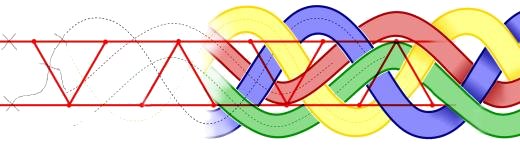
image credit: Christian Mercat, under GNU license v 1.2 — see documentation.
What does it mean for a war to be a religious war, or — to avoid the complexities that defining war bring into the picture while substituting the equivalent complexities attendant on the word violence — for violence to be religious violence?

  • Do both sides have to fight a religious war for it to be religious?
  • Can individuals perform acts of religious violence within a war that is not itself religious?

In some ways the issue parallels the one raised by Zen today in a quote from Colin Gray:

It is not sensible to categorize wars according to the believed predominant combat style of one of the belligerents. Guerrilla-style warfare is potentially universal and, on the historical evidence, for excellent reasons has been a favored military method of the weaker combatant eternally. There are no such historical phenomena as guerrilla wars. Rather, there have been countless wars wherein guerrilla tactics have been employed, sometimes by both sides. To define a war according to a tactical style is about as foolish as definition according to weaponry. For example, it is not conducive of understanding to conceive of tank warfare when the subject of interest is warfare with tanks and so forth, typically, if not quite always, in the context of combined arms.

Zen’s response to Gray:

Gray is correct that many wars partake of a blend of tactical fighting styles or that most wars are better defined (or at least should be in terms of causation) by their political character. That said, a specific fighting style sometimes is a definitive descriptive characteristic of a war, particularly if a dominant tactical style explains one side’s consistent comparative advantage (ex. the Macedonian phalanx vs. the Persians) in battle and some of the resultant choices which were forced upon the adversary.

**

We have a sort of Venn-diagram-in-words possibility: religiopolitical — but it’s really little more than a sop to the fact that religion and politics are at time closely woven. The religiosity of voiolence, and for that matter the violence of religiosity — these are things that wax and wane, shifting sands — they don’t always stay still long enough for us to box them in words, to reify them, to treat them as easily discernible and manipulable mental objects.

That said, to paraphrase Zen, “a specific religious style sometimes is a definitive descriptive characteristic of a war…”

Our understanding may be shifting and nuanced, but the briefs and executive summaries that decision-makers receive, the soundbites they articulate (can one articulate a soundbite?), and the headlines that preach their doctrines to the wide world — these use a given word or they don’t.

Let me turn that around: the briefs and executive summaries that decision-makers receive, the soundbites they articulate, and the headlines that preach their doctrines to the wide world inevitably either use a given word, or they don’t. And yet a realistic understanding of the given situation will be no less inevitably shifting and nuanced…

I feel very timid dipping a toe into Boyd in present company, but a fighter-pilot is a one-person observer, orienter, decider and actor, no? with a loop measured in fractions of seconds, not months? — whereas between intelligence gathering, strategic orientation, policy-making, and diplomatic or military action there are a multitude of communications channels — many of which function as shears that trim nuance down to the nub.

I suspect that questions like “is this a religious war?” and “is this guerrilla war?” carry (at a minimum) book-length subtleties with them, and wind up all too often with answers which are either yes or no, one or zero.

**

It’s all a bit like asking, “what game is this war we’re playing?”

One senior US official in Iraq was quoted by Anthony Cordesman as saying:

the current situation is like playing three dimensional chess in the dark while someone is shooting at you.

Tom Barnett, in The Pentagon’s New Map:

It is not chess but something closer to soccer. The ball is always moving, and substitutions are constantly changing the composition of both your team and your enemy’s. But worse still, your political leadership’s definition of the “problem” you are trying to solve keeps changing, making your attempts to keep score almost meaningless. You want to know what today’s definition of the problem is? Try reading the op-ed pages; you will have plenty to choose from.

John Arquilla and David Ronfeldt:

Major transformations are thus coming in the nature of adversaries, in the type of threats they may pose and in how conflicts can be waged. Information-age threats are likely to be more diffuse, dispersed, multidimensional nonlinear and ambiguous than industrial-age threats. Metaphorically, then, future conflicts may resemble the Oriental game of Go more than the Western game of chess. The conflict spectrum will be remolded from end to end by these dynamics.

As I noted recently, Alasdair MacIntyre wrote, about the complexity of contemporary life in general:

Not one game is being played, but several, and, if the game metaphor may be stretched further, the problem about real life is that moving one’s knight to QB3 may always be replied to by a lob over the net

When it comes time to think, there are only so many metaphor-boxes to fit your nuances into. You pays your money, and you takes your choice.

Not Morsi but Mahdi

Tuesday, June 26th, 2012

[ by Charles Cameron — Egyptian presidency, Mahdist candidate, Center for Millennial Studies, Christ candidate ]
.


Source.
.

I ran across this reasonably remarkable web image while following a link from the tail end of Tim Furnish‘s comments on the Egyptian presidential election, and can’t really comment on the candidate himself, either as Mahdi-claimant or as (failed) aspirant to the Presidency.

I am, however, put in mind of my days with the Center for Millennial Studies at Boston University, and a fellow I met at one of their conferences there called Chris King. But I’ll let another friend of mine from those days make the introduction — here’s Damian Thompson, writing in the Daily Telegraph a while back:

I spent the evening of December 31, 1999, climbing up the Mount of Olives, only to be confronted by a wild-haired messiah figure in a patchwork robe walking down the slope. That was surprising enough, but my jaw really dropped open when he said: “Hi, Damian.” Turned out we’d met a few weeks earlier, at a conference organised by the Center for Millennial Studies in Boston. The “messiah” was a Kiwi maths lecturer called Chris King, which he explained also meant “Christ the King”, though only in a complex esoteric way. (He was a lovely guy, actually.)

Chris King was, as Damian reports, both a likeable guy and an academic, and what I found most appealing about his self-presentation — beyond the very fact of his turning up to attend a conference on Millennial Studies — was that his view, essentially a gnostic one, was that we are all Christs in potentia, if we would but realize it… wait for it…

and his consequent request that his claim to messianic status should be peer-reviewed!

One bead for a rosary

Friday, June 22nd, 2012

[ by Charles Cameron — one bead from NASA for the glass bead game as rosary ]
.


photo credit: Norman Kuring, NASA’s Goddard Space Flight Center
.

Consider her sacred, treat her with care.

Video clips I: Torah, Theonomy, Sharia?

Saturday, June 16th, 2012

[ by Charles Cameron — religious law espoused in Judaism, Christianity and Islam ]
.

I came across this first video, featuring Dov Lior, Chief Rabbi of the Kiryat Arba settlement outside Hebron, yesterday, and thought it would be worthwhile to seek out companion pieces proposing divinely sanctioned legal systems in the two other Abrahamic traditions:

There are naturally differences as well as similarities between the three messages and the relative levels of influence of their respective messengers. A scholar of comparative religion might be concerned with their selections of canonical texts to enforce and the techniques of interpretation variously applied to them, an historian might compare our second speaker, the Chalcedon Institute’s (late) RJ Rushdoony‘s view of the applicability of Biblical law with that of Calvin in Geneva, a strategist consider the groundswells of popular opinion attaching to each of these speakers, their political and military potentials…

All three speakers claim that law should be based on a divinely authored and thus authoritative text — but the books so considered differ. Anjem Choudary, the third speaker, brings vividly to mind the impact that such doctrines can have on those who do not share his religious convictions when he proposes that Buckingham Palace could become a mosque…

I think it important to be aware that such men exist, and have followings. There are members of all three religions that I count as friends, events of horrific, divinely sanctioned violence in the histories of all three religions, and figures in the history of each religion from whom I take inspiration. I would not wish to live in a land where any one of these three men wielded power, and I do not believe that any one of them is fully representative of the grand sweep of his own tradition.

My intent in posting these three videos is to inform, not to inflame, and I invite you to view them in that spirit.

Crucifixion and Resurrection, ancient and modern

Wednesday, April 18th, 2012

[ by Charles Cameron — religious resonances of the Tupac video, from the Drachenloch cave bears to today ]
.

1.

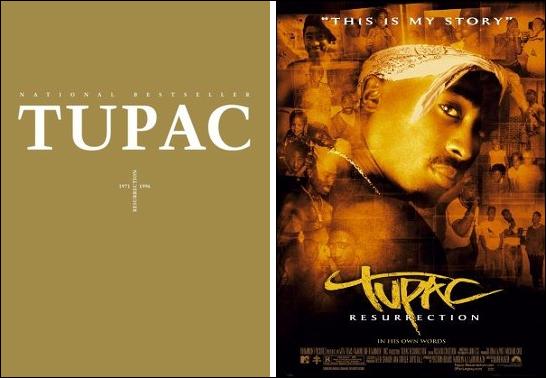
As the 2006 book and DVD covers above suggest, the themes of crucifixion and resurrection have been associated with Tupac Shakur for a while.

R.N. Bradley blogs at Red Clay Scholar and is a doctoral candidate in African American Literature and Culture at Florida State University. She makes the same connection clear in a post titled Smilin’ Serpent: the Violent Passion of Tupac Shakur on September 13, 2010:

Projects revealed Shakur’s pseudo-schizophrenic obsession with death and resurrection. These tropes manifested in videos like “I Ain’t Mad Atcha” or the collabo featuring Scarface “Smile,” and the coverart of The Don Illuminati: the 7 Day Theory(1996).

2.

Death comes before resurrection: Tupac Shakur died of gunshot wounds in 1996, after completing his final album, Makaveli — which was posthumously released:

3.

What may be more surprising is that he was brought back to something approximating life — in a holographic performance that included a duet with a decidedly non-holographic Snoop Dogg— just this week…

4.

But then, that’s religion.

Time-bound, mortal and frankly disintegrating as we are, we’d like there to be more to the story after death, and that yearning is something that religion addresses.

Perhaps to get the point across in an interesting way you’ll allow me to quote from a move in a game I played some years back:

Exploring the Drachenloch cave in Switzerland, Emil Bachler found cave bear skulls arranged in wall niches in one part of the cave, and stone tombs in another chamber containing cave bear skulls and bones. Ursus spelaeus, the cave bear, has now been extinct 10,000 years, while the Neanderthal inhabitants of the caves appear to have ceased as a species themselves about 40,000 years ago.

In Shepard and Sanders’ book, The Sacred Paw, which deals with both the natural history of the bear and its appearances in myth and ritual, Bachler surmises that his finds provide “the first evidence in man of an already awakened higher spiritual life.”

But why the bear in particular? What could we learn from the bear that we couldn’t learn anywhere else? Shepard and Sanders’ answer is that the bear seemed able to teach us how to survive bodily death. Hibernation isn’t just a “natural” phenomenon — it’s also a “spiritual” revelation… I’ll let them explain in their own words:

The bear, more than any other teacher, gave an answer to the ultimate question… an astonishing, astounding, improbable answer, enacted rather than revealed. Its passage into the earth, winter’s death, and burial under the snow was like a punctuation in the round of life that would begin again with its emergence in the spring…

The miracle was double, for the bear burst out with young — birth and rebirth. Somehow the bear knew when to reenter the world again, emerging just ahead of the snowmelt, as though its very heat set the new year in motion… Clearly the bear was master of renewal and the wheel of the seasons.

The bear ‘knows’ about death and how to survive it… She is therefore seen by traditional peoples as a guide to the movement between worlds.

So the bear is not only the first shaman, s/he’s also the first dying and rising God, and the first divine “Mother and Child” — teaching us two things that are still at the heart of religion 40,000 years later: nativity and resurrection!

5.

Death and resurrection certainly date back quite a ways. Attis, Osiris and Odin are only a few of those thought to have died and been resurrected — and indeed the early Christian writer Justin Martyr confirms (In his First Apologia XXI), the similarities between Christian and pagan teachings when he writes:

In saying that the Word, who is the first offspring of God, was born for us without sexual union, as Jesus Christ our Teacher, and that he was crucified and died and after rising again ascended into heaven we introduce nothing new beyond those whom you call sons of Zeus. You know how many sons of Zeus the writers whom you honor speak of — Hermes, the hermeneutic Word and teacher of all; Asclepius, who was also a healer and after being struck by lightning ascended into heaven –as did Dionysus who was torn in pieces; Heracles, who to escape his torments threw himself into the fire; the Dioscuri born of Leda and Perseus of Danae; and Bellerophon…

6.

Here’s the video:

7.

Max Eddy, blogging at The Geeoksystem today, not only describes the technology used to bring Tupac back to artificial life, but gives us a feel for the event:

The Tupac Hologram put on an eerie performance. When it appeared, the crowd became noticeably quiet while the show continued so achingly aware of its strangeness. The CG simulacrum even declared “I’m a ghost” during a rendition of “Hail Mary.” The ghostly, semi-transparent image went on to do two more numbers – one opposite a likely perturbed Snoop Dogg – before, no kidding, dissolving into triangles in a blaze of otherworldly light.

He also gives us an overview of the endurance of the resurrection motif within the music biz. He writes:

While I must confess ignorance to the life and body of work of Tupac, the resurrection obsession is part and parcel of the music industry. We can get specific: Back in 1995, the surviving Beatles recorded two new tracks along with unreleased demos recorded by John Lennon in 1977. Lennon had been dead since 1980. For his 75th birthday in 2010, Elvis Presley netted $60 million despite having been dead since 1977. Deceased in 2004, Ol’ Dirty Bastard still managed to appear on 2009?s “Blackroc,” a rap album put together by the Black Keys.

Though resurrections are a phenomenon that is particularly common in the music industry, it’s notable that CG recreations of dead actors haven’t broken into mainstream film. Perhaps it’s because fooling the ear is easier than fooling the eye.

Posthumous musical careers are clearly not unique to Tupac, but Shakur’s has been particularly lively. Since his death, seven albums have been released under the rapper’s name. For Forbes’ 2002 edition of the magazine’s annual list of top-earning dead celebrities, Shakur came in at number ten. A 2003 documentary about Shakur’s life, titled Tupac: Resurrection, was narrated entirely by Shakur. From 1997 on, Shakur has made 49 guest “appearances” on the tracks of other recording artists.

All of this is not to mention the rumors held by some ardent fans that Shakur is, in fact, still alive and in hiding somewhere.

8.

I don’t know whether this image is taken from an early archaeological report on the Drachenloch caves, or is just a reconstruction of what those first bear-altars with their carefully arrange skulls and bones might have looked like. I don’t really know if the dying-and-rising-god meme has been overblown or not — or the circumpolar bear cult for that matter.

But bears hibernating and coming back to life, Attis and Adonis, Christ, Arthur, the Once and Future King, more recently, Elvis sightings — and now Tupac coming back, as a hologram — it makes me wonder.

9.

I’ll give Max Eddy the final word:

When a singer is on stage, he or she is mostly their celebrity, with their humanity tucked safely away for later. At home, they are someone else, but on stage they fill a role assigned to them by their fans and perhaps by themselves. Some take it to an extreme – Ozzy bit the head off a bat. For others, it’s subtle – Roy Orbison’s dark glasses, for instance.

Unlike them, the Tupac Hologram has no humanity; it is only celebrity. The Tupac Hologram will not go home and read Shakespeare, as Shakur did. The Tupac Hologram will not make controversial political statements. The Tupac Hologram will not visit Tupac’s mother, Afeni Shakur Davis. The Tupac Hologram is empty, and we made it.

[ … ]

When we look into the Tupac Hologram, we see ourselves reflected brightly on a thin Mylar screen.

_________________________________________________________________________________________________________
A hat tip to Doug Breitbart, for suggesting I check out the Tupac video and nudging me along the way. The details of Crucifixion and Resurrection are from the superlative Isenheim Altarpiece by Matthias Grunewald (ca. 1510).


Switch to our mobile site