zenpundit.com » social science

Archive for the ‘social science’ Category

Broke Down and Bought

Wednesday, January 12th, 2011

Grand Strategies: Literature, Statecraft, and World Order by Charles Hill

Heard way too many good things about this book from regular commenters like Scott Shipman (read his review here) to ignore it. The blurbs on the dust jacket are from some genuine heavyweights (and provoked an amusing academic political tantrum masquerading as a review  in FP.com from some minor departmental nemesis of Hill’s at Yale, where Hill is one of the founding lecturers of their Grand Strategy Program).

I will upjump this in my antilibrary queue to be read after I finish with Luttwak.

An Iridology of the Sciences?

Tuesday, January 4th, 2011

[ by Charles Cameron ]

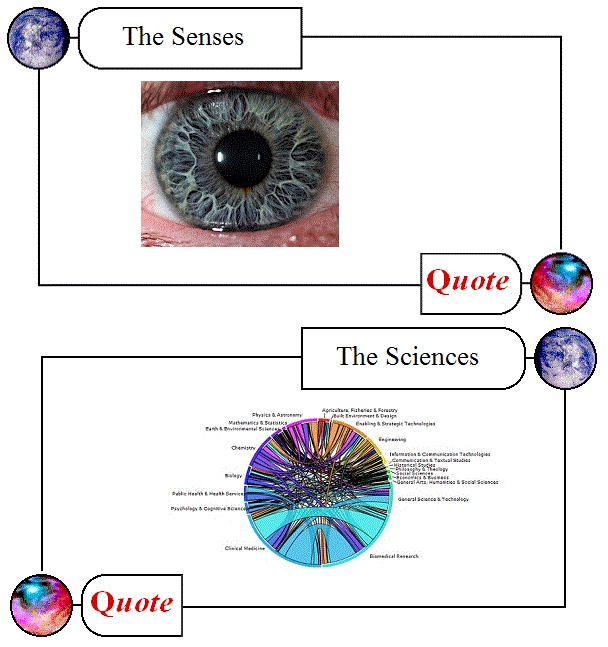
I for one am delighted to know that we can now play around with the iridology of the sciences, using the software available on the Science-Metrix Ontology Explorer site to view which fields have journals which cross-link to journals in other fields…

Seriously — that lower image is of the Field Citation Wheel that you can find, suitably enlarged for easy viewing, on that site.

*

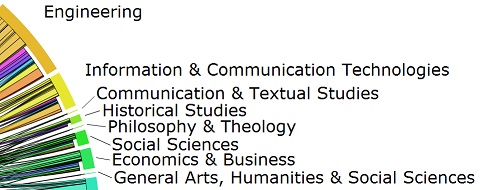
And it’s heartening for me to know, for instance — taking a closer look at the segment of that image that’s roughly east north-east — that scientific journals do have some links on their pages to works of theology or philosophy:


Engineering
, you’ll notice, has more links than history, philosophy, theology, the social sciences (even counting them twice), economics, business, the arts and humanities combined.

My own field, theology, has to share its thin segment with philosophy, and you can guess how small the number of links to articles on Islamic apocalyptic probably are…

Which is, in part, why I wonder whether a project like the ETH’s Living Earth Simulator will really manage to map such things as, well, a possible outbreak of global jihadist Mahdism and its consequences.

*

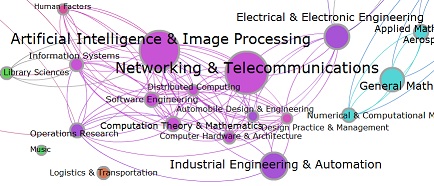
But then I look at another gorgeous graphic from the same source, focusing in on a part of the network of knowledge that interests me, and I can just faintly make out, lower left, entirely isolated, the field of music

What splendid isolation! That’s all of Bach, mind you – and all the Beatles, too.

*

Seriously, though:

  • It’s fascinating to be able to see how the various branches of knowledge cross-reference each other.
  • Visual data representation is a gorgeous, fantastic, field.
  • Mapping the all-of-everything is an irresistable lure for keen minds
  • I’m betting the humanities will prove to be at least as good at it as the sciences.
  • And I recall, not without a pang of regret, the time when my beloved Theology was Queen of the Sciences, and one might converse with Abelard on the streets of Paris…

A Clausewitzian on “Cohesion”

Thursday, December 30th, 2010

Long time ZP readers are probably familiar with seydlitz89, a dedicated Clausewitzian and retired former military officer who comments here occasionally and blogs at Milpub regularly. I first read seydlitz89 at Dr. Chet Richards’ late, great, DNI site and seydlitz89 went on to participate in two extensive events at Chicago Boyz, the Clausewitz Roundtable and the Xenophon Roundtable and also had some of his more extensive writings featured on Clausewitz.com.

I would like to draw attention to one of those articles and seydlitz89’s focus on Clausewtz’s concept of “cohesion” and an implicit “theory of political development”. I am going to excerpt for my own purposes, but suggest that you read seydlitz89’s argument in full:

The Clausewitzian Concept of Cohesion as a Theory of Political Development

….The concept of cohesion comes up in various forms in On War and to lesser extent in Clausewitz’s other writings.   These forms of the overall concept include:

  • Cohesion as the moral (think tribalism, nationalism) and material (think constitution, institutions, shared views of how to define “civilization”) elements that make up the communal/social organizations of political communities, as exemplified in the three ideal types discussed below. Moral cohesion can be seen as the traditional communal values of a political community, what values and motivations guide people in their actions with family, friends and neighbours, whereas material cohesion are the modern cosmopolitan values associated with society or those social actions associated with institutions of various types. The two types exist is a certain state of constant stress and tension with modern values actually being destructive to the retention of traditional values (following Weber). Cohesion here is Clausewitz’s theory of politics which also includes the abstract concept of money. (Book VIII, Chapter 3B & the essay titled “Agitation”)
  • Cohesion provides the process behind which the center of gravities of both participants in a conventional war are formed. Lack of a center of gravity would indicate the inability to win decisively, which would include the target of conventional militaries committed to unconventional/guerrilla warfare. (Book VI, Chapter 27, Book VIII, Chapter 4)
  • Cohesion is the target of strategy in that tactical success is extended by strategic pursuit in order to expand the sphere of victory and bring about the disintegration of the enemy. Cohesion links the whole sequence of decisions (contingency) that allows the political purpose to be achieved through the means of the attained military goal, that is cohesion provides the chain of decisions/outcomes that unite political purpose with strategy and strategy with tactics, or vice versa. (Books II, IV, & Book VI Chapter 8)
  • Cohesion acts within the balance of power among various states – especially in terms of interests – with an aggressor having to contend with all the other states having an interest in maintaining the status quo. This would include the tendency for Clausewitz of a potential hegemon to fail in its attempt to dominate other peer states. (Book VI Chapter 6)
  • Cohesion can also be seen has having an influence in the varying states of balance, tension and movement through which all conflicts proceed. The cohesion (moral and material forces, willingness to take risks, soundness of the military aim in connection with the political purpose, etc) of each side being relatively equal while in balance, but increasing on one side during tension until a release of the tension (attack) and decreasing again during movement until balance is once again achieved or the conflict ends. (Book III, Chapter 18)
  • At the most abstract level the concept of cohesion could be seen as providing the unifying concept which maintains the various elements (the remarkable trinity and the operating principles) of Clausewitz’s general theory as part of a whole, the fields of attraction and tension that provide the general theory with its dynamic quality. (Book I Chapter 1)

Thus cohesion can be seen as a very broad concept, but for my purpose I am using only the first point listed above. 

and later:

….The third type of theory I wish to mention is what I refer to as Clausewitz’s theory of politics, or maybe more accurately, a theory of political development, which I see as inseparable from his concept of cohesion as I described in point one above in discussing the various forms of cohesion. 

For our purposes here we are interested in Clausewitz’s concept of cohesion as it pertains to this first point, the physical and moral cohesive elements of political communities, how cohesion acts in effect as a sliding scale of ever increasing (or deceasing) concentration, integration and organization of a political community. 

This is a very useful elucidation by seydlitz89, regardless if one favors Clausewitz or Sun Tzu or is altogether indifferent to military-strategic concerns and are more interested in broad questions of political philosophy and social policy.

Furthermore, I think Clausewitz’s speculations on cohesion were, like many of his systemic perceptions in On War, remarkably farsighted and intuitively rooted in a scientific reality that was unknown and untestable in his day. The conservative and eponymous scholar, Paul Johnson noted in his book Birth of the Modern that the 1820’s represented a time of great intellectual ferment when the arts, humanities and sciences were not yet compartmentalized, professionalized and estranged from one another. To paraphrase Johnson, it was still an era when a scientist like Faraday and an artist ( probably Harriet Jane Moore) could and did have a productive conversation about the properties of light in complete seriousness. As an intellectual, Clausewitz shared that zeitgeist.

In a military frame of reference,  the concept of “cohesion” brings to mind the Greek-Macedonian Phalanx as a representative example

but the phenomena appears not merely in military tactics or in human social relations but throughout the animal kingdom. Howard Bloom, the popular science writer using a sociobiological perspective, used “Spartanism” and “Phalanx” as metaphors for documented behaviors of creatures as disparate as bacteria, baboons and hard shell Baptists. “Groups under threat, constrict” Bloom wrote in Global Brain and this characteristic of cohesion appears to apply even when the groups are not sentient. Network theorists and scientists can explain collective behavior in terms of “strong” and “weak” ties, nodes and hubs and resilience, including emergent behavior of systems are not even alive.

Cohesion is an aspect of the natural world.

Follow-up: Martyrdom, messianism and Julian Assange

Friday, December 24th, 2010

[ by Charles Cameron ]

This is a follow-up to my earlier post on Zenpundit and ChicagoBoyz, picking up on some comments made on both sites, explaining my own interests, and taking the inquiry a little further.

On Zenpundit, Larry said, “Your need to destroy Assange is getting embarrassing. Why not make lemonaid?” and JN Kish, “The real story here should be about the data – and who is helping Assange – not Assange himself.” Meanwhile on ChicagoBoyz, a certain Gerald Attrick commented, “Ah, but as we say in in art crit: Deal with the Art and not the Man…”

To Larry I would say, I think that my post WikiLeaks: Counterpoint at the State Department? — in which I point up the irony inherent in the same State Department spokesman celebrating World Press Freedom Day and chiding Assange for “providing a targeting list to a group like al-Qaida” on the same day — could as easily be read as pro-Assange as today’s post, Martyrdom, messianism and Julian Assange can be read as calling for his destruction.

More generally, it seems to me that there are a whole lot of stories to be told here: the ones I wish to tell are those where I have a reasonably informed “nose” for relevant detail, and which tend to be overlooked by others — and thus have the potential to blindside us.

*

My own main interest is in tracking religious, mythic and apocalyptic themes in contemporary affairs, where they are all too easily overlooked, misunderstood or dismissed. Thus I have posted on Tracking the Mahdi on WikiLeaks, and added related material in section 1 of my post today.

I am also interested in concept mapping, games and creative thinking — interests which led me to post WikiLeaks: Critical Foreign Dependencies and The WikiLeaks paradox, and more lightheartedly to take an amused sideways glance at WikiLeaks in The power of network visualization.

And I certainly find Assange himself an interesting figure, and have done what I can to illuminate his background in mythology, religion and games in Wikileaks and the Search for a Cryptographic Mythology, again in Update: Wikileaks and Cryptographic Mythology and (again light-heartedly) in A DoubleQuote for Anders.

*

Let me be more explicit: I have no wish to lionize Assange, nor to feed him to the lions — I would like to understand him a little better.

I come from a scholarly tradition that doesn’t favor the demonization of new religious movements, and believes (for instance) that it is entirely plausible that the Waco inferno could have been avoided if the religious beliefs of David Koresh and the Branch Davidians had been taken seriously as such, and not dismissed out of hand as “bible babble”.

James Tabor and Eugene Gallagher in Why Waco for instance, write:

The Waco situation could have been handled differently and possibly resolved peacefully. This is not unfounded speculation or wishful thinking. It is the considered opinion of the lawyers who spent the most time with the Davidians during the siege and of various scholars of religion who understand biblical apocalyptic belief systems such as that of the Branch Davidians. There was a way to communicate with these biblically oriented people, but it had nothing to do with hostage rescue or counterterrorist tactics. Indeed, such a strategy was being pursued, with FBI cooperation, by Phillip Arnold of the Reunion Institute in Houston and James Tabor of the University of North Carolina at Charlotte, one of the authors of this book. Arnold and Tabor worked in concert with the lawyers Dick DeGuerin and Jack Zimmerman, who spent a total of twenty hours inside the Mount Carmel center between March 29 and April 4, communicating directly with Koresh and his main spokesperson, Steve Schneider. Unfortunately, these attempts came too late. By the time they began to bear positive results, decisions had already been made in Washington to convince Attorney General Janet Reno to end the siege by force.

Jane Seminaire Docherty’s Learning Lessons from Waco, similarly, “offers a fresh perspective on the activities of law enforcement agents. She shows how the Waco conflict resulted from a collision of two distinct worldviews-the FBI’s and the Davidians’—and their divergent notions of reality. By exploring the failures of the negotiations, she also urges a better understanding of encounters between rising religious movements and dominant social institutions.” [Syracuse UP]

I’d therefore be hesitant to drag Assange into a somewhat murky association with the “cult milieu” – but Assange himself was quite open in talking with Raffi Khatchadourian of the New Yorker about the man his mother lived with and had a child by, then ran away from, after her marriage to Assange’s father broke up. Khatchadourian writes:

When I asked him about the experience, he told me that there was evidence that the man belonged to a powerful cult called the Family—its motto was “Unseen, Unknown, and Unheard.” Some members were doctors who persuaded mothers to give up their newborn children to the cult’s leader, Anne Hamilton-Byrne. The cult had moles in government, Assange suspected, who provided the musician with leads on Claire’s whereabouts.

Wikipedia’ has an account of that group, also known as the Santiniketan Park Association.

And as you might expect, there’s a bizarre and frankly conspiracist take on this connection already out and about on the web.

*

For a more detailed and indeed harrowing view of the Santiniketan Park Association from a member who left, see this excerpt from Sarah Moore’s book, Unseen, Unheard, Unknown.

A couple of odd remarks here strike me:

Some of us had multiple birth certificates and passports, and citizenship of more than one country. Only she knows why thus was and why we were also all dressed alike, why most of us even had our hair dyed identically blond.

The motto of the sect is ‘Unseen, Unheard and Unknown’, and even now the thought of the consequences of betraying that motto still worries me sometimes.

We weren’t often allowed to see newspapers, in fact that happened only after we were quite a bit older and even then they’d been censored .

and:

Looking back, I can see that any game or hobby that we started we would get hooked on, playing it over and over again in our limited spare time. If we got into a game or fantasy we tended to want to keep on with it and it assumed the utmost importance in our lives.

It might have appeared that we were obsessive kids but it was understandable considering the malevolent reality we faced outside our games. Usually Anne and the Aunties saw to it that as soon as we started enjoying ourselves, it was stopped, and a new rule would be made, forbidding us from playing that particular game. We would thus be forced to try and make up a new one within the boundaries of the rules that governed our lives, still knowing that eventually this new one would be banned also.

*

Speaking of “cults” – there are several WL cables that make reference to a cult or cults, generally in the context of a “cult of personality” (Mao, eg), and in one case with reference to Scientology. There’s also – and this where things get interesting from my POV — one intriguing reference to a cult in Iran:

Though stressing that he is not an opponent of the Islamic system, he warned that the Revolutionary Guard-based faction which “stole the election,” and is now seeking total control is “extremely dangerous to both us and you.” He repeatedly characterized this group as “a criminal cult,” motivated by its fanaticism, ignorance, and the monetary self-interest of its members. He added that the group is intent on exporting revolution. According to source, both Ahmedinejad and Ayatollah Mesbah-Yazdi are affiliates rather than “leaders” of this group, and neither will likely end up with significant power if the group successfully consolidates control over the state and its economy (see reftel).

A religious group of which “both Ahmedinejad and Ayatollah Mesbah-Yazdi are affiliates” sounds suspiciously like the Hojjatiyeh.

But that’s the topic for another upcoming post, I promise.

Now Reading Luttwak

Thursday, December 23rd, 2010

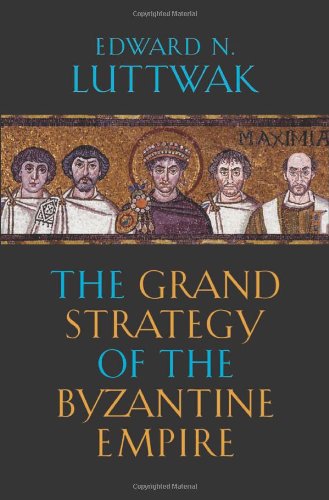
The Grand Strategy of the Byzantine Empire by Edward Luttwak

Just starting reading this magnum opus by eminent strategist Edward Luttwak and I am thoroughly enjoying it; particularly, the context-building historical digressions that enrich the text.  Highly recommended.


Switch to our mobile site