zenpundit.com » India

Archive for the ‘India’ Category

No man’s land, one man’s real estate, everyone’s dream?

Monday, August 17th, 2015

[ by Charles Cameron — borders and distinctions from Trump to Revelation, plus one ]
.

Donald Trump‘s “three core principles of real immigration reform”:

1. A nation without borders is not a nation.

**

G Spencer-Brown wrote of his book. Laws of Form, “The theme of this book is that a universe comes into being when a space is severed or taken apart” — or as Heinz Von Foerster rephrased him, “Draw a distinction and a universe comes into being”. Indeed, his book opens with the words:

We take as given the idea of distinction and the idea of indication, and that we cannot make an indication without drawing a distinction.

He writes:

Distinction is perfect continence.

That is to say, a distinction is drawn by arranging a boundary with separate sides so that a point on one side cannot reach the other side without crossing the boundary. For example in a plane a circle draws a distinction.

Similarly, Gregory Bateson defines an idea as “A difference or distinction or news of differences”.

**

Borders are both physical and metaphysical: the border between the physical and the metaphysical passes through human beings, who are themselves both metaphysical and physical.

Borders may thus be heeded or ignored.

Smugglers don’t necessarily ignore them, they may take them very seriously, as do those who police them. Birds, however, ignore them, fishes, lizards, languages..

There are would-be states that straddle national borders, as the Basque peoples straddle the border between France and Spain:
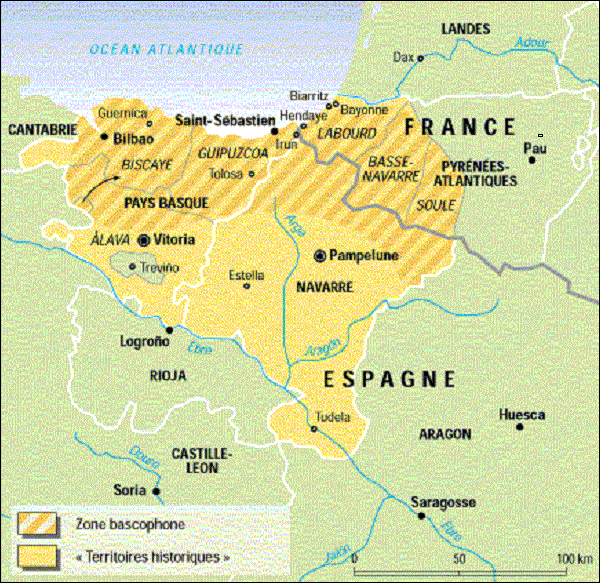
Basque France Spain 600

There are also would-be states that literally erase national borders, as in the case of IS bulldozing thw border between Iraq and Syria:
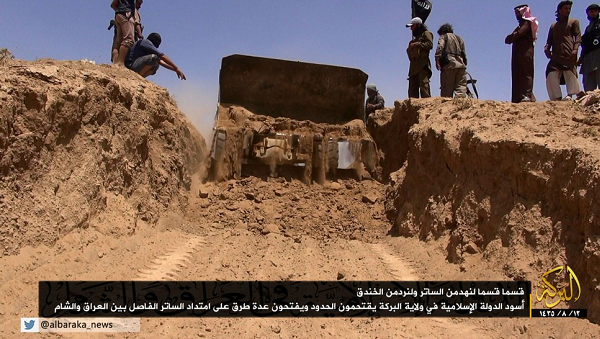
Iraq Syria Border 600

Thus while borders may be tidy in separating one from a second, they are also untidy in straddling them, neither one nor two, yet (like Janus) both.. They are, in short, thresholds, limina. And so wahat we know of liminality applies to them. I have discussed tthis previosuly on Zenpundit in Liminality II: the serious part — suffice it to say here that limiality is a condition that exacerbates, intensifies.

**

The anthropologist Mary Douglas, in her book Purity and Danger: An Analysis of Concepts of Pollution and Taboo, quotes Leviticus 19.19:

You shall keep my statutes. You shall not let your cattle breed with a different kind; you shall not sow your field with two kinds of seed; nor shall there come upon you a garment of cloth made of two kinds of stuff.

Why these disjunctions? Dougles notes the repeated refrain in just such contexts:

Ye shall therefore be holy, for I am holy

and points out that Ronald Knox correctly — if “rather thinly” — translates this:

I am set apart and you must be set apart like me

She then tells us:

Holiness means keeping distinct the categories of creation. It therefore involves correct definition, discrimination and order.

noting that:

The word ‘perversion’ is a significant mistranslation of the rare Hebrew word tebhel, which has as its meaning mixing or confusion.

and concludes

ideas about separating, purifying, demarcating and punishing transgressions have as their main function to impose system on an inherently untidy experience. It is only by exaggerating the difference between within and without, above and below, male and female, with and against, that a semblance of order is created.

**

The upper image, below, is taken from my recent post on Matrioshka cartography, and waas taken in turn from Say goodbye to the weirdest border dispute in the world in the Washington on August 1st..

SPEC DQ maps

… while the lower image is from Welcome to Liberland, the World’s Newest Country (Maybe) in the New York Times Magazine, dated Aug 11

**

Lydia Kiesling, in her post Letter of Recommendation: Uzbek in the NYT magazine today, writes:

National borders can be risibly at odds with reality, especially in Central Asia, where Turks, Mongols, Persians and others roved and mingled, where ‘‘Uzbek’’ was, for a time, more of a descriptive antonym of ‘‘Tajik’’ — no­­madic versus settled — than an ethnic classification.

And why not?

They are, after all, distinctions drawn in the mind, lines drawn on paper. Thus the Sykes-Picot map:

Sykes_Picot_Agreement_Map_signed_8_May_1916 600

Sykes was quite clear about the “lines dorawn on paper” part. He is reported to have said:

I should like to draw a line from the e in Acre to the last k in Kirkuk

The map, in other words, is not the territory: the map is a map.

To take another instance of importance in today’s world, the Durand Line:

Durand_Line_Border_Between_Afghanistan_And_Pakistan 600

Not only is the map not the territory in this case — it can be seen, as one-time Afghan president Hamid Karzai said, as “a line of hatred that raised a wall between the two brothers” — Afghanistan and Pakistan.

**

Sympathies which exist across borders can be potent forces for their dissolution. In a poem titled “Their Eyes Confer Fire” written in the 1980s about Basque country, I wrote

We have
little time,
Marie explained,
for those
who, because
it is hard
to draw
lines
across actual
mountains,
carve up
this earth on
paper.

France, Spain:
we disdain
boundaries, borders,
and border guards.

A canny reader noted that the entire poem could be read not as a description of the Basques as they exist in reality, but as a paean to the corpus callosum joining the two hemispheres of the brain — and thus the two modes of cognition of which I so recently wrote.

**

Returning to Lieberland, or Gornja Siga as the locals call it, we learn:

Gornja Siga has come, over the last few months, to assume an outsize role in the imagination of many — not only in Europe, but also in the Middle East and in the United States. Its mere existence as a land unburdened by deed or ruler has become cause for great jubilation. There are few things more uplifting than the promise that we might start over, that we might live in the early days of a better nation. All the most recent states — South Sudan, East Timor, Eritrea — were carved from existing sovereignties in the wake of bitter civil wars. Here, by contrast, is a truly empty parcel. What novel society might be accomplished in a place like this, with no national claim or tenant?

Consider one sentence alone as the key to that “outsize role in the imagination”:

There are few things more uplifting than the promise that we might start over, that we might live in the early days of a better nation.

The apocalyptic yearning here and its kinship with the Amrican dream are hard to miss — it is like a conflation of Matthew 5.14:

A city that is set on an hill cannot be hid.

with Revelation 21.1-2:

And I saw a new heaven and a new earth: for the first heaven and the first earth were passed away; and there was no more sea. And I John saw the holy city, new Jerusalem, coming down from God out of heaven, prepared as a bride adorned for her husband.

**

Plus:

Sunday surprise: on Matrioshka cartography

Monday, August 3rd, 2015

[ by Charles Cameron — an enclave within an enclave within an enclave within a state no more! ]
.

You know my obsession with form — and that one form of particular interest to me is the world within a world, the play within a play, or that potentially infinite regression of dolls we know as Matroshka?

Dahala Khagrabari

Dahala Khagrabari, the Washington Post informs us, was “a part of India, surrounded by a Bangladeshi enclave, which was surrounded by an Indian enclave, which was surrounded by Bangladesh”.

No more, it’s not.

India and Bangladesh have swapped out various enclaves, 160 of ’em in all, and Dahala Khagrabari is no longer “the only third-order enclave in the world – an enclave surrounded by an enclave surrounded by an enclave surrounded by another state.”

**

But all is not lost, nor won. At least for fictioneers, there still remain the Groaning Hinges of the World of which RA Lafferty informed us:

Eginhard wrote that the Hinges of the World are, the one of them in the Carnic Alps north of the Isarko and quite near High Glockner, and the other one in the Wangeroog in the Frisian islands off the Weser mouth and under the water of this shelf; and that these hinges are made of iron. It is the Germanies, the whole great country between these hinges that turns over, he wrote, after either a long generation or a short generation. The only indication of the turning over is a groaning of the World Hinges too brief to terrify. That which rises out of the Earth has the same appearance in mountains and rivers and towns and people as the land that it replaces.

We all know how dire the result can be when that happens.

**

Back to the enclaves — there’s a games angle there too. Again via the Washington Post:

Old stories say that the enclaves were the end result of a chess game between the Maharaja of Cooch Behar and the Faujdar of Rangpur many centuries ago, or the result of a drunk British colonial spilling ink on a map, both apocryphal stories but a good indication of how arbitrary the borders seemed.

Chess, a game of skill. Spilled ink, a game of chance. Is that what this post is? A game of virtual spilled ink?

Two new collections from Tim Furnish, plus two

Friday, July 31st, 2015

[ by Charles Cameron — a chance to have Tim Furnish’s recent writings in book form, plus a couple of recent apocalyptic issues bcoz apocalypse hasn’t gone away, oh no ]
.

Friend, blog friend and colleague Dr Tim Furnish recently tweeted:

I hope to review these two volumes of Tim’s essays here on Zenpundit.

**

Plus Two:

While we’re on the topic of apocalypse..

Sara A. Carter of the American Media Institute posted on the 28th on USA Today:

Islamic State recruitment document seeks to provoke ‘end of the world’

An apparent Islamic State recruitment document found in Pakistan’s lawless tribal lands reveals that the extremist group has grand ambitions of building a new terrorist army in Afghanistan and Pakistan, and triggering a war in India to provoke an Armageddon-like “end of the world.”

The 32-page Urdu-language document obtained by American Media Institute (AMI) and reviewed by USA TODAY details a plot to attack U.S. soldiers as they withdraw from Afghanistan and target American diplomats and Pakistani officials.

AMI obtained the document from a Pakistani citizen with connections inside the Pakistani Taliban and had it independently translated from Urdu by Harvard researcher and translator Mustafa Samdani. The Pakistani’s identity was shared with USA TODAY, which has agreed not to identify him publicly because of concerns for his safety.
The document was reviewed by three U.S. intelligence officials, who said they believe the document is authentic based on its unique markings and the fact that language used to describe leaders, the writing style and religious wording match other documents from the Islamic State, also known as ISIL and ISIS. They asked to remain anonymous because they are not authorized to discuss the matter publicly.

The undated document, titled “A Brief History of the Islamic State Caliphate (ISC), The Caliphate According to the Prophet,” seeks to unite dozens of factions of the Pakistani and Afghan Taliban into a single army of terror. It includes a never-before-seen history of the Islamic State, details chilling future battle plans, urges al-Qaeda to join the group and says the Islamic State’s leader should be recognized as the sole ruler of the world’s 1 billion Muslims under a religious empire called a “caliphate.”

“Accept the fact that this caliphate will survive and prosper until it takes over the entire world and beheads every last person that rebels against Allah,” it proclaims. “This is the bitter truth, swallow it.”

Retired Defense Intelligence Agency Director Lt. Gen. Michael Flynn, who also reviewed the document, said it “represents the Islamic State’s campaign plan and is something, as an intelligence officer, I would not only want to capture, but fully exploit. It lays out their intent, their goals and objectives, a red flag to which we must pay attention.”

That. friends, is the Ghazwa e-Hind, which we’ve been discussing on occasion here on Zenpundit for several years:

  • http://zenpundit.com/?p=4462
  • http://zenpundit.com/?p=12683
  • http://zenpundit.com/?p=12756
  • http://zenpundit.com/?p=20592
  • http://zenpundit.com/?p=31402
  • http://zenpundit.com/?p=44267
  • Look for Tim Furnish to have more to say about this document and its implications

    **

    And…

    from a Jewish source quoted and discussed in the Times of israel on March 11 this year — yes, I’m playing catch up here — comes an apocalyptic call for two nuclear attacks — with a specific reference to the coming of the Messiah in the final paragraph:

    Op-ed calls on Israel to nuke Germany, Iran<

    Right-wing media outlet Israel National News published an opinion piece Tuesday calling on Israel to launch nuclear bombs at Iran and Germany, only days after the outlet came under fire for publishing a piece accusing a war widow of killing her husband over her pro-peace views.

    In the opinion article published Tuesday, the author claims that only through nuclear annihilation of Iran and Germany, with 20 or 30 nuclear bombs each, can Israelis prevent the state’s destruction.

    “If Israel does not walk in the ways of God’s Bible,” author Chen Ben-Eliyahu wrote in Hebrew, “it will receive a heavy punishment of near complete destruction and doom and only a few will be saved.”

    One of Israel’s missions is to remember the crimes of Amalek, a tribe representative of pure evil in the Bible, whom Jews are commanded to obliterate. Among those descended from the band, the author writes, are Iranian leaders Ayatollah Ali Khamenei, former president Mahmoud Ahmadinejad and current President Hassan Rouhani.

    “They don’t miss an opportunity to discuss the need for the annihilation of Israel,” he wrote.

    To combat this Israel must respond in kind, Ben-Eliyahu declared. “To an existential threat we must respond with an existential threat,” he wrote, “not with speeches in Congress. We must make it clear to the Iranians that Israel will wipe out their nuclear program and Tehran and Isfahan as well.”

    “If [an enemy] rises up to destroy you, rise earlier to destroy him: twenty, thirty nuclear bombs will do to assure the job gets done,” he continued.

    He also called on the Jewish people to remember its near destruction at the hands of the Nazis and exact revenge on Germany, now a staunch ally of Israel.

    When the Messiah comes, Ben-Eliyahu wrote, Israel will reverse the Final Solution. “Twenty, thirty atomic bombs on Berlin, Munich, Hamburg, Nuremberg, Cologne, Frankfurt, Stuttgart, Dresden, Dortmund and so on to assure the job gets done. And the land will be quiet for a thousand years,” he wrote.

    Of note here: The phrase rendered here “If [an enemy] rises up to destroy you, rise earlier to destroy him” is not a remark of Ben-Eliyahu — he is quoting the Babylonian Talmud, Sanhedrin 72a:

    Im ba l’hargekha, hashkem l’hargo

    variously translated “If he come to slay thee, forestall by slaying him<" in the Soncino edition and more colloquially "If someone comes to kill you, rise up and kill him (first)" on the AJC site.

    My Pragati review of Stern & Berger’s ISIS: State of Terror

    Thursday, May 7th, 2015

    [ by Charles Cameron — in which the Islamic State is nicely viewed through the lens of WB Yeats ]
    .

    My review of Jessica Stern & JM Berger‘s book, ISIS: State of Terror, just came out in tbe Takshashila Institution‘s magazine, Pragati. Here’s a teaser..

    **

    Things fall apart, the centre cannot hold,
    Mere anarchy is loosed upon the world.
    The blood-dimmed tide is loosed, and everywhere
    The ceremony of innocence is drowned;
    The best lack all conviction, while the worst
    Are filled with passionate intensity.

    WB Yeats, The Second Coming

    In the closing pages of ISIS: the State of Terror, Jessica Stern and JM Berger quote Yeats’ celebrated poem and comment: “It is hard to imagine a terrible avatar of passionate intensity more purified than the ISIS. More than even al Qaeda, the first terror of the twenty-first century, ISIS exists as an outlet for the worst — the most base an horrific impulses of humanity, dressed in fanatic pretexts of religiosity that have been gutted of all nuance and complexity. And yet, if we lay claim to the role of ‘best’, then Yeats condemns us as well, and rightly so. It is difficult to detect a trace of conviction in the world’s attitude toward the Syrian civil war and the events that followed in Iraq…”

    Stern and Berger suggest that in Yeats’ poem, “the reality of the world is distilled to the razor-sharp essence that the best poetry provides”. Indeed the poem and their comments on it, captures the essence of both their book and of the situation we find ourselves in.

    Yeats in his poem writes “The blood-dimmed tide is loosed”. It would be hard to find a more apt description for the IS’ video of the twenty-one Coptic Christians beheaded on the Libyan shores of the Mediterranean, their blood mingling with the tide, than these few words written a century earlier. Yeats writes “The worst are filled with passionate intensity”. This intensity is something we need to come to terms with. And how better explain the increasing sectarianism in the Middle East, than with the simple words, “The centre cannot hold?” Finally, Yeats’ vision is an overtly apocalyptic one, as the poem’s title, The Second Coming, eloquently testifies.

    In understanding that intensity, three words describe the major strands with respect to the ISIS: barbaric, viral, and eschatological. The barbaric nature of IS behavior is not a spontaneous eruption, but a calculated move away from al Qaeda’s more subdued approach, premised on Abu Bakr al-Naji’s book, The Management of Savagery, which describes, according to its subtitle, “the most critical stage through which the Ummah will pass”. Al-Zarqawi, the leader of Al Qaeda in Iraq and the revered forerunner of today’s Islamic State, was heavily influenced by Naji’s tract, as is IS to this day, as Stern and Berger make clear. Indeed, to quote a phrase from within the book, their book itself might have been subtitled The Marketing of Savagery.

    **

    To read the whole review, please visit the review on Pragati.

    Buddha, Shiva, and the elements

    Saturday, May 2nd, 2015

    [ by Charles Cameron — Buddha against the earthquake, Shiva against the floods ]
    .

    SPEC DQ buddha quake shiva floods

    Images are from Nepal (upper panel) and India (lower panel).


    Switch to our mobile site

