zenpundit.com » Mexico

Archive for the ‘Mexico’ Category

Of the sacred, III: saliva redux

Friday, July 6th, 2012

[ by Charles Cameron — yet another angle on religious violence ]
.

Religion can be a lot stranger than one might think.
.

Wrathful deity, Tibet


Here, I’m going to tie in my recent post about Iranian clerics claiming Khamenei‘s saliva could cure diseases with the notions of religious danger and religious violence.

Bear with me, this will give us a richer understanding of how religious violence may work with people who are naturally rule-averse — and I’m thinking here of criminals who get into a mix of religion and violence, including criminals who get involved in jihad, but also the cultic side of cartel violence in Mexico.

My aim is not to explicate either of these phenomena specifically, nor to claim they necessarily resemble each other or the punk or Hindu practices I’ll reference, but simply to suggest again, from another angle, how astonishingly diverse, powerful — and frankly surprising, disgusting and on occasion dangerous — religious expressions can be.

**

In my post about Iranian clerics’ claims of virtue for the Ayatollah’s saliva, I drew on other examples in Islamic, Hindu and Christian traditions where the saliva of saints was considered capable of conferring blessings. Marcus Ranum replied with a hilarious, down to earth comment about Chuck Norris‘ saliva, and Derek Robinson then chimed in with a link to a story about punk rockers and spit:

It was the glorious contemptuousness of spitting, of course, that lay behind its enthusiastic adoption by rock stars and others attempting an instant badge of streetwise chic. Spittle’s finest hour came when the activity was adopted as a collective pastime by fans of punk in the 70s, although, according to Jon Savage, the author of England’s Dreaming, a history of the period, the affection for flob may initially have been accidental. “There are various theories as to how it all started but it seems to have originated, with Johnny Rotten blowing his nose on stage when he had a bronchial problem. He may have started the whole thing, unconsciously.” What probably gave the habit legs, he says, was the penchant of the Damned to go to other bands’ gigs and spit at them from the mosh pit as a sign of disapproval.

“The interesting thing about punk spitting was that it was supposed to be friendly, a gesture of solidarity. It was a clever inversion by the punk audience: if you call us disgusting, we’ll show you that we can be disgusting. Bands at the period routinely complained about having to come offstage because they couldn’t play with their hands slipping all over their guitars, however, and if you look at footage of the period – there is some of the Clash in 77 – they are operating in a hail of spit. Completely disgusting.” The power of sputum in punk reached its zenith when Joe Strummer, the band’s lead singer, caught hepatitis after accidentally catching a blob of goo on stage.

What’s clear from this quote, I think, is that the idea behind all this spitting is what some scholars call “transgressive” — there’s a delight here in going beyond accepted boundaries? — and I think FWIW that that’s very much part of what some tantra is about.

**

So we’re in the realm where excitement is generated by doing what’s against the code — moral, legal, social, whether written or unwritten. There’s a frisson of excitement there, in crossing the line, and in religion the technical term for religious practices that explore the crossing of lines and breaking of taboos is “antinomian”.

There are plenty of examples of antinomian behavior in religion. They often crop up when new religious movements are born in defiance of an existing order perceived as unjust, corrupt or hypocritical — as when some medieval heresies held that stealing from wealthy bishops to share food with the poor was more in line with Christ‘s teaching than paying tithes to support the bishop in his splendor.

Perhaps the most interesting example in Christian history is that of the agapetae or subintroductae, who in the early church made the experiment of sleeping together as couples without sex, as if to demonstrate by deed that their love in Christ (agape) was stronger than the love of sexual desire (eros). As Charles Williams noted, the experiment often failed, and the Church Fathers accordingly shut it down.

It’s instructive, I think, that Mahatma Gandhi attempted the same experiment, inviting his 19-year-old grand-niece Manu to share his bed without sexual relations. As Stanley Wolpert put it in Gandhi’s Passion: The Life and Legacy of Mahatma Gandhi (OUP, 2002):

Gandhi was testing the “truth” of his faith in the fire of “experience.” His had always been a practical philosophy, an activist faith. He appears to have hoped that sleeping naked with Manu, without arousing in himself the slightest sexual desire, might help him to douse raging fires of communal hatred in the ocean of India, and so strengthen his body as to allow him to live to 125 in continued service to the world.

I have an extensive set of notes on both the subintroductae and Gandhi’s prayog, prepared as a briefing for a scholar friend’s use in legal proceedings, available on my Forensic Theology blog for further reading. Here, I’d simply note that the breaking of codes and taboos regarding purity, cleanliness and sexuality forms part of the approach to spiritual liberation known as tantra, in which all the energies of human desire, including those normally repressed, may be brought into play under focused, conscious spiritual direction, in the effort to achieve transcendance.

**

Some Tantric practices are not transgressive of any boundaries — forms of meditation focusing on the energy of breath (pranayama) within the seated body, for instance. But some are, as we can see from Loriliai Biernacki‘s book, Renowned Goddess of Desire: Women, Sex, and Speech in Tantra (Oxford UP):

What do we mean when we talk about the “transgressive” in Tantra? The idea of the transgressive gets neatly encapsulated within the Tantric tradition in a simple and pervasive list of words all beginning with the letter m. The “Five Ms,” a list of five substances, including, for instance, liquor and sex, become incorporated within ritual worship of the goddess. The five elements are meat (mamsa), fish (matsya), alcohol (madya), parched grain (mudra), and illicit sexual relations (maithunam). The transgressive ritual that incorporates these substances is designated as “left-handed,” following a nomenclature also prevalent in the West where the right hand is the auspicious and normatively socially acceptable hand and the left represents that which must be repressed and expelled.

The “Five Ms” have elicited a concatenation of emotional Western and Indian appraisals of Tantra ranging from a Victorian repulsion and embarrassed dismissal to ecstatic embrace by contemporary popular culture in the West.

Another aspect of the same tantric strategy consists in arousing and transmuting the energies of disgust by meditating in charnel grounds — the location favored by Lord Siva himself. Mark Taylor has a fascinating and thought-provoking commentary on the cross-cultural role of bones, skulls and skeletons in religious practice in his Cabinet article, Sacred Bones.

**

Now let’s get back to the our starting point: saliva.

Alf Hiltebeitel in his book Criminal Gods and Demon Devotees: Essays on the Guardians of Popular Hinduism (SUNY Press) describes how the god Shiva (Siva) pulled a devotee of his who was a hunter “completely out of the web of conventions that make up the communal life of hunters”. I think you can get the gist even if you don’t know all the technical terms in these paragraphs, but “apna” is love or devotion, and a “linga” is the god Shiva worshiped in the form of a symbolic, stone penis, and the Agamas are scriptures:

When Tinnanar decided to clean his Lord up and to feed him, he did so in complete ignorance of the Agamas and acted as an infatuated Untouchable hunter would. He brought to the linga pig’s meat that he chewed in order to find the tastiest morsels, water that he carried in his mouth, and flowers that he stuck in his hair. He then performed puja in ways that the Agamas rank as defiling. He brushed the linga off with the sandal on his foot, he bathed it by spitting water over it, he dropped the flowers from his head onto Siva’s, and he fed him the saliva-drenched pork. He did this for six days.

In the meantime, Kalattiyappa explained to a Brahman who served the linga while Tinnanar was away hunting why he enjoyed Tinnanar’s abominable ritual, a lengthy explanation summed up by one example: “The water The water that he spits on us from his mouth, because it flows from the vessel made of love called his body, is more pure to us than even the Ganges and all auspicious tlrthas. Anpu is the normal experience we have when our feeling, thinking, and speaking are unified in an attentiveness to another that we call infatuation, but infatuation for Siva may carry one far beyond normal moral boundaries.

**

Humans come in all shapes and sizes, qualities and kinds — and it appears that at least in this Indian example, the divine is prepared to bless the human “where the human is at” — in a manner according with his own nature.

If we can understand this, perhaps we can understand also the curious paradox by which the book Wild at Heart by the Colorado Springs evangelist John Eldredge, becomes part of the “Bible” of La Familia, the Mexican narco-terror group, how the deceased Mexican bandit, now a folk-saint, Jesus Malverde, receives prayers like “Lord Malverde, give your voluntary help to my people in the name of God. Defend me from justice and the jails of those powerful ones” — and how more generally, terror groups with a strong religious ideology can easily number petty criminals and the like among their enthusiastic members, without ceasing to draw on religious motivation.

*****

ADDENDUM regarding the illustration at the top of this post:

A wrathful deity is characteristically wrathful in the sense of Malachi 3.2:

And who can stand when He appears? For He is like a refiner’s fire…

Speaking generally, the purpose of the wrath is purification. It may be helpful to bear this in mind as you contemplate the full image of that wrathful Tibetan deity which heads this post:

Full image of Tibetan wrathful deity seen above


Carlos Fuentes (1928 – 2012)

Wednesday, May 16th, 2012

[ by Charles Cameron — in memory of Carlos Fuentes, requiescat in pace ]
.


.

Carlos Fuentes‘ great novel, Terra Nostra, opens with these words:

Incredible the first animal that dreamed of another animal.

It’s a sentence to stop you in your tracks, a sentence to give pause to time itself, circling back on itself like the serpent that eats its own tail, a dream of a sentence, a dream sentence.

Fuentes continues:

Monstrous the first vertebrate that succeeded in standing on two feet and thus spread terror among the beasts still normally and happily crawling close to the ground through the slime of creation. Astounding the first telephone call, the first boiling water, the first song, the first loincloth.

How does a mind move so agilely among these many and diverse firsts — the sleeping, the archeo-anthropological, the technical, the musical, the shameful or sinful or perhaps decorative, even erotic? In a single paragraph — the first in a book that will run 890 pages and not tire?

And Fuentes continues:

About four o’clock in the morning one fourteenth of July, Pollo Phoibee, asleep in his high garret room, door and windows flung wide, dreamed these things, and prepared to answer them himself.

Pollo Phoibee dreamed these things, Carlos Fuentes dreamed Pollo Phoibee…

And we are in Paris, Paris of the artists, of the garret, and yet a Paris where the Seine is boiling, where the Louvre has become crystalline, the black eyes of the gargoyles of Notre Dame see “a much vaster panorama”…

*

Carlos Fuentes died today, and I am saddened — remembering him signing my short, fat British Penguin paperback of Terra Nostra (its fondly remembered cover image above) and commenting that it was his preferred English edition, since one could slip it into one’s pocket…

And Terra Nostra was special to me, both as a great and tumultuous fiction, and as a fiction that quoted Norman Cohn‘s In Pursuit of the Millenniun, the book that back in my Oxford days introduced me to the history of apocalyptic thought… a fiction also familiar with Frances Yates, another scholar I greatly admire, and her writings on the Memory Theater

Carlos Fuentes, the imagination that conceived Terra Nostra, is no longer with us.

*

He had been a diplomat, this great imagination. Born into a diplo family, he had served as Mexican ambassador to Paris — Paris of the diplomatic banquets, but also of the artist’s garret, of this New World imagination spanning continents and centuries as though they were a playground, the playground of a single, multiple, cosmopolitan and erudite mind.

The poet Paul Claudel, French ambassador to Japan, was reproved by the Surrealists in 1925 with the words:

One cannot be both ambassador for France and poet!

The poet Saint-John Perse was secretary to the French Embassy in Peking, and later General Secretary of the French Foreign Office. The poet Giorgos Seferis was Royal Greek Ambassador to the United Kingdom. The poet Pablo Neruda was Chilean ambassador to France… The poet Octavio Paz, Mexico’s ambassador to India.

Among novelists, it was Lawrence Durrell — an Englishman born in India with what he described as “a Tibetan mentality” — one who found life in England itself “like an autopsy … so, so dreary” — who was British press attaché in Alexandria, Egypt, during World War II, where as they say:

Ostensibly working, Durrell was in reality closely observing the assortment of sights, sensations, and people that wartime Alexandria, a crossroads of the East and West, had to offer.

The result was his masterpiece, The Alexandria Quartet.

*

Fuentes is heir to many lineages: of Mexico, of the world, of literature, of diplomacy, of the imagination.

In honoring him today, my researches turned up this apposite quote from Aldo Matteucci at the Reflections on Diplomacy blog:

To survive, a diplomat needs poetry. Filed amidst the many layers of the brief, the short poem will refresh the bleary mind. Poetry brings distance – hence perspective and insight. Poetry reminds the diplomat that the best professional is the amateur.

Most deeply – poetry is truth.

Carlos Fuentes survives us all.

Iconic: compare and contrast

Thursday, December 22nd, 2011

[ by Charles Cameron — iconic images, riot police, compare and contrast, repetition with variation ]

First, let’s be clear that both these images have been widely considered iconic.

Thus NPR reported of the first photo:

There have been countless accounts of violence recorded during the uprisings in Egypt but the image that perhaps has captured the most attention is the most recent. The image has been widely referred to as the “girl in the blue bra.”

While Real Clear Politics quotes Michael Moore on the second:

“The images have resonated around the world in the same way that the lone man standing in front of the tanks at Tiananmen Square resonated. It is an iconic movement in Occupy Wall Street history,” Michael Moore declared on MSNBC’s “Last Word” program.

Moore was referring to police pepper spraying students at an “Occupy” protest at UC Davis.

So we have two similarities between the two images: they both show police in riot gear taking action against demonstrators, and they have both caught the public eye as somehow being representations that can “stand in” for the events they seek to portray.

Beyond that, it’s all compare and contrast territory — or variations on a theme, perhaps — and different people will find different reasons to attack or defend the demonstrators or the police in one, the other, or both cases.

1.

These are, for many of us, “home” and “away” incidents, to borrow from sports terminology, and some of our reactions may reflect our opinions in general of what’s going on in Egypt, or in the United States.

We may or may not know the rules of engagement in effect in either case, on either side.

In a way, then, what the photos tell us about those two events, in Tahrir Square and on the UC Davis campus, may tell us much about ourselves and our inclinations, too.

2.

As I’ve indicated before, I am very interested in the process of comparison and contrast that the juxtaposition of two images — or two quotes — seems to generate. And I’ve quoted my friend Cath Styles, too:

A general principle can be distilled from this. Perhaps: In the very moment we identify a similarity between two objects, we recognise their difference. In other words, the process of drawing two things together creates an equal opposite force that draws attention to their natural distance. So the act of seeking resemblance – consistency, or patterns – simultaneously renders visible the inconsistencies, the structures and textures of our social world. And the greater the conceptual distance between the two likened objects, the more interesting the likening – and the greater the understanding to be found.

I’d like to examine these two particular photographs, then, not as images of behaviors we approve or disapprove of, but as examples of juxtaposition, of similarity and difference — and see what we might learn from reading them in a “neutral” light.

3.

What I am really trying to see is whether we can use analogy — a very powerful mental tool — with something of the same rigor we customarily apply to questions of causality and proof, and thus turn it into a method of insight that draws on our aha! pattern recognition and analogy-finding intuitions, rather than the application of inductive and deductive reason.

And that requires that we should know more about how the mind perceives likenesses — a topic that is often obscured by our strong emotional responses — you’re making a false moral equivalence there! or look, one’s as bad as the oither, and it’s sheer hypocrisy to suggest otherwise!

So among other things, we’re up against the phenomenon I call “sibling pea rivalry” — where two things, places, institutions, whatever, that are about as similar as two peas in a pod, have intense antagonism between them, real or playful — Oxford and Cambridge, say, and I’m thinking here of the Boat Race, or West Point and Annapolis in the US, and the Army-Navy game.

Oxford is far more “like” Cambridge than it is “like” a mechanic’s wrench, more like Cambridge than it is a Volkswagen or even a high school, more like it even than Harvard, Yale, Princeton or Stanford — more like it than any of the so-called “redbrick universities” in the UK — so like it, in fact, that the term “Oxbridge” has been coined to refer to the two of them together, in contrast to any other schools or colleges.

And yet on the day of the Boat Race, feelings run high — and the two places couldn’t seem more different. Or let me put that another way — an individual might be ill-advised to walk into a pub overflowing with partisans of the “dark blue” of Oxford wearing the “light blue” of Cambridge, or vice versa.  Not quite at the level of the Zetas and the Gulf Cartel, perhaps, but getting there…

4.

So one of the things I’ve thought a bunch about is the kind of analogy that says a : A :: b : B.

As in: Egyptian cop is to Egyptian protester as UC Davis cop is to UC Davis protester.

Which you may think is absolutely right — or cause for impeachment — or just plain old kufr!

And I’ve figured out that the reason people often have different “takes” on that kind of analogy — takes so different that they can get extremely steamed about it, and whistle like kettles and bubble over like pots — has to do with the perceptual phenomenon of parallax, whereby some distances get foreshortened in a way that others don’t.

5.

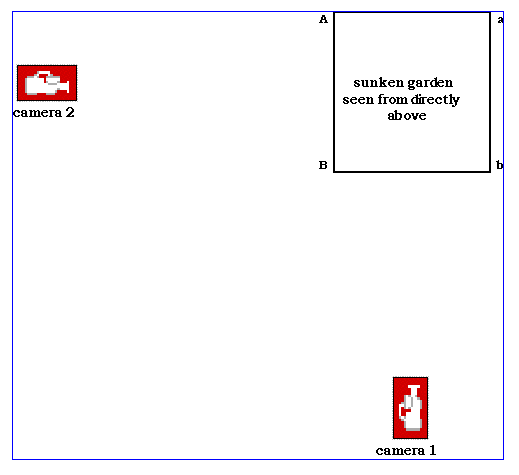
So my thought experiment sets up a sunken garden — always a pleasure, with two video cameras observing it, as in this diagram:

And from the two cameras, the respective views look like this:

In this scheme of things, Aa (Oxford) seems very close to Bb (Cambridge) seen from the viewpoint of camera 1 — but from camera 2’s standpoint, Aa (Oxford) and Bb (Cambridge) are at opposite ends of the garden, and simply couldn’t be father apart.

6.

Now, my thinking here is either so obvious and simple as to be a platitude verging on tautology — or one of those subtle places where the closer examination of what looks tautological and obvious leads to the emergence of a new insight, a new “difference that makes a difference” in Bateson’s classic phrase.

And clearly, I hope that the latter will prove to be the case here.

7.

What can we learn from juxtapositions? What can we learn from our agreements about specific juxtapositions — and what can we learn from our specific disagreements?

Because it’s my sense that samenesses and differences both jump out at us, as Cath Styles suggested — and that both have a part to play in understanding a given juxtaposition or proposed likeness.

Each juxtaposition will, in my view, suggest both a “sameness” and a “difference” — in much the same way that an arithmetic division of integers, a = qd + r, gives both quotient and dividend.

And then we have two or more observers of the juxtaposition, who may bring their own parallax to the situation, and have their own differences.

8.

Tahrir is to Tienanmen as Qutb is to Mao?

Or is pepper spray just a food additive?

And how do icons become iconic anyway? Are they always juxtapositions, cops against college kids, girl vs napalm, man against line of tanks?  Even in the iconic photo of Kennedy from the Zapruder film, the sudden eruption of violence into the stateliness of a presidential parade is there — a morality play in miniature.

Any thoughts?

STRATFOR on Anonymous vs. The Zetas

Thursday, November 3rd, 2011

I don’t think of STRATFOR as a cyber shop, generally, but this is worth a look.

Iranian Assassination – Narco-Cartel Plot Charged

Wednesday, October 12th, 2011

The US Attorney General Eric Holder, supported diplomatically by the Kingdom of Saudi Arabia, charged the Iranian government earlier today with a plot to enlist a Mexican narco-cartel to assassinate the Saudi Ambassador to the United States. SECSTATE Hillary Clinton, the FBI Director and President Barack Obama have all weighed in on this issue with strong public statements:

U.S. authorities said they had broken up a plot by two men linked to Iran’s security agencies to assassinate Saudi Ambassador Adel al-Jubeir. One was arrested last month while the other was believed to be in Iran.

Iran denied the charges. But President Barack Obama called the plot a “flagrant violation of U.S. and international law” and Saudi Arabia said it was “despicable.” Revelation of the alleged plot, and the apparent direct ties to the Tehran government, had the potential to further inflame tensions in the Middle East, and the United States said Tehran must be held top account.

Secretary of State Hillary Clinton, in a Reuters interview, expressed hope that countries that have hesitated to enforce existing sanctions on Iran would now “go the extra mile.” At a news conference, FBI Director Robert Mueller said the convoluted plot, involving monitored international calls, Mexican drug money and an attempt to blow up the ambassador in a Washington restaurant, could have been straight from a Hollywood movie.

U.S. Attorney General Eric Holder alleged that the plot was the work of the Islamic Revolutionary Guard Corps, which is the guardian of Iran’s 32-year-old revolution, and the Quds force, its covert, operational arm. “High-up officials in those (Iranian) agencies, which is an integral part of the Iranian government, were responsible for this plot,” Holder told the news conference.

“I think one has to be concerned about the chilling nature of what the Iranian government attempted to do here,” he said….

I confess that I am not quite sure what to make of this story. 

If accurate – the case originated with a DEA confidential informant in Mexico – it would amount to a new stage of reckless boldness by Iran’s hardline Pasdaran clique of security and intelligence agencies run by the Iranian Revolutionary Guards and their retired leadership that have a semi-hegemony over the Iranian regime. It also points to the danger to American national security of a long, basically open, border with a failing state Mexico that is deeply embattled in a polycentric counterinsurgency war with the rapidly morphing narco-cartels (that said, I do not expect the administration to move a policy inch to repair the latter). Why would Iran do this – and in such a harebrained manner?

Some possible motives:

* Internal factionalism – Iran recently released imprisoned American hikers, albeit after a substantial ransom payment. Potentially, this could be viewed in the topsy-turvy world of Iranian Islamist politics as a “goodwill gesture” toward the United States. Historically, such gestures provoke rival factions in Iran to initiate anti-American actions, including acts of terrorism, usually via proxies. If an intel operation was “factional” rather than blessed by a wide elite consensus, it might very well be a marginal idea carried out on a shoe-string.

* Counterpressue – Indirect Iranian skirmishing against the US which is drawing down in Iraq and is pressuring Iran’s ally Syria. Also against the Saudis who brutally suppressed a predominantly Shia “Arab Spring” rising in Bahrain which, if it had succeeded in toppling the regime, would have added Bahrain to the regional “Shia Revival”.

* Opportunism – The Pasdaran leadership may have  believed the stories of American decline, assessed our extensive military commitments and budgetary problems and taken the Obama administration’s temperature and concluded that the benefits of carrying out the assassination outweighed the remote risk direct  of US military retaliation.

Some points to consider:

* Proximity – Iran could more easily, with less risk and with far greater likelihood of success, carry out acts of anti-American terrorism closer to home in Iraq, Lebanon, Afghanistan the Gulf States, even in Saudi Arabia or Egypt.  Acts of terrorism in the American homeland risk a massive overreaction by Washington ( the US only needs the Navy to deal out severe consequences to Iran) which might welcome a legitimate pretext to bomb all of Iran’s suspected nuclear facilities and national security sites.

* Self-Preservation by the Mexican narco-cartels make such cooperation with Iran less likely, having the example of their Colombian predecessors in the 1980’s before them when they raised the ire of the USG sufficiently. The narcos have their hands full fighting the Mexican Army and one another without adding the CIA, Global Predator drones or the SEALs to their plate.

* Friends of MeK – By some miraculous deus ex machina, the cultish, 1970’s era Iranian Marxoid terrorist group, the People’s Mujahedin of Iran (MeK) have spent a wealth of funds to buy the lobbying services of a glittering array of former top US national security officials and general officers – despite being on the State Department’s official terrorist list.

….Among the new faces: former Indiana Congressman Lee Hamilton (D), who once chaired the House Foreign Affairs Committee, and who served as vice chairman of the 9/11 Commission; Ambassador Dell Dailey, who was the State Department’s Coordinator for Counterterrorism from July 2007 to April 2009; General Michael Hayden, director of the CIA from 2006 to 2009; and not one, but two former chairmen of the Joint Chiefs of Staff. Former Attorney General Michael Mukasey, former New Mexico Gov. Bill Richardson, former Under Secretary of Defense for Policy Walter Slocombe and ex-Sen. Robert Torricelli (D-NJ) also spoke.

In what should be a national scandal, those names are not even a comprehensive list of the very influential former politicians, K Street lobbyists and Beltway law firms accepting payments to whisper in the ears of current officials in the national security community, regarding Iran, on behalf of the MeK. Not sure how it is legal to do so either, since aiding a group on the State Department’s list by providing services normally can get you hauled into Federal  court pronto, if you are an ordinary American citizen. A most curious situation….

I have no brief for Iran, the regime is a dedicated enemy of the United States, but a group of exiled Iranian Marxist-terrorists who used to work for Saddam Hussein hardly have our best interests at heart.

It will be interesting to watch this case unfold, but in the meantime, opinions are welcome in the comments, particularly on the Mexican narco-cartel angle.

Hat tip to James Bennett.


Switch to our mobile site