zenpundit.com » 18th century

Archive for the ‘18th century’ Category

Vivaldi, veiling and revelation…

Wednesday, March 14th, 2012

[ by Charles Cameron — some glorious music, Venice, Kandahar ]
.

I was listening to Pergolesi‘s Stabat Mater the other day, and talk came around to the question of whether women would have sung the two solo parts – whether they were written for soprano and contralto, in other words, or for treble and counter-tenor – all of which reminded me that the “red priest” Vivaldi was, for over thirty years, maestro of the Ospedale della Pietà orphanage in Venice.

The Ospedale’s all-woman choir performed many of his sacred choral works in church, hidden from view if not speculation in a high balcony behind an iron grille…

The BBC has an hour-long documentary on the subject of Vivaldi’s Women, which features the Ospedale but also the contemporary choir and orchestra, Vivaldi’s Women, more properly known as the Schola Pietatis Antonio Vivaldi.

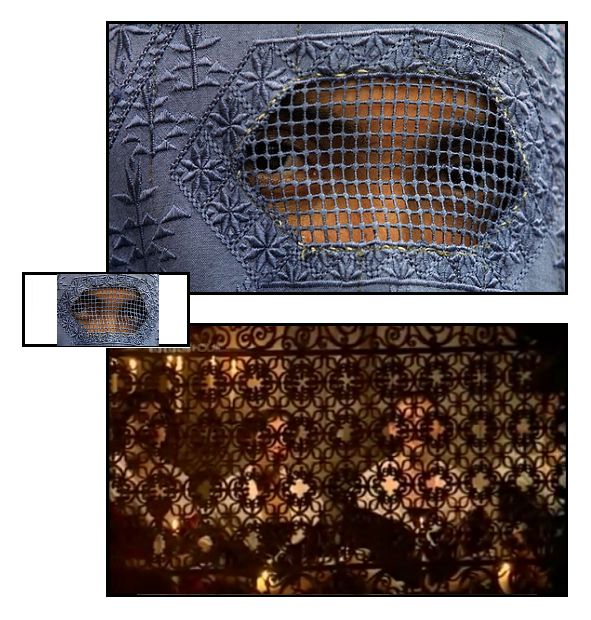
The (lower) image of the present-day women’s choir singing behind one of those grilles – accompanied by a voice-over reading from a fashionable “grand tour” diary of the day which reports that the “grilles conceal the angels of loveliness” (the writer was perhaps aware, perhaps not, that many of the orphans in Vivaldi’s day would have been scarred or deformed by the pox or their parents’ syphilis) reminded me of another contested icon of “women behind a grille” – this time, the traditional Afghan chadari (upper image)…

*

I have exchanged greetings through a grille with Carmelite nuns in California, and they clearly appreciated the sanctuary that their enclosure offered them…

My point is not to argue the superiority of bikini over burqa or vice versa: it is to offer you a chance to hear some Vivaldi or Pergolesi, and to consider the issue of veiling and revealing — intimacy’s equivalent of secrecy and transparency — from what was for me at least an unexpected and fresh angle.

America in Arms, John McAuley Palmer, a review

Tuesday, February 28th, 2012

[by J. Scott Shipman]

America in Arms, John McAuley Palmer (1870-1955)

Thanks to our blog friend Joseph Fouche, I discovered Brigadier General Palmer’s excellent history of how America has organized the army both in peacetime and in times of war. Fouche introduced Palmer in an excellent piece called, How Did We Get Here.

The Prologue to this excellent book begins:

When Washington became President, he had two main planks in his administration platform. His first plank called for a sound financial system; his second plank called for a sound national defense system.

Thanks to Alexander Hamilton, his Secretary of the Treasury, his first plank was installed before the end of his first administration. But it was not until 1920, more than one hundred and thirty years later, that Congress established a modern adaptation of his military organization. And it was not until 1940 that Congress completed the Washington structure by accepting the principle of compulsory military training and service in time of peace.

Thus begins one of the best written books I’ve read since Rear Admiral J.C. Wylie’s Military Strategy. While the authors cover different topics, both write in crisp, efficient prose and say what they mean the first time. One won’t find much fluff or nuance in either book; I like that.

Palmer traces the history of how America has organized to fight wars, and more often than not, the “how” is not pretty (we usually play catch-up in the early days of conflict). Palmer’s purpose in writing “this little book” was “to tell how Washington arrived at his military philosophy: how and why he was unable to persuade his countrymen to accept it; how their rejection of his advice affected their subsequent history; and finally how, after a century and a half their descendants have have been impelled to return to his guidance.” From the period of 1783 through 1911, Palmer’s book is history. Following 1911, Palmer provides “first-hand experience of the events described.”

Palmer begins with an early (pre-Constitution) inquiry to Washington by Congress on his views on a proper military policy for the new nation. Washington shopped the query around to Generals Steuben, Knox, Huntington, Pickering, Health, Hand and Rufus Putnam. Their responses were strikingly similar; “a well-regulated militia” would be sufficient for national defense. They agreed on a small regular army to patrol the Indian frontier and other “special duties” that could not be performed by citizen soldiers.

Palmer discovered Washington’s “Sentiment on a Peace Establishment” when researching his Washington, Lincoln, Wilson: Three War Statesmen. Washington’s treatise was pretty straightforward:

A Peace Establishment for the United States of America may in my opinion be classed under four different heads Vizt:

First. A regular and standing force, for Garrisoning West Point and such other Posts upon our Northern, Western, and Southern Frontiers, as shall be deemed necessary to awe the Indians, protect our Trade, prevent the encroachment of our Neighbours of Canada and the Florida’s, and guard us at least from surprizes; Also for security of our Magazines.

Secondly. A well organized Militia; upon a Plan that will pervade all the States, and introduce similarity in their Establishment Manoeuvres, Exercise and Arms.

Thirdly. Establishing Arsenals of all kinds of Military Stores.

Fourthly. Accademies, one or more for the Instruction of the Art Military; particularly those Branches of it which respect Engineering and Artillery, which are highly essential, and the knowledge of which, is most difficult to obtain. Also Manufactories of some kinds of Military Stores.

(Would highly recommend reading the entire piece.)

Palmer accounts for Washington’s seeming contradiction on the issue of militias, and points out that Washington was specific in his low opinion of an “ill-organized militia” (one based on short enlistments and political connections influencing the selection of leaders—a problem which endured in Lincoln’s Union Army). Washington favored a “well-organized militia” with the Swiss model ranking high in his esteem. Of the generals providing Washington with their thoughts, Palmer writes that Steuben and Knox were largely in agreement with Washington’s ideas. Both were in general agreement on the organization of small infantry divisions, or legions divided between New England, the Mid-Atlantic, and the South Atlantic. Under the direction of Congress, in 1786, General Knox (then Secretary of War) completed a Plan for a General Arrangement of the Militia of the United States.

The following plan is formed on these general principles.
1st.
That it is the indispensible duty of every nation to establish all necessary institutions for its own perfection and defence.
2’ndly,
That it is a capital security to a free State for the great body of the people to possess a competent knowledge of the military art.
3’dly,
That this knowledge cannot be attained in the present state of society but by establishing adequate institutions for the military education of youth— And that the knowledge acquired therein should be diffused throughout the community by the principles of rotation.
4’thly
That every man of the proper age, and ability of body is firmly bound by the social compact to perform personally his proportion of military duty for the defence of the State.
5’thly;
That all men of the legal military age should be armed, enrolled and held responsible for different degrees of military service.
And 6thly,
That agreeably to the Constitution the United States are to provide for organizing, arming and disciplining the Militia, and for governing such part of them as may be employed in the service of the United States, reserving to the States respectively the appointment of the officers, and the authority of training the Militia according to the discipline prescribed by Congress.

Congress did not enact the Knox plan as the United States, still under the Articles of Confederation was “insolvent” and unable to act. Palmer estimated that had Knox’s plan been adopted in 1786, “it is my estimate that the advanced corps would have numbered 60,000 men at the end of three years.” Those numbers would grow progressively as the population increased, so that at the outbreak of the Civil War, “the first line of the civilian army would have numbered about 500,000 men. ” By WWI in 1914, that number would have been about 1.8 million.

As president, Washington’s military policy was closely aligned to the Knox plan (Washington amended the original). The change involved a reduction in the required training for the advanced corp—then, as now, costs were the motivating factor for the reduction, but Washington wanted to get a national infrastructure approved. As mentioned previously, the Swiss model factored heavily among Washington and his general’s thinking—with the essential difference between the Swiss plan and Knox being the “distribution of training time.”

The first Congress was reluctant to embrace Washington’s ideas and instead passed the “notorius Militia Act of 1792.” Palmer said this Act made “our military system worse than before the bill was introduced. The old militia organization [the “ill-organized” that Washington deplored] with its phony regiments and divisions now had Federal sanction and was made uniformly bad throughout the nation.”

Washington was defeated in his efforts to develop and deploy a national militia. Washington in warning of foreign entanglements in his Farewell Adress also reminded us of the realities nations must shoulder:

If we remain one People, under an efficient government, the period is not far off, when we may defy material injury from external annoyance; when we may take such an attitude as will cause the neutrality we may at any time resolve upon to be scrupulously respected; when belligerent nations, under the impossibility of making acquisitions upon us, will not lightly hazard the giving us provocation; when we may choose peace or War, as our interest guided by justice shall Counsel…Taking care always to keep ourselves, by suitable establishments, on a respectably defensive posture, we may safely trust to temporary alliances for extraordinary emergencies.

Palmer covers the efforts of Jefferson, and then, Madison to develop a cogent national military organization. The War of 1812 illustrated the the dangers of “the ill-organized militia” as it was, as organized the militias were found wanting. A new force emerged from the War of 1812 and that new force was the regular army. Palmer concludes this chapter: “The history of our modern regular army really begins with the War of 1812. Since then it has never failed to give a good account of itself. It won the pride and gratitude of the American people just when the failure of the national militia had filled them with contempt and humiliation.”

“A new military gospel” was formed after the War of 1812, and the War Department became the new headquarters of the regular army. Madison’s successors had to start over as the archives (including Washington’s Sentiments) were destroyed when the British burned the capitol in 1814. John C. Calhoun, Secretary of War under Monroe, advocated an “expansible standing army”—the antithesis of Washington’s ideas. Palmer said, this “expansible-standing-army” plan hampered American plans for preparedness for more than a century…[through 1941] and…is not quite dead.” The problem was “how” to expand this force in time of war.

As Palmer traces the military policy from Florida to Mexico, and the Civil War, the same problems recurred: the standing army was stretched thin at the outset of conflict and ill-equipped to train recruits provided by the Several States. Added to this was the problems of short enlistments, that in some cases left commanders waiting to pursue the enemy while waiting for fresh troops (Battle of the City of Mexico).

After the Civil War Congress took action to attempt a solution to the broken military organization problem. The Burnside Commission was formed with veterans of the Civil War, but without Washington’s wisdom to guide them. Palmer recounts the accident of history where General Emory Upton had just finished reviewing Washington’s military writings—but missed Sentiments (referenced in a footnote). Upton missed the “key” to Washington’s thinking on an “efficient citizen army.” It appears Upton took the Washington he had read and connected to the expansible standing army idea—and missed Washington’s true intent.

Elihu Root became Secretary of War in 1899 and traced our military faults in the Spanish American war to “defective organization.” The defective organization, in Root’s estimation was this paragraph in Army regulations: “The military establishment is under orders of the Commanding General of the army in that which pertains to its discipline and control. The fiscal affairs of the army are conducted by the Secretary of War through the several Staff Departments”—dual control. While he was resisted, in 1903 the office of the chief of staff was created. Palmer calls this the first of Root’s “great reforms.” He followed by formalizing planning and organizing “the American war army.” A General Staff college was formed to educate those who would serve in the newly reorganized Army. Root and his use of Upton’s work made an indelible mark on the army, and in many ways made the army more professional and able. On the downside, I sense Root provided the shell of what is now the massive military bureaucracy.

I’ll conclude my chronological review here, as the author enters the narrative in first person while signed to Henry L. Stimson, Secretary of War. Suffice it to say, Palmer’s recounting of “how” we have traditionally organized our army is a very informative read. I have seen many “reading lists” of generals and leaders, but haven’t seen this old book on any of those lists—it should be. The “tribal” disconnect between the regular army and the National Guard is explained (not in so many words, mind you), and Palmer’s recounting of the dangerous power of doctrine and dogma is worth the read. The writer of the biblical book Ecclesiastes said, “There is nothing new under the sun.” In America in Arms, military personnel and general reader will find that many of today’s challenges have been challenges since our Founding.

This book has my highest recommendation—especially if you are a serving army officer or have interest in American military organization. This is a great old book. Get a copy; Palmer has much to teach us.

Postscript: Another friend of this blog, Lexington Green, recommended Citizen and Soldiers: The Dilemmas of Military Service, by Eliot Cohen, in the comments to the same post posted at chicagoboyz.net. On Lex’s recommendation, I ordered and have Cohen’s book, but have not yet read.

Second Postscript: I purchased America in Arms from a used book dealer on abe.com, and was fortunate to get a first edition hardback (ex-library book) in excellent condition. This particular title spent time on the shelves of The Catlin Memorial Free Library, Springfield Center, NY, and was placed there by the Arthur Larned Ryerson Memorial; Mr. Ryerson perished on the Titanic. In addition, this particular edition was also published by Yale by the Foundation established in the memory of Philip Hamilton McMillan (check the wife and children entry), Yale Class of 1894. Quite a pedigree for any book; a book that will remain safely in my collection. (the photo above is a snap-shot of my copy)
The Forum and The Tower, a review

Sunday, November 20th, 2011

[by J. Scott Shipman]

the-forum-and-the-tower.jpeg

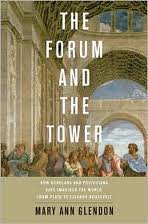
The Forum and The Tower by Mary Ann Glendon

“The relationship between politics and the academy has been marked by mutual fascination and wariness since the time of Plato.”

The first sentence on the flap of the dust jacket of this very good and informative small book. Professor Glendon, who is the Learned Hand Professor of Law at Harvard Law school, set out to write a book for her students that would answer ageless questions such as:

“Is politics such a dirty business, or are conditions so unfavorable, that couldn’t make a difference? What kinds of compromises can one make for the sake of getting and keeping a position from which one might be able to have influence on the course of events? What kinds of compromises can one make for the sake of achieving a higher political goal? When does prudent accommodation become pandering? When should one speak truth to power no matter what the risk, and when is it acceptable, as Burke put it, to speak the truth with measure that one may speak it longer? When does one reach the point at which one concludes, as Plato finally did, that circumstances are so unfavorable that only the reasonable course of action is to “keep quiet and offer up prayers for one’s own welfare and for that of one’s country”?”

Professor Glendon answers these questions and more through brief examinations of the lives and works of some of history’s most important figures:

Plato

Cicero

Justinian, Tribonian, and Irnerius

Machiavelli

Thomas Hobbs and Edward Coke

John Locke

Jean-Jacques Rousseau

Edmund Burke

Tocqueville

Max Weber

Oliver Wendell Holmes

Eleanor Roosevelt and Charles Malik

All in all, I believe Professor Glendon has provided a uniquely valuable book to help her students and other readers to answers those questions. In short but focused chapters of about 20 pages each, she provides mini-biographies of the subjects above and how they answered the some of the questions both in their lives and in their philosophy. Some of her subjects were thinkers lacking the abilities for the public square, Plato, for instance, but were enormously influential just the same. Rare were those like Cicero and Burke who were equally comfortable in the political arena or the academy.

My favorite chapters were on Plato, Cicero, Machiavelli, and Burke—mostly because I’ve read a respectable amount of their work. That said, I have not read Plato’s The Laws—and Professor Glendon suggests it is much better than The Republic—which I have read and did not much enjoy. Not surprisingly, The Laws will be on my list for this winter.

The inclusion of Eleanor Roosevelt and Charles Malik was something of a surprise, but Professor Glendon is weaving a sub-story through each chapter and illustrating how Roosevelt and Malik’s work on the Universal Declaration of Human Rights was something of culmination and extension of over 2,000 years of thinking and political action—not in the context of human progress towards a utopia of sorts, which she wisely rejects,  but rather a reflection the common threads of political thought throughout history.

While this is not criticism, I would have liked to have seen a chapter on John Adams and Thomas Jefferson, and a chapter on Karl Marx, whom she frequently mentions.

This is a book that is approachable and readable, and in our tumultuous domestic and global political climate, important.

She closes with this illuminating sentence:

“If one message emerges from the stories collected here, it is that just because one does not see the results of one’s best efforts in one’s own lifetime does not mean those efforts were in vain.”

Professor Glendon is to be commended for a job “well done!”

The book comes with my highest recommendation and may be the best book I’ve read this calendar year. Add this book to your must read list.

.
Referenced works you may find of interest (some of these works are out of print and expensive—for simplicity I’ve used Amazon links): 

The Laws of Plato, translated by Thomas Pangle

Cicero: The Life and Times of Rome’s Greatest Politician, by Anthony Everitt

Cicero, A Portrait, by Elizabeth Rawson (Glendon praised this book.)

A Panorama of the World’s Legal Systems, John Henry Wigmore

The Life of Nicolo Machiavelli, Roberto Ridolfi

The Prince, translated by Harvy Mansfield

Machiavelli, by Quentin Skinner

The Lion and the Throne, Catherine Drinker Bowen

The Spirit of Modern Republicanism, by Thomas Pangle

Statesmanship and Party Government, by Harvy Mansfield

The Great Melody, A Thematic biography of Edmund Burke, by Conor Cruise O’Brien (I read this wonderful book in 1992 when it was released: highly recommended.)

Trial of a Thousand Years, by Charles Hill—a review

Thursday, August 11th, 2011

 trial of thousand years

by J. Scott Shipman 

Trial of a Thousand Years, World Order and Islamism, by Charles Hill

Ambassador Charles Hill’s Grand Strategies, Literature, Statecraft, and World Order was the best book I read in 2010, so I had high expectations for this volume and was not disappointed. Ambassador Hill provides a 35,000-foot view of the relationships between the West and Islam in history focusing on the subtitle of his earlier work in the form of “world order.”

Unsurprisingly, as in Grand Strategies Hill goes back to the roots of modern order in the Treaty of Westphalia (1648). He provides a brief review of the world ushered in by the men who negotiated, and quotes another historian who said, “men who were laboring, each in his own way, for the termination of a terrible war. They had no idea of progress. The word “innovation” was anathema to them. The last thing on their minds was the creation of a new system of sovereign states…” Here we are 363 years later and “from the seeds sown at Westphalia” the system they set in place is has grown, but has been under siege many times from many fronts.

Westphalia was distinctive because it was “procedural, not substantive” and required a minimum number of procedures/practices to which to adhere and allowed disparate parties with different, “even mutually antagonistic, substantive doctrines and objectives” to work together. Hill points out four distinctions:

  • Religious arguments were not allowed in diplomacy.
  • The State was the fundamental entity.
  • Interstate/international norms and laws were encouraged, absent “divine sources” but based on mutually beneficial/positive agreements.
  • Use of professional military and diplomats with “its own set of protcols.” [Personal note: In another life, I was an arms control inspector enforcing the START I and INF Treaties—protocol was very serious and the true measure of the actual treaty language. There was also a strong and consistent application of reciprocity that made each party think before stretching protocol—this happened to my teams more than once.]

For Hill a central mission of the United States is the defense of the Westphalian world order. In less than 165 pages and six chapters, he outlines the origins of modern Western order and correspondingly covers Islamic order. From the beginning to the end Hill provides ample evidence of challenges to Westphalia, often from indigenous Western sources, but focusing mostly on our trials with Islam.

Hill sets the sources from whence the Western and Islamic world orders arose, where the West was grounded in Christianity, and the Islamic in the Caliphate. For two religions claiming Abrahamic roots, their worldviews were, and in many instances remain diametrically opposed. Central was the question of duality or unity. For the West, the State and religion were two complementary systems/powers—following the teaching of Christ ““Render unto Caesar the things which are Caesar’s, and unto God the things that are God’s” (St Matthew’s Gospel 22:21) For Islam there was no distinction, and the very thought was hateful to Islamists. Islam’s “unswerving devotion to monotheism” continues to this day among those groups and states using terror to upend existing world order.

I am sympathetic to Hill’s ideas; however recognize with globalization and the internet tweaks may be required. And I’ll take this segue to introduce an idea for consideration.

Westphalia’s removal of religion made trade possible among former religious enemies. Unambiguous rules for contracts and dispute resolution evolved. What if we could bridge the gap between Western jurisprudence and tribal, or non-Western legal systems? What if, instead of insisting our way or the highway we design a solution that would allow both sides to keep their respective legal processes and procedures, thereby opening untapped markets?

At least one person has already considered these alternatives. Michael Van Notten (1933-2002) was a practicing lawyer in the Netherlands and married into a Somali tribe. Van Notten used his legal training and insights gained as a member of his new family to design a method of contracting where tribal law and Western jurisprudence could peacefully and prosperously coexist. Van Notten recorded his ideas in a book called The Law of Somalis, A Stable Foundation for Economic Development in the Horn of Africa. I’ll not review this book, but wanted offer this as a teaser alternative.

After reviewing the history of the West and Islam, Hill identifies seven Clausewitzian centers of gravity for both: legal, military, the State, women, democracy, nuclear weapons, and values. Hill makes the distinction between the use of diplomacy by Islam and the Islamist (the fundamental variety). No surprises, to the Islamist a secular State is an “apostasy,” as is international law (Sharia being the single source), democracy and the rights of women.

Hill concludes, “Islamic civilization entered the international system under duress,” which he believes has contributed to the current situation of failing states and lagging economies that establish conditions where radicalized Islam can flourish. The radicalized elements reject the secular Westphalian world order, however Hill points out that some in Islam insist that sharia imposed by the state “cannot be the true law of Islam. It is not possible to apply sharia through the state; it can only be applied through acceptance by human beings (An-Na’im).” Another alternative is the Medina polity established by the Prophet (“later called the Pact—kitab—of Medina) “guaranteeing each tribe the right to follow its own religion and customs, imposing on all citizens rules designed to keep the overall peace, establishing a legal process by which the tribes settled purely internal matters themselves and ceded to Muhammad the authority to settle intertribal disputes…Although this document has been called the first written constitution, it was really more of a multiparty treaty” (Ansary).

Hill convincingly demonstrates that more often than not, rulers have co-opted Islam as a way to dominate the people (Iran comes to mind.). He quotes Professor L. Carl Brown of Princeton, “nothing exclusively “Islamic” about this Muslim attitude towards politics, any more than the politics of feudalism or of imperial Russia was distinctly “Christian.” It is the political legacy of Muslims, not the theology of Islam…”

For the Islamist, secularism is the booger man, but secularism in the Westphalian order has its own set of problems. Hill writes, “A new phenomena arose: wars motivated by religious convictions were replaced by wars driven by ideologies—surrogates for religion—each aimed to oppose, undermine, destroy and replace the Westphalian system. The greatest of these was international communism, the latest is international Islamism.”

In many respects, Trials is as good as Grand Strategies. Ambassador Hill is to be commended for his insight, courage, and conviction—this little book packs a big, enlightening punch. Strongest recommendation.

References you may find of interest (links to quoted authors above are links to the respective reference):

The Incoherence of the Philosophers, Abu Hamid Muhammed Al-Ghazali

The Crisis of Islamic Civilization, Ali A. Allawi

The Caliphate, Thomas W. Arnold

Sayyid Qutb and the Origins of Radical Islamism, John Calvert

Crimea: The Last Crusade, Orlando Figes —Figes’ The Whisperers was very good.

The Morality of Law, Lon L. Fuller

The Muqaddimah, Ibn Khaldun (Translated Franz Rosenthal)

The Clash of Empires: The Invention of China in Modern World Making, Lydia H. Liu

The Government of the Ottoman Empire in the time of Suleiman the Magnificent, Albert Lyber

Byzantine Civilization and The Fall of Constantinople, both by Steven Runciman

The First World War, Hew Strachan

Mozart and the Enlightenment; Truth, Virtue and Beauty in Mozart’s Operas Nicholas Till

Muslim Intellectual: A Study of Al-Ghazadi, W. Montgomery Watt

Dialectic of Enlightenment, Max Horkheimer and Theodor W. Adorno 


“We hold these Truths to be Self-Evident….”

Monday, July 4th, 2011

This is the core of what it America is, a civic creed, adherence to which defines the holder as possessor of the exalted title of “American”, without regard to their origins, however humble, their condition, however mean, they can hold their heads above those of kings as a free people, jealous of their liberties and none greater than another under the law.

That was the revolutionary ideal that set the world on fire, long though in the coming to arrive as a reality. It is our greatest legacy to the history of mankind and if we ever lose our vigilance and submit to tyrants, forgetting ourselves in seeking security, Jefferson’s words may yet inspire others to take up the cause on our behalf as we have done so for others:

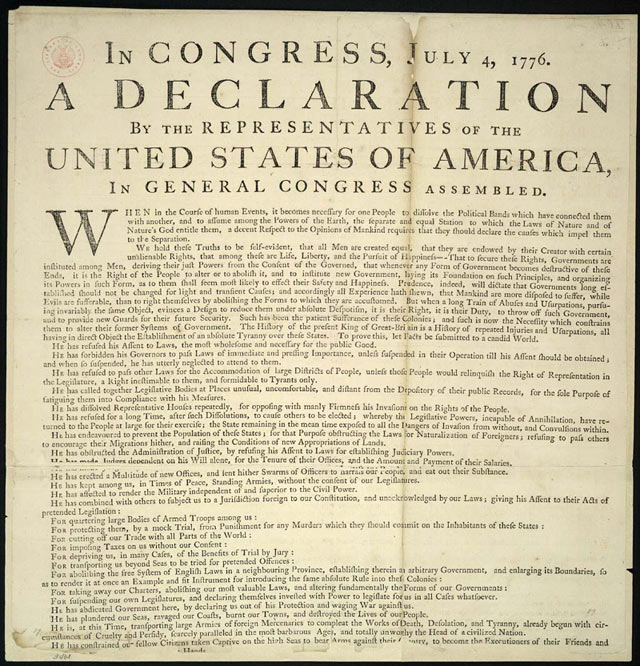
“We hold these truths to be self-evident, that all men are created equal, that they are endowed by their Creator with certain unalienable Rights, that among these are Life, Liberty and the pursuit of Happiness.–That to secure these rights, Governments are instituted among Men, deriving their just powers from the consent of the governed, –That whenever any Form of Government becomes destructive of these ends, it is the Right of the People to alter or to abolish it, and to institute new Government, laying its foundation on such principles and organizing its powers in such form, as to them shall seem most likely to effect their Safety and Happiness. Prudence, indeed, will dictate that Governments long established should not be changed for light and transient causes; and accordingly all experience hath shewn, that mankind are more disposed to suffer, while evils are sufferable, than to right themselves by abolishing the forms to which they are accustomed. But when a long train of abuses and usurpations, pursuing invariably the same Object evinces a design to reduce them under absolute Despotism, it is their right, it is their duty, to throw off such Government, and to provide new Guards for their future security.–Such has been the patient sufferance of these Colonies; and such is now the necessity which constrains them to alter their former Systems of Government. The history of the present King of Great Britain is a history of repeated injuries and usurpations, all having in direct object the establishment of an absolute Tyranny over these States. To prove this, let Facts be submitted to a candid world….”

Thomas Jefferson, at great age and infirmity, ten days before July 4th, 1826 – the 50th anniversary of the signing of the document that was largely written in his own hand, wrote a letter declining to participate in celebrations, due to ill health; but Jefferson declared:

“May it be to the world, what I believe it will be … the signal of arousing men to burst the chains … and to assume the blessings and security of self-government. That form, which we have substituted, restores the free right to the unbounded exercise of reason and freedom of opinion. All eyes are opened, or opening, to the rights of man. … For ourselves, let the annual return of this day forever refresh our recollections of these rights, and an undiminished devotion to them.”

Amen.


Switch to our mobile site