zenpundit.com » Patterns

Archive for the ‘Patterns’ Category

One for Madhu — A Meditation in Time of War

Friday, March 23rd, 2012

[ by Charles Cameron — a poem of mine, with continuing exploration of Koestler’s notion of creativity at the intersection of fields, showing how three thoughts are braided in a single polyphony ]
.

A Meditation in Time of War
.

It is for the artist to see skeleton behind flesh
when depicting war, tho’ beauty too
deserves a hint of her inevitable decay,
flesh being heir to dust and dust its progeny:

nothing is so mechanical visioned in paint
as the tubing that supplies a gas mask with air,
yet the throat is no different, constricted
by an urgency to breathe as breath snuffs out:

gone, gone, paragon, quintessence of dust, svaha!

.

William Butler Yeats has a well-known poem with the same title, so I am borrowing from, flattering, and wondering whether I might sneak under the same mantle as a member of the illustrious departed here.

And Madhu, friend and friend of this blog, encouraged me some while back to post poems here on occasion, so this one is for her by way of a response.

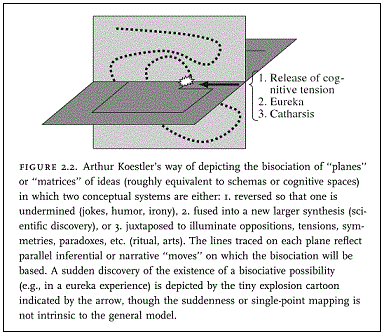
I also wanted to post this particular poem here, though, because its last line nicely illustrates the same notion of overlapping or juxtaposed elements that Koestler claims lies at the heart of the creative process which I have been exploring in my recent posts on Klimt, on Nancy Fouts, and constellational thinking.

Because yes, I now have a book project under way, and it concerns the development of a new style of multifaceted, complex / simplex thinking.

*

The first lines of my poem were triggered by one of those fleeting glances at a blog logo — in this case, the logo of the Kings of War blog from London, which I’ve shaved down a bit to give you a taste of here:
.


.

It’s impressive, eye-catching — and then you get used to it.

So a couple of nights ago when I glimpsed it, I slowed down enough to take a quick but deliberate look, came away with an impression — not necessarily accurate as to detail, but giving me my emotional response to the piece — and worked and played to get it into words, making this what I believe is technically called an ekphrastic poem, a poem about a painting.

The original painting is a mural — José Clemente Orozco‘s Catharsis (1934), from the Museo Palacio de Bellas Artes in Mexico City.

So that, with a little wandering of the mind, is what gives us the first eight lines. It’s the ninth and last line I want to comment on, here.

*

That last line reads:

gone, gone, paragon, quintessence of dust, svaha!

And what’s happening here that delights me, and that gives the poem either a perplexing close or a powerful one, depending on the associations which the reader brings to bear on it, “happens” as follows:

I am letting two, or you might say three, streams of language that are very dear to me braid together in that last line.

There’s the mantra that sums up the entire Prajnaparamita or Perfection of Wisdom literature — a major strand in Buddhist teachings — at the end of the Heart Sutra:

Gate, gate, paragate, parasamgate, bodhi, svaha!

There’s the English translation of the same, which Thich Nhat Hanh explains thus:

Gate means gone. Gone from suffering to the liberation of suffering. Gone from forgetfulness to mindfulness. Gone from duality into non-duality. Gate gate means gone, gone. Paragate means gone all the way to the other shore. So this mantra is said in a very strong way. Gone, gone, gone all the way over. In Parasamgate sam means everyone, the sangha, the entire community of beings. Everyone gone over to the other shore. Bodhi is the light inside, enlightenment, or awakening. You see it and the vision of reality liberates you. And svaha is a cry of joy or excitement, like “Welcome!” or “Hallelujah!” “Gone, gone, gone all the way over, everyone gone to the other shore, enlightenment, svaha!”

— and which I remember from my days at Oxford in Edward Conze‘s much earlier English version:

Gone, gone, gone beyond, gone altogether beyond…

And there’s this, from Hamlet, Act 2 scene 2:

What a piece of work is a man! how noble in reason! how infinite in faculty! in form and moving how express and admirable! in action how like an angel! in apprehension how like a god! the beauty of the world! the paragon of animals! And yet, to me, what is this quintessence of dust?

*

So “gate, gate, paragate” gives me “gone, gone, paragon…” — and “paragon” brings me to “paragon of animals … quintessence of dust”.

If you have all three of these utterances in mind — and each one of them is memorable the way a passage in Isaiah or Job, or some great Churchillian speech, or phrase in Melville or Dickens can be memorable — they will all three be present, braided together as a single music, a polyphony, a constellation of meanings, in that one last line.

Roll them on your tongue, taste the beauty in each one of them, the nobility, the evanescence of this human life. And now read the poem through again.

Nancy Fouts and the heart of the matter

Thursday, March 22nd, 2012

[ by Charles Cameron — Nancy Fouts, sculpture, juxtaposition, essence of creativity, pocket universes, Arthur Koestler, Mark Turner ]
.

Nancy Fouts is an American artist based in London. I ran across her work a while ago thanks to Michael Weaver on Google+, and was immediately struck by the intensity of her images, each one of which seemed like a landmark from a larger geography, more precisely focused and dense with meaning than our own world usually appears to be.

First impression:

.
The first image I saw was of a snail on the straight edge of a razor blade (above, left) — an image out of the script of Apocalypse Now to be sure, but presented by Fouts in sharp detail and unadorned by any other context, visually, direct from eye to mind and heart.

This may be the image many people first see of her work — very, very striking, exquisite, terrifying if you allow it to be so, and yet as clear and simple, almost, as a single drop of water on a leaf.

Singer and song:

.
But it was this next image that conquered me:

The juxtaposition is impeccable: sewing machine, record on turntable – and the overlap between the two, the link, the vesica piscis between them, is the needle.

The music of Bach, Handel, and Vivaldi — particularly on harpsichord — has been disparagingly called “sewing-machine music”. If that phrase gave rise to this marvelous image, perhaps the slight can be forgiven.

The sewing-machine? It’s a Singer. And in what must surely be an ironic, gender-influenced choice coming to us from an artist so assured and exacting — the music that the needle draws from the groove of the record is, as you can tell from the record label, the music of His Master’s Voice.

Philosophical aside:

.
I have pointed before to this diagram from Mark Turner‘s The artful mind: cognitive science and the riddle of human creativity, based on those in Arthur Koestler‘s The Act of Creation (eg those on pp 35 and 37):

koestler-model.gif

It shows the essence of the creative act — the “release of cognitive tension” that occurs when some form of analogy, similitude, overlap allows the mind to join conceptual clusters from two fields in a “creative leap”.

Nancy Fouts’ work doesn’t merely make use of such twinned field overlaps, it makes twinned fields with overlap the defining quality of her works.

She is aiming right at the heart of the creative process. And it shows.

Moving further afield:

.
In that earlier post of mine, I talked about Ada, Countess of Lovelace, and noted that her analogy between Charles Babbage‘s Analytical Engine and Jacquard‘s mechanical loom, famously expressed by her thus:

The Analytical Engine … weaves algebraic patterns, just as the Jacquard-loom weaves flowers and leaves.

was precisely the creative leap that led to the us of punched card systems in computation from Babbage to Watson…

I could give other examples. The Taniyama-Shimura conjecture which formed the basis of Andrew Wiles‘ proof of Fermat‘s Last Theorem, bridges two previously distinct branches of mathematics precisely by showing that for every elliptic curve, there is a related modular form

And no, I don’t understand the mathematics. But I understand the concept of twinned fields, and the power of their overlap.

Some favorite tropes:

.
Back, then, to Nancy Fouts:

One thing that interests me about her work is that she has a few simple “essences” that she returns to time and again: in this case, bees, forms that resemble honeycombs, and by implication, honey.

In my own work, making similar connections between what we might paradoxically call “kindred ideas in unrelated fields” — I might set Nancy’s honeybees across from the verse from the Upanishads [Brihadaranyaka, fifth Brahmana, 14] which says:

This Self is the honey of all beings, and all beings are the honey of this Self.

Another of Nancy’s tropes connects nature and music…

The piercing:

.
And thimbles, those miniature emblems of armor and protection, are another recurring theme:

Let’s take a look at that last image, of the thimble transpierced by a needle.

I believe it has a history — again, accessible via an associative leap. Here are three images of the “wounded healer” motif, two of them specifically images of the Inuit shaman who has harpooned himself — a motif which the anthropologist and zen roshi Joan Halifax writes “captures the essence of the shaman’s submission to a higher order of knowing”:

Armor, the defenses we have in place to protect our selves, and vulnerability, the ability to to allow our selves to be wounded, so that the “self” which is “the honey of all beings” may shine through us. The paradox of Selflessness and Self.

Koan and sacrament:

.
Among wounded healers, we might count the crucified Christ, his side pierced by the spear of a Roman soldier — and here I might suggest that Fouts contrasts (image below, left) the self-sacrifice at the heart of Christianity with the pugilistic approaches of some proponents of his message:

And the image of Christ (right) balancing on a high wire?

Again I’m reminded of the language of shamanism. The anthropologist Barbara Myerhoff studied the religious beliefs and practices of the Huichol or Wixaritari of the Mexican Sierra Madre Occidental, with Ramon Medina Silva, a mara’akame or shaman of the tribe.

In her book, Peyote Hunt: The Sacred Journey of the Huichol Indians, she describes a feat of balance that Ramon performed, which appeared to serve a “sacramental” function for his people – providing them with what Cranmer‘s Book of Common Prayer calls “an outward and visible sign of an inward and spiritual grace”:

One afternoon Ramon led us to a steep barranca, cut by a rapid waterfall cascading perhaps a thousand feet over jagged, slippery rocks. At the edge of the fall Ramon removed his sandals and told us that this was a special place for shamans. We watched in astonishment as he proceeded to leap across the waterfall, from rock to rock, pausing frequently, his body bent forward, his arms spread out, his head thrown back, entirely birdlike, poised motionlessly on one foot. He disappeared, reemerged, leaped about, and finally achieved the other side. We outsiders were terrified and puzzled but none of the Huichols seemed at all worried. The wife of one of the older Huichol men indicated that her husband had started to become a mara’akame but had failed because he lacked balance.

It’s easy to read the description — but by no means as easy to keep one’s balance — something that Fouts’ image perhaps suggests more vividly than words easily can.

Richard de Mille describes the mara’akame‘s function in Huichol society as to “cross the great chasm separating the ordinary world from the otherworld beyond,” and suggests that Medina Silva’s feat of acrobatics on the barranca that day is to be understood as offering “a concrete demonstration in this world standing for spiritual balance in that world.”

Myerhoff herself was never entirely sure whether Medina Silva was “rehearsing his equilibrium,” or giving it “public ceremonial expression” that afternoon: it is clear, however, that for the Huichols, such feats of balance possess a resonance and meaning that extends beyond the “merely” physical.

Bringing the viewer into the picture

.
I may of course be projecting some of my own ideas onto Nancy Fouts’ work — and indeed, perhaps that’s the point.

She has some pretty fierce observations to make concerning matters religious — Christian, Buddhist and other — and I’ll leave those who are interested to make their own discoveries on her website. I don’t doubt there are places where her sympathies and my own overlap, and others where we differ.

Fouts speaks a direct and visceral language of images — and her juxtapositions, carefully chosen and choreographed as they are, provoke us to feel and think.

Thank you, Nancy.

No need to reach for the gun, fellas — but that’s art.

_________________________________________________________________________________________

credits for images of Harpooned Shaman: Charlie Ugyuk (left); David Ruben (right).

The Said Symphony: move 19

Sunday, March 18th, 2012

[ by Charles Cameron – extended analytic game on Israeli-Palestinian conflict — for those who wish to catch up, our game thus far consists of an intro to the game and game board, followed by moves 1-5, 6-9, then moves 10-11 which together constitute a meditation, moves 12, 13-15, 16-17, and most recently before this, move 18 with cadenza ]

Move 19: The view from above

Move content:

Discussing strategy, the very canny LTG (USMC, Ret’d.) Paul Van Riper had this to say:

What we tend to do is look toward the enemy. We’re only looking one way: from us to them. But the good commanders take two other views. They mentally move forward and look back to themselves. They look from the enemy back to the friendly, and they try to imagine how the enemy might attack them. The third is to get a bird’s-eye view, a top-down view, where you take the whole scene in. The amateur looks one way; the professional looks at least three different ways.

A bird’s-eye view, a hawk’s eye view, a top-down view, an overview, a view from 30,000 feet, a God’s eye view, a view from above, a zoom…

If move 18 and its cadenza gave us a view of the depth of vision or insight that is necessary for a full and rich understanding of the world we live in — its qualitative or spiritual scope, if you like — this next move, with its picnic and drone-sight, addresses its breadth in space and time — materially and quantitatively speaking.

The classic expression of the sheer material scope of the universe was put together by Charles and Ray Eames in their justly celebrated film, Powers of Ten, from which the lower of these two images is drawn:

Here are some other relevant scans of the scope of things, in terms of time and space:

The Scale of the Universe 2
A Brief History of The Universe
The Known Universe
A Time-Lapse Map of Every Nuclear Explosion Since 1945

These are impressive videos to be sure, but as an aside I’ll invite you to ask yourselves how well they compare with this zoom in words, a poem by the zennist, ecologist, essayist and poet Gary Snyder, from his book, Axe Handles: Poems:

Such breadth of vision, such craft.

*

If this “material scope of things” too has a cadenza, it would be that all of this is shot through with some primary oppositions, dappled as the poet Gerard Manley Hopkins would have it, with swift, slow; sweet, sour; adazzle, dim — as indicated in the drone-sight and picnic double image at the head of this move.

This dappling, this constant flux of opposites, takes many forms — day and night lead to the more abstract light and dark, which can then be interpreted morally as good and evil, to which we respond with repulsion and attraction as the case may be, building our worldviews from love or fear…

At different scales the opposites that matter most to us may have different names and shadings, but here I’d just like to draw attention to the dappling of our world with:

competition and cooperation
Darwin‘s natural selection and Kropotkin‘s mutual aid
duel and duet (ah! — a favorite phrasing of mine)
war and peace

Provocatively, we find this dappling in scriptures, too, wherein the ripples of such verses as “The LORD is a man of war: the LORD is his name” (Exodus 15.3) dropped like a stone into the pond of the human mind, meet with the ripples of other verses such as “God is love; and he that dwelleth in love dwelleth in God, and God in him” (I John 4.16).

There are times when we take such oppositions literally, perhaps too literally, and times when we begin to see oppositions as abstract and theoretical end-points to what is in fact a yin-yang process continually unfolding…

Which brings me by a commodius vicus of recirculation to this image of the great opposition between war and peace, its dappling, its unfolding:

Links claimed:

To the Lamb, move 18: this move presents the material scope of the universe in counterpoint to its visionary scope as laid out in move 18 with its cadenza.

To Revelation, move 17 — the word revelation means unveiling, as we have seen, and our sciences and technologies, with their spectra of telescopes, microscopes, cameras and zooms, are unveiling and revealing to us much about the physicality of the world we live in — much that was accounted for in other times and places through intuition, vision and poetry.

This scientific and technical revelation of material existence, for many of us moderns, has largely eclipsed the mode of visionary revelation of move 17 — yet it cannot eradicate it. Implicit in this move, then, is the sense that we carry with us both subjective and objective, inner and outer, qualitative and quantitative understandings — though the data that “sight” and “insight” provide us with may be different in kind, and resolving them may be something of a koan to us, the deep problem in consciousness as philosophers of science have named it — and that we can discount neither one if we are to have and maintain a rich sense of our situation.

Comment:

If the two previous moves have shown us the scope of the universe we co-inhabit, perhaps we should now make our own zoom in, much as James Joyce did when he had the schoolboy Stephen inscribe his name and address in his geography book as Stephen Dedalus, Class of Elements, Clongowes Wood College, Sallins, County Kildare, Ireland, Europe, The World, Universe – an address that Stephen then read both forwards and backwards, finding himself in one direction, and finding in the other that he had no means of knowing what might lie beyond the universe…

Imagine then, skipping rapidly from (unimaginable) cosmos via such things as the intriguingly named End of Greatness to galaxy or nebula…

…solar system and planet — whence we can slow down and zero gently in on the Middle (or as my friend Ralph Birnbaum would call it, the Muddle) East, Israel / Palestine, Jerusalem / Al Quds / the Temple Mount / Noble Sanctuary – and to such matters of contemplative vision and tribal passion as the first, second and projected third Temples, the al-Aqsa mosque.

Our increasing focus will bring us, then, to that the rock which Jews believe marks the place where Abraham bound his son Isaac (the Akedah), and which Muslims believe to be the place of ascent of the Prophet to the celestial realms (the Mi’raj) on his Night Journey (Qur’an, Al-Isra).

Here again myth and history collide, and both visionary and material considerations merge in the heart of the what my friend the Israeli journalist Gershom Gorenberg has justly called “the most contested piece of real estate on earth”.

The Era of the Creepy-State is Here

Tuesday, March 6th, 2012

George Orwell was more right than he knew….

Congress passed a law – by unanimous consent in the Senate and by a suspension of rules in the House – to permit the Federal government to arbitrarily arrest and imprison for up to ten years members of the serf class (formerly known as “American citizens”) whose presence annoys or offends specally designated members of the elite and foreign dignitaries. A list that will no doubt expand greatly in future legislation to include very “special” private citizens.

Think about that, future “Joe the Plumbers” or Cindy Sheehans, before you ask an impertinent question of your betters or wave your handmade cardboard sign. Is ten seconds of glory on your local ABC affiliate news at 5 o’clock worth that felony arrest record and federally funded anal exam?

No? Then kindly shut your mouth, sir. Learn your place.

Two nebbish Representatives, one Republican and one Democrat, distinguished only by their lack of legislative or political importance, sponsored the bill on behalf of the big boys who fast-tracked it under the radar (they learned from the SOPA debacle). Forget ideology or boasts about carrying a copy of the Constitution in the breast pocket of their suit, whether you are in an archconservative Congressional district or an ultraliberal one, almost every member of Congress voted “aye” to trash multiple amendments in the Bill of Rights.

Almost every one.

This is an accelerating trend in recent years and in particular, a bipartisan theme of the 112th Congress, which views Constitutional rights of nobodies as an anachronistic hindrance to the interests (or convenience) of their powerful and wealthy political supporters. Our elected officials and their backers increasingly share an oligarchic class interest that in important matters, trumps the Kabuki partisanship of  FOXnews and MSNBC and inculcates a technocratic admiration for the “efficiency” of select police states.

It is from this demographic-cultural root of incestuous corruption that our creeping – and increasingly creepy – manifestations of authoritarianism in American life springs. The SOPA/PIPA internet censorship bills, naked scanners at airports, Stasi-like expansion of expensively wasteful TSA security theater, proposed 24/7 monitoring of  every American’s online activities, migration of police powers to unaccountable private firms, replacement of elected municipal governments with “emergency managers” (favoring financiers over taxpayers), Federal agencies monitoring political critics , the Department of Justice retro-legalizing corporate racketeering, fraud, perjury and conspiracy on a national scale, plus other infringements of liberty or gross corruption that I could list, ad nauseum.

We have reached the point where we as Americans need to stop, step back from moment by moment fixation on nonsensical, “white noise” fake political issues like “contraception” ginned up to keep the partisans distracted and become seriously involved in determining the direction in which our nation is headed. Our elite are telegraphing their strong preference for a “soft dictatorship” but we still have time to check their ambitions and rein in their looting.

It is almost quaint these days to pick up Friedrich von Hayek’s classic,  The Road to Serfdom and thumb through it. The libertarian antistatists of the 20th century were so focused on the clear and present dangers of totalitarianism that the idea of a weak state that endangered liberty through a mixture of corruption and regulatory capture eluded them. The Westphalian state at it’s apex was so overweening that the enemy of free societies, after foreign monsters like Hitler and Stalin, could be ambitious intellectual pygmies like Harold Laski or Tom Hayden. The state was so omnipotent that even it’s efforts at benevolence, to build a “Great Society” of the Welfare State were injurious to individual freedom because the expanse of statism crowded and weakened civil society , the market and private life. The argument gained political traction because, to varying degrees, it was true and looked prophetic when the Welfare-state began to crash economically in the 1970’s on stagflation.

Give the Welfare-state liberals and Social Democrats of the past their due though, their intentions by their own lights were benign. They wanted to make a safer, more secure, more equal, more just life through a more powerful state (whether that was a good idea or a realistic endeavor was the central political question between right and left). The current elite in comparison is so inferior in moral character and overconfident in their abilities that they may soon make us yearn for the former’s return.

What have now in our ruling class,  are the  builders of a Creepy-state and their intentions are not benign, except toward themselves, for as long as the looting of the American economy can last.

Unlike the Welfare-state, the Creepy-state, shot through with corruption, is  not omnipotent  because it is to be the servant and gendarme of the emerging oligarchy and not their master – but it is to be omniscient and omnipresent, constantly watching, monitoring, investigating, recording, interrogating, coercing, sorting, muzzling, gatekeeping and shearing the sheep on behalf of the shepherds.

Or the wolves.

The Creepy-state is not there to protect you or give you a higher standard of living or ensure justice or democracy, but to maintain a hierarchical public order from “disruption” (formerly known as “politics” or “democracy”). If the classical liberal ideal was the night watchman state, this state is the shadowy and ill-disposed watcher in the night.

The American political elite, Democrat and Republican, Conservative and Liberal, are in are largely in consensus that the government should, in regard to the American people:

Read your email
Listen to your phone calls
Track your movements on GPS
Track your online activity
Track your spending
Track your political activity
Read your medical records
Read your financial records
Scan your body
Scan your house
Scan your DNA
Keep you under video surveillance in public
Detain you at random in public places for security checks
Close off public spaces for private use
Seize private property for private use
Censor your speech
Block your access to judicial relief
Determine your educational and career path
Regulate your diet, place of residence, lifestyle and living standards (ever downwards)
Charge you with secret crimes for breaking secret regulations
Share or leak information about you at will

Is this the America we wish for our children or grandchildren? One that epitomizes the values of our Constitution or Declaration of Independence, or is it some kind of tawdry and shameful dime store fascism of a small Latin American country? Perhaps life is finally imitating fiction?

Fortunately, it is not too late. Irrevocable changes in the constitutional order have yet to be engineered. Our politicians are followers, not leaders here. They are a small and cowardly lot for the most part and will recoil in fear from this authoritarian ethos if a sufficiently large number of elected officials are thrown out of office at once. We can still roll this back – at least the most egregiously anti-American aspects – if we get sufficiently angry come November.

Self-interest is their only lodestone.

A note about nodes

Monday, March 5th, 2012

[ by Charles Cameron – places, people, neurons, ideas, with Kabul and Khost providing illustrations ]
.


[ illus: Starlight, from PNL ]

I was just reading Matthieu Aikins‘ GQ account of The Siege of September 13 in Kabul, when a couple of sentences caught my eye, not because of the attack itself, but because they reminded me of a point I want to make about the way we think these days about networks, nodes and linkages:

Salangi’s SUV was passing down the main road north of the embassy when the sound of gunshots and his police radio simultaneously erupted. He told his driver to turn around and head toward the sounds.

At Massoud Circle, the next roundabout down from Abdul Haq, they encountered a bottleneck of police vehicles, and so Salangi continued on foot, ducking as he heard the crack and whine of bullets passing close by…

What specifically caught and rerouted my attention was that phrase, “Massoud Circle, the next roundabout down from Abdul Haq” — Abdul Haq Circle, I’d read earlier in the article, “is a wide traffic roundabout named for a deceased mujahideen commander”, as presumably is the circle named for Massoud.

So we have two roundabouts connected by a road… and two deceased mujahideen commanders.

Or to put that another way, we have two nodes and a connection between them, twice over — in once case the nodes are places, and in the other the nodes are people.

*

Further into the article, I found a graphic showing the two places and the road connecting them — and an image of two people in Kabul that day, one extending an arm of care to the other. These two men weren’t Abdul Haq and Massoud, of course, but two people nonetheless. So in each graphic, we have two nodes and a connection:

A great deal of time and treasure goes into the analysis of networks of communication — cellphone to cellphone, person to person — or travel — place to place — (a) because the patterns can be revealing, and (b) because the data (what number called what number, e.g., how often Nidal Hassan emailed al-Awlaki, or what route bought Abu Dujanah from Amman to Khost) is unambiguous when obtained.

*

We’re also fond of neural nets, eh? — whether the “artificial” nets of AI or the “biological” nets of the brain — and again, these are unambiguous, scientists and technicians love them, and software developed with Congress-friendly budgeting implications is required to process them.

But what about ideas?

What about minds, what about the subjective side of persons and travels and communications and contacts and brains — what about thoughts, what about admiration?

That’s the node-link-node mapping that I find most interesting: it utilizes the most complex software (human intelligence), and demands the least complex support system (cappucino, napkin and pencil) — and some of its nodes and their linkages (beliefs, e.g., leading to actions) are among the richest features of the human behavioral landscape.

*

The idea that jihad is an individual obligation, for instance, is a staple of AQ-style theology. It is my contention, indeed, that acceptance of that idea is the religious foundation on which acts of jihadist suicide are based.

And by the same token, these suicide acts are then viewed in terms of martyrdom, since they were enacted in the cause of Allah, giving rise to such eulogies as this one, offered by AQ to Abu Dujanah after the Khost event:

May Allah have mercy on you, our dear Abu Dujanah, and may He raise your ranks in register of the inhabitants of Paradise. By the Lord of the Ka’bah, indeed you have succeeded, our dear Abu Lailah, Allah willing. You were truthful, and you became known. You set an example, and you were truthful in word and deed. You followed the speakers and writers before you. May Allah be pleased with you . Your patience, Jihad, and tolerance of hardships were in Allah’s Cause. Your prayers and insistency was for Allah, and was your solitude and secret conversation. Thus, your reward is with Allah. Allah is your Lord and Protector, and Allah willing, our next meeting will be in Al-Firdaws Al-A’la, our dear beloved brother.

Such logic, such rhetoric, and such devotion are of the essence of what we confront in the jihad…

*

And richest of all for us to come to terms with: the person to person transmission of such ideas…


Switch to our mobile site